
What actually happens to med students who bomb a big exam — the shelf they “had to” honor, the block exam they fail, or the NBME practice that comes back 40 points below target? Do they quietly disappear from the profession, proving the story everyone tells themselves: “See, not cut out for this”?
That story is garbage. And the data proves it.
Let me be blunt: the belief that one bad test means you’re not meant to be a doctor is one of the most damaging, lazy myths in medical education. It’s not just emotionally harmful; it’s empirically wrong. It confuses a single performance with your overall trajectory, and it ignores everything we know about test reliability, anxiety, and how skills develop under pressure.
You’re in medical school. Someone already bet a lot of money, time, and social capital on you being able to do this. One bad exam doesn’t overrule that.
Let’s dismantle this myth properly.
What One Exam Actually Measures (And What It Doesn’t)
Every exam score is a mix of three things: your knowledge, your test-taking process, and randomness. Yes, randomness. You had a headache. You misread two stems. You guessed wrong instead of right. You slept 4 hours instead of 7. Welcome to noise.
Testing theory has a dry term for this: measurement error. For standardized tests like the USMLE, the score you see isn’t a pure reflection of ability; it’s ability + error. The NBME even publishes standard error of measurement ranges. Translation: if you took the same exam twice in similar conditions, your score will bounce around.
So when people say “this exam proves I’m not cut out for medicine,” what they’re actually doing is taking a noisy single data point and treating it as a final verdict. That’s not perfectionism. That’s statistical illiteracy.
Now add in test anxiety. There’s a solid body of research showing that high anxiety reduces working memory capacity during high-stakes tests. You can know the material cold and still underperform if your heart rate is 130 and your mind keeps whispering “If I fail this, I’ll never be a doctor.” That anxious thought loop directly interferes with performance.
So that “one terrible test” might be saying more about your arousal level and cognitive load than your actual medical potential.
The Reality: Most Physicians Had At Least One Train-Wreck Exam
Here’s what people do not talk about on match day speeches: the ugly scores.
I’ve sat in rooms where future subspecialists casually admit things like:
- “I got a 68 on my first med school anatomy exam. I thought I was done.”
- “I failed my first clerkship shelf because I didn’t finish half the questions.”
- “My first NBME practice test for Step 1 came back 190. I almost quit.”
Where are they now? Cardiology, GI, EM, Derm, IM, you name it.
The survivors don’t share these stories loudly because medical culture worships the illusion of linear excellence. But the match statistics are very clear: people match every year with blemishes — failed exams, low shelves, average Step scores, repeat coursework.
Do those blemishes close some doors? Yes. Certain ultra-competitive specialties care a lot about numerical scores. But that’s a very different claim than “you’re not cut out for medicine at all.” The first is a constraint. The second is melodramatic fatalism.
Let’s be concrete.
| Scenario | Long-Term Impact |
|---|---|
| One failed preclinical block exam, passed on remediation | Embarrassing but rarely career-changing |
| One low shelf score in a core rotation | May limit honors, minimal effect if rest of record is solid |
| One failed shelf, passed on retake | Needs explanation, but many still match into solid programs |
| One low Step 1/Level 1 (pass) | Narrows some specialty options, still compatible with many fields |
| Pattern of failures across years | This is a real red flag and needs deeper intervention |
The pattern matters. One point of failure rarely does.
What The Data Actually Shows About “Not Cut Out for It”
Let’s talk evidence, not vibes.
When students ultimately fail out of medical school or cannot progress, it is almost never because of a single bad exam. It’s because of:
- Repeated academic failures across multiple courses or years
- Unaddressed learning disabilities or major knowledge gaps
- Severe mental health issues, burnout, or life crises
- Professionalism problems, not just test scores
- Chronic, unmodified test anxiety that nobody took seriously
This is a pattern problem, not a “one test” problem.
Meanwhile, look at the published distributions of USMLE Step scores by specialty. You’ll see something that should kill this myth instantly: wide score ranges, not just at the low end but even among matched applicants. There are matched residents in mainstream specialties (FM, IM, Peds, Psych, etc.) with scores clustered just above passing. They saw some very bad practice tests. Many failed block exams along the way. And yet they’re now taking care of patients.
Are there truly people who are misaligned with medicine as a career? Of course. But that generally shows up as persistent mismatch over years: chronic lack of interest, persistent academic struggle despite genuine effort and support, inability to function in clinical environments, or complete burnout that doesn’t budge with intervention.
It doesn’t show up as: “I panicked on my first cardio exam and scored below the class mean.”
The Psychological Trap: Catastrophic Thinking Masquerading as Insight
Here’s the real reason this myth sticks: it lines up perfectly with how an anxious brain thinks.
“I failed this test” quietly mutates into “I always mess things up” and then into “I’m not meant to be here” in about 0.5 seconds. That’s textbook catastrophic thinking. Not “deep insight about your future suitability.”
I’ve watched students walk out of a single exam and start rewriting their entire career narrative:
“I thought I wanted neurology but after this neuro block score I don’t think I’m even capable of primary care.”
That’s not rational evaluation. That’s panic with a lab coat on.
The kicker is that this panic itself worsens performance on the next exam, making it look like the story is “proving” itself true. It’s a feedback loop:
Bad score → catastrophic story → more anxiety → worse performance → “See? I was right, I don’t belong.”
You’re not just fighting test content. You’re fighting this loop.
What Actually Predicts Improvement After A Bad Test
I’ve seen students take a 60% on a block exam and end up with strong shelf scores and solid boards. Not through magical affirmations. Through specific, measurable changes.
And interestingly, the predictors of improvement are behavioral, not innate.
The students who recover do three things differently:
They do a post-mortem that’s brutally specific, not emotional.
Not “I’m stupid.” Instead: “I missed 40% of cardio phys questions and misread several two-step questions under time pressure.”They change the system they use to study and test, not just “work harder.”
They switch resources strategically, change how they review questions, fix sleep and schedule. They stop rereading notes and start doing retrieval practice. They change something concrete.They adjust the anxiety, not just the content.
Breathing drills between question blocks. Timed practice under realistic conditions. Sometimes beta-blockers prescribed for performance anxiety. Therapy for catastrophic thinking. They treat performance like physiology, not morality.
The myth says: “If you were meant for this, you wouldn’t need all that.”
Reality: Most high performers in high-pressure fields use some version of exactly that.
Where Test Anxiety Management Really Changes the Game
You’re in the TEST ANXIETY MANAGEMENT category, so let’s be honest about this piece. A lot of “I’m not cut out for medicine” is really “My nervous system is not tolerating this testing environment.”
That’s addressable.
Here’s how I’ve seen people move the needle in a non-hand-wavy way.
First, they stop overestimating how much of the problem is “content.” The student who already did 3,000 questions, understands the concepts during review, but drops 20 points under timed, high-stakes conditions? That’s not pure knowledge deficit. That’s an anxiety + executive function problem in the moment.
What works better is approaching exams like a sport:
You train under the same conditions you’ll compete in. Timed blocks, test-like interface, minimal distractions. Then you add stress-management techniques into that environment instead of treating them like something separate you do on a yoga mat once a week.
You practice:
- Quick reset rituals between questions (small exhale, relax jaw, refocus)
- Letting go of a bad previous question instead of mentally replaying it
- Recognizing the “oh no, I’m failing” thought and deliberately shelving it
These aren’t cute wellness tricks. They’re performance tools. Elite performers in other fields use the same thing.
To make this graphic:
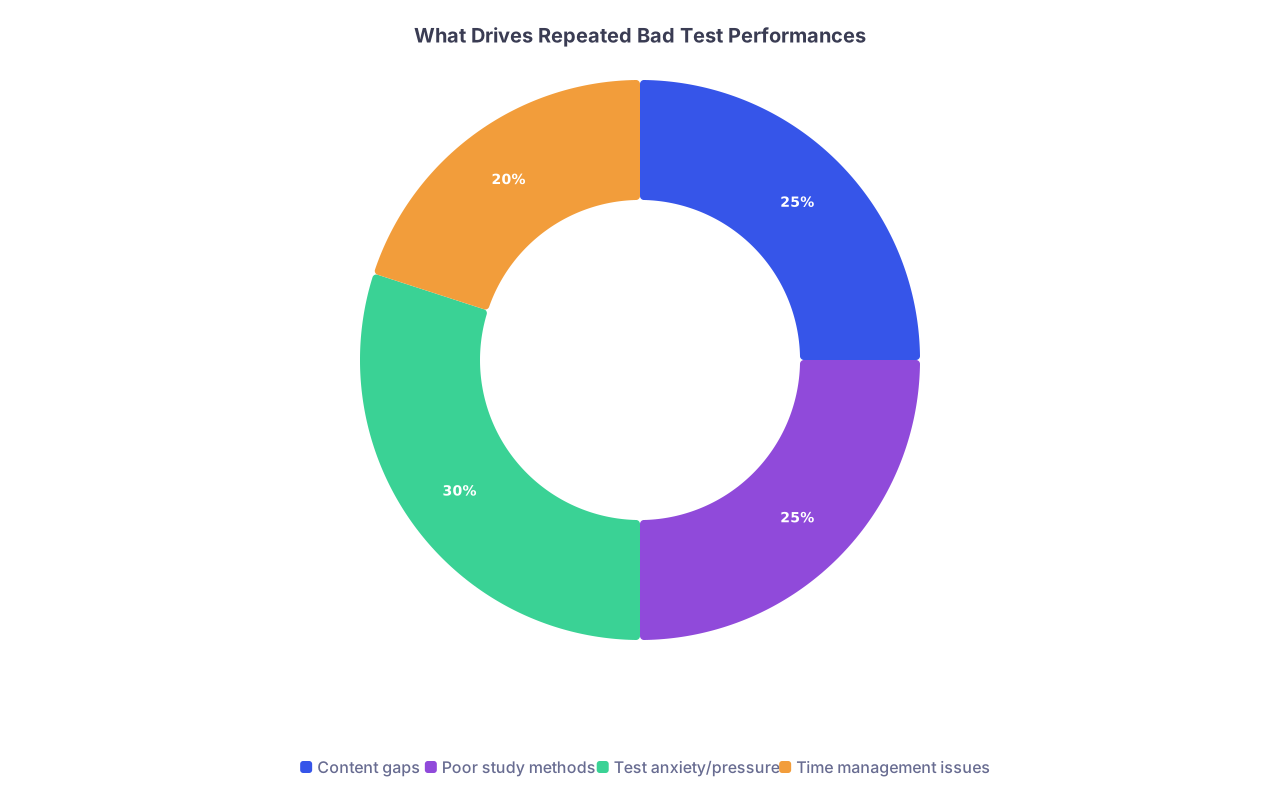
| Category | Value |
|---|---|
| Content gaps | 25 |
| Poor study methods | 25 |
| Test anxiety/pressure | 30 |
| Time management issues | 20 |
The pie shifts for each person, but test anxiety and method issues are often a bigger slice than students want to admit, because it’s more comfortable to say “I’m just not smart enough” than “I need to radically change how I’m approaching this.”
The first story is fixed. The second demands work.
How To Respond to One Bad Exam Like Someone Who Is Cut Out for Medicine
If being “cut out for medicine” means anything, it’s not “never failing.” It’s how you respond when you do.
Here’s the difference I see between students who spiral and students who turn a bad exam into a turning point.
The spiral looks like this:

| Step | Description |
|---|---|
| Step 1 | Bad Exam Score |
| Step 2 | Catastrophic thoughts |
| Step 3 | Shame, avoidance |
| Step 4 | No honest review of what went wrong |
| Step 5 | Same study methods |
| Step 6 | Increased anxiety next exam |
The adaptive response looks much less dramatic:
- You allow yourself to feel awful for 24–48 hours. Fine. You’re human.
- Then you sit down with the exam breakdown or your question log and classify your misses: content, misread, time, panic.
- You alter your study plan based on data, not vibes. More active recall, fewer passive re-reads. More timed blocks, not endless untimed review.
- You experiment with at least one anxiety-management technique during practice exams, not only on test day.
- You talk to someone: advisor, resident, psychologist. You say the quiet part out loud: “I’m scared this means I don’t belong.”
Most students never do this because they’re busy defending their ego instead of rebuilding their system. They’d rather cling to “I’m just not cut out for it” because it gives them a narrative that feels final. No more uncertainty. No need to try again and risk failing a second time.
But medicine, as a career, is repeated exposure to uncertainty with no guaranteed outcomes. Learning to operate under that is the skill, not a side quest.
When You Actually Should Worry
I’m not going to sugarcoat everything. There are times when exams genuinely signal a deeper issue.
You should worry — and by worry, I mean actively seek help and re-evaluate strategy, not quit outright — when you see:
- Multiple failed exams across different subjects, despite serious studying
- Step/Level practice scores that remain below passing after months of focused prep
- You can’t complete practice blocks on time no matter what you try
- You’re so anxious you’re dissociating, shaking, or blanking out for large parts of the exam
- Faculty and advisors are repeatedly raising concerns, not just about one number, but about patterns
Even then, the move usually isn’t “I’m not cut out for medicine.” It’s “I need to dramatically escalate support and possibly re-think my current path or timeline.”
Sometimes that means taking an LOA for health, getting formal testing for learning differences, or considering whether a different specialty—or rarely, a different career—would align better with your brain and your life. Those are adult decisions, not verdicts handed down by one bad test.
The Bottom Line: What One Bad Test Actually Means
Let me strip this all the way down.
One bad exam means:
- You underperformed on that test, on that day.
- Your current system (study + test-taking + anxiety management) produced a result you don’t like.
- You now have more information about how that system behaves under pressure.
That’s it.
It does not mean:
- You’re fundamentally not smart enough.
- You were admitted to med school by accident and someone will “find you out.”
- No residency will ever want you.
- You must change careers.
The myth says one bad test is a verdict on your future in medicine.
Reality: It’s a data point about your current process under stress.
Three things to remember:
- Patterns matter; single events almost never define a medical career.
- Test performance is heavily influenced by anxiety and method, not just intelligence.
- Being “cut out for medicine” is less about never failing and more about how you rebuild after you do.