
The way you think your test anxiety sounds to committees is not how it actually lands in a rank meeting.
Let me tell you how those conversations really go behind closed doors—because I’ve sat in those rooms, listened to the whispers, watched good applicants slide down a rank list over one poorly framed “test anxiety” story.
This isn’t about whether test anxiety is real. It is. I’ve watched stellar students shake walking into a Step 1 exam and residents throw up before their boards. The problem isn’t the anxiety. The problem is how you present it—and how it gets translated in the one room you never see: the rank meeting.
What a Rank Meeting Really Looks Like When Your Name Comes Up
Strip away the glossy brochure image. A real rank meeting is messy, rushed, and unforgiving.
It’s 7 PM on a Thursday. Everyone’s already done a full clinical day. There’s pizza nobody’s eating, cold coffee, and a giant spreadsheet or ERAS dashboard projected on the wall. Applicants’ faces blur together.
When your name comes up, nobody pulls up your entire life story. What they do instead is scan key fields, glance at a few impressionistic notes, and then someone in the room who remembers you speaks first. That first narrative sets the tone.
Here’s the part you don't see: when test anxiety is in your file, the narrative that gets told isn’t “this person bravely struggles with performance anxiety.” It’s usually one of a small handful of scripts. And those scripts can bury you or save you.
The Four Ways “Test Anxiety” Usually Shows Up – And How Committees Actually Talk About It
There are four broad patterns I see over and over. Read these like transcripts. Because they’re closer to the truth than anything you’ll hear in public.
1. The “Excuse With No Receipts” Story
This is the one that tanks you.
Applicant writes in the personal statement or secondary essay: “I have always struggled with standardized tests due to test anxiety, which is why my USMLE scores do not reflect my true capabilities.”
No concrete actions. No treatment. No documentation of improvement. Just “test anxiety” as a label thrown over a low score.
Here’s how that sounds in the room.
PD: “So scores… Step 1 was just barely passing. Step 2 is 213. They mention test anxiety in the personal statement.”
Faculty 1: “Do they have a pattern of improvement? COMATs better? Shelf exams?”
Faculty 2 (scrolling): “No, clerkship exams are all ‘Pass’, a couple low passes, nothing that screams they overcame anything.”
Chief resident: “If they’re already telling us ‘I don’t test well’ now, that’s going to be an issue when it’s in-service, boards, and credentialing time.”
Then someone says the quiet part out loud:
“We’ve been burned by this before.”
Because they have. They’ve ranked applicants whose files said “test anxiety,” then watched them fail in-service exams twice, or miss board deadlines, or jeopardize accreditation metrics.
What “test anxiety” means without any supporting evidence of change is: risk. And risk, in that room, does not get rewarded.
2. The “Documented, Managed, and Improved” Story
Now the opposite scenario. Still anxiety, but written and lived very differently.
This applicant doesn’t whine. They document a progression:
- Early undergrad: terrible standardized test history.
- Step 1: low but passing.
- Then they sought help: therapy, sometimes medication, structured accommodations.
- Step 2: materially better. Not 270, but a real jump.
- Clerkship exams: upward trend.
- Letters: mention reliability, growth, resilience.
How it gets talked about is entirely different.
PD: “Scores aren’t stellar, but look at the jump from Step 1 to Step 2.”
Faculty 1: “Yeah, and note from dean’s letter: ‘Student accessed learning support and consistently improved exam performance over clinical years.’”
Chief: “I interviewed them. They actually brought it up maturely—said they used to freeze on big exams, got evaluated for anxiety, started seeing a therapist, and built a structured approach. Said they now take in-service exams under standard conditions and feel confident for boards.”
Now the label “test anxiety” is not read as weakness. It’s read as: self-awareness + intervention + improvement. That’s a much more comfortable story for a committee to bet on.
The unspoken logic is this: “Boards are a risk, but they’ve already shown they can trend upward under pressure.”
3. The “Overshare in the Wrong Place” Story
This one is common among sincere, anxious students who were told to “be vulnerable” in their personal statement. So they dump their entire psychological history into an essay that the selection committee never asked for.
You’ll see lines like:
- “I’ve had crippling test anxiety since childhood.”
- “On the day of Step 1 I had a panic attack in the parking lot…”
- “I blacked out during exams.”
You think you’re showing courage. But the way this lands in a rank room is very stark:
Faculty 1 (quietly): “Is this person going to melt down on call?”
PD: “We’re not a therapy service. We can support residents, but we can’t be their primary mental health provider.”
Faculty 2: “And we can’t afford someone failing boards twice. GME will be all over us.”
Does that sound harsh? It is. Those rooms are not support groups. They’re risk-assessment committees under pressure from GME, hospital leadership, and accreditation metrics.
There’s a world of difference between:
“I’ve had severe anxiety and here’s how I’ve stabilized and functioned consistently for years.”
vs.
“I’ve had severe anxiety and here’s a graphic play-by-play of my worst crisis six months ago.”
One reads as “history, treated, managed.”
The other reads as “current, volatile, unpredictable.”
Rank meetings don’t handle “unpredictable” kindly.
4. The “Third-Party Framing” Story
Sometimes you never mention test anxiety at all. But someone else does. That’s where things get interesting.
Maybe your advisor or dean writes something vague like: “Student has had some challenges with standardized testing.” Or an attending comments during interview: “They seemed quite nervous—wonder how they’d function in a code.”
Now the story lives in whispers, not in your own narrative. And vague concern is more dangerous than a clear, owned explanation.
I’ve seen this play out like this:
PD: “Anything else on them?”
Faculty 1: “I think Dr. S said they were very anxious in the simulation session? Hesitant, second-guessing.”
Chief: “Yeah, I remember—he said something about them not being sure under pressure.”
PD: “With these borderline scores, that’s enough for me to slide them low.”
No one goes back to confirm. No one talks to you. A five-second comment becomes your unofficial label: “Anxious, not great under pressure.”
That’s how fragile this whole thing is.
How Test Anxiety Interacts With Your Numbers: The Silent Math
Programs won’t say this publicly, but they run mental equations during rank meetings. They’ll never write it down, but it shapes your fate.
| Profile Type | Typical Internal Reaction |
|---|---|
| Low scores + no anxiety mention | “Weak test-taker, but maybe stable; check other evidence.” |
| Low scores + anxiety excuse, no improvement | “Risk. Probably rank low or not at all.” |
| Low scores + clear anxiety history + improvement | “Possible redemption arc. Consider mid-list if rest is strong.” |
| Mid scores + subtle anxiety + strong evals | “Probably fine. Don’t overthink.” |
| High scores + anxiety mention | “Still capable under pressure. Probably overthinks.” |
There’s an ugly subtext here.
In borderline score ranges, any mention of “test anxiety” without a redemption arc often nudges you into the “not worth the risk” pile.
Most programs won’t articulate that openly. But watch the behavior. You can see the pattern.
What Committees Care About More Than Your Anxiety Label
Test anxiety in isolation is not what kills you. It’s what it predicts for the people at that table.
They care about:
- Will you pass your boards on time?
- Will you function in high-stakes situations?
- Are you reliable, or will you disappear when pressure peaks?
- Will you drain time and resources?
Let me show you how that gets inferred.
Pattern 1: Do You Actually Improve When Stakes Rise?
If your story is “I’ve always had test anxiety” and:
- MCAT: weak
- Step 1: weak
- Step 2: weak
- Shelf exams: mediocre
You’re telling them: under pressure, I don’t perform.
Now consider a different file:
- MCAT: okay
- Step 1: mediocre
- Step 2: significantly higher
- In-service exams during residency (if later): solid
Same “test anxiety” label, but the pattern screams: “I adapt and improve under repeated exposure.”
That’s the person we argued to keep high on the rank list even with a messy narrative.
Pattern 2: Can You Function Clinically While Anxious?
If your test anxiety bleeds into real-time performance—freezing on oral exams, tanking in simulation, visibly coming apart during stressful rotations—that’s what terrifies programs.
On the flip side, I’ve heard this exact line more than once:
“Yeah, they’re anxious about exams, but they’re rock solid on the wards. I’d trust them with my patients.”
That sentence has saved more “test anxious” applicants than any personal statement paragraph ever did.
How Your “Test Anxiety” Stories Get Distorted In the Room
Here’s what no one tells you: by the time your application hits the rank room, the nuance is mostly gone. What’s left is a shorthand narrative.
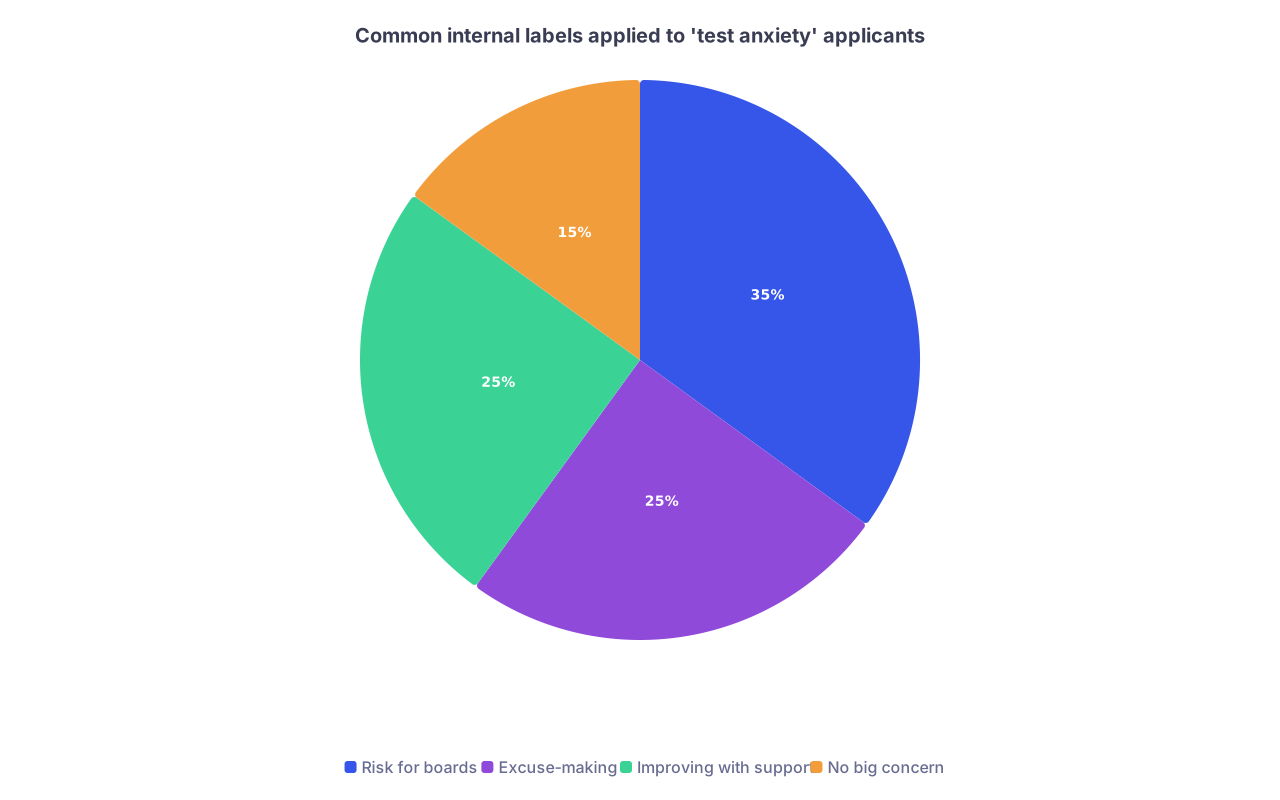
Your carefully written “I learned coping strategies and grew” essay gets compressed into four or five words:
- “Anxious, but improving.”
- “Excuse-maker.”
- “Low resilience.”
- “Honest about struggle.”
- “Red flag for boards.”
| Category | Value |
|---|---|
| Risk for boards | 35 |
| Excuse-making | 25 |
| Improving with support | 25 |
| No big concern | 15 |
Those labels come from how you framed your story, where you put it, and whether your numbers and evaluations back it up.
You need to write and talk like someone who understands they’re being reduced to a tagline—and chooses that tagline strategically.
What Actually Works: The Test Anxiety Story That Moves You Up The List
Let me spell out the structure I’ve seen work. Not in theory. In real files that got ranked high.
The strongest “test anxiety” narratives have four elements:
History with specifics, not drama
“In undergrad and early medical school I consistently underperformed on large standardized exams despite strong course performance.”Concrete action
“During second year I met with student mental health, was evaluated for anxiety, and began regular therapy and skills-based coaching. I also worked with academic support to build a structured, repeated-exposure test plan.”Objective improvement
“Over the next year, my shelf scores moved from the 30–40th percentile range to consistently around the 60–70th percentile. My Step 2 score was 18 points above Step 1.”Stability and function now
“I still feel anxious before major exams, but I’ve learned predictable strategies that work for me. On the wards, I’ve been able to perform reliably in stressful situations – including rapid responses and night cross-cover – and my evaluations reflect that growth.”
Now here’s how that gets voiced in a rank meeting:
PD: “They mention test anxiety, but it sounds well-managed. Numbers do show improvement.”
Faculty 1: “Yeah, they framed it like a problem they treated, not an excuse. Shelf trajectory looks good.”
Chief: “I had them on nights. No issues under pressure. I’d rank them.”
Notice the difference? You left them with a story that feels controlled. That’s what they want.
The Mistakes That Quietly Kill You
Let me walk you through the self-inflicted wounds I see every year.
Mistake 1: Making Test Anxiety Your Central Identity
If your personal statement is 70% about your anxiety and 30% about your actual growth, clinical skills, or motivation, you’ve misread your audience.
Committees are not looking for “the Test Anxiety Applicant.” They’re looking for a competent future colleague who happens to have had test anxiety—which they now manage.
When your narrative is dominated by your struggle, you get mentally filed under “high maintenance.”
Mistake 2: Confessing Without Showing Control
A pure confession—“I had panic attacks, I froze on exams”—with no clear, long-term resolution arc is devastating.
I heard this once:
“I feel bad for them, but I don’t want them in our call room melting down at 3 AM. We don’t have bandwidth for that.”
Cold, but real. If you open the door to your psyche, you had better be ready to show that now, today, you function at the level of a physician in training. Not “someday.”
Mistake 3: Bringing Up Anxiety Reactively, Only When You’re Cornered
Another subtle problem: you say nothing about test anxiety anywhere. Then in the interview, when asked about low scores, you suddenly bring it up.
It sounds like a last-minute shield.
Faculty walk out and say: “They blamed test anxiety when we asked. But it’s nowhere in the dean’s letter, nothing in their file. That felt like an afterthought excuse.”
If it’s real and central to your journey, you integrate it thoughtfully, consistently, briefly—not as an on-the-spot justification.
Where to Put Test Anxiety in Your Application So It Helps, Not Hurts
Placement matters almost as much as content.
Personal Statement
Use it only if:
- It was a turning point that transformed how you work and study, and
- You can show lasting improvement and stability.
Keep it to one tight paragraph. Do not build your entire statement around it. That reads like you’re applying to a therapy program, not a residency.
Secondary Essays / “Adversity” Prompts
This is usually the best place.
You can be honest, focused, and specific. Tell the story of problem → intervention → measurable improvement. End with how you function now.
These sections often get scanned closely by PDs, because that’s where they look for risk and resilience.
Interviews
If asked about low scores, you:
- Acknowledge clearly: “I struggled with test anxiety early on.”
- Emphasize action and change: “Here’s what I did differently, and here’s the concrete improvement.”
- Finish on stability: “At this point I’ve taken multiple high-stakes exams using the same strategies, and I’m confident approaching future board exams.”
What you do not do is launch into a blow-by-blow of your worst day in the Prometric parking lot.
How This Plays Out During Boards and In-Service Exams
One more layer committees are thinking about that you rarely consider: downstream consequences.
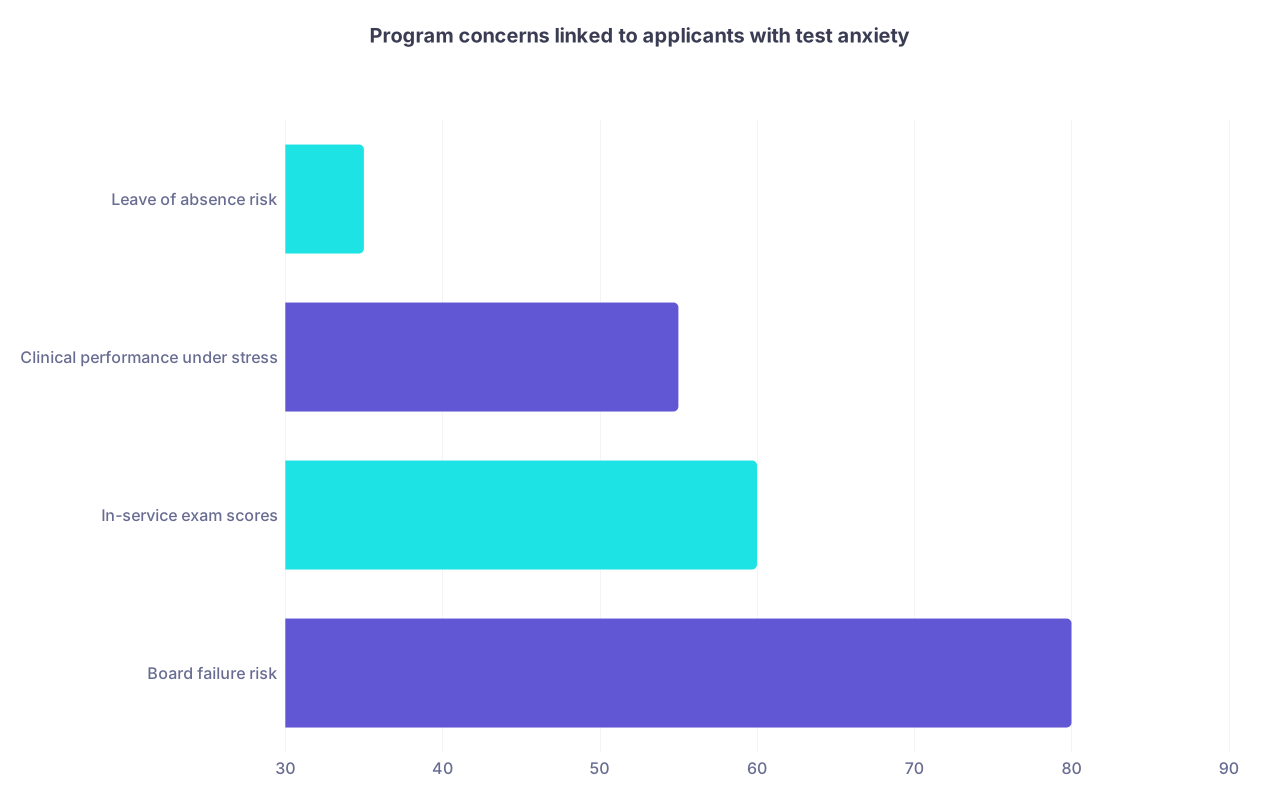
| Category | Value |
|---|---|
| Board failure risk | 80 |
| In-service exam scores | 60 |
| Clinical performance under stress | 55 |
| Leave of absence risk | 35 |
They care about your anxiety because:
- Board failures hit their accreditation reports.
- Repeat failures mean more remediation time, faculty time, and money.
- Chronic underperformance can trigger institutional scrutiny or jeopardize future positions.
So when we’re in that room late at night, and someone sees “test anxiety” in your narrative, their brain jumps straight to: “Can they pass boards on time with minimal drama?”
If your story clearly answers “yes” with evidence, you survive and often thrive.
If your story is murky, dramatic, or framed as “please make special allowances for me,” you slide.
What I’d Tell You If We Were Sitting in a Call Room at 1 AM
I’ve watched anxious students outperform everyone once they got the right support. I’ve also watched others weaponize “test anxiety” as a shield to avoid responsibility, and programs learn the hard way.
So here’s the blunt version.
- Program directors don’t hate that you have test anxiety. They hate uncontrolled risk.
- Your numbers and clinical evaluations write the first half of your story. Your narrative either confirms or redeems that story—never contradicts it.
- Inside a rank meeting, you are reduced to a one-line summary. Your job in how you write and talk about test anxiety is to make sure that line sounds like:
“Anxious by history, but stable, improving, and reliable under pressure.”
If your current story doesn’t land that way, you don’t need more vulnerability. You need tighter strategy.