
Talking about test anxiety is not what ruins applicants. Silence is.
The unspoken rule in medical training goes like this: “Never admit test anxiety to a program. They’ll think you’re unstable, weak, or a liability.” I’ve heard this exact line from deans, senior residents, and more than a few anxious MS2s hiding in the library stairwell.
Let me be blunt: that blanket advice is outdated, exaggerated, and in some cases, actively harmful.
Are there wrong ways to talk about test anxiety? Absolutely. Can it be a red flag if you frame it badly? Yes. But the idea that you must never, under any circumstances, acknowledge test anxiety to a residency program is myth, not medicine.
This is not “feelings-first” fluff. It’s based on how programs actually evaluate risk, how licensing exams work, and what data we do have on performance and mental health.
Let’s dissect what is really risky—and what is completely survivable.
What Programs Actually Care About (It’s Not Your Feelings)
Residency programs are not sitting around judging whether you ever felt anxious. They care about three things:
- Can you pass the exams required to be licensed and board certified?
- Are you safe to put in front of patients at 2 a.m.?
- Are you going to implode mid-residency and require major coverage?
Test anxiety only matters to them to the extent that it threatens one of those three.
That is why they obsess over objective signals:
- Did you pass Step 1 / Level 1, Step 2 / Level 2, and your school’s high-stakes exams?
- Did you need multiple attempts?
- Did you vanish for a year “on leave” with no explanation?
- Do your dean’s letter and letters of recommendation describe reliability—or chronic chaos?
Notice what’s missing: “Did you ever feel anxious about exams?” No one cares. Because everyone is anxious. The only people pretending otherwise are lying or forgetting.
What does raise eyebrows:
- Repeated failures with no growth arc
- Vague, evasive explanations for long gaps
- Stories that suggest poor insight or no coping plan
So “I struggled with test anxiety” is not automatically a red flag. “I failed repeatedly, blamed everyone else, and learned nothing” is.
The Training Culture Lie: “Real Doctors Don’t Have Test Anxiety”
Let’s kill this one cleanly.
Anxiety around high-stakes exams in medicine is not rare, not special, and definitely not a moral failing. Data from multiple countries show elevated rates of anxiety and depression in medical students and residents compared to age-matched peers.
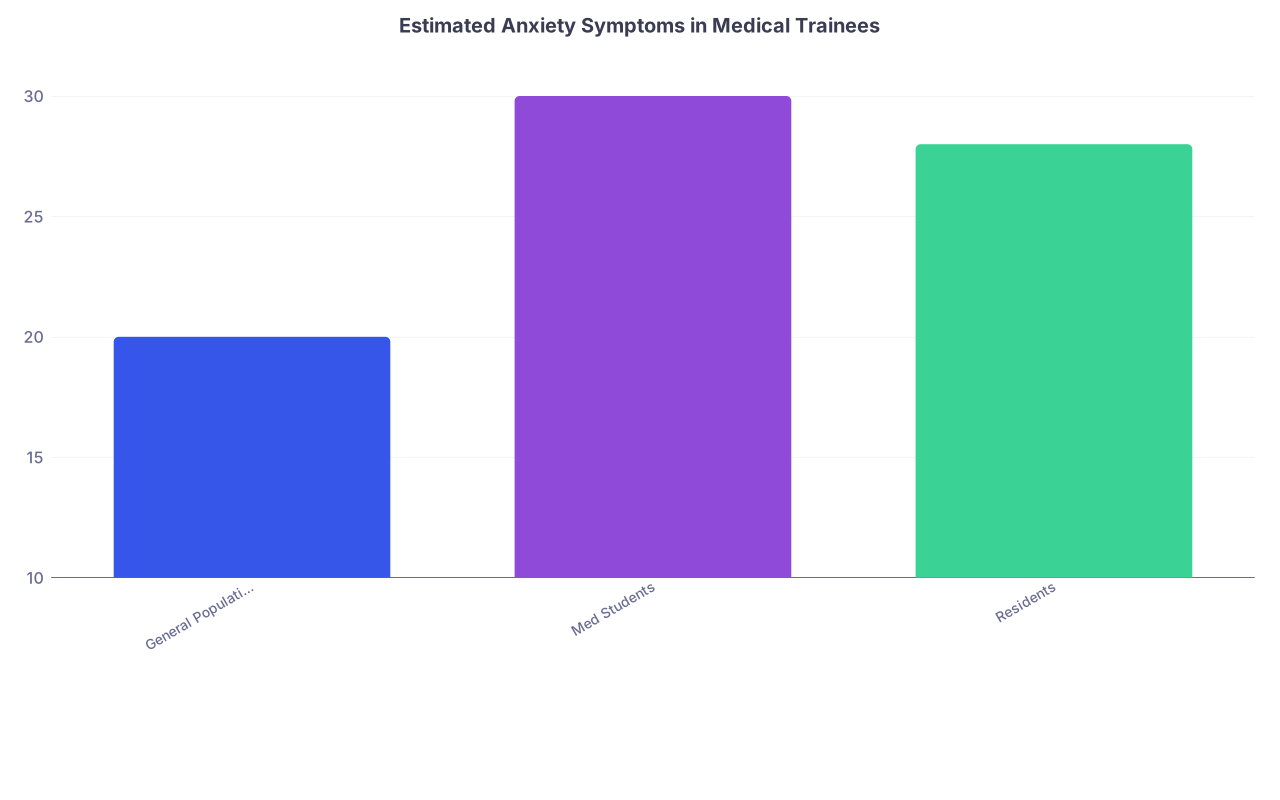
| Category | Value |
|---|---|
| General Population 18–30 | 20 |
| Med Students | 30 |
| Residents | 28 |
You can argue about methodology, but the trend is consistent: medical trainees are more anxious. Not less.
Programs know this. Program directors are not under the illusion that their residents are all emotionally bulletproof. Many of them still remember their own pre-call jitters and Step exams that nearly broke them.
What they actually dislike is uncontained anxiety:
- Panic that spills into frequent absences
- Crumbling during basic clinical tasks
- Test performance so unstable they cannot predict whether you’ll pass required board exams
So the macho narrative—“If you’re anxious, you shouldn’t be here”—is not how they really operate. They want functionally anxious. Not non-human.
Where Test Anxiety Does Become a Real Risk
Here’s where the myth has a kernel of truth.
Test anxiety becomes a genuine red flag when any of these are true:
You have multiple high-stakes failures with no clear improvement story.
Think: failed Step 1 three times, barely passed on the fourth, then failed Step 2. That does not scream “I’ve got this under control now.”You frame your anxiety as uncontrollable and others’ responsibility.
“My school’s exams are unfair and that’s why I failed.”
“The NBME questions just trigger my anxiety; there’s nothing I can do.”
This kind of language tells programs: this could be our problem later.You describe current, active instability—without any plan.
“I still have severe panic during all exams and am not sure how to fix it.”
That’s not honesty. That’s telling them they’re about to inherit a crisis.
None of this is about whether you ever had test anxiety. It’s about whether you have:
- Insight into what happened
- Evidence of progress
- A workable, repeatable system that now functions
If you can show those three, talking about test anxiety is not a red flag. It can actually convert a liability into a resilience story.
What the Data Actually Shows About “Red Flags”
Let’s be evidence-based for a second, not just vibes.
Surveys of residency program directors (NRMP Program Director Survey, repeated over years) repeatedly rank these as major concerns:
- Failing Step exams / COMLEX
- Unexplained leaves of absence
- Negative comments in MSPE (dean’s letter)
- Significant professionalism concerns
“Reported history of anxiety” doesn’t even make the top tier. Why? Because they do not routinely get “anxiety diagnosis” data on applications in any systematic way. What they do see, every time, are attempts, scores, and pass/fail histories.
| Factor | Perceived Risk Level |
|---|---|
| Step failure (especially Step 2) | Very High |
| Major professionalism issue | Very High |
| Unexplained long leave | High |
| Weak or concerning MSPE | High |
| Mention of past test anxiety *with clear recovery* | Low |
So when someone tells you “talking about test anxiety is a red flag,” what they’re actually reacting to is this: most students talk about it badly. Rambling. Vague. Blame-heavy. Present tense chaos.
The content is the problem, not the topic.
When You Should Talk About Test Anxiety
There are three main scenarios where test anxiety comes up:
You have an obvious academic blemish
Failed Step/COMLEX, remediation, delayed exams, extended curriculum.You took a leave of absence partially related to anxiety or burnout
This will show on your MSPE. You don’t get to pretend it didn’t happen.You’ve turned it into a clear strength with evidence
Strong Step 2 after a brutal Step 1. Massive shelf score improvement after addressing anxiety.
In those scenarios, complete silence often looks worse than a clean, contained explanation.
Programs are trying to answer: “Is this problem solved enough that we’re not betting our board pass rates on magic?”
If your story goes like this:
- I struggled
- I identified the problem
- I used specific strategies and help
- My performance improved and has stayed stable
…you are not waving a red flag. You’re demonstrating the exact thing they need: you adapt under pressure.
Where you get into trouble is treating the personal statement or interview like therapy. It’s not. They’re not your therapist. They’re risk managers with pagers.
How to Talk About It Without Sabotaging Yourself
There’s a right way and a wrong way to frame this. I’ve seen both, side by side, in applicants with almost identical records.
Bad version (heard almost verbatim in an interview):
“I’ve always had horrible test anxiety and it really affects me during exams. Step 1 was miserable; I couldn’t sleep the night before and I completely panicked. I know standardized tests don’t reflect my potential, and I still feel like they’re unfair.”
That screams: ongoing, uncontained, externalizing. Red flag.
Better version:
“My first major hurdle in medical school was test anxiety. I underestimated how much the stakes would amplify it. After struggling with Step 1 prep, I worked with our learning specialist, changed my study and test-day routines, and started exposure-based practice exams under realistic timing. Since then, my shelf scores and Step 2 performance have been consistent, and high-stakes exams are now stressful but predictable rather than paralyzing.”
That says: insight, action, stability. Not perfect. Human. Manageable.
The structure is the same every time:
- Briefly name the issue (no drama).
- Identify what you changed—concrete actions, not vibes.
- Point to evidence that things have improved and remained stable.
- Close the topic. Do not keep circling back to your anxiety as your core identity.
If you cannot do step 3 honestly—if your scores are still erratic—then oversharing will hurt you. At that point the problem is not “talking about test anxiety.” The problem is that your performance is genuinely unstable and programs are right to be cautious.
Reality Check: Programs Already See the Smoke
Here’s the part students forget: if test anxiety has meaningfully impacted your record, they already know something is off.
- A failed Step is visible.
- A delayed exam block is visible.
- An extra year in school is visible.
Silence does not erase that. It just forces them to guess.
And when programs guess, they usually assume the worst:
- Maybe this person had a serious professionalism issue.
- Maybe they had a major psychiatric event.
- Maybe they still don’t understand what went wrong.
A controlled explanation often reduces the risk in their mind. You’re telling them, “This was the cause. Here’s what I did. Here’s why you don’t need to be scared of this recurring.”
You’re not obligated to name diagnoses. You are obligated, if asked, to account for major deviations in your trajectory.
Handled well, test anxiety is often a more reassuring explanation than the unnamed alternatives they’re imagining.
The Quiet Upside: Programs Like People Who Have Done Real Work on Themselves
There’s a pattern I’ve noticed over years of watching outcomes: the best residents are not the ones who never struggled. They’re the ones who learned how to struggle productively.
A candidate who says:
- “I coasted through everything; Step was easy; I don’t really get why people stress about it”
…doesn’t actually give you much predictive information about how they’ll perform the first time they’re truly slammed.
Compare that to:
- “I hit a wall with standardized tests, got scared, almost broke, then rebuilt my approach and now have a replicable system that works”
That person has:
- Self-awareness
- A history of implementing feedback
- Proof that they can re-tool under pressure
You do not need to oversell your trauma arc. But do not underestimate how much weight programs give to: “Will this person improve when things get hard, or will they melt?”
Test anxiety that you have actively addressed is, bizarrely, sometimes an asset. Not a liability.
What You Should Actually Focus On
If you’re worried about how programs will see your test anxiety, ask a better question:
“Is my recent performance reassuring?”
Because this is what directors quietly care about:
- Trend: Did your scores go up after interventions?
- Recency: Are your most recent exams solid and stable?
- Consistency: Are there any new surprises after you “fixed” the problem?
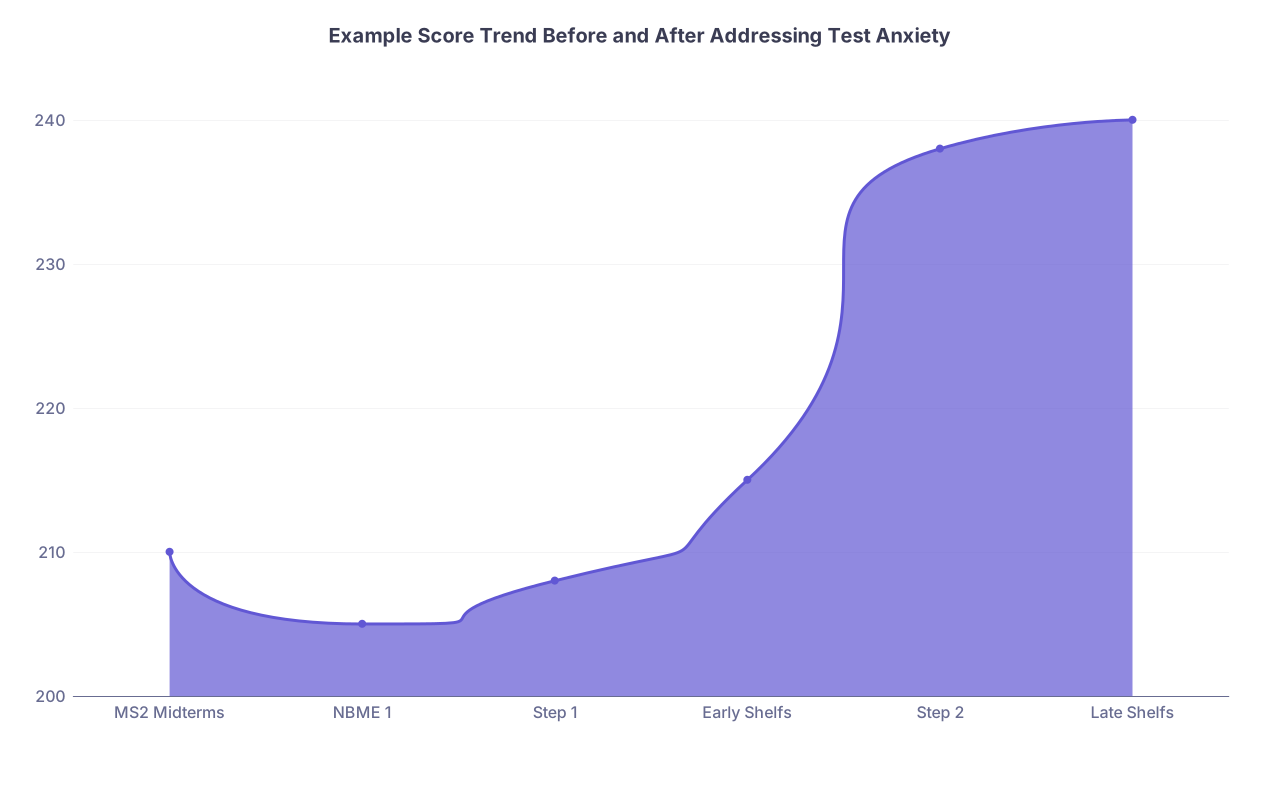
| Category | Value |
|---|---|
| MS2 Midterms | 210 |
| NBME 1 | 205 |
| Step 1 | 208 |
| Early Shelfs | 215 |
| Step 2 | 238 |
| Late Shelfs | 240 |
This kind of pattern—shaky early metrics followed by clear upward movement—is exactly what makes your story credible. It tells a program: whatever anxiety you had, you’ve made it less dangerous.
If instead your scores bounce all over the place, or Step 2 is weaker than Step 1, test anxiety is not your PR problem. It’s your performance. And that will be an issue even if you never say the word “anxiety” once.
How to Decide What to Say, Practically
Here’s a simple mental flowchart you can use when crafting your personal statement or preparing for interviews:

| Step | Description |
|---|---|
| Step 1 | Do you have major exam issues visible on your record? |
| Step 2 | Dont center anxiety. Mention only if asked. |
| Step 3 | Did your performance improve clearly after interventions? |
| Step 4 | Be very brief, focus on accountability, and emphasize current support. Avoid long narratives. |
| Step 5 | Use a concise growth story: struggle → interventions → stable success. |
If you’re in box E, talking thoughtfully about test anxiety is not a red flag. It’s damage control and, sometimes, character evidence.
If you’re in box D, your energy should be going into current performance and support, not narrative spin.
If you’re in box B, you don’t need to volunteer this as your main storyline. You can keep it in your back pocket in case someone directly asks, “What has been your biggest academic challenge?”
One More Reality: You’re Not Hiding It From Your Peers Either
Side point, but it matters.
The “never show weakness” culture around test anxiety doesn’t just distort residency applications. It isolates people. You get entire classes of students thinking they’re uniquely broken when in fact half the row is silently white-knuckling the same exam.

Residency programs are slowly, painfully, starting to recognize that the old “suck it up or get out” approach is not just cruel—it’s unsafe. For residents and for patients.
So if you’re looking for the smart play, not the macho one: learn how to function with your anxiety. Learn how to explain it like an adult. And then, if relevant, own it calmly.
That looks more like professionalism than pretending you’ve never been scared in your life.
The Bottom Line
Let’s strip it down.
First: Test anxiety itself is not a red flag. Unmanaged, performance-damaging anxiety with no improvement story is.
Second: Programs care about outcomes and stability, not whether you ever felt nervous. If your recent performance is strong and consistent, a brief, mature explanation of past test anxiety can actually reassure them.
Third: How you talk about it matters more than whether you talk about it. Insight, concrete steps, and evidence of growth are green flags. Blame, drama, and present-tense chaos are not.
You do not have to be fearless to match well. You have to be functional—and able to show that you know how to get yourself there.