
The most common “productivity hack” medical students use to manage exam stress is one of the fastest ways to destroy it.
I am talking about over-scheduling. Hyper‑planned days. Color‑coded blocks from 6:00 to 23:00. Every minute accounted for. No slack. No white space.
On the surface, it looks disciplined. Serious. High achiever behavior. In reality, it quietly amplifies test anxiety, wrecks your focus, and makes you more fragile on exam day.
You are not failing because you lack another app, another calendar, or another hour-by-hour plan. You are suffering because your nervous system cannot breathe.
Let me walk you through how this mistake plays out, why it backfires, and how to use structure without letting it own you.
The Trap: Mistaking Control for Calm

Most anxious test‑takers do not start from laziness. They start from fear.
You get scared about Step, shelf exams, OSCEs, or board-style finals. So you try to control the fear by controlling the clock. You:
- Build 12‑hour study days with no real breaks.
- Plan every 30 minutes: “7:00–7:30 Anki,” “7:30–8:00 Pathoma video,” all the way to bedtime.
- Feel guilty if you deviate from the plan by more than 10 minutes.
It feels productive. It feels like “doing something.” But here is what actually happens internally.
Your brain starts tying safety to the schedule. “I am okay as long as I stay perfectly on track.” That is fragile. Because in medical school, nothing stays perfectly on track:
- The attending keeps you late.
- The bus is late.
- You need a nap and your brain just quits.
- Your friend calls in crisis.
- You have a bad question block that rattles you.
Once your “calm” depends on a schedule that is constantly under threat, your anxiety climbs. You think the solution is “better scheduling.” What you actually need is more tolerance for imperfection.
Over‑scheduling is a false god. It promises control. It delivers fragility.
How Over-Scheduling Worsens Exam Stress (Step by Step)
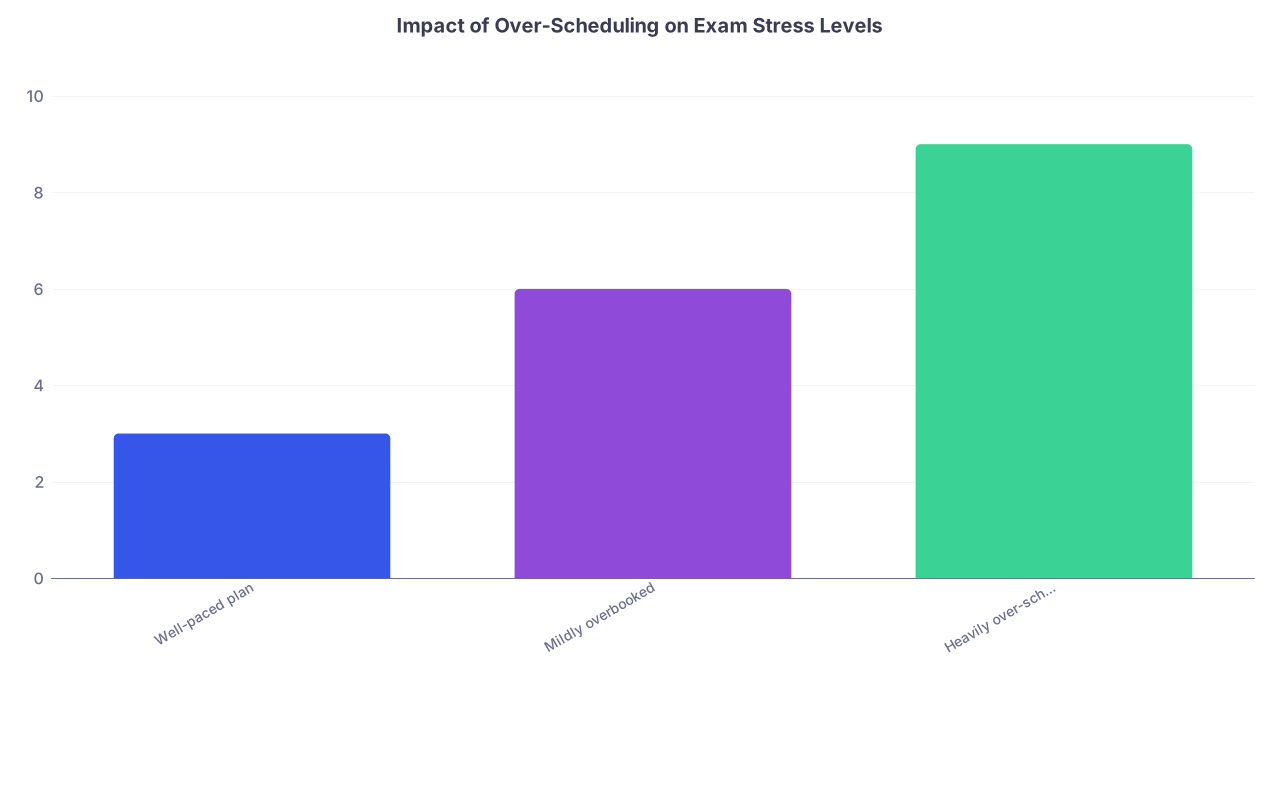
| Category | Value |
|---|---|
| Well-paced plan | 3 |
| Mildly overbooked | 6 |
| Heavily over-scheduled | 9 |
Let me be blunt: over‑scheduling does not just “not help.” It directly fuels several anxiety drivers that crush exam performance.
1. You Create Constant Micro-Failures
I have watched this pattern over and over:
You plan 300 Anki cards, 80 questions, 2 chapters of review, plus a video, plus notes. On a clerkship day. While commuting. While pretending you also sleep.
You finish the day at:
- 240 Anki, not 300
- 40 questions, not 80
- 1 chapter, not 2
Objectively? That is still a lot. Subjectively? You feel behind, weak, and “not ready.”
Your brain learns a nasty association: “Study day = fail to meet plan.” That feeds:
- Self‑doubt (“I can never do what I say I will.”)
- Shame (“Other people can handle this. Why can’t I?”)
- Catastrophic thinking (“If I cannot keep up now, I will bomb Step.”)
Repeated daily, this becomes a chronic background stressor. Your study days start with an expectation of failure. That is not mental prep; that is psychological sabotage.
2. You Destroy Flexibility — A Core Anti-Anxiety Skill
Anxiety hates uncertainty. Over‑scheduling is a way to pretend you can remove uncertainty: “If I plan enough, nothing will surprise me.”
But exam prep and medical school life are basically random event generators:
- Pager goes off.
- Lecture gets moved.
- You get sick the week before a big test.
- Your attending randomly pimp‑grills you and you come home wrecked.
When your day is packed end to end, there is no buffer. A single disruption at 10:00 throws off the whole day. Now you are staring at a completely broken schedule by noon.
Flexible people say, “Ok, reallocate. Drop one task. Shift another.”
Over‑scheduled people say, “The day is ruined. I am doomed.”
That rigid reaction is pure gasoline on test anxiety.
3. You Turn “Rest” into Another Performance Metric
Here is the sneakiest part: many over‑schedulers start blocking “self‑care” as another item to execute.
“19:30–20:00 Mindfulness app”
“20:00–20:30 Walk 2 km”
It looks balanced. It is not. Because you are still evaluating yourself: “Did I rest correctly? Did I use the whole 30 minutes? Did I start on time?”
Rest stops being rest. It becomes another task to succeed or fail at.
On exam day, you need a nervous system that has practiced truly down‑regulating. Not performative rest. Actual decompression. Over‑scheduled students usually do not know how to do that anymore.
4. You Cram in Ways That Destroy Memory
Let’s be specific about the cognitive science. Durable learning benefits from:
- Spaced repetition
- Interleaving
- Sleep
- Reasonable cognitive load
Over‑scheduled days often pack in too many high‑intensity tasks back to back. Long blocks of:
- Questions with immediate review
- Long‑form reading
- Video + note‑taking
- Simulation practice
All in one long, continuous grind.
You get:
- Mental fatigue by mid‑day
- Superficial processing
- Declining question quality (guessing instead of reasoning)
So you feel like you are “working all day” but retain less. That gap between effort and results is terrifying. It ramps exam stress fast.
The Hidden Cost: You Train the Wrong Nervous System for Exam Day

| Step | Description |
|---|---|
| Step 1 | Over-scheduled daily plan |
| Step 2 | Frequent deviations |
| Step 3 | Sense of failure & guilt |
| Step 4 | Increased baseline anxiety |
| Step 5 | Hyper-focus on control |
| Step 6 | More rigid scheduling |
| Step 7 | Poor sleep & fatigue |
| Step 8 | Worse exam performance |
| Step 9 | Higher future anxiety |
Your exam performance is not just knowledge and question practice. It is nervous system training.
When you over‑schedule, your daily state becomes:
- Rushed
- Behind
- Threatened by the clock
You rehearse panic. Daily. You practice studying with a tight chest and clenched jaw. You practice telling yourself you are behind no matter what you do.
Then you walk into the exam and expect to somehow feel calm, focused, and confident. That is not how conditioning works.
You are training:
- Hyper‑vigilance to time
- Obsessive checking (“How many blocks left? How many questions?”)
- Low tolerance for uncertainty (“I cannot flag this, I must know now.”)
This shows up on test day as:
- Burning way too long on early questions because you “need to be sure”
- Panic rising when you realize you are behind on time
- Mental fatigue halfway through because you are fighting not just the exam, but your own stress response
Over‑scheduling builds a brittle nervous system. You need a robust one.
How to Use Structure Without Letting It Own You
Let me be clear: the answer is not “go with the flow” or “just chill.” That is equally useless.
You do need a plan. You do need structure. But not the obsessive, minute‑by‑minute kind. Aim for a schedule that is:
- Clear on priorities
- Loosely timed
- Built with buffer
- Focused on systems, not on squeezing every minute
1. Switch from Minute-Counting to Priority-Counting
Instead of “7:00–7:30 Anki 1–100, 7:30–8:00 100–200,” build your day around 2–3 non‑negotiable priorities.
Example for a dedicated Step 2 CK day:
- Priority 1: Complete 2 UWorld blocks with full review
- Priority 2: Clear new Anki reviews (not all backlogs)
- Priority 3: 30–45 minutes of targeted content review on weak area from yesterday
Then add:
- Flexible “nice‑to‑have” tasks only if there is genuine extra time
- Hard end‑of‑day cutoff so work does not eat sleep
If you hit your 2–3 priorities, you call the day a win. Even if the timing changed. That is how you re‑train your brain to see progress instead of failure.
2. Plan Using Windows, Not Exact Start Times
Replace “8:00–8:50” style precision with blocks or windows.
For example:
Morning block (8:00–11:30):
- 2 question blocks + quick stretch between each
Afternoon block (13:00–16:00):
- Question review + Anki
Evening block (18:00–20:00):
- Targeted content review + light cards
You still have structure. But you have room to:
- Take an unplanned 5‑minute break
- Start 20 minutes late because you slept poorly
- Extend a good review discussion with a friend without “ruining” everything
That kind of flexibility is what reduces anxiety, not fake precision.
3. Build Mandatory Buffer — And Protect It
If your schedule has no white space, you are not realistic. You are in denial.
You need buffer for:
- Tech issues
- Bad question blocks that take longer to process
- Short mood crashes
- Meals that run long
- Arbitrary clinic demands
A simple rule: no more than 70–75 percent of your waking hours should be pre‑assigned to work or study. The rest is:
- Slack time
- Movement
- Actual rest
| Aspect | Over-Scheduled Day | Sane Structured Day |
|---|---|---|
| Task count | 10–15 micro-tasks | 3–5 priorities |
| Time planning | Every 30 minutes blocked | 2–3 broad work blocks |
| Buffer | 0–10 minutes total | 2–3 hours of true buffer |
| End-of-day rule | Study until exhausted | Fixed stop time |
| Emotional outcome | Behind, guilty, anxious | Mostly accomplished, calmer |
If you feel panic rising when you intentionally leave buffer in your schedule, that is exactly the anxiety you need to work with. Not by adding more tasks. By proving to yourself you still make progress without flogging every minute.
Red Flags Your Schedule Is Making Your Anxiety Worse
Let me give you some very specific warning signs. If you see yourself in several of these, your schedule is part of the problem, not the solution.
You might be over‑scheduling if:
- You feel like a failure on 80–90 percent of days, regardless of actual volume.
- A single missed block (“I skipped my 10:00 Anki session”) ruins your mood for hours.
- You update your schedule compulsively instead of studying.
- You constantly tell yourself “I will be fine once I catch up,” but you never feel “caught up.”
- You panic when someone suggests something spontaneous (“Walk now?” “No, I planned that for 19:00.”).
- Your “breaks” are spent calculating how to rearrange the rest of the day rather than actually resting.
Over‑scheduling is often disguised as “being serious.” In practice, it is anxious procrastination dressed up as discipline.
Training the Right Kind of Discipline
Real exam resilience is not about how much you can cram into a day. It is about how consistently you can show up over weeks and months without burning out or melting down.
That requires a particular discipline:
- Discipline to protect sleep
- Discipline to leave some things undone
- Discipline to accept “enough for today” without spiraling
- Discipline to adapt when your day breaks, without deciding “it is all ruined”
Think of exam stress control as a skill set, not a side effect of the “perfect plan.”
Skill set looks like:
- Practicing going to bed even when you feel behind
- Doing a shorter, focused block instead of punishing yourself with endless half‑focused hours
- Taking a genuine 20‑minute walk without your study app, on purpose, and letting that be ok
- Letting a “B+ day” count as success in a long prep period
The hardest part for driven students is this: sometimes doing less today is exactly what protects your performance on exam day.
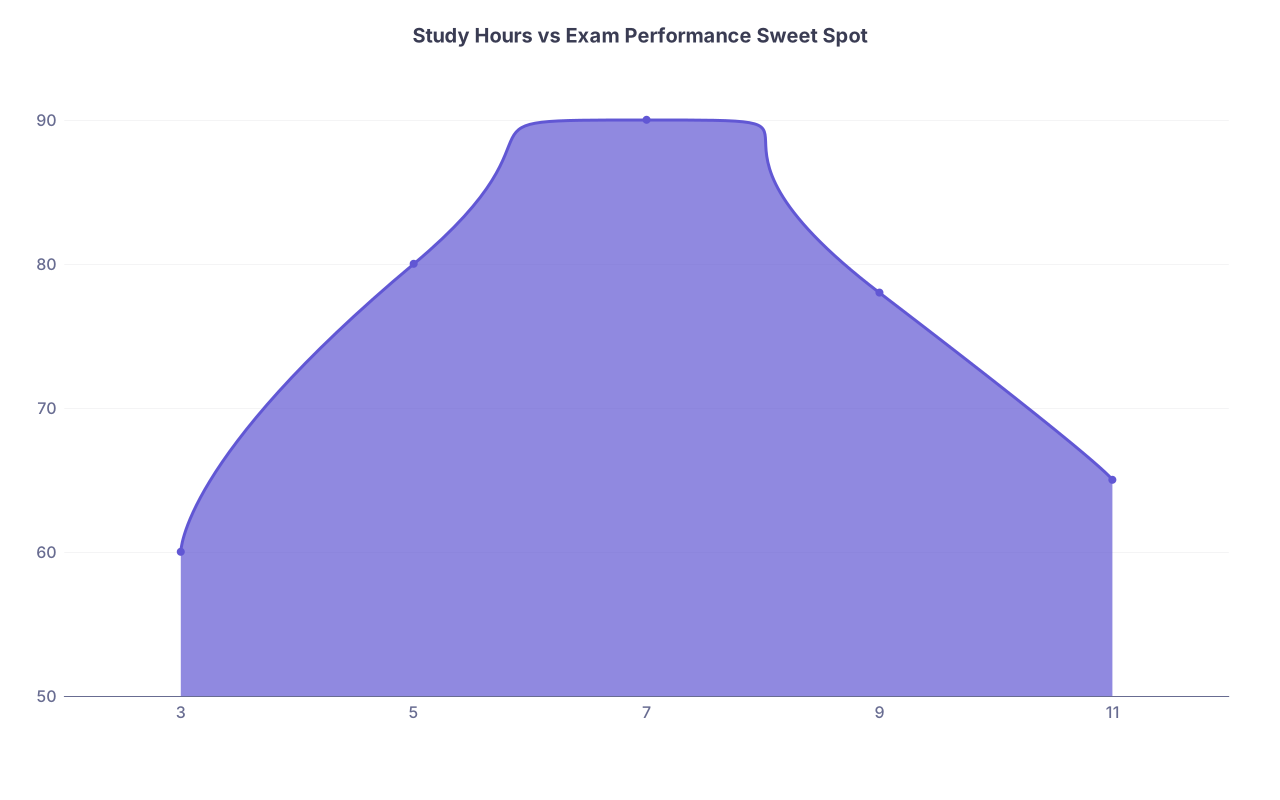
| Category | Value |
|---|---|
| 3 | 60 |
| 5 | 80 |
| 7 | 90 |
| 9 | 78 |
| 11 | 65 |
There is a sweet spot. Beyond that, your performance drops, even if your hours look “impressive” on paper.
A Simple Framework You Can Actually Use
If you want something concrete, use this test to check your plan for an exam block (Step, shelf, big final).
- Set 1–3 critical tasks per day.
- Timebox with blocks, not precise minutes.
- Reserve at least 25–30 percent of your day as unassigned.
- Enforce a hard stop time (even during dedicated).
- Evaluate days by: “Did I do my critical tasks?” not “Did I follow my schedule perfectly?”
Then ask yourself, weekly:
- “Did this plan leave me more or less anxious?”
- “Did I sleep?”
- “Did my question performance trend up, flat, or down?”
If you are working 10–12 hours a day, following a rigid plan, and your anxiety is climbing while your scores stagnate or fall, the problem is not your willpower. The problem is the structure.
You cannot brute‑force your nervous system into calm.
Key Takeaways
Do not confuse more scheduling with more control. If your plan leaves no room for life to happen, it will fail, and you will blame yourself instead of the design.
Use structure as a tool, not a cage. Priorities, loose time blocks, real buffer, and hard stop times build resilience. Hyper‑detailed, minute‑by‑minute planning builds fragility.
If your daily schedule makes you feel like a failure most days, it is not a good schedule. I do not care how pretty the colors are.