
You’re on week three of surgery. You’ve pre-rounded on eight patients, got pimped on the steps of a Whipple, wrote your notes, and you still have to scrub a 5 p.m. case. Your shelf exam is in ten days. Your heart races every time you open UWorld. You keep thinking, “If I could just get a week off to study, I’d be fine.” But you cannot. The rotation owns your schedule.
This is for that exact situation. You’re anxious, overwhelmed, and you don’t have the luxury of stepping away. So we’re not going to fantasize about “ideal conditions.” We’re going to talk about how to function under fire.
Step 1: Get Honest About What’s Actually Making You Anxious
Test anxiety on rotations is rarely just “I’m bad at tests.” It’s usually a mashup of a few things:
- Constant time pressure (rounds, notes, cases, call)
- Guilt every time you study (“I should be reading for patient care”)
- Fear of looking stupid in front of residents/attendings
- Past bad score hanging over your head
- Exhaustion. Plain and simple.
You need to name your mix. Tonight, after you get home (or after sign-out if you’re on call), take 5 minutes and write down:
- One sentence: “Right now I’m most afraid that…”
- Three bullets: “What specifically triggers my anxiety about this exam?”
- One reality check: “If I fail / underperform, then what concretely happens?”
Most students stop at vague dread. That’s what keeps the anxiety big and blurry. Specificity shrinks it.
Example:
- “I’m most afraid that I’ll fail the shelf and everyone will see I’m not cut out for this.”
- Triggers:
- Opening question bank and seeing “block 1 of 40”
- Going into an exam with only 50% of question bank done
- Attending saying “You should know this by now”
- Reality:
- If I fail: I might have to remediate the exam, it’ll look bad on my MSPE, but I won’t get kicked out of school, and my career is not instantly dead.
Is that fun? No. Is it survivable? Yes. Your brain needs that reminder, in writing.
Step 2: Build a Rotation-Realistic Study Framework (Not a Fantasy Plan)
The dumbest thing anxious students do is write “ideal” study plans they’ll never touch on a real rotation schedule.
You aren’t a full-time test-taker right now. You’re a part-time one.
You need a minimum viable study plan that works on 5 hours of sleep, a 12-hour day, and 20 minutes of mental energy.
Here’s the frame I’ve seen work:
Non-negotiable core:
- 20–40 questions per day (depending on rotation difficulty and your baseline)
- 15–20 minutes of very targeted review (not re-reading whole chapters)
Weekly structure:
- 5–6 days of “minimum core” (questions + quick review)
- 1 “catch up / longer” day (often post-call afternoon or weekend)
Let’s map something concrete.
| Day | Questions | Review Time | Extra Task |
|---|---|---|---|
| Mon | 20 | 20 min | None |
| Tue | 20 | 20 min | 10 min formulas/cards |
| Wed | 30 | 25 min | None |
| Thu | 20 | 20 min | 10 min weak topics |
| Fri | 20 | 20 min | None |
| Sat | 40–60 | 45–60 min | Small practice exam |
| Sun | 0–20 | 15–20 min | Light review/rest |
This is not heroic. It’s sustainable. The goal is “never fully disconnected from the material,” not “cram like a Step 1 hermit.”
If you’re thinking, “I can’t even do that,” fine. Start with 10 questions a day and 10 minutes of review. Lower the bar so your anxious brain can’t keep shouting “we’re failing already.”
Step 3: Hard-Wire Study Into the Cracks of Your Day
You’re not going to get a clean two-hour block most days. Stop waiting for it. Use the weird, ugly gaps.
Typical rotation gaps you’re wasting right now:
- Waiting for OR turnover (10–20 minutes)
- Sitting outside CT / MRI with a patient
- Waiting for attending to arrive for rounds
- Post-call dead time before you crash
- Shuttle rides, cafeteria lines, bathroom breaks (yes, really)
You weaponize these with pre-fragmented tasks:
- 5-question chunk (set a block of 5 only, timed)
- 10 flashcards (pharm, micro bugs, diagnostic criteria)
- 1 rapid high-yield page (summary table, algorithms)
You prepare this before the day starts. Example morning prep (5–10 minutes):
- Download or open your next 20 questions in an app.
- Flag 1–2 short review PDFs or screenshots you can look at offline (e.g., “Cirrhosis complications,” “Acute coronary syndrome algorithm”).
- Decide: “Today’s micro topic = UTIs” or “Today’s pharm topic = antihypertensives.”
Then during the day:
- OR turnover? Do 3–5 questions.
- Waiting for attending? Skim that one-page algorithm.
- On the elevator alone? Two flashcards.
Is this perfect learning? No. Is it enough repeated exposure to calm “I don’t know anything”? Yes.
Step 4: Use What You See on the Wards to Kill Anxiety (Not Feed It)
Most students separate “ward learning” from “exam learning.” That’s a mistake.
The rotation is not your enemy. It’s your built-in memory palace.
Here’s the move:
- Each day, pick one patient and tie them to an exam concept.
- End the day by doing 5–10 questions on that concept only.
- Write 2–3 lines about the link.
Example:
- Patient: 65-year-old man with decompensated cirrhosis.
- Exam concept: Portal hypertension and variceal bleeding.
- End-of-day:
- 8 questions on cirrhosis complications / management.
- Two-sentence summary: “Mr. X with ascites + low albumin + coagulopathy → classic decompensated cirrhosis. Need to remember: screening EGD, SBP prophylaxis, and when to do paracentesis.”
Now when that topic shows up on the exam, it’s not an abstract bullet point. It’s tied to an actual human you saw at 4:30 a.m. when you were half-awake. That sticks.
If you do this 3–4 days a week, your test anxiety drops because your brain stops thinking, “We’re faking it.” You’re not faking anything; you’re reinforcing.
Step 5: Manage Anxiety in the Moment, Not Just in Theory
You don’t have time for 45-minute meditation sessions. You do have 60–120 seconds between things.
You need micro-interventions you can deploy:
60-second physiological reset (box breathing)
Use it:- Before opening your question bank
- Right after getting yelled at on rounds
- Walking into the exam room
Pattern:
- Inhale through nose for 4 seconds
- Hold for 4 seconds
- Exhale through mouth for 4 seconds
- Hold empty for 4 seconds
Do 3–4 cycles.
This isn’t woo-woo. You’re manually downshifting your sympathetic nervous system.
Two-line reality script
Write this on a sticky note you keep in your pocket or on your phone screen:- “I’m allowed to be anxious and still perform.”
- “My job is to answer the next question, not all 125.”
When your heart starts pounding, read it. Out loud if you can. Quietly if you cannot.
The 3-question check
When you freeze mid-question block, ask:- What is the question actually asking for?
- What’s the most dangerous diagnosis I must rule out?
- What’s the next best step, not the perfect step?
This pulls your brain out of “I’m going to fail” and back into clinical reasoning—the one thing rotations are actually training you for.
Step 6: Protect a Bare-Minimum Sleep Floor
You can’t think your way out of physiology. Chronic 4-hour nights will wreck your focus and push your anxiety into panic territory.
On a brutal rotation, I tell students to protect a 5–6 hour floor on normal days and accept 3–4 on call days. Not ideal. Just survivable.
You do this by sacrificing the right things:
- Cut low-yield, guilt-driven reading (random 40-page Uptodate rabbit holes) and reserve that time for sleep.
- Stop doom-scrolling after you get home “to unwind.” It’s sedating trash, not rest.
- Choose: If it’s 11:30 p.m. and you’re fried, 20 minutes of sleep beats 20 minutes of zombified studying you won’t remember.
A hard rule that works:
- If you can’t define what you’ll study in 1 sentence (“20 questions, then stop”), you’re too tired. Go to bed.
Step 7: Talk to Your Team Strategically (Not as a Crisis Dump)
You probably think, “I can’t tell them I’m anxious about this exam. They’ll think I’m weak / lazy / uncommitted.”
Reality: Many attendings and residents remember bombing an exam while on call. Some of them still wake up sweating about Step 1. You just have to present it like a professional, not like you’re asking for a vacation.
Here’s a script that works:
“Dr. Smith, I want to make sure I’m performing well both for the team and on my upcoming shelf. I’ve been pretty anxious about the exam and I’m studying in the evenings, but I wondered if you had any suggestions on how prior students balanced this rotation with test prep.”
You’re not asking for special treatment. You’re asking for strategy. This:
- Signals you care.
- Normalizes that this is hard.
- Opens the door for small accommodations (“On post-call days, try to leave by X so you can study”).
If you do need a minor tweak—like leaving at 5 p.m. the day before the exam—frame it:
“I’m absolutely committed to the team; the day before my shelf, would it be possible for me to leave by 5 so I can get solid sleep and a bit of review? I think I’ll function better on the floor after if I don’t get wrecked on this exam.”
Sometimes they’ll say no. Sometimes they’ll say yes. But at least you gave them a chance to not be the villain your anxiety has made them into.
Step 8: Modify How You Use Question Banks When You’re Fried
Your anxiety isn’t just about life; it’s about how you engage with the studying itself.
Common mistakes when anxious and tired:
- Forcing 40-question blocks late at night, scoring 40–50%, spiraling.
- Obsessing over explanations until 1 a.m.
- Interpreting every wrong answer as “I don’t deserve to be here.”
Fix the structure:
On brutal days:
- Do 10–15 questions untimed, topic-based (e.g., “pneumonia,” “acute abdomen”).
- Focus on pattern recognition: “What was the key clue in the stem?”
On moderate days:
- 20 timed questions, mixed, in exam mode.
- Quick pass on explanations: only deeply read:
- Questions you got wrong
- Questions you got right but guessed
On your weekly “longer” day:
- 40-question timed block, sit like it’s the exam.
- Full review of that block only.
And you need a rule: Question performance is diagnostic, not personal. If your brain starts narrating, “You’re stupid,” you stop. Close the laptop, walk, reset.
Step 9: Train Your Brain for the Actual Exam Conditions You’ll Face
You’re not walking into this exam fresh and rested. You’re walking in after 4–8 weeks of chronic mild sleep debt and cognitive overload.
So don’t only practice on your best days. Do some practice blocks:
- When you’re a little tired (not destroyed, but not fresh)
- After a normal ward day
- At the time of day your exam will actually happen (8 a.m., 1 p.m., etc.)
You’re teaching your brain: “We can perform under these conditions.” That does more for your anxiety than any inspirational quote.
Use one of your Saturday or Sunday sessions for this: wake up at the time your exam is scheduled, quick breakfast, 40-question block, timed. No phone, no interruptions. Treat it like rehearsal.
Step 10: Have a Day-Before and Day-Of Plan so You Don’t Spiral
Last 24–48 hours can undo weeks of work if you let anxiety drive.
Here’s a lean version that works while still on rotation.
The day before:
Aim for a half-day of work if at all possible (this is where that earlier ask to your team might matter).
Study plan:
- 20–30 easy questions (not brand-new, terrifying topics).
- Review 2–3 high-yield summary resources (tables, algorithms, not full chapters).
- Stop hard studying by early evening.
Evening:
- Pack bag, snacks, ID, water, jacket.
- Choose your breakfast and clothes now, not at 6 a.m. tomorrow.
- In bed at a realistic time (not fantasy “9 p.m.” if you don’t get home until 9:30).
The morning of:
- Very light review only:
- 5–10 flashcards.
- One page of key formulas / scores / criteria.
- Do 2–3 cycles of box breathing.
- Before you start exam, write a one-line anchor at the top of your scratch paper:
- “One question at a time.”
- Or “I’ve done hard things like this for years.”
When (not if) anxiety hits mid-exam:
- Force yourself to move your eyes along the words of the stem. Don’t stare at the timer.
- If you freeze, pick a letter you’ll choose if still stuck after 60 seconds.
- Mark and move on. You’re not a better doctor if you die on a single question.
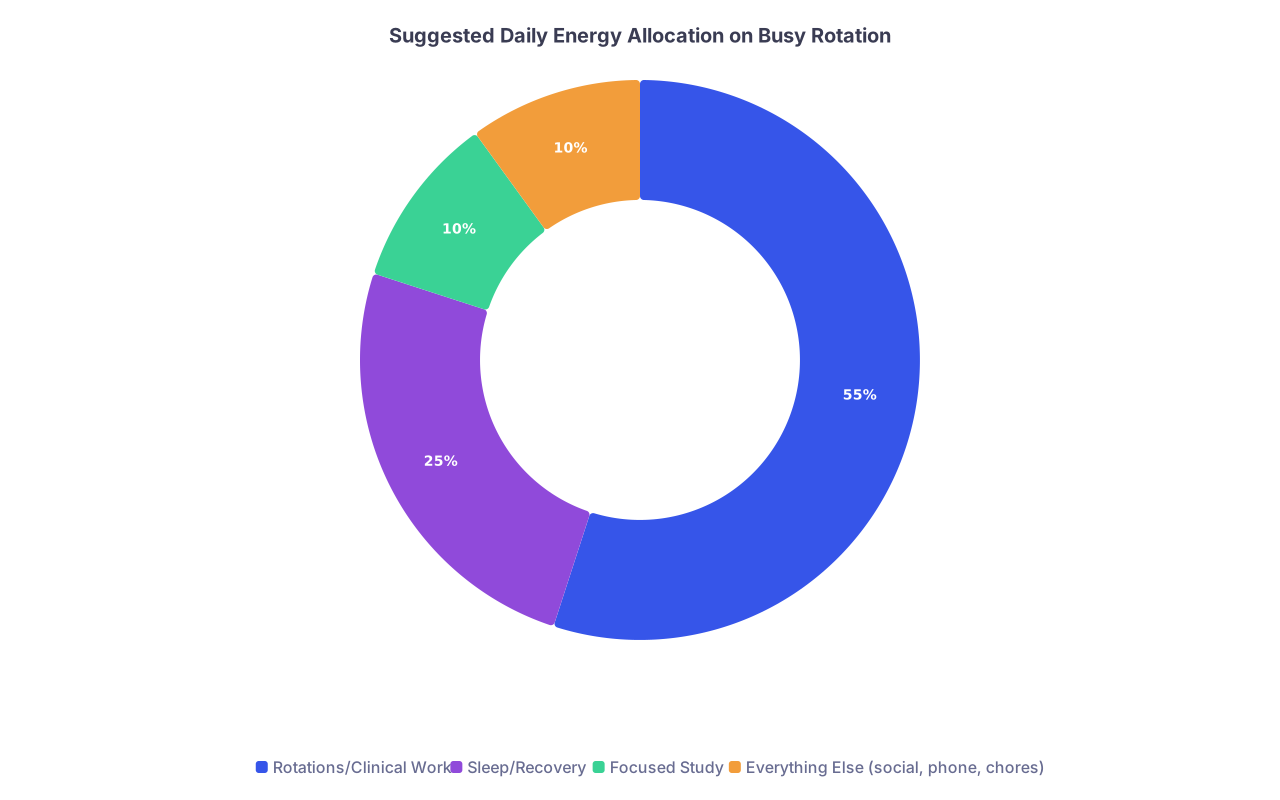
A Quick Visual: Where Your Limited Energy Should Actually Go
| Category | Value |
|---|---|
| Rotations/Clinical Work | 55 |
| Sleep/Recovery | 25 |
| Focused Study | 10 |
| Everything Else (social, phone, chores) | 10 |
That “Everything Else” slice is where you usually pay for your anxiety. Social media, mindless browsing, sitting there thinking about how doomed you are. If you reclaim even half of that for sleep and focused study, the anxiety drops.
What If Your Anxiety Is Past “Normal”?
Test anxiety on rotations is common. Full-blown panic attacks, chest pain, inability to sleep more than 2–3 hours, nausea every time you sit to study—that’s more than just “a tough block.”
If you’re there:
- Email student health or counseling. Explicitly say “test anxiety impacting functioning on rotations.”
- Loop in your dean or advisor sooner rather than later. You are not the first student they’ve seen like this. Not even close.
- If you’re using stimulants (caffeine or prescribed) aggressively, talk to someone about dose/timing. Stimulants + anxiety + sleep debt is a vicious triad.
And no, this doesn’t automatically “go in your permanent record” in a way that ruins residency. Unmanaged explosions do more damage than early intervention.

| Step | Description |
|---|---|
| Step 1 | End of Clinical Day |
| Step 2 | 10 min review only or sleep |
| Step 3 | 20-30 question block |
| Step 4 | Stop, breathe 60 sec, switch to light review |
| Step 5 | Finish block, brief review |
| Step 6 | Protect sleep floor |
| Step 7 | Too Exhausted to Focus? |
| Step 8 | Anxiety Spiraling? |
FAQ (Exactly 3 Questions)
1. What if I’m so behind on studying that these small daily chunks feel pointless?
They feel pointless because your brain is addicted to “all or nothing” thinking. “If I can’t do 6 hours, why bother with 30 minutes?” That mindset is exactly why you’re behind. Exams don’t care how dramatic your effort felt; they care about accumulated exposure to concepts. Ten days of 30–40 questions daily is 300–400 questions you wouldn’t have seen otherwise. That absolutely moves your score. Start small, track your daily question count on paper, and let the total climb. Progress is what calms anxiety. Not perfection.
2. Should I ever ask for time off or an adjusted schedule for test anxiety, or is that career suicide?
It’s not career suicide if you handle it like a professional and not an emergency flail. The cleaner path is: document your anxiety with student health or counseling → talk to your dean/advisor → they help communicate with the rotation director as needed. A targeted accommodation (like protected time the afternoon before the exam, or avoiding post-call exam days) is reasonable. What hurts you more is silently imploding, failing exams, and having to explain multiple remediations later. Appropriate help requested early looks responsible, not weak.
3. Is it better to read a textbook/online resource or just hammer questions when I’m this busy and anxious?
On rotations with limited time and high anxiety, I’d put about 70–80% of your effort into questions and case-based resources, 20–30% into focused reading (algorithms, summary tables, short chapters on weak areas). Questions give you active retrieval, exposure to test style, and confidence that “I’ve seen this pattern before.” Long reading when you’re exhausted tends to turn into word-scanning and guilt. If you can’t remember what you just read, it’s not working. Keep reading targeted, anchored to patients you’ve seen, and let question performance guide what you need to read.
Open your calendar and your question bank right now. Pick tomorrow and block off where your minimum core will fit: exact times for 20 questions and 15–20 minutes of review. Write it down like an appointment with yourself. Once it’s on the page, you’re not just anxious about the exam—you’re actually doing something about it.