
Failing a course does not mean you’re a bad future doctor. Letting it destroy your confidence does.
If you’re remediating a course in med school and your test anxiety just exploded, you’re in one of the roughest psychological spots in training. You’re not only fighting the material. You’re fighting the story in your head: “Everyone else can do this. Maybe I shouldn’t be here.”
Let me be direct: the remediation + anxiety combo is survivable. I’ve watched students go from remediation to honor-level performance later. The ones who make it do three things well: they protect their confidence, they control the test situation, and they get ruthless about how they study.
Let’s walk through what to do, step by step, if this is you right now.
1. Get Clear on the Actual Threat (Not the Story in Your Head)
Right now your brain is probably telling you a disaster movie.
“I failed one exam → I remediated a course → I clearly can’t handle medicine → I’ll fail Step → I’ll never match.”
That chain is emotionally real, but logically garbage.
You need to separate three things:
- What actually happened
- What it means for your record
- What you’re making it mean about you
Start with cold facts. Write this out on paper, not in your head:
- Course:
- Original outcome:
- Reason for remediation (if faculty gave you feedback):
- What remediation requires (exam, OSCE, attendance, etc.):
- Official policy consequence if you fail remediation (probation, repeat year, dismissal, etc.):
This matters because test anxiety feeds on ambiguity. Your brain loves a vague threat. So kill the vagueness.
Most of the time, remediation means:
- Your record will show a remediated course or delayed pass
- You remain in good standing if you pass
- Long-term, this is a “red flag” that needs a clear story, not a career-ender
You’re not trying to pretend it’s nothing. You’re trying not to inflate it into “I’m doomed.”
Circle this sentence and put it on your desk:
“I’m in a high-stakes situation, but not a hopeless one.”
That’s the frame you want.
2. Diagnose Your Test Anxiety Like It’s a Patient
You’re in medicine. Use your training. Don’t just say “I have bad test anxiety.” That’s like writing “SOB” as your entire note.
You need to figure out what actually happens. Symptom-level.
Ask yourself:
- Do you blank on questions you know cold when relaxed?
- Do you get physical symptoms (heart pounding, sweating, shaking, nausea)?
- Do you obsess over one question and lose track of time?
- Do you rush, click fast, and make dumb mistakes?
- Do you panic more with multiple-choice or practical exams (OSCEs, labs)?
- Does anxiety start days before or only during the test?
Write this in two columns:
- “Before test” symptoms
- “During test” symptoms
Then rate each 1–10 in severity.
Why bother? Because this tells you where to intervene. If 80% of your problem is during exam panic, and all you do is change your Anki strategy, your scores won’t move much. You’d be treating the wrong thing.
3. You Must Run Two Tracks: Content and Nervous System
Most students remediating do this wrong. They double down on content and completely ignore their nervous system. Then they’re shocked when their practice scores are good but they still freeze during the real thing.
You need two parallel tracks:
Track 1: Skill & Knowledge
Track 2: Nervous system regulation & confidence
If you don’t schedule both, Track 2 never happens. Because it feels “optional” compared to “I have 300 cards due.”
Here’s a simple weekly structure:
| Focus Area | Frequency | Duration |
|---|---|---|
| Deep content blocks | 4–5x/week | 2–3 hours |
| Timed practice sets | 3–4x/week | 40–75 minutes |
| Nervous system work | Daily | 10–20 minutes |
| Post-practice review | 3–4x/week | 30–45 minutes |
| Sleep wind-down routine | Daily | 30 minutes |
Nothing fancy. But if your calendar is 100% “study,” you’re setting yourself up to repeat the same disaster under pressure.
4. Build a “Controlled Exposure” Plan Instead of Avoiding Exams
Avoidance is the fuel for test anxiety. If every practice test feels like life-and-death, you never get used to it.
You need graded exposure. Slowly training your brain: “I can handle test conditions.”
Here’s a four-week sample progression for a remediation exam (adjust time scale to your reality):

| Step | Description |
|---|---|
| Step 1 | Week 1 Low-stakes timed sets |
| Step 2 | Week 2 Longer timed blocks |
| Step 3 | Week 3 Half-length mock exams |
| Step 4 | Week 4 Full mock exam + review |
Week 1 – Low Stakes, High Frequency
- 15–20 question timed blocks, open-note allowed at first
- Primary goal: stay in the chair, don’t quit, practice breathing when anxious
- After each block: mark questions you knew but missed due to panic / rushing
Week 2 – Longer Timed Blocks
- 30–40 question timed blocks, closed-book
- Recreate some test-day elements: same time of day, same snack, same water bottle
- Introduce a simple pre-test routine (more on that later)
Week 3 – Half-Length Exam
- 50–60 questions in one sitting
- Treat it as “dress rehearsal lite”
- Notice: when in the block does your anxiety spike? Early? Middle? When you see a weird question?
Week 4 – Full Mock Exam
- As close to real as you can make it
- Same start time as real exam
- No phone, no breaks except what’s allowed on testing day
The rule: you never go more than 48 hours without doing some timed questions under mild pressure. You’re training your nervous system by repetition, not by pep talks.
5. Build a ruthlessly practical test-day protocol
Let’s talk about the actual remediation exam. The day that keeps replaying in your mind at 2 a.m.
You do not walk into that day hoping you’ll “just stay calm this time.” Hope is not a plan. You need a script.
The 24 hours before
Non-negotiables:
- Stop doing new content by mid-afternoon. Only light review or flashcard skimming.
- Sleep: aim for a stable bedtime, not a magical number of hours. If you normally sleep midnight–7, don’t suddenly try 10 p.m.
- Decide your exam clothes, snacks, water, and timing the day before. Decision fatigue will raise anxiety.
If you’re the type who spirals at night, write this down before bed:
- One sentence on what you’ve actually done to prepare (“I completed X% of Qbank, reviewed weak topics, and did 3 mock blocks.”)
- One sentence on your job tomorrow (“My job is to execute my process, not to be perfect.”)
Then put your notes away. You’re done.
The 60 minutes before
Minimal inputs. This is where many students sabotage themselves by cramming, texting classmates, or looking up last-minute facts.
Instead:
- 10–15 minutes: light warm-up
- 3–5 easy questions to get your brain moving. Stuff you’re likely to get right. This is not the time to hunt zebras.
- 5–10 minutes: body downshift
- Few rounds of physiological sighs (inhale normally, quick second inhale, long slow exhale), or box breathing (inhale 4, hold 4, exhale 4, hold 4).
- 2–3 minutes: micro-visualization
- Picture yourself opening the exam, seeing a hard question, pausing, breathing, marking it, moving on. Not a fantasy of getting 100%. A rehearsal of handling difficulty.
During the exam
You need rules. Otherwise anxiety improvises.
Try these:
First 5 questions rule
- Your only job is to establish rhythm. You’re not proving anything. Breathe before Q1, Q3, and Q5. Deliberate, not rushed.
“Mark and move” rule
- Hard, unfamiliar, or anxiety-triggering questions: read twice, eliminate what you can, pick best option, mark and move on. No more than 90 seconds on a single question during first pass (adjust for your test’s timing).
Physical reset every 10–15 questions
- Tiny movement: roll shoulders, unclench jaw, plant feet, slow exhale. You’re telling your body “I’m not trapped.”
Panic protocol
When you feel the wave rising:- Take hands off keyboard/mouse.
- Look away from the screen (floor, desk, not the clock).
- Do two slow breaths with long exhales.
- Tell yourself: “I know how to do questions like this” or “I’ve seen this before,” even if it’s not literally the same. Then re-engage.
This is not mindfulness poetry. It’s mechanical. You’re training your body to accept “we are safe enough to think.”
6. Studying While Remediating Without Destroying Your Confidence
Remediation messes with identity. You feel behind your classmates. You feel watched. You may be re-learning material you’re ashamed you “should have already known.”
Here’s how you study without turning every session into a self-attack.
1. Start each study block with a “win”
First 5–10 minutes: do something you’re reasonably good at.
- Easy UWorld-style questions you typically nail
- A topic you enjoy (renal physiology instead of that cursed biostats if it wrecks you)
You’re building the narrative: “I can do parts of this.” That matters.
2. Cut out shame-based goals
“Today I’ll finally do everything I was supposed to do last block” is not a goal. It’s a weapon.
Use concrete, controllable targets, like:
- “Two 20-question timed blocks plus review.”
- “Review all missed micro questions tagged ‘bacteria.’”
- “Finish and annotate one lecture I didn’t understand before.”
At the end of the day, you check: did I do what I said I’d do? Confidence grows when your actions line up with your plan, not when you magically become brilliant overnight.
3. Avoid the comparison vortex
The worst move while remediating: hanging around classmates obsessing over their research, away rotations, or Step scores.
You need a firewall:
- Mute group chats that constantly talk about scores or “how easy that exam was.”
- If someone asks about your remediation and they’re not in your trusted circle, you’re allowed to say: “I’ve got a plan with the school; I’m just focusing on my work right now.”
You’re not being secretive. You’re protecting your bandwidth.
7. Use Faculty and Counseling Smartly (Not Desperately)
Most med schools actually have more help than students think. The problem is students only reach out when they’re already on fire mentally, so it feels like “going to the principal’s office.”
You’re remediating. You have a legitimate reason to ask for help. Use it.
Academic support
Ask your course director or academic support office very specific questions:
- “Looking back at my original exam, what patterns do you see?”
- Timing vs. content vs. misreading vs. careless mistakes
- “Can we go over 5–10 questions I missed that represent common errors I make?”
- “What would you prioritize for me in the next 3 weeks given my prior performance?”
You’re not asking, “What should I do?” You’re asking for targeted feedback.
Mental health / counseling
If your anxiety is high enough that:
- You’re losing significant sleep
- You’re having panic attacks
- You’re avoiding studying because of dread
then you should not white-knuckle this.
Your goals in counseling/therapy:
- Learn 2–3 specific anxiety tools you can actually use during exams
- Untangle the “if I fail this, I’m worthless” story that’s strangling you
- Decide whether evaluation for medication is appropriate
CBT-style approaches for performance anxiety are especially useful. That’s not “lying on a couch dissecting your childhood for three years.” It’s structured. Practical. Often short-term.
8. Protecting Your Long-Term Narrative (For When This Shows Up Later)
Let’s be blunt: remediation may show up later in:
- Dean’s letter/MSPE
- Residency applications
- Interviews: “Tell me about this course you remediated.”
Your future self needs a clean, honest story that doesn’t sound defensive or broken.
The story you want to live into right now:
- I hit a wall.
- I learned exactly why.
- I changed how I work.
- My later performance shows that change.
Everything you’re doing now is future evidence. Imagine being able to say to a program director:
“I struggled with X course in MS2, remediated it, realized I had to change how I approached timed exams and volume of material. I worked with academic support and counseling on test anxiety, revamped my study process, and from then on my exam scores and clinical evaluations steadily improved.”
That answer is very different from: “Yeah, I don’t know, that was just a bad block.”
So as you go through this:
- Keep a simple log of what changes you made (study, scheduling, anxiety tools).
- Notice and record small improvements (practice scores, how far you get through questions before panicking, etc.).
- If you do better on the remediation exam than the original, that’s part of the story: growth under pressure.
9. What If You Fail the Remediation?
I won’t sugarcoat it. It can happen. I’ve seen it.
And when it does, almost every student thinks, “That’s it. I’m done. I’m too broken for this.”
Reality is more complicated.
Depending on your school, failing remediation can mean:
- Repeating the course or year
- Academic probation
- In extreme cases, dismissal
Your brain will jump straight to “no residency ever.” Do not make career decisions in that mental state.
If you do fail:
Get information, not vibes
- Meet with the dean/academic affairs.
- Ask: “What are my actual options and required steps from here?”
- Ask for it in writing if possible.
Ask yourself two separate questions (not one blended one):
- “Is medicine still what I want?”
- “If so, am I willing to do the extra year / conditions they’re asking?”
Get neutral perspectives
- Talk to someone outside your school: a mentor, physician you trust, or therapist who understands med training.
- You’re trying to avoid making a permanent decision (leaving medicine) based on a temporary moment (one remediation outcome).
I’ve seen students repeat a year, carry that scar, and still end up solid residents. I’ve also seen people realize, with relief, “I actually don’t want this path enough to keep fighting for it.”
Both are valid conclusions. Just don’t let panic decide for you.
10. A Simple Daily Template While You’re in the Thick of It
If you’re overwhelmed and just need “tell me what a decent day looks like,” use this as a starting point:
Morning
- 10–15 minutes: light review of yesterday’s mistakes
- 60–90 minutes: focused content block on one system/topic
- 5 minutes: breathing or short walk before switching tasks
Midday
- 20–40 question timed set
- 5–10 minutes: quick break, snack, stand up
- 30–40 minutes: review those questions (focus on why you missed things)
Afternoon
- 60–90 minutes: targeted weak area work (based on your log of mistakes)
- 10 minutes: nervous system work (guided relaxation, breathing, or short run/walk if that helps you)
Evening
- 30–60 minutes: lighter work (flashcards, skimming key tables/figures)
- 30 minutes before bed: no screens, no studying; something that signals “day is done”
You’re not aiming for perfection. You’re aiming for repeatable days that slowly move your understanding and your anxiety in the right direction.
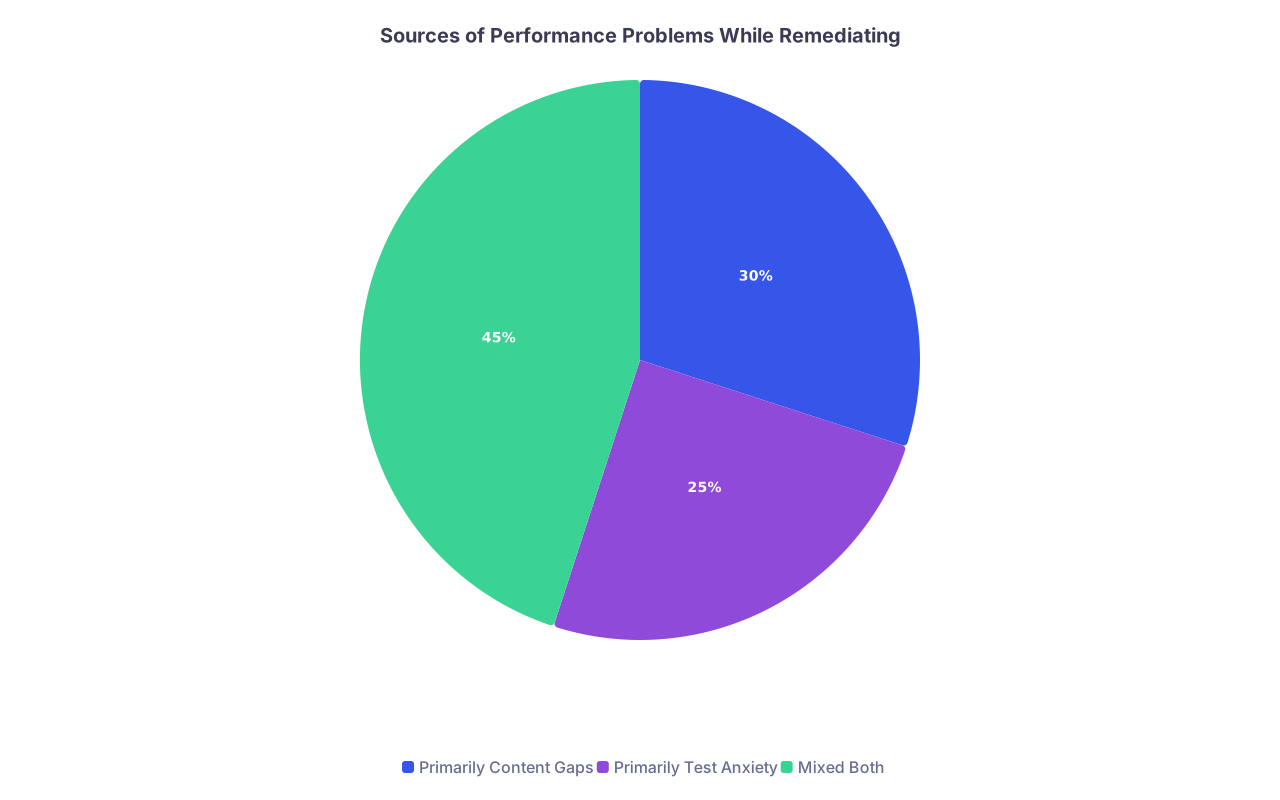
| Category | Value |
|---|---|
| Primarily Content Gaps | 30 |
| Primarily Test Anxiety | 25 |
| Mixed Both | 45 |


FAQ (Exactly 3 Questions)
1. Should I tell residency programs about my remediation, or hope they don’t notice?
They will almost certainly see it in your MSPE/Dean’s letter. Hiding is not an option. What you control is the frame. Be brief, factual, and growth-oriented: “I struggled in [course], remediated successfully, identified that my test performance was being limited by anxiety/timing issues, worked with support, and my subsequent performance reflects that change.” Practice saying this out loud until it doesn’t sting as much. That’s your script for interviews.
2. Is it worth trying medication for test anxiety while I’m remediating?
Maybe—but not as a last-minute fix the week before your exam. If your anxiety is severe (panic attacks, severe insomnia, physical symptoms that derail you), talk to a psychiatrist or your physician early. Some students benefit from SSRIs for baseline anxiety or very carefully used beta-blockers for physical symptoms. But any medication should be trialed before the high-stakes exam to see how your brain and body respond. Pills without behavioral work is a half-built bridge.
3. How do I stop thinking “everyone else is moving on without me” while I’m stuck remediating?
You don’t completely stop that thought—it has some truth. What you do is refuse to let it be the headline of your life. Limit exposure to class gossip and social media. Anchor yourself to your own lane: your tasks for this week, your small wins, your actual progress. Keep one or two people in your circle who know what’s happening and support you without drama. Remember: med training is long. Careers are 30–40 years. A delayed course feels massive now, but over a lifetime it becomes one chapter, not the whole book.
Key points:
- Remediation plus test anxiety is a tough spot, but it’s not proof you don’t belong in medicine.
- You need a two-track plan: targeted content work and deliberate nervous-system training under timed conditions.
- Protect your confidence by focusing on controllable actions, building a solid test-day protocol, and crafting the long-term growth story you’ll eventually tell about this season.