
It’s 1:07 a.m. You’ve read the same UWorld explanation three times and none of it is sticking. Your heart is thumping for no good reason, your stomach feels like it’s dropping even though you’re just sitting at your desk, and the thought “What if I actually need meds for this?” has been quietly getting louder for weeks.
And then the next thought crashes in:
If I go on meds for test anxiety… are residency programs going to judge me? Am I basically branding myself “not resilient enough for medicine”?
Let’s walk straight into the worst-case scenarios your brain is probably rehearsing, because I know you’re not here for fluffy “self-care” quotes. You want to know if taking an SSRI or propranolol or even a benzo is going to screw your career.
The blunt truth: programs don’t see your meds
Let me start with the thing your brain doesn’t quite believe: no residency program is logging into some secret database and seeing you’re on sertraline or propranolol or whatever.
They don’t see your pharmacy records. They don’t see your therapist notes. They don’t get a printout of “this applicant has test anxiety and takes meds.”
What they see is:
- Your transcript
- Your MSPE (Dean’s letter)
- Your exam scores
- Your personal statement
- Your letters of recommendation
- Your interview performance
That’s it. There is no “medication” field in ERAS.
The only time this even gets close to relevant is if either:
- You tell them directly, or
- Your mental health led to something documented and non-private (leave of absence, professionalism issue, repeated exam failures, etc.)
Medication itself? Invisible to them.
So no, there’s no checkbox anywhere that says: “On meds for test anxiety: Y/N.”
“But what about the medical license questions?”
This is the other big spiral: “What if the state medical board asks and I have to disclose and then I never get licensed and then I’m unemployable?”
I’ve watched a lot of people go through this. Here’s how it usually plays out in real life, not in anxiety-brain fanfic.
Most state medical boards have shifted away from “Have you EVER had any mental health condition?” to questions like:
- Do you currently have any condition that impairs your ability to practice medicine safely?
- Have you been hospitalized or court-ordered for mental illness or substance use in the last X years?
- Are you currently unable to meet the essential functions of your role due to a health condition?
Taking an SSRI for test anxiety and functioning fine? That is not what these questions are about.
Boards care about impairment: people showing up drunk to clinic, uncontrolled manic episodes that jeopardize patients, repeated dangerous behaviors. They are not trying to punish a med student who got panic attacks from Step studying and saw a psychiatrist like a reasonable human.
Could you run into an old-school, badly written question in a few states? Yes. Some still have awful wording. But even then, “I got test anxiety, I saw a psychiatrist, I’m treated and functioning, my evaluations are fine” is nowhere near “we won’t license you” territory.
It feels like a career death sentence in your head. It’s really not.
The thing that does hurt applications: untreated impairment
Here’s the uncomfortable flip of this that nobody wants to say out loud.
I have never seen someone hurt in the match process because they were quietly on meds and doing fine.
I have 100% seen people hurt because they were so anxious, depressed, or panicked that:
- They failed Step 1 or Step 2 multiple times
- They had to repeat a year with messy documentation
- They had professionalism flags like “not showing up,” “frequent call-outs,” or “can’t function on rounds”
- They melted down after too long of trying to “muscle through” and then had to take big leaves
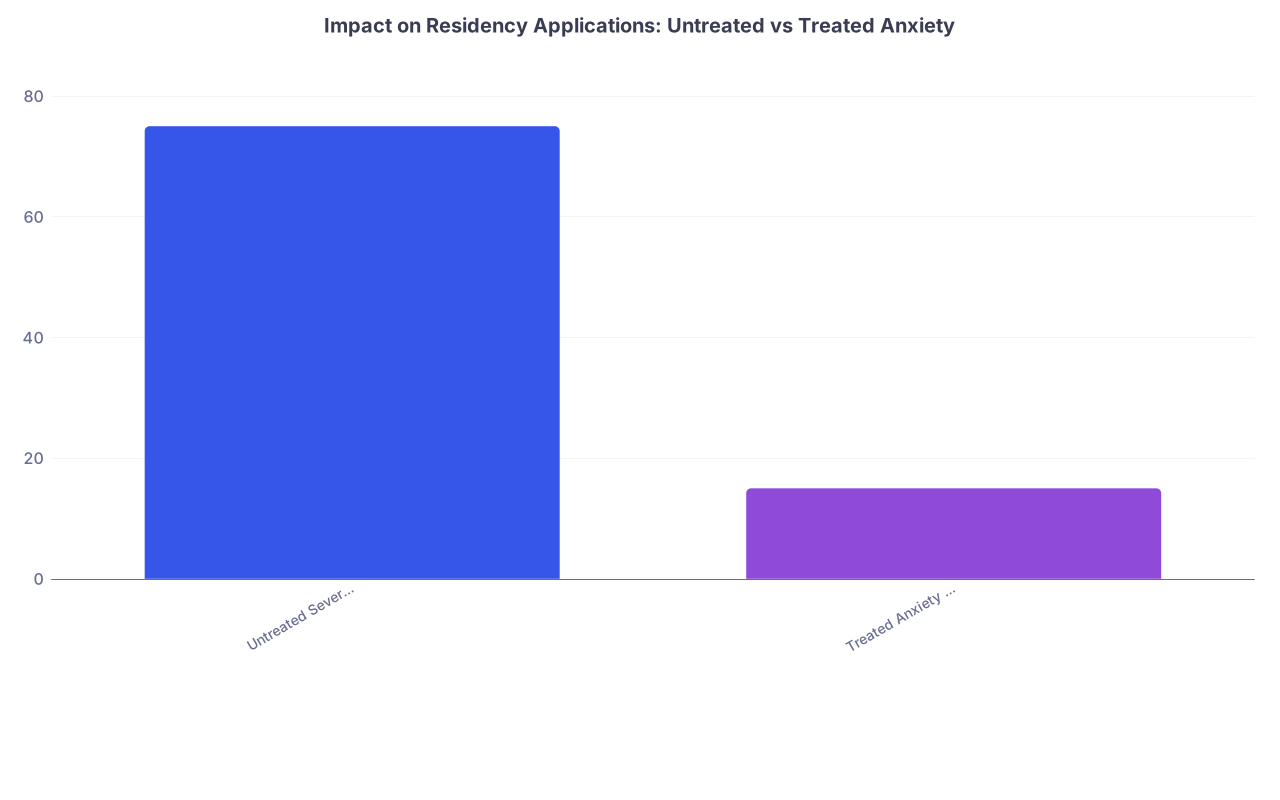
| Category | Value |
|---|---|
| Untreated Severe Anxiety | 75 |
| Treated Anxiety (Meds/Therapy) | 15 |
^ Approximate “risk” of real application damage: repeated fails, LOAs, professionalism documentation. Not scientific, but pretty close to what I’ve actually seen.
Programs don’t care that you’re human and needed help. They care if you are unsafe, unreliable, or so unstable that you can’t do the job.
The irony is brutal: the thing you’re scared will hurt you (treatment) is usually what prevents the stuff that actually hurts applications (spiraling grades, exam failures, LOAs with vague scary explanations).
“Will my Dean’s letter say I’m on meds?”
No. Unless something big and official happened around it.
The MSPE / Dean’s letter does not list diagnoses or medications. It’s not a psych chart note. It comments on:
- Academic performance
- Clinical performance
- Professionalism issues
- Leaves of absence / extended time
Where it gets tricky is if your test anxiety led to things like:
- Delayed graduation
- Multiple exam failures
- Repeated course/clerkship failures
- Behavioral issues that got written up
If you took a medical leave, there might be a line like: “The student took a leave of absence from X to Y for personal/medical reasons and then returned in good standing.”
That’s not the same as: “This person is on meds and anxious, do not rank.”
And again, that’s about the impact on your functioning, not the fact that you sought treatment.
The meds themselves: what people actually use (and how programs see it)
Let’s be concrete, because I know your brain is filling in the blanks with the worst possibilities.
Things I’ve seen med students use for test anxiety:
- SSRIs/SNRIs (sertraline, escitalopram, venlafaxine, etc.)
- Propranolol before exams or OSCEs
- Hydroxyzine as needed
- Very rarely, low-dose benzos (more controversial, more careful monitoring, etc.)
Residency programs do not know which of these you’re on. There is no pharmacy printout attached to your ERAS.
The only time they might indirectly notice anything is:
- You’re so sedated you’re clearly not functioning on interview day
- Your anxiety is so raw and visible that your interviews go poorly
- Substance use or misused meds cause obvious problems
Taking sertraline quietly so you can actually sleep and not dissociate during NBME blocks? That doesn’t show up anywhere. It just makes you look like someone who does decently on exams and can hold a normal conversation.
“What if I want to explain my Step score and mention anxiety?”
This is where judgment actually matters, and people often over-share from a place of guilt or wanting to “confess.”
You do not owe programs your full psych history.
If you had a big drop in performance tied to severe untreated anxiety, you can explain it in a focused, grown-up way without turning ERAS into a therapy session.
Good version: “I struggled with significant anxiety around my first major board exam, which I didn’t address early. My performance on that exam doesn’t reflect my current abilities; since then, I sought help, established regular care, and my subsequent clinical evaluations and exam scores are more consistent with my true performance.”
Bad version: “I’ve had crippling test anxiety since childhood, multiple panic attacks before every exam, and I take X, Y, Z medications. I still get panic attacks sometimes.”
One shows insight and stability. The other raises questions about ongoing impairment.
You can mention that you sought help. You do not need to specify meds. You definitely don’t need to list diagnoses.
The big fear: “Does needing meds mean I’m not cut out for this?”
I know this one cuts pretty deep.
Med culture still quietly worships the “machine” archetype: zero sleep, no feelings, never anxious, never sick. This is fake. It has always been fake. A lot of those people are just suffering quietly or imploding later.
Anxiety is extremely common in med students. Board exams are specifically designed to be high-stress, high-stakes, and timed in a way that pushes people’s nervous systems to the edge. You are reacting like a human.
Needing medication to calm the physiologic overdrive your brain is stuck in… does not say anything about your worth as a physician. If anything, people who’ve stared down their own panic, depression, OCD, whatever—those are often the ones who get it with patients.
Here’s what actually matters for medicine:
- Can you show up consistently and take care of patients safely?
- Can you function under pressure without falling apart?
- Do you have insight into your limits and get help when needed?
Sometimes the answer to those is “yes—but only if I’m treated.” That’s still yes.
What you should actually worry about (and what you can drop)
Your anxiety is latching onto “Will they judge me for meds?” because it feels concrete. Like there’s a rule somewhere you could accidentally trip.
But here’s the ugly truth: the system doesn’t care about whether you ever struggled. It cares about whether you currently look like a “problem” on paper.
| Thing | Real risk to your career? |
|---|---|
| Quietly taking SSRIs/propranolol | Very low |
| Failing boards multiple times | High |
| Taking a well-managed LOA | Low–moderate |
| Untreated anxiety causing LOA + fails | High |
| Seeing a therapist regularly | None |
Here’s what’s actually smart to worry about:
- Are you passing your exams at a level consistent with your goals?
- Are you so anxious you’re losing days of studying because you’re frozen?
- Are you avoiding practice tests because you can’t tolerate seeing scores?
- Are you sleep-deprived and constantly in fight-or-flight mode?
Those things you can do something about. Sometimes with therapy alone. Sometimes with meds. Often with both.
The stuff you can drop:
- “Will PDs find out I take sertraline?” (No.)
- “Will my classmates judge me if I go to student mental health?” (Some might; they’re wrong; also, who cares—you’re not applying to match into them.)
- “Will I be labeled forever?” (If anything, not treating it is what labels you in your record.)
How to actually move toward getting help (without blowing up your life)
If you’re still reading, you probably already suspect you need more than just “try harder.”
Rough path I’d suggest—learn from everyone who waited too long:
- Start with your student mental health or counseling center. Tell them clearly: “My main issue is crippling test anxiety that’s impacting performance.”
- Be open to therapy plus meds. You don’t have to commit forever. You can try, adjust, or stop later under supervision.
- Time it reasonably. Don’t start something like bupropion 3 days before Step 1. But also don’t keep punting it until you’re a total wreck 2 weeks out.
- Loop in someone you trust academically if things are really bad—a dean, an advisor, someone who can help you map out exams, LOA vs no LOA, etc.

| Step | Description |
|---|---|
| Step 1 | Recognize test anxiety is impairing you |
| Step 2 | Contact student mental health |
| Step 3 | Initial eval: therapy, meds, or both |
| Step 4 | Continue plan and monitor |
| Step 5 | Adjust meds/therapy, consider accommodations |
| Step 6 | Discuss LOA or exam rescheduling with dean |
| Step 7 | Symptoms improved? |
| Step 8 | Still impaired? |
You are not weak for doing this. You’re being strategic.
The social fear: “What if this comes up on rotations or with attendings?”
Most attendings don’t know and don’t care what meds you’re on, unless:
- It’s impacting your work
- You choose to tell them
If you ever do disclose to a mentor (which can actually be helpful if they’re decent), you can keep it simple:
“I struggled with serious test anxiety during Step prep. I ended up getting treatment, and it’s made a huge difference. I’m functioning well now, but I was worried it might affect my future.”
If their response is, “Wow, that’s weak, you should just toughen up,” then you just learned something important: that’s not a person whose judgment you should internalize.
Plenty of faculty and residents quietly take the same meds you’re scared to start. They remember being exactly where you are.

Bottom line: the “career risk” of meds is mostly in your head
Is there stigma in medicine? Yes. Is the system always fair? Absolutely not.
But on this specific issue—“If I get meds for test anxiety, will programs judge me?”—you’re fighting a ghost.
Programs judge:
- Scores
- Patterns of failure
- Documented professionalism problems
- Whether you seem stable and functional on interview day
Meds are often what prevent you from having those problems. The thing you’re scared of is often the thing that saves you.
You don’t get bonus points for suffering more. You just bleed time, sleep, and sanity you desperately need.

FAQ (exactly what your brain is probably asking)
1. Will residency programs know if I’m on meds for test anxiety?
No. They don’t get your medication list, psychiatry notes, or pharmacy records. They only see what’s in your application: scores, transcript, MSPE, letters, personal statement, and how you interview. Meds don’t appear anywhere unless you bring them up.
2. Can being on meds for anxiety stop me from getting a medical license later?
For ordinary, treated test anxiety? Extremely unlikely. Licensing boards care about impairment, not “have you ever taken an SSRI.” If you’re stable, working safely, and not repeatedly impaired, you’re in the same boat as thousands of other physicians who quietly take meds and are fully licensed.
3. Should I mention my anxiety/meds in my personal statement or interviews?
Usually no, not in detail. If you need to explain a blip (like a low Step score), you can briefly say you struggled with anxiety, sought help, and are now stable. You don’t need to name meds or give your full psych history. Keep it focused on growth and current functioning, not a trauma dump.
4. Will a leave of absence for mental health destroy my chances?
Not automatically. A short, well-managed LOA with a solid return to form is much less damaging than repeated failures and chaos from untreated anxiety. Programs see LOAs all the time. What worries them is ongoing instability, not “this person took time, got help, and came back stronger.”
5. Is needing meds a sign I’m not cut out for medicine?
No. It means your nervous system is maxed out by an objectively brutal training process. Tons of med students, residents, and attendings are on SSRIs, SNRIs, beta-blockers, or other meds. What actually matters is whether you can function, learn, and care for patients safely—with or without meds.
6. What if meds make me worse or blunt my performance?
That’s a valid fear—and exactly why you do this with a real clinician, not by guessing. Start when you still have some buffer before a huge exam. Check in regularly. If a med sedates you or worsens things, you adjust or stop it under supervision. The goal isn’t to zombify you; it’s to get you back to a level where your actual abilities have a chance to show up.
If you remember nothing else, remember this:
- Programs don’t see your meds; they see your performance and stability.
- Untreated anxiety causes far more career damage than quietly getting appropriate treatment.
- You’re not weak for needing help—you’re being strategic about surviving a system that was never built to be kind.