
The silence around test anxiety in med school is doing more damage than the anxiety itself.
Let me just say the quiet part out loud: you’re not actually afraid of your symptoms. You’re afraid of what happens if someone finds out you have them. Afraid it’ll be written somewhere. Afraid it’ll haunt you when you apply for residency. Afraid people will think you’re weak, unstable, “not cut out for medicine.”
I’ve heard this exact sentence more times than I can count:
“If I tell my school I have test anxiety, am I basically ending my career?”
So let’s pick that apart. Honestly. With all the worst-case scenarios you’re already running in your head.
What You’re Really Afraid Of (And Which Parts Are Real)
You’re not just scared of saying, “I have test anxiety.” You’re scared of the fallout.
Let me guess, some of these thoughts sound familiar:
- “What if they put something in my permanent record and program directors see it?”
- “What if they tell me I need a mental health eval and somehow that affects my license later?”
- “What if my faculty find out and start treating me like I’m fragile or incompetent?”
- “What if asking for extra time makes people think I’m cheating the system?”
- “What if it doesn’t help, and now I’ve exposed myself for nothing?”
You’re not crazy for thinking any of that. Med culture is still pretty bad at talking about mental health without judgment, and a lot of us have watched classmates “disappear” after struggling.
Here’s the uncomfortable-but-true middle ground:
Yes, disclosure changes things. No, it usually doesn’t ruin your career. But how you do it, when you do it, and who you tell matters a lot.
What Actually Happens When You Tell Your School
Let’s strip out the myths and talk about what this usually looks like in real life.
Most medical schools route anything involving test anxiety, ADHD, learning differences, or other exam-related issues through disability services or an accommodations office, not through the dean’s gossip pipeline.
That usually means something like:
- You contact the disability/accommodations office (not usually your course director).
- You fill out forms and provide documentation (psych eval, previous diagnoses, etc.).
- They decide what accommodations you qualify for (extra time, separate room, breaks, etc.).
- They notify course admins and exam coordinators with a short, sterile notice like:
“Student is approved for 1.5x time on exams”
No diagnosis. No “this student has anxiety and cries during blocks” note.
Most faculty will never know why you have accommodations. Many won’t even care. They’ve seen this a hundred times.
Do some schools mishandle this? Yes. I’ve seen schools delay approvals for months. I’ve seen a preclinical director accidentally say in a meeting, “Oh right, that’s the student with anxiety accommodations.” Unprofessional? Yes. Career-ending? No.
The key thing: accommodations are routine. Quietly, in the background, a lot more of your classmates are using them than you think.

Could It End Up in My “Permanent Record” or Residency File?
This is the big monster under the bed.
Here’s how it actually works in most places:
- Disability services records are kept separate from your main academic file.
- Accommodations themselves don’t usually appear on your transcript.
- Your MSPE (Dean’s Letter) is not supposed to include disability info or mental health diagnoses. That would be a massive legal and ethical problem.
Will everyone follow the rules perfectly? Not always. But programs are terrified of violating disability laws (ADA in the US, similar frameworks elsewhere). They’re way more scared of that than they are of your extra 30 minutes on an exam.
The more realistic “record risk” isn’t “this will be in my residency file forever.” It’s this: if your test anxiety leads to failures, leaves of absence, or professionalism issues, those are the things that show up.
And that’s the twisted irony. Hiding it and letting it blow up into repeated failures is actually more likely to leave a visible mark than asking for help early and stabilizing.
The Real Ways It Can Backfire (And How to Avoid Them)
I’m not going to pretend there’s zero risk. There are a few ways this can go sideways if you’re not strategic.
Telling the wrong person first
Walking into a random course director’s office and trauma-dumping about your anxiety, with no documentation, right before an exam? That’s how you get the “we’ll see what we can do” vague answer and no real help.Better route: start with the official student disability/ accessibility office or counseling center. Keep it formal, documented, and inside the system that exists to protect you.
Waiting until you’re already failing
If you only tell the school after two failed blocks and a shelf in the 2nd percentile, now you’re not just a student with test anxiety. You’re a student with an academic performance problem. And yes, that has consequences: remediation, delays, sometimes leaves.Honestly, if your heart rate spikes, your mind goes blank, and your practice scores tank on exam days compared to what you know you can do, the “backfire” risk of not disclosing is higher.
Expecting accommodations to magically fix everything
Extra time is not a cure for full-blown panic. A separate room doesn’t rewire your perfectionism. If you disclose but don’t also work on coping skills, practice under realistic conditions, and maybe therapy/meds if indicated, you risk looking like “the student who keeps asking for more and still struggles.”Programs aren’t mad you have anxiety. They’re worried if they see a pattern of impairment with no improvement.
Being vague or minimizing when you actually need more help
Saying, “I’m a little stressed about tests” won’t get you proper support. And then when things collapse, it looks like it came out of nowhere. Be honest with the people who need the full picture (disability services, therapist), even if you downplay it to your peers.
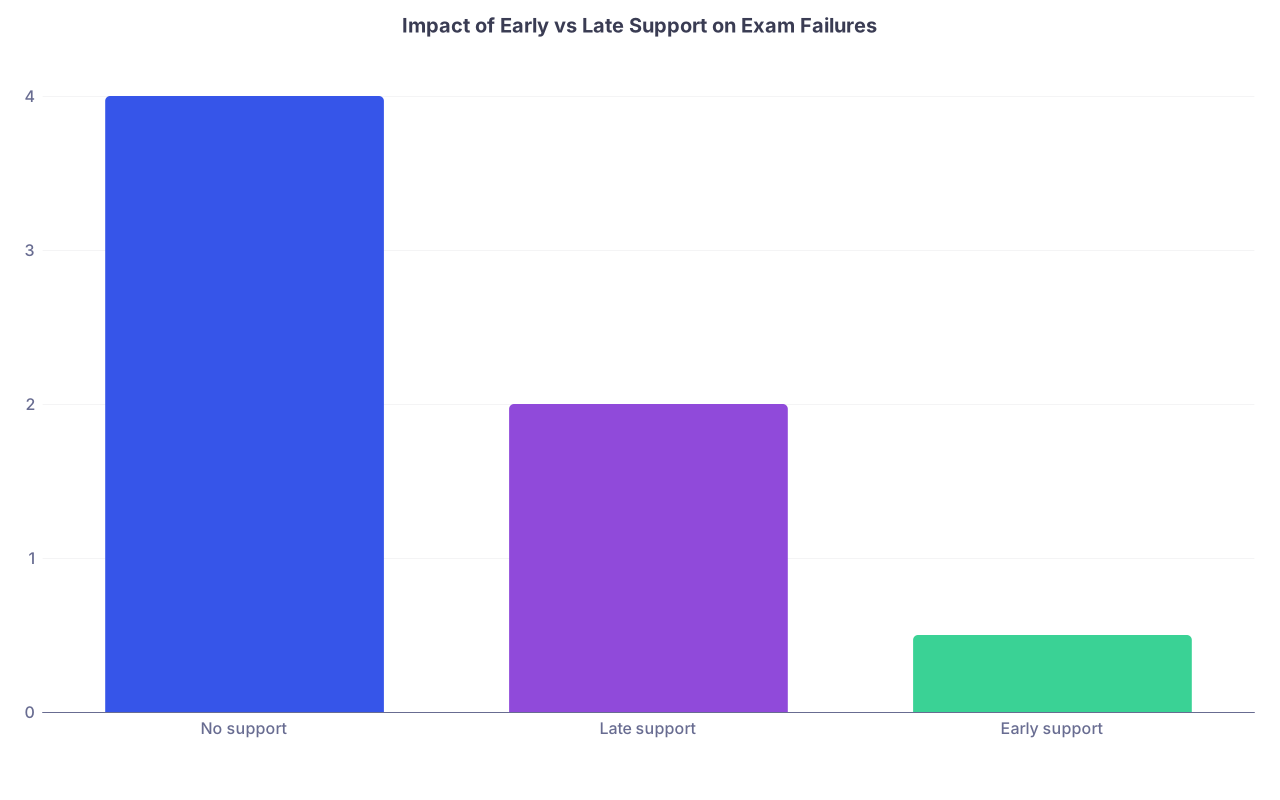
| Category | Value |
|---|---|
| No support | 4 |
| Late support | 2 |
| Early support | 0.5 |
“But What About Licensure and Boards? Will They See This?”
Different beast, different fears.
Licensing boards and Step/COMLEX folks mostly care about:
- Is there impairment affecting your ability to practice safely?
- Are you using substances unsafely?
- Are you ignoring treatment or unstable?
They do not care that you took an exam with 1.5x time in a small room because your sympathetic nervous system thinks NBMEs are bear attacks.
In the US, for example, USMLE doesn’t stamp your score report with “BTW this student had accommodations, so feel free to judge them.” They don’t mark you as “less valid.”
Licensing boards may ask vague questions about mental health or conditions that impair your ability to practice. Having test anxiety that you treated responsibly and got accommodations for is a lot more defensible than a pattern of hiding, failing, disappearing, and reappearing.
- Your scores
- Your clinical performance
- Your letters
- Whether you showed up and did the work
They do not have a separate column in ERAS for “needed extra time because their amygdala is too enthusiastic.”
The Unspoken Reality: A Lot of Med Students Are Already Doing This
You’re not the one weird outlier thinking about test anxiety accommodations. You’re just the one talking about it in your own head instead of out loud.
I’ve seen entire groups quietly using supports like:
- Extended time
- Separate testing rooms
- Earplugs/white noise
- Breaks for bathroom or blood sugar
- Reduced-distraction environments
You know that classmate who goes mysteriously missing 15 minutes before every exam and isn’t seen in the main testing room? Odds are they’re not skipping. They’re in the special room with their accommodation.
And no, they’re not all “weaker” students. Some are top of the class who refuse to let their physiology sabotage what their brain actually knows.

How to Decide If You Should Tell Your School
Let’s be brutally practical. Ask yourself:
- Do practice exams or non-graded quizzes go significantly better than real exams, even with similar content and timing?
- Do you have physical symptoms (heart racing, sweating, shaking, nausea, tunnel vision) that make recalling information almost impossible during tests?
- Have your scores or performance started dropping in a way that doesn’t match how hard you’re working or how much you actually understand?
If yes to any of that, then this isn’t just “normal stress.” This is exam performance being distorted by anxiety. And once you hit clerkships and board exams, this problem doesn’t magically disappear. It usually gets louder.
So your choice isn’t “tell the school vs keep everything normal.”
It’s more like: “tell the school now while things are still manageable and mostly private” vs “wait until it becomes an academic issue that will end up in your record.”
One path feels safer but is actually riskier. The other feels terrifying but is usually more protective in the long run.
Protecting Yourself While Getting Help
You’re allowed to be smart and paranoid at the same time. Here’s how you thread that needle without blowing up your life.
Learn your school’s system before you step into it.
Anonymous browse the website. See how they describe disability/accommodations. Some schools even have PDFs that outline privacy rules and who sees what.Start with a low-stakes, information-gathering appointment.
Something like: “I’ve been having significant test anxiety and I’m wondering what the process would look like if I sought accommodations. I’m trying to understand how this is handled and who gets informed.”
You’re not signing your soul away by asking questions.Get proper documentation from outside if you can.
A psych eval or note from a licensed provider who understands med school demands will carry more weight than you sobbing in an office the day before a shelf. It also helps you feel grounded: this isn’t “I’m being dramatic,” this is “I have a documented condition.”Use counseling/therapy in parallel.
If they ever do question you later, being able to say, “I’ve been in treatment, I’ve been working on coping skills, here’s what I’ve tried” shuts down the narrative that you’re just looking for an easy pass.Keep things need-to-know with peers and faculty.
Disability services? Full honesty.
Attending you barely know? “I’ve been managing test anxiety with support from the school and my scores have been stable.” That’s enough.

| Step | Description |
|---|---|
| Step 1 | Struggling with test anxiety |
| Step 2 | Try self-management strategies |
| Step 3 | Consult counseling/therapist |
| Step 4 | Gather documentation |
| Step 5 | Meet disability services |
| Step 6 | Use accommodations + ongoing support |
| Step 7 | Appeal or adjust strategies |
| Step 8 | Impacting exam performance? |
| Step 9 | Accommodations approved? |
What If They Judge Me Anyway?
Someone might. Let’s not sugarcoat it.
There will always be that one attending who says, “Back in my day we had eight exams in a week and we did fine.” Or a classmate who jokes, “Must be nice to have extra time.”
Here’s the thing: those people don’t decide your fate. They don’t write your MSPE alone. They don’t control whether you become a physician.
And between being silently crushed by your own physiology during every exam vs enduring a few ignorant comments while you protect your scores and sanity? I’d pick the second one every time.
You’re not asking for a trophy. You’re asking for the conditions you need to be evaluated on what you actually know, not how well you suppress panic.
Medicine is full of quiet accommodations: stool in the OR for someone with back pain, split call schedules for parents, ergonomic keyboards, scribes, glasses, hearing aids.
This is just the student version.

If You Do Nothing, What Happens?
Let me flip the question you started with:
You asked, “Could telling my school about my test anxiety backfire?”
You’re not asking the scarier question:
“What if I don’t tell them, and my anxiety keeps running the show?”
Worst-case scenario for disclosure?
You get accommodations, maybe deal with some awkwardness, maybe run into a clueless faculty member, and you have to manage a bit of pride and vulnerability.
Worst-case scenario for staying silent?
You fail exams. Remediate. Maybe repeat a year. Maybe step away. That absolutely gets documented. That does show up in the MSPE. That raises red flags for residencies in a way “had extra time due to anxiety” never will.
So yes, it can backfire. But not in the way your brain keeps replaying at 2 a.m.
The more common “backfire” is this: waiting so long to get help that your file shows concrete academic damage that you now have to explain for the rest of your training.
FAQ (The Things You’re Probably Still Worried About)
1. Will residency programs know I had test anxiety accommodations in med school?
Generally, no. They don’t get a list of who was accommodated and why. They see your transcript, MSPE, scores, comments on performance. Unless your anxiety led to academic problems, leaves, or unprofessional behavior, there’s usually no trace. The risk to your record comes more from unaddressed consequences (failures, delays) than from the accommodations themselves.
2. Do I have to tell my school the full emotional level of how bad it is?
You need to be honest enough for them to understand the functional impact: how it affects your studying, performance, physical state during exams, and scores. You don’t have to bleed your entire life story onto their desk. Think “clear, specific, clinical description,” not “raw emotional confession.” A therapist or evaluator can help put it into language that’s taken seriously.
3. What if I ask for help and they say no or minimize it?
It happens. Some schools are still behind. If that’s you, you’re not out of options. You can: get an outside psych eval, appeal through formal processes, use counseling for skills training, and adjust your own testing routines (simulation exams, mindfulness, beta-blockers if appropriate with a doctor). Even if the school isn’t perfect, you’re still better off having tried early than pretending everything is fine until it collapses.
4. Could this affect my license application later if they ask about mental health?
Most modern licensing language is shifting away from “have you ever had a mental health diagnosis?” and toward “do you currently have a condition that impairs your ability to practice safely?” Having had test anxiety, treated it responsibly, and functioned safely through training is not the kind of thing that usually triggers major issues. A pattern of untreated, impairing problems is what boards worry about. Taking this seriously now puts you firmly in the “responsible and stable” category, not the risky one.
Key things to remember:
You’re not the only one scared to say “test anxiety” out loud. Early, official help usually protects your record more than it risks it. And the real danger to your career isn’t that someone might know you’re anxious—it’s letting that anxiety quietly wreck your exams while you pretend it’s not there.