

What if the thing that ruins your entire career isn’t your knowledge, but a stupid little countdown clock in the corner of the screen?
Because that’s what this feels like, right? Not “I’m not smart enough,” but “I literally fall apart the second a timer shows up.” Heart racing. Brain blank. Reading the same sentence three times and nothing sticks. Watching the minutes bleed away and thinking, “This is it. I’m going to fail because I can’t handle a clock.”
I know exactly the flavor of dread you’re talking about.
Let’s Say The Worst Part Out Loud
You’re not worried about being average.
You’re worried that you’re going to walk into a USMLE Step or COMLEX Level exam…
…see the timer start…
…and completely shut down.
You imagine:
- Burning the first 10–15 minutes of the block rereading question 1
- Feeling your chest tighten every time you look up and see “40 minutes left… 30 minutes… 18 minutes…”
- Suddenly rushing, clicking random answers, and making dumb mistakes you never make in untimed practice
- Hitting “End Block” with 8 questions blank because you froze on a few early ones
And then you go all the way to the worst-case scenario: you fail, you have to explain it on every residency interview, maybe you don’t match, and all because your nervous system short-circuits around clocks.
Let me be very blunt: I’ve seen people with brutal timer anxiety still pass USMLE/COMLEX. Some even crush them.
Not because the anxiety magically disappears.
Because they learn how to contain it and build their test day around that reality.
Is it harder? Yes.
Is it impossible? No. Not even close.
What Timers Actually Do To Your Brain (You’re Not Broken)
You’re not being dramatic when you say timers make you panic. There’s a real physiologic thing going on.
This is what usually happens:
- Timer starts → your brain tags the situation as “threat”
- Sympathetic nervous system kicks in: heart races, breathing gets shallow, palms sweat
- Your prefrontal cortex — the part you need to reason through vignettes — gets partially hijacked
- You focus on survival (the timer) instead of the actual question
That’s why you can do fine with untimed or gently timed UWorld or COMQUEST blocks, and then your performance nosedives when you try to simulate real exam timing.
You’re not dumb. You’re physiologically flooded.
This is why “just don’t look at the timer lol” is useless advice. Your brain knows it’s there. Even if you don’t stare at it, you feel it.
But here’s the non-doom part:
You can train this. You’re not stuck with your current level of timer freak-out.
Reality Check: How Much Time You Actually Have
Sometimes the raw numbers help calm the “I’m always behind” story your brain keeps telling you.
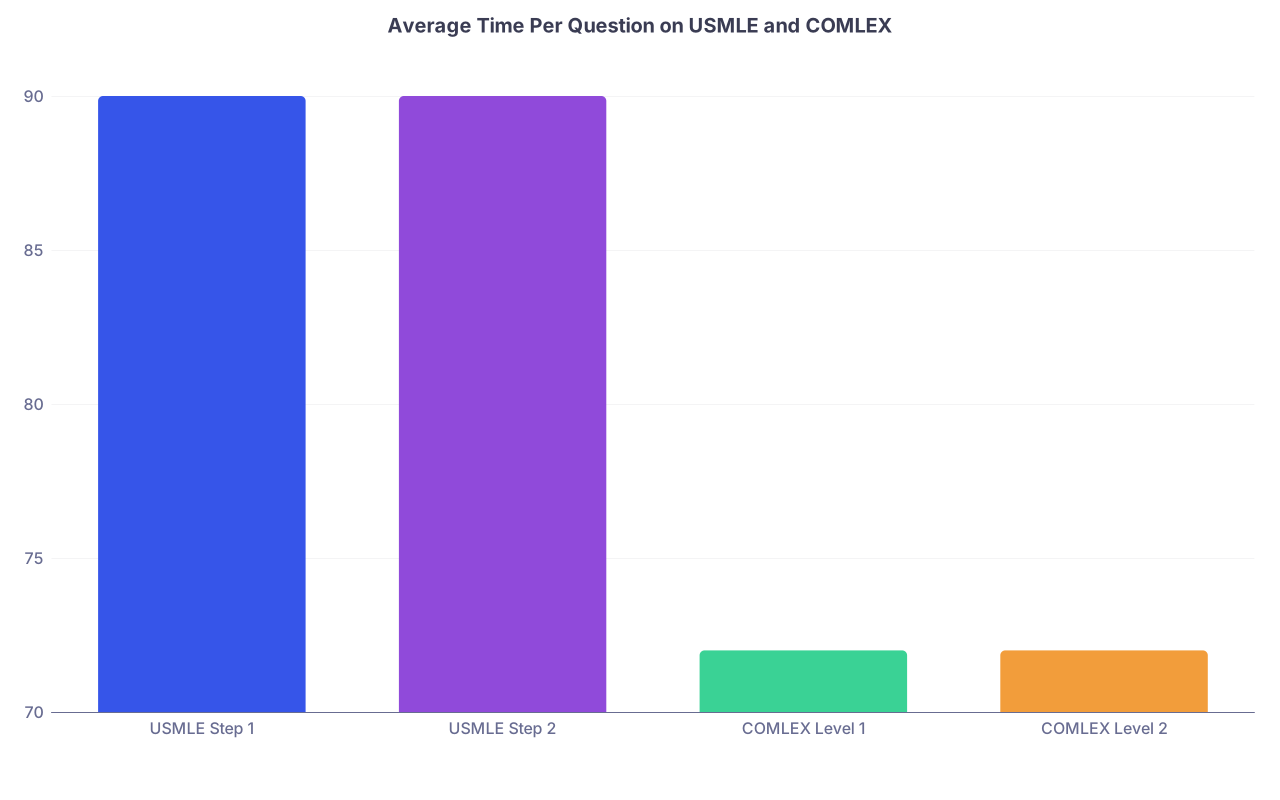
| Category | Value |
|---|---|
| USMLE Step 1 | 90 |
| USMLE Step 2 | 90 |
| COMLEX Level 1 | 72 |
| COMLEX Level 2 | 72 |
- USMLE Step 1 / 2: about 90 seconds per question
- COMLEX Level 1 / 2: closer to ~72 seconds per question (more questions, slightly less time)
That sounds terrifying when you’re a slow, timer-panicky test taker.
But here’s the part no one emphasizes enough: you do not need to fully solve and deeply meditate on every question. You need to get to a “good-enough” answer in a reasonable time and move on.
And if your brain is screaming, “I can’t do that,” then yes — we have to train your process, not just your knowledge.
Training For Timers Without Melting Down
You don’t go from “I lose it the second I see a countdown” to “I’m chill for 8 hours of USMLE” in a week. You build it in layers.
Think of it like exposure therapy, but actually planned, not just “suffer through full-lengths and hope it works out.”
Here’s the structure I’ve seen help the most timer-anxious people.
Step 1: Untimed → Soft Timed → Hard Timed (On Purpose)
Most anxious test takers do this backwards. They’re behind on QBank questions, freak out, jump straight into fully timed blocks, implode, and then tell themselves they’re hopeless.
Try this progression instead:
Untimed blocks first
Not as your only method, but as a start.
Do 10–15 questions untimed. Your only job is process: read, summarize, predict, then check the options. No rushing. No clock.Soft timed blocks
Set a timer for something generous like 2–2.5 minutes per question. For 10 questions, maybe 25 minutes.
Hide the countdown if you can. Just let it go off at the end. You’re teaching your brain: “There is a time container, and I can still function.”Hard timed, but shorter
Do 5 questions in 8 minutes. Or 10 questions in 15. Something close to realistic timing but not 40-question death blocks.
Here, you’re practicing moving on instead of getting stuck.
You don’t jump straight to 40-question, 60-minute survival-mode blocks if timers already trigger you. That’s like trying to run a marathon when you can’t jog a mile yet.
Step 2: Script Your “Timer Panic Protocol”
You need a concrete “if I start to spiral, I do X, Y, Z” script. Not vague “I’ll try to stay calm.”
Something like this:
You notice your chest tightening, eyes darting to the timer.
Without negotiating, you:
- Sit back in your chair and take exactly three slow breaths (4 seconds in, 6 seconds out).
- Put your hand on the desk, feel the surface, and mentally say, “Question. Stem. First sentence.”
- Force your eyes only on the first sentence of the stem. You read it twice slowly.
Yes, this costs you 10–20 seconds.
Yes, that’s better than staying in a panic state for the next 5 questions.
I’ve watched people rescue entire blocks by interrupting the first wave of panic instead of trying to “push through it” which just feeds the spiral.
Step 3: Practice “Bailing Early” Without Guilt
Huge one. Timer-panicky people cling to early questions because they’re terrified of “wasting” the time they already sank.
This is how you end up spending 4–5 minutes on one confusing question, then rushing the last 8.
You need a hard rule, something like:
- If I’ve read the question twice and I still feel stuck at 90 seconds → I choose my best guess, flag it, and move on.
- I do not earn extra points for dying on this hill.
And then you practice that in QBank. Set a watch or use the on-screen timer as a trigger: once it hits 75–90 seconds and you’re still stuck, you force a guess and move on, even in practice.
You’re training your brain: “Moving on does not equal failure. It’s strategy.”
But What If I’m Just Slow? Like Actually Slow?
You might be thinking, “Cool, but I literally read slowly. This isn’t just anxiety.”
Sometimes that’s true. More often, your “slow reading” is actually “anxious rereading.”
You read:
- While also thinking, “This is taking too long.”
- While also scanning the timer.
- While also worrying about the last question you maybe got wrong.
No wonder it feels slow. Half your brain is somewhere else.
Still, let’s say you genuinely process language slower than average. That doesn’t mean you’re doomed. It means your strategy has to be tighter.
| Strategy Type | Impact on Timer Anxiety |
|---|---|
| Untimed → Soft → Hard timing progression | High |
| Strict 'bail by 90 seconds' rule | High |
| Minimizing rereads with note keywords | Medium |
| Practicing with distracting timers | Medium |
| Breathing reset protocol per block | High |
| Full-length sims early in prep | Medium |
A few things that actually help slow processors:
- Minimal note-taking in the stem. One or two words per key idea (“65M DM neuropathy numbness,” “LLQ pain diarrhea, blood, fever”). Not essays. You’re anchoring the story, not transcribing.
- Reading question last, not first, if you get distracted. Some people swear by reading the last line first. For truly anxious brains, that sometimes backfires because you start hunting for the answer instead of absorbing the story. Try both in practice and commit to the one that keeps you calmer.
- Practicing with ugly questions. COMLEX-style vague stems, questions with too much fluff, or unnecessary lab values. Train yourself to aggressively ignore the noise.
And look — if you’re consistently missing timing by a mile in practice, that’s not a “you’re a failure” sign. It’s a “you probably need more time before your exam date” sign. Big difference.
Making Peace With The Clock Before Test Day
Your brain, right now, treats timers like snakes. You want it to treat them more like annoying background noise.
That means you need controlled exposure before the real thing. Not self-torture — strategic exposure.
I’d build up something like this in the weeks before your exam:

| Step | Description |
|---|---|
| Step 1 | Week 1-2: Untimed Blocks |
| Step 2 | Week 2-3: Soft Timed 10-15 Qs |
| Step 3 | Week 3-4: Hard Timed 10-20 Qs |
| Step 4 | Week 4-5: 40 Q Timed Blocks |
| Step 5 | Week 5-6: Full-Length Simulation |
You don’t have to follow this exact calendar, but you get the idea: don’t save your first fully timed block for 2 weeks before your real exam and then freak out when your anxiety spikes.
Also: practice with the timer visible eventually. Hiding it forever is not a long-term solution. For some sessions, force yourself to glance at it only after every 5 questions, not constantly.
You’re building familiarity. The same way you stopped noticing the hum of a refrigerator or the sound of the AC, your brain can learn to partially tune out a clock.
Test Day: How Do I Not Implode?
Let’s be honest. You’re not going to walk in perfectly zen. That’s okay.
Your goal is not “I feel no anxiety.”
Your goal is “My anxiety doesn’t run the show.”
Some test-day anchors that help timer-panicky folks:
- Decide your “first block rule” now. For example: “In Block 1, I’m allowed to feel horrible. I don’t judge my entire exam off Block 1.” Many people warm up after the first block. If you expect perfection right away, you’ll spiral.
- Script your block-start routine. Before you click “Start”: shoulders down, one deep breath, tell yourself: “One question at a time. Just get to the next one.” Same exact words, every block.
- Have a mid-block reset. Around question 15–20, if you notice your eyes drifting to the timer nonstop, use your 10-second protocol: look away from the screen, exhale slowly, then refocus on just the first sentence of the next stem.
And no, you are not the only one silently panicking about the clock in that testing room. The difference is that you’ll have practiced what to do about it.
Here’s the other piece: majority of people walk out sure they failed. Some are timer-anxious, some aren’t. Very often, their score reports tell a different story.
Your anxiety is a terrible predictor of your performance.
What About Accommodations?
Let’s not ignore this part.
If your timer panic is part of a broader pattern — diagnosed anxiety disorder, ADHD, processing speed issues — you might be eligible for accommodations. Extra time, extra breaks, things like that.
Two things I’ll say here:
- Getting accommodations is a process. Paperwork, documentation, deadlines. You don’t start this two weeks before your exam.
- Extra time is not a magic fix if you still freeze at the sight of a clock. I’ve seen people with 1.5x or 2x time still panic because the relationship to the timer never changed.
If you suspect you might qualify, talk to your school’s disability office or a provider who knows you now, not later. Best case, you get more time and use it well. Worst case, you’re still stuck with standard time — which you’re already training for.
You’re Not The Outlier You Think You Are
Timer panic feels so isolating. You look around and assume everyone else just calmly churns through questions with a quiet, organized brain.
They don’t.
I’ve seen:
- A 250+ Step 1 scorer who still checked the timer every 3–4 questions because they were terrified of running out
- A DO student who was sure they failed COMLEX because they guessed on 10 questions per block due to timing, and they still passed comfortably
- Someone who had to exit a practice exam in tears at question 12 because the timer set them off — and three months later, they got through an entire full-length with only one mini-meltdown that they pulled themselves out of
The difference between “this ruins me” and “this is annoying but manageable” is not some magical personality trait.
It’s practice with the right targets:
- Exposure to timers in controlled ways
- A repeatable script for panic moments
- Hard rules about when to move on
- Accepting “imperfect but finished” as success, instead of chasing “perfect on every stem”
You are absolutely capable of handling USMLE and COMLEX with timer anxiety.
But you can’t just hope it disappears the morning of your exam.
You have to train for it like it’s another content area.
Like cardio for your brain.
Do one concrete thing today:
Set up a 10-question QBank block with a 15-minute timer. Before you start, write on a sticky note: “Bail by 90 seconds. Guess, flag, move on.” Put it next to your screen. Then actually follow it for all 10 questions.
Not tomorrow. Today. Train the part of you that panics to see that you can survive the clock and still think.


