
Review timing alone will lie to you.
You hit the spacebar, the algorithm reschedules the card or question, and your dashboard gives you a clean, green completion metric. You feel safe. You think you've checked the box. But behind that green streak, something dangerous is happening: your incorrect clinical reasoning is sitting in the dark, quietly hardening into permanent habit.
I see this exact failure pattern every single board cycle. An M2 spends eight weeks obsessively maintaining their review schedule, hitting 80% on their Anki mature cards and completing 40 UWorld questions a day. Yet their NBME practice scores remain stubbornly flat. Why? Because they trusted review timing to fix what only a true debrief can repair.
Spacing algorithms prioritize retrieval frequency. They do not care whether you retrieved the right answer for the right reason, or whether you just memorized a keyphrase while your underlying understanding of renal physiology remains completely inverted.
Don't Trust Review Timing Alone, That's How Wrong Answers Rot
Re-exposing yourself to a question on day 3, day 7, and day 21 does not magically correct your brain's flawed logic. If you missed a stem on heart failure exacerbation because you misread "decreased compliance" as "decreased contractility," merely seeing that question again three weeks later won't automatically fix your mental model.
In fact, passive re-exposure does something worse: it trains you to recognize the question rather than understand the pathology. You select Choice C because it looks familiar, logging a false "correct" while the rot in your reasoning deepens.
Your goal on USMLE Step 1 is not to remember facts. Step 1 is a clinical reasoning test disguised as a basic science exam. Your sole objective during review is rebuilding the correct clinical decision loop:
$$\text{Question Stem} \longrightarrow \text{Differential} \longrightarrow \text{Key Evidence} \longrightarrow \text{Best Next Step}$$
If any segment of that chain snaps and you don't explicitly repair it, you are wasting your time. Watch out for these three red flags in your daily workflow:
- Fast "correct" answers on repeated items that vanish on fresh NBME forms. You recognize the stem, not the mechanism.
- Confident wrong answers that you skip past during review. You glance at the red box, say "Oh, right, stupid mistake," and smash the spacebar without analyzing why your intuition betrayed you.
- A "review complete" mindset without error tracking. You feel accomplished because your review queue is at zero, but you couldn't tell anyone the top three reasons you missed questions today.
If any of these sound familiar, stop. Your review schedule is actively insulating you from your real weaknesses.
The Hidden Problem: Spaced Repetition Can Reinforce the Wrong Model
Treating question review as a simple binary pass/fail loop is one of the quickest ways to stall your score. A wrong answer is not an item on a to-do list to be cleared; it is evidence of a fractured mental model.
Spaced repetition systems are engineered to prevent forgetting, not to correct faulty logic. When you answer a question incorrectly, your brain picked that wrong option for a specific reason. Maybe you connected hyperkalemia to Aldosterone resistance when the stem actually described an Addisonian crisis. If you simply flip the card over, read "Choice B is correct because Addison's causes Aldosterone deficiency," and move on, your brain retains two things: the correct fact AND your original, un-corrected misinterpretation.
When you encounter a different stem testing the same physiology under exam-day stress, your brain will revert to its strongest neural path: the incorrect rule-of-thumb you never actively dismantled.
To stop this decay, every wrong answer must be categorized into a specific "wrong model" bucket:
- Knowledge Gap: You simply did not know the enzyme, gene, or drug mechanism.
- Misapplied Concept: You knew the principle, but ran the pathway backward or confused cause with effect.
- Misread Stem Details: You overlooked a crucial qualifier ("denies alcohol use," "elevated ESR," "normal MCV").
- Test-Taking Heuristic Error: You fell for distractor options because of buzzword association without checking the clinical context.
- Sequencing/Next-Step Error: You picked the definitive diagnostic test when the stem asked for the initial management step.
- Data/Graph Interpretation Error: You misread the lab panel, flow cytometry plot, or pressure-volume loop.
If you don't tag the miss with its specific structural failure, you cannot apply a targeted fix.
Build an Error Taxonomy (So Your Review Has Something to Fix)
"I missed it" is not a diagnosis. It's an excuse. If you cannot name the exact failure mode of a missed question, you cannot design an effective remedy.
Look at the data above. I've tracked students who spend hours clearing cards vs. those who force themselves to tag every single error. The difference isn't intelligence or effort; it's debrief quality. The first group's performance degrades because their wrong answers rot beneath passive exposure. The second group turns every miss into a targeted rule update.
Here is the exact Step 1 Error Taxonomy you should implement today:
- Concept Gap: Missing foundational science (e.g., confusing Gs vs Gi receptor pathways).
- Rule Misapplication: Knowing the disease but picking the wrong clinical presentation due to a flipped rule.
- Detail Trap: Missing a subtle lab value (e.g., normal vs high calcium in hyperparathyroidism variants).
- Condition Confusion: Misinterpreting overlapping presentations (e.g., Crohn's vs Ulcerative Colitis extragastrointestinal manifestations).
- Next Step vs. Diagnosis: Identifying the right disease, but choosing the final imaging test instead of immediate stabilization.
- Mechanism Mismatch: Pinpointing the organ system, but mistaking an autoimmune etiology for an infectious one.
- Data Translation: Misinterpreting an axis on a graph or failing to calculate an alveolar-arterial gradient correctly.
The Implementation Rule
For every incorrect question, log one error tag and one actionable sentence. No essays. No copying and pasting three paragraphs of UWorld text into an Anki card.
Bad log: "Missed Wilson disease question. Wilson disease is an autosomal recessive mutation of ATP7B causing copper accumulation..."
Good log: "[Condition Confusion] I confused Wilson disease with Hemochromatosis because both present with liver disease, but Wilson shows decreased ceruloplasmin and neuropsychiatric symptoms, not skin hyperpigmentation."
If it takes you more than 45 seconds to write your log entry, you are writing an essay, not an actionable fix.
Wrong Answer Debrief: The 5 Moves That Prevent Rot
Passive reading during review is an illusion of productivity. Your brain loves passive reading because it consumes very little metabolic energy. It feels comfortable. But comfort doesn't build clinical intuition.
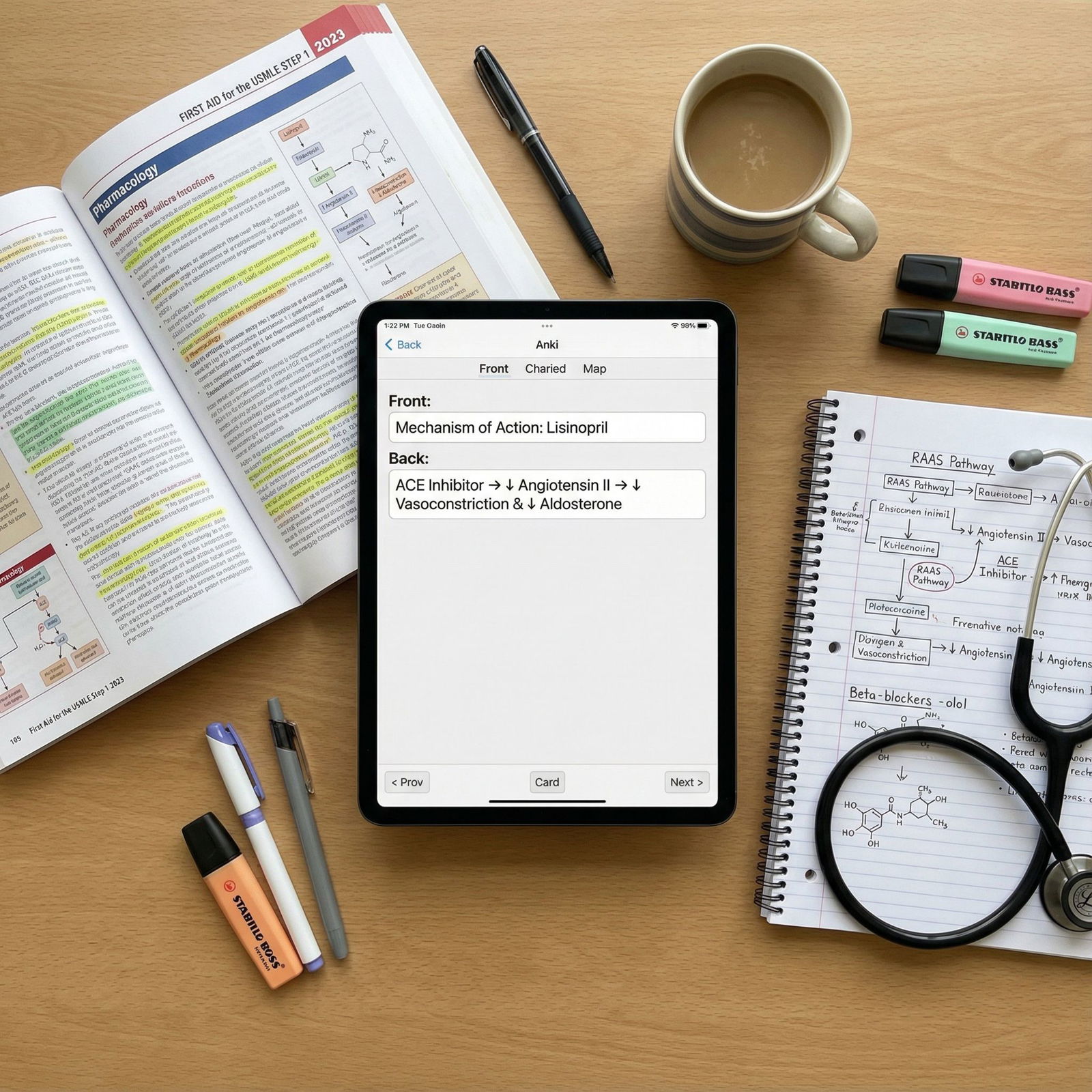
When you open an explanation for a question you got wrong, execute these five moves immediately:
Move 1: Re-state the Stem in Your Own Words
Do not read the question again word-for-word. Summarize it in one simple sentence: "This is a 45-year-old male with chronic alcohol use presenting with acute pancreatitis and sudden dyspnea, which means I'm dealing with ARDS." If you can't summarize the stem, you didn't understand what the patient actually had.
Move 2: Identify the Exact Question Type
Ask yourself: What is the NBME really asking for? Are they asking for the underlying enzyme deficiency? The secondary complication? The first-line treatment? Many students pick a correct statement that answers the wrong question.
Move 3: Construct a 3-Option Mini-Differential
Before looking at why the correct answer was right, look at the top choices you struggled between. Identify the single clinical feature that separates Option B from Option D.
Move 4: Pinpoint the Deciding Evidence
Find the exact phrase in the stem that ruled your answer out or made the correct answer undeniable. Highlight it. Was it "elevated urinary methylmalonic acid"? Was it "coarse facial features"? That single data point is your golden lead.
Move 5: Write the One-Line Fix and Micro-Drill
Write your single-sentence rule update. Then, immediately execute a 30-second micro-drill: close your eyes and mentally recite the differential, or write out the immediate pathway step on a scratchpad.
If you skip Move 5, the debrief did not happen. You just read an article about a mistake you made.
Common Review-Timing Pitfalls (and How to Catch Them Fast)
Even students who understand the value of debriefing frequently fall into predictable review traps. Here are the five major pitfalls that destroy review efficiency:
1. Tracking Percent Correct Instead of Reasoning Integrity
Measuring success purely by percentage correct creates a dangerous feedback loop. If you guessed correctly between two options, log it as a miss. A lucky guess is a wrong answer that hasn't caught up with you yet.
2. Ignoring Near-Miss Patterns
If you narrowed a stem down to two choices and picked the wrong one three times in a single block, that isn't bad luck. That is a systematic failure to recognize deciding evidence. Treat near-misses with the exact same rigor as outright blind misses.
3. Passive Explanation Reading
Reading UWorld or Amboss explanations top-to-bottom without actively recalling the mechanism beforehand is pure recognition memory. If your eyes are gliding down the screen, you aren't learning.
4. Allowing the "Debrief Debt" to Accumulate
"I'll do 80 questions now and debrief them all tomorrow night." No, you won't. By tomorrow night, the subtle thought process that led you to pick Choice B will be forgotten. You must debrief in the same session, or at absolute latest, the end of the same day.
5. Applying a One-Size-Fits-All Fix
Fixes must match the error type. A knowledge gap requires a quick flashcard or text review. A stem-misread requires an attention micro-drill (e.g., forcing yourself to highlight the chief complaint and lab outliers on the next 10 stems).
The 30-Second Self-Audit
Before closing any reviewed item, force yourself to answer these four questions:
- Why are the wrong options wrong in this specific patient context?
- What single piece of evidence turned the case?
- How will the NBME try to trick me on this concept next time?
- If I changed the patient's age/labs by X, how would the answer change?
If you can't answer all four smoothly, you don't own the question yet.
A Safer Scheduling Strategy: Review Timing + Micro-Fixes
Do not abandon spaced repetition, upgrade it. Spaced repetition is a powerful engine, but it requires clean fuel. You must feed your spacing schedule corrected models, not raw repeat questions.
Divide your missed questions into two distinct queues based on your error taxonomy:
Queue A: Evidence & Decision Errors
These are items where you knew the underlying science, but failed in execution (misread details, sequencing errors, heuristic traps).
- The Strategy: Schedule these for a rapid re-test within 24 to 48 hours. The goal is to test whether your decision-making heuristic has been recalibrated while the stem context is still fresh.
Queue B: Mechanism & Knowledge Gaps
These are items where you simply lacked the biological principle or confused two complex disease pathways.
- The Strategy: Do not immediately re-test these tomorrow. You will just recall the answer choice. Route them to a targeted content refresh session first (reviewing a pathway map or high-yield textbook section), then schedule the re-test 3 to 5 days later to verify true transfer of knowledge.
The "Why Not the Others?" Verification Test
When a queued item comes up for review, do not just select the right answer and move on. Force yourself to explain why two other choices are wrong before you click. If you cannot explain why the distractors are wrong, reset the interval. The item has rotted.
Closing Reminder: If You Don't Fix the Reason, Timing Only Delays the Damage
Spaced review algorithms can keep questions appearing on your screen at mathematically optimal intervals, but they cannot fix a broken thought process.
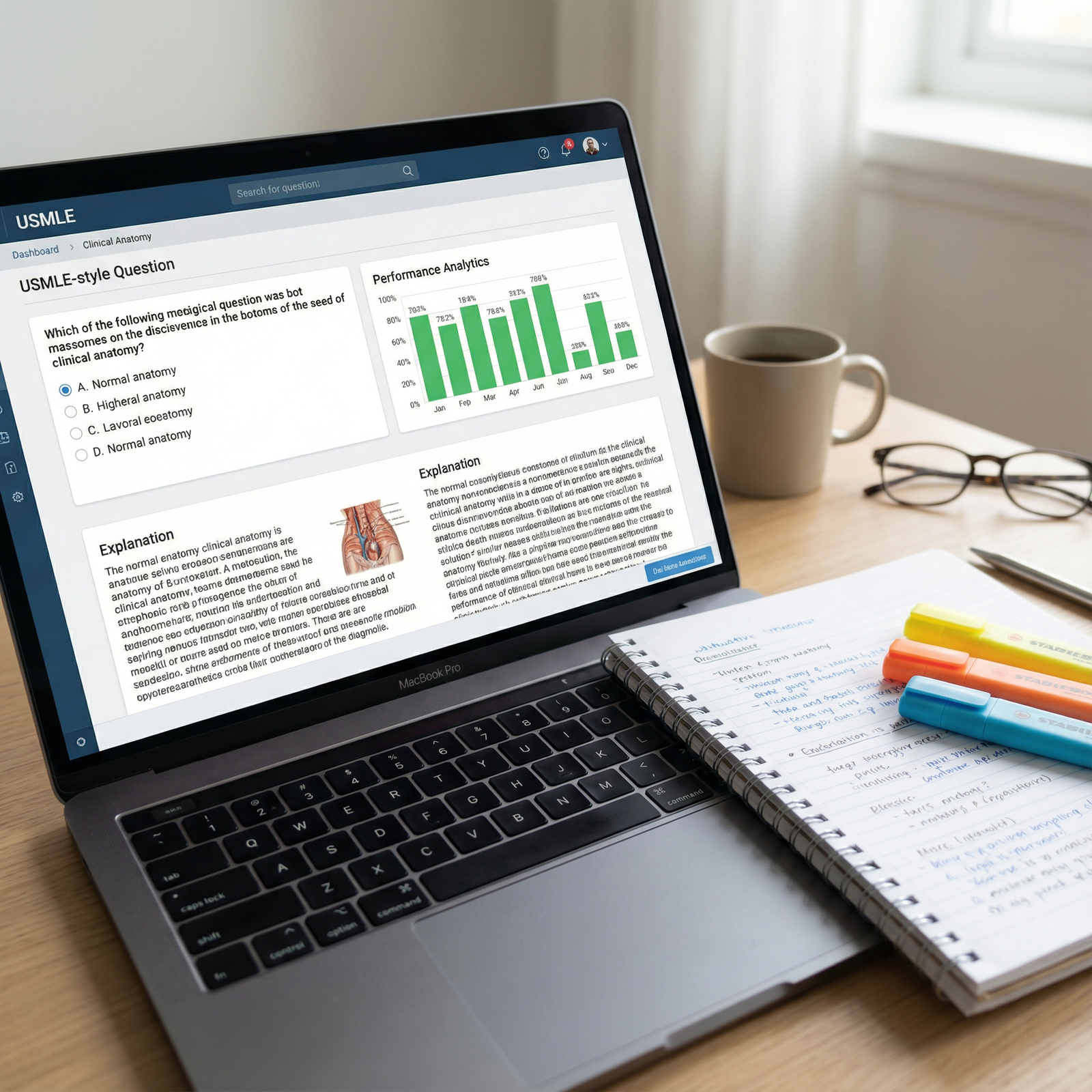
Every time you hit "Easy" or "Good" on an item you didn't truly debrief, you aren't advancing your prep. You are delaying the moment your flawed logic gets exposed on a full-length exam. High Step 1 scores aren't built by students who answer thousands of questions passively. They are built by students who refuse to let a single wrong answer rot.
Keep this action checklist beside your screen for your next review block:
- Tag every miss: Assign one clear category from your error taxonomy.
- Write one sentence: Draft a single-line fix focused on the deciding evidence.
- Run a micro-drill: Execute an immediate 30-second active recall check.
- Sort your queues: Separate execution errors from true knowledge gaps.
- Verify distractor logic: Explain why wrong options are incorrect before marking an item safe.
Don't let rot win because you were too busy chasing review metrics. A single, perfectly debriefed question will protect your score far more than a hundred passive spacebar clicks ever could.
Key Takeaways
- Spaced review timing does not fix faulty logic. Spacing algorithms prioritize retrieval frequency, not reasoning accuracy. Without active debriefing, you risk memorizing answer choices while preserving your incorrect mental models.
- Implement an Error Taxonomy immediately. Categorize every miss into specific buckets (e.g., Concept Gap, Detail Trap, Next-Step Error) and write a single-sentence fix. If you can't name the precise failure mode, you can't prevent it from recurring on exam day.