
You are not “bad at sticking to QBank schedules.” Your system is bad. Fix the system and the routine sticks.
Most Step 1 study failures I see are not about intelligence or motivation. They are about students trying to brute-force their way through 3,000+ questions with zero structure, vague goals, and a fantasy schedule that collapses the first week they are on call or have an anatomy exam.
Let me show you how to build a Step 1 question review routine that actually survives real life.
Step 1: Set a Realistic Daily Question Target (Not a Fantasy Number)
The fastest way to kill a routine is to overpromise. “I will do 100 questions a day” sounds impressive. Until you are post-call, hungry, and have two quizzes tomorrow. Then it dies.
You need two numbers:
- Baseline daily questions – what you can do on an average, busy school day
- Stretch daily questions – what you can do on lighter days or weekends
If you have never done consistent QBank work before, here is the honest starting point:
| Study Phase | Baseline Weekday | Stretch Weekend |
|---|---|---|
| Early MS1 (light exposure) | 10–15 | 20–25 |
| MS1 Systems Blocks (aligned topics) | 20–25 | 30–40 |
| MS2 Pre-Dedicated | 30–40 | 50–60 |
| Dedicated Study Period | 60–80 | 80–100 |
Your job: pick one baseline and one stretch number and commit to them for 2 weeks. No “I’ll see how I feel.” Feelings do not pass Step 1. Systems do.
How to pick your numbers:
- If you are already drowning in coursework: start at the low end of your phase range
- If you are cruising through material and already doing some questions: mid–high range
- If you are in dedicated: do not start at 120/day unless you like burnout and shallow review
Sharpen the rule:
- Non-negotiable: Baseline every single weekday
- Optional but strongly preferred: Stretch both weekend days (or your two light days)
If you cannot define these two numbers clearly, you do not have a routine yet. You have a wish.
Step 2: Choose and Configure Your Tools Properly (Most People Botch This)
You need three things:
- One primary QBank
- One primary reference (usually First Aid or equivalent)
- One spaced repetition system (Anki or a QBank’s built-in spaced review)
Stop hopping between five resources. That is how you stay busy and stay mediocre.
2.1 Pick one primary QBank and commit
For Step 1, the typical situation I see that works well:
- UWorld as primary QBank
- AMBOSS or Kaplan as secondary (if you must) for specific weak areas or early practice
If you have UWorld, use it. If not, pick AMBOSS or Kaplan and stop shopping.
Configure UWorld (or equivalent) like this for your daily routine (not full-length practice tests):
- Mode: Tutor or Tutor, Timed (early on, I prefer Tutor for learning)
- Question count per block: 10, 20, or 40 depending on your baseline
- Question order:
- During systems blocks: “By System” matching your current course
- Pre-dedicated: mix “By System” with “Random” blocks
- Dedicated: mostly Random, Timed 40-question blocks
Turn off all the cute extra metrics for a while. You need to answer questions and learn, not stare at graphs.
2.2 One reference text, not three
Most students try to juggle:
- First Aid
- Pathoma
- Boards and Beyond
- Sketchy
- Plus lecture notes
Then wonder why they remember nothing.
Pick one primary mapping target. Usually:
- First Aid (or Boards & Beyond outline) as the “skeleton”
- Use Pathoma / Sketchy / B&B only to deepen when you identify a weak point from questions
Rule: When you miss a question, you map it to one place in your reference. Not five. That is how you create coherent memory, not fragments.
2.3 Spaced repetition: use it or you will leak knowledge
You must have some way to see concepts again:
- Anki with pre-made decks (e.g., AnKing)
- Or your own small personal deck
- Or the QBank’s “marked questions” + notes you actively review
If you already use Anki:
- Protect it. Anki reviews come before new QBank questions each day
- Cap max new cards so it does not cannibalize your QBank time (often 20–40 new/day)
If you do not use Anki and hate it:
- Fine. Then you will:
- Mark important or missed QBank questions
- Export key points into a very concise notebook (digital or paper)
- Review this notebook on a fixed schedule (I will show you the schedule later)
Step 3: Build a Time-Block Template That Survives Real Life
Your routine lives or dies in your calendar.
You cannot “fit in questions when you have time.” That is how you scroll Instagram at midnight realizing you did zero.
You need:
- A default time block for QBank (same window every weekday)
- A fallback micro-block for disaster days
3.1 Default weekday routine models
Pick one model based on your schedule.
Model A: Morning-first (my preferred)
- 06:30–07:00 – Wake / coffee / no phone
- 07:00–08:00 – QBank block (baseline questions)
- 08:00–08:15 – Quick review of marked/missed items
- Then: classes, labs, whatever
Why this works: your willpower is not yet drained by the day. The block is protected.
Model B: Split blocks
- 07:30–08:00 – 10–15 questions
- 18:30–19:00 – 10–15 questions + quick review
Good if you cannot sit for a full hour or have unpredictable mornings.
Model C: Evening anchor (use only if mornings are impossible)
- 19:30–20:30 – QBank baseline block
- 20:30–20:45 – Quick review
The risk: long, chaotic days crash this easily. If you choose this, you need a hard pre-commitment: no social, no Netflix, no “quick game” before this block. QBank comes first.
3.2 Fallback “disaster day” protocol
You will have days that explode: call, exams, family problems, illness.
Most students on those days: “Today is shot. I will do double tomorrow.” They rarely do.
You need a minimum viable routine:
- Disaster day rule:
- 10 questions + review, no matter what, even at 11:30 PM
- No excuses, unless you are literally in the hospital or traveling for a funeral
This keeps the identity intact: “I am someone who does Step 1 questions every day.” When the identity holds, the full routine comes back the next day without much friction.
Step 4: A Clear, Repeatable Question-Answer-Review Protocol
Most people waste time inside the question session itself. They read too slowly, overthink stems, or do a lazy review that teaches them nothing.
Here is a protocol I use with students that actually works.
4.1 While answering questions
Per-question steps (for non-timed or lightly timed tutor mode):
Read the last line first
- “What is the most likely diagnosis?”
- “What is the mechanism of action…?”
- This aligns your brain before the stem floods you with data.
Scan the answer choices briefly
- High-level categories only: all drugs? all lab tests? pathologies?
- This prevents you from collecting irrelevant details.
Read the stem once, actively
- Ask: age, sex, timeline, key positives, and key negatives
- Mark 1–2 phrases that you think are “the tell”
Form a hypothesis before looking again at answers
- Even if rough: “Sounds like ulcerative colitis complication”
Choose an answer in under 90 seconds (ideally)
- If you are stuck, pick best guess and flag it
You are training pattern recognition, not legal-grade argumentation for every choice.
4.2 After submitting the block: structured review
Your review is where the learning happens. If you just look at the green/red and move on, you are burning your time.
For each question:
Classify your outcome
- Correct / confident
- Correct / low confidence (lucky or shaky)
- Incorrect / content gap
- Incorrect / misread or test-taking error
For incorrect or low-confidence questions: do this sequence
- Summarize in one sentence what the question was testing
- “Recognize features of minimal change disease and treatment mechanism.”
- Identify the one key fact you were missing or confused about
- “MCD responds to steroids; EM shows foot process effacement.”
- Decide: is this a core Step concept or a detail?
- Core: goes into Anki or core notes
- Detail: quick note or mental “ok, not central”
- Summarize in one sentence what the question was testing
Plug back into your reference
- Go to your reference (First Aid or B&B outline)
- Find the exact line/section that corresponds
- Add a micro-note or a symbol next to it (e.g., date + “UW: MC disease → steroids”)
Optional: Create or tag a card
- If you use Anki:
- Add / tag 1–3 cards per session (max). Not 30.
- If not using Anki:
- Add 1–3 bullet points to your personal “Step core notebook”
- If you use Anki:
Time cap for review:
- 10-question block → 15–20 minutes review
- 20-question block → 25–35 minutes
- 40-question block → 45–60 minutes
If you are taking 2–3 hours to review 40 questions every single time, you are doing too much. You will quit eventually. Trim.
Step 5: Weekly Planning So the Routine Does Not Drift
Daily actions are built on weekly planning. No plan → questions drift to whatever system you enjoy most, and half the test never gets touched.
You need a simple weekly protocol. 30–40 minutes, once a week.

| Step | Description |
|---|---|
| Step 1 | Start Weekly Review |
| Step 2 | Check Last Weeks Question Counts |
| Step 3 | Identify Weak Systems |
| Step 4 | Allocate Question Mix for Next Week |
| Step 5 | Schedule Daily Time Blocks |
| Step 6 | Set Mini-Goals and Rewards |
| Step 7 | Execute During Week |
Here is the structure:
5.1 Look back at last week’s numbers
Ask yourself:
- How many questions did I actually do each day?
- On which days did I miss my baseline? Why, exactly?
- Any predictable pattern? (e.g., Wednesdays always collapse after anatomy lab)
You are not judging. You are diagnosing.
5.2 Adjust your baselines if necessary
If you hit:
- Baseline 5–7 days easily: consider increasing by 5–10 questions
- Baseline only 2–3 days: reduce by 5–10 and fix schedule conflicts
You want a baseline that is challenging but achievable 80–90% of the time.
5.3 Decide the topic mix for the next week
You should not do only your favorite system repeatedly.
Use your school schedule plus your weaknesses:
- 50–70% of questions: aligned with current system/lectures
- 30–50%: mixed / random or targeted at weak areas
For example, you notice from UWorld performance:
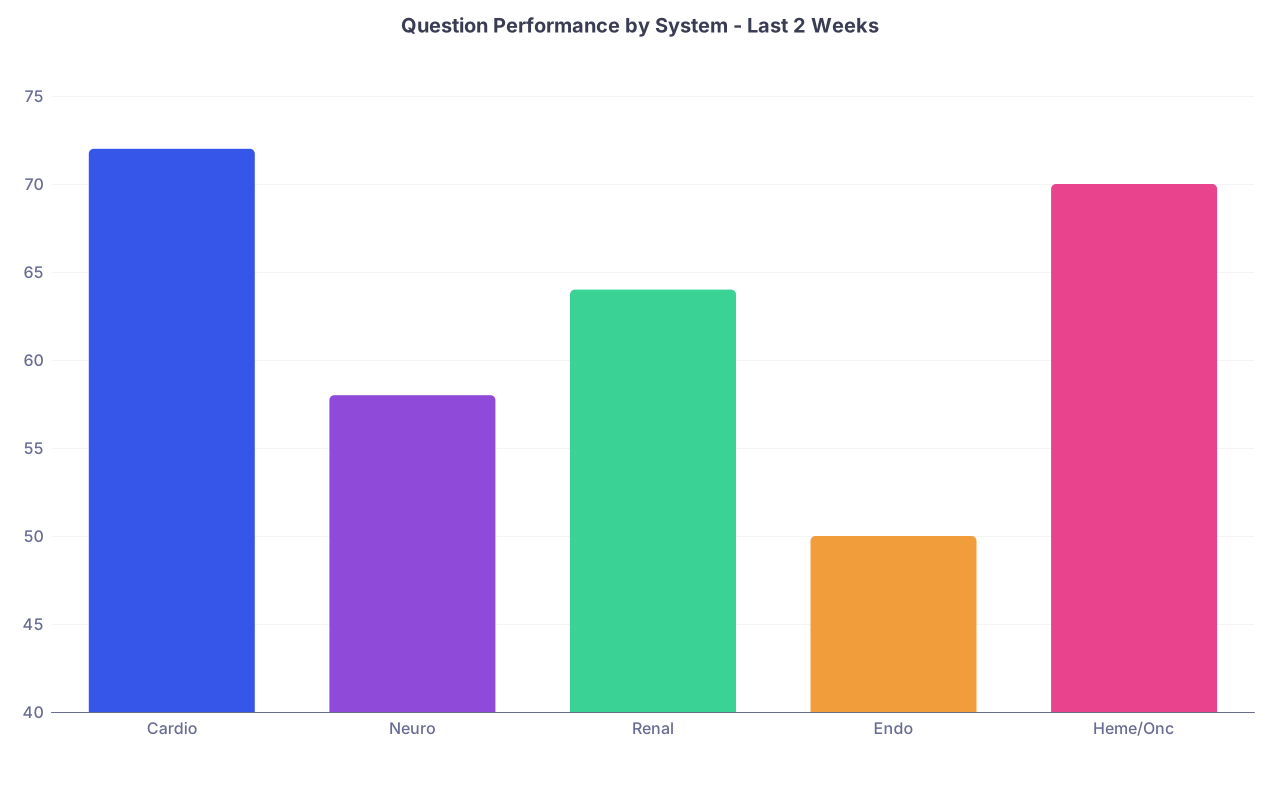
| Category | Value |
|---|---|
| Cardio | 72 |
| Neuro | 58 |
| Renal | 64 |
| Endo | 50 |
| Heme/Onc | 70 |
Neuro and Endo are lagging. So for next week:
- 3 days: blocks focused on current school topic (say, cardio)
- 2 days: mixed blocks with a Neuro+Endo bias
- Weekend: at least one fully random block
Write this down clearly:
- Mon: 20 cardio
- Tue: 10 neuro + 10 random
- Wed: 20 cardio
- Thu: 10 endo + 10 random
- Fri: 20 mixed
- Sat: 40 random
- Sun: 20 weak systems only
5.4 Protect the time in your calendar
Put QBank blocks in your schedule as actual events:
- “07:00–08:00 – Step 1 Qs (20+ review)”
- Set reminders
- Treat as seriously as clinic or an exam review session
If someone asks you to do something during that hour, you can say, “I already have a commitment.” Because you do.
Step 6: Handle Mental Resistance and Burnout Before They Blow Up
Your brain will fight this routine. Expect it. Plan for it.
Three common problems show up over and over:
- Perfectionism – “I cannot start this block unless I have 2 free hours.”
- Score obsession – compulsively checking percentiles after every block.
- Shame spiral – “I am at 40%, I am doomed, why bother.”
Here is how to deal with each.
6.1 Beat perfectionism with minimums and caps
Set two rules:
- Minimum rule: Even on disaster days, I do 10 questions.
- Cap rule: I do not exceed X questions without review. No “200 questions binge” that you barely remember.
Perfectionists like “big days” and then collapse. Your ceiling and floor should be close enough that you can be consistent:
- Typical: floor 10–20, ceiling 60–80 when in pre-dedicated; higher ceiling in dedicated, but only if review quality remains good.
6.2 Treat scores as data, not identity
Stop checking your percent correct after every block and making it a personality test.
Instead, track:
- 7-day rolling average % correct
- Volume: questions done per week
- Distribution: systems and topics covered
Use a simple spreadsheet or app.
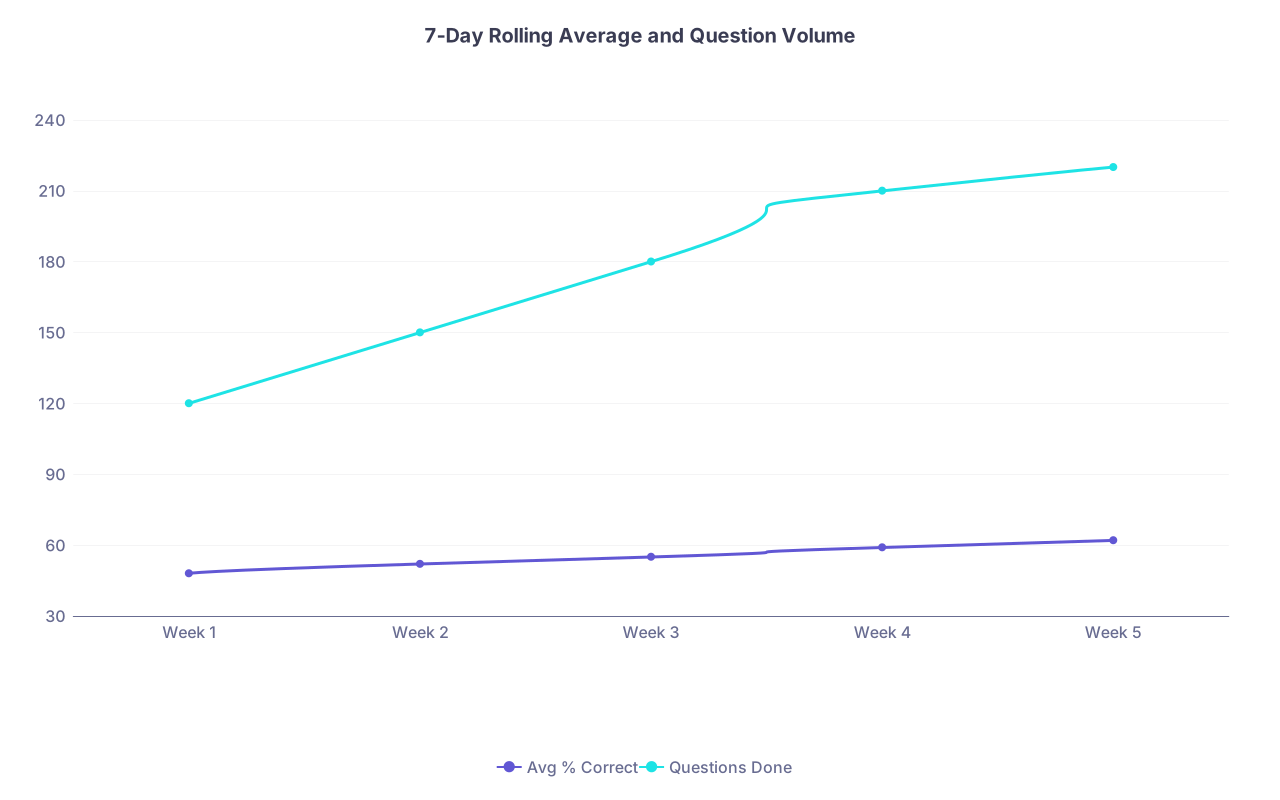
| Category | Avg % Correct | Questions Done |
|---|---|---|
| Week 1 | 48 | 120 |
| Week 2 | 52 | 150 |
| Week 3 | 55 | 180 |
| Week 4 | 59 | 210 |
| Week 5 | 62 | 220 |
You care about the trend, not single bad days.
If your average is low early on (40–55%), welcome to the club. UWorld is not a confidence-boosting platform. It is a training arena.
6.3 Build microscopic friction against skipping
Use two cheap psychological levers:
- Visible streak counter
- Paper calendar on the wall
- Each day you complete your baseline: big X
- Break in the chain = visible pain
- “If-then” escape clauses
- “If I miss my morning block, then I will do a half-block before dinner.”
- Written, not just mental
Your willpower is limited. Your environment, pre-commitments, and defaults should carry part of the load.
Step 7: Integrate Your Routine with Different Phases of Med School
This routine is not static. It changes depending on whether you are early MS1, deep in MS2, or in dedicated.
Here is a rough, honest progression map:
| Phase | Daily Questions | Focus | Timing Priority |
|---|---|---|---|
| Early MS1 | 10–15 | Basic foundations, slow pace | 3–4 days/week minimum |
| Late MS1 / Early MS2 | 20–30 | System-aligned, build habits | 5 days/week baseline |
| Pre-Dedicated MS2 | 30–60 | Mix random + weak areas | 6–7 days/week |
| Dedicated | 60–100 | Random blocks, exam simulation | Every day, strict blocks |
Step 9: When to Break the Routine on Purpose (And When Not To)
Sometimes you should deviate deliberately:
Acceptable reasons:
- Major exam that is not Step 1 (block exam, OSCE) and you are behind
- 24+ hour call / overnight shift with real exhaustion
- Genuine illness with fever and cognitive fog
Even then, consider switching to the disaster-day minimum rather than full zero.
Bad reasons that you should not accept:
- “I am behind on lecture watching”
- “I do not feel like doing questions today”
- “I am afraid to see my percentage drop after a bad day”
Those are precisely the days that build long-term resilience if you push through with at least the baseline.
Step 10: How You Know Your Routine Is Working
You will not feel massive day-to-day progress. You are looking for these medium-term signs instead:
- You no longer need to bargain with yourself to start a block. It is just “what I do at 7 AM.”
- Your review gets faster and sharper. You can identify the “testing point” quickly.
- Your random-block performance stabilizes or trends upward over several weeks, even when individual days fluctuate.
- You can miss a day and bounce back without sliding into a week-long slump. That means your identity-level habit is built.
If those things are happening, stay the course. Do not overhaul everything because a friend sent you a screenshot of their QBank progress bar.
Final Tight Summary
- Set realistic daily question targets (baseline + stretch), attach them to fixed time blocks, and protect a 10-question “disaster day” minimum so your habit never fully breaks.
- Use a single primary QBank + one reference + one spaced review method, and follow a strict answer–review protocol that focuses on core concepts, not perfectionistic overanalysis.
- Run a weekly planning and review cycle to adjust volume, rebalance topics, and troubleshoot failures, so your Step 1 question routine survives the messy reality of medical school rather than existing only on paper.