
Introduction: What Top USMLE Step 1 Scorers Do Differently
The USMLE Step 1 exam is a defining moment in medical school life. Even though it is now pass/fail, it still serves as a rigorous assessment of your understanding of basic medical sciences and your ability to apply them to clinical scenarios. Strong performance remains important for residency applications, scholarship opportunities, and—equally crucial—your own confidence moving into clinical training.
Many medical students ask the same question: What exactly do top scorers do to prepare? While there is no single “magic” resource or schedule, there are clear patterns in how high performers approach Exam Preparation, Study Techniques, and day-to-day habits.
This guide breaks down those patterns into practical, step-by-step strategies you can adapt to your own learning style. You’ll see how successful students:
- Understand the exam’s structure and expectations
- Build efficient, realistic study schedules
- Use active learning and high-yield resources strategically
- Track progress with data-driven adjustments
- Protect mental and physical health to sustain performance
Use this as a blueprint, then personalize it based on your timeline, baseline knowledge, and learning style.
Understanding the USMLE Step 1: Exam Structure and Expectations
Before you can copy the Study Techniques of top scorers, you need to understand the “game board.” Top performers start by mastering not just content, but also format and testing style of this Medical Examination.
Core Content Areas
The USMLE Step 1 primarily assesses your grasp of:
- Anatomy
- Biochemistry and Molecular Biology
- Microbiology and Immunology
- Pathology
- Pharmacology
- Physiology
- Behavioral sciences, biostatistics, and epidemiology
- Genetics and cell biology
- Multisystem processes (e.g., inflammation, neoplasia)
The exam is largely systems-based and integrative. Questions rarely test isolated facts; they blend physiology, pathology, and pharmacology in clinically oriented vignettes.
Question Format and Testing Style
- Question type: Single-best-answer multiple-choice questions
- Clinical vignette focus: Nearly every question is framed around a patient scenario—age, symptoms, labs, imaging, and history.
- Cognitive level: Emphasis on understanding and application, not rote recall. You must connect mechanisms to clinical findings and management implications.
Top scorers study with this in mind. Instead of asking, “What facts do I need to memorize?” they ask, “How will this concept appear in a patient scenario?”
Building a High-Yield Study Schedule That Actually Works
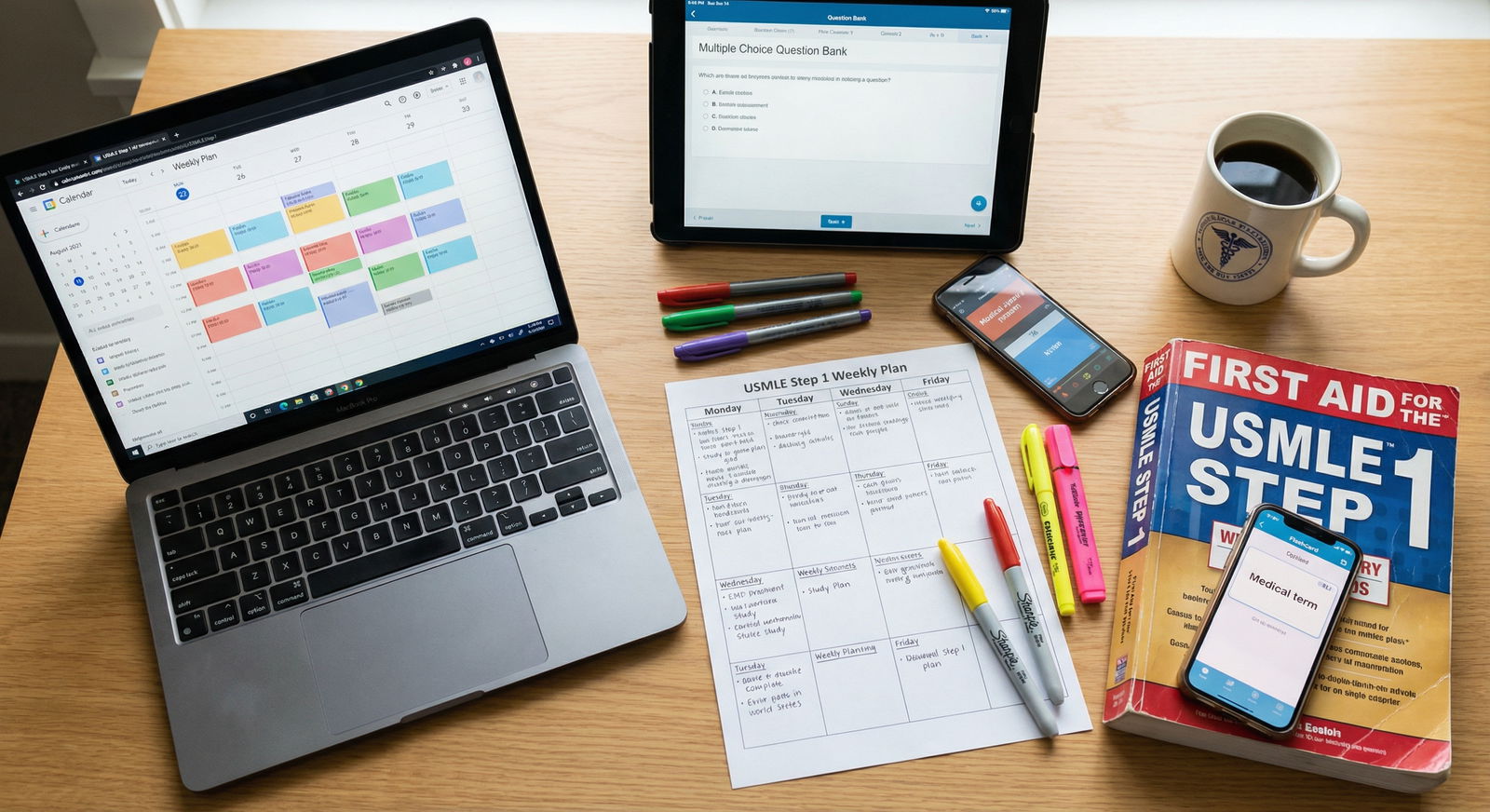
Top scorers are rarely the students who simply study the most hours; they’re the ones who use their time with precision. A structured, adaptive study plan is one of their major competitive advantages.
Step 1: Define Your Timeline and Phases
Most students prepare across two overlapping phases:
Foundations Phase (pre-dedicated)
- Occurs during first and second year of medical school
- Focus: Learning systems with a Step 1 mindset, integrating class material with board-style resources
- Common activities: Light question bank use, Anki, sketching out weak areas
Dedicated Study Phase (usually 4–10 weeks)
- Full-time or near full-time Exam Preparation
- Focus: High-yield review, intensive question banks, practice exams, and targeted remediation
Your schedule should reflect:
- How strong your preclinical foundation is
- How long you have for dedicated
- Any other obligations (research, family, clinical duties)
Step 2: Use SMART Goals for Each Week
Top performers don’t just say, “I’ll study cardio this week.” They set SMART goals:
- Specific – “Finish cardiovascular questions in UWorld, annotate First Aid cardio chapter.”
- Measurable – “Complete 160 mixed questions and review them thoroughly.”
- Achievable – Based on your realistic daily capacity.
- Relevant – Focused on high-yield organ systems and weak areas.
- Time-bound – Tied to weekly and daily time blocks.
Example weekly goal (during dedicated):
- Complete 300–350 UWorld questions (timed, random, mixed)
- Review and annotate First Aid sections for 2–3 systems
- Watch targeted videos (e.g., Sketchy micro, Pathoma path) for weak topics
- Do one half-length practice block under exam conditions
Step 3: Design Your Daily Structure
A common pattern among high scorers in dedicated:
Morning (high-focus time)
- 40–80 timed, random UWorld questions (1–2 blocks)
- Immediate review of all questions (correct and incorrect)
Afternoon
- Content review using First Aid, Pathoma, and annotated notes
- Flashcards (Anki) for active recall of key facts
Evening
- Lighter tasks: reviewing sketchy images, revisiting tough questions, or group discussion
Build in short breaks and at least one lighter evening or half-day per week to prevent burnout.
Step 4: Prioritize Weaknesses With Data
Top scorers are data-driven:
- Use NBME, UWorld, or other self-assessments early in dedicated to identify weak systems or disciplines (e.g., renal physiology, endocrine pharmacology).
- Allocate extra time to those weak areas in your weekly plan.
- Re-test the same domains later to confirm improvement.
Active Learning: The Core Study Techniques of Top Scorers
Simply reading or watching videos is not enough for Step 1. High-performing Medical Students rely on active learning—techniques that force retrieval, processing, and application of information.
Active Recall: Training Your Brain to Pull Information Out
Active recall means testing yourself rather than re-reading:
Anki flashcards
- Top scorers frequently use spaced-repetition flashcards daily.
- They customize or lightly edit pre-made decks to match their resources.
- They keep up with reviews consistently (e.g., 200–500 cards/day during dedicated, depending on deck size and history).
Closed-book recitation
- After reading a First Aid page, close the book and list what you remember.
- Teach the topic out loud as if explaining to a peer or patient.
One-sentence summaries
- For complex topics (e.g., renal tubular acidosis), summarize the core idea in one sentence and test yourself later.
Question Banks: The Single Most Powerful Tool
Among all Study Techniques, disciplined question bank use consistently predicts strong Step 1 performance.
How Top Scorers Use Question Banks
- Primary QBank: UWorld is the gold standard for Step 1 style and difficulty.
- Secondary QBank (optional): Amboss, Kaplan, or others for extra practice or earlier phases.
Best practices:
- Do questions in timed, random, mixed blocks as early as possible in dedicated to mirror the actual exam.
- Avoid doing only subject-specific blocks late in the game; real exam blocks integrate all systems.
- Spend at least as much time reviewing explanations as you did answering questions.
When reviewing:
- Ask why each correct option is right and why others are wrong.
- Link each question to a concept, not just a fact.
- Annotate First Aid or your own notes with insights from difficult questions.
- Tag or mark questions you want to revisit before test day.
Self-Explanation and Teaching
Top scorers frequently teach as they learn:
- Explain a pathway (e.g., renin-angiotensin-aldosterone system) to an imaginary student.
- Walk through each step of a mechanism and connect it to clinical findings.
- Use a whiteboard to map out pathophysiology and then explain it verbally.
Teaching forces you to identify gaps in understanding and reinforces organization of knowledge—both crucial for complex vignette questions.
Strategic Use of High-Yield Resources
There is no prize for using the most resources; top scorers instead use a limited set extremely well.
Core Resources Most High Scorers Rely On
First Aid for the USMLE Step 1
- Functions as a master outline and checklist of high-yield facts.
- Top scorers often do multiple passes and annotate it with UWorld and lecture pearls.
UWorld Question Bank
- Primary source for practice questions and clinical correlation.
- Often completed once thoroughly; some students do a second pass focused on marked or incorrect questions.
Pathoma (or similar pathology resource)
- Particularly valuable for building conceptual understanding of pathology and mechanisms.
Sketchy (Micro/Pharm) or similar visual mnemonics
- Helpful for memorizing microbiology and pharmacology through imagery and storytelling.
Supplementary Resources and When to Use Them
Amboss, Kaplan, or BoardVitals
- Extra questions for pre-dedicated phases or if you finish UWorld early.
Online Med Ed, Boards & Beyond, or similar video series
- Useful for initial conceptual understanding in M1/M2 or early dedicated.
Mobile apps
- UWorld, Amboss, or Anki mobile versions are ideal for downtime: commuting, short breaks, or waiting between activities.
The key is alignment: every resource you use should connect back to the core framework of Step 1 content and high-yield concepts.
Study Groups, Solo Study, and Peer Learning
Not all top scorers study the same way, but many use a hybrid approach: primarily solo work, plus selective collaboration.
Benefits of Effective Study Groups
- Clarification of difficult concepts (e.g., acid–base physiology, biostatistics)
- Accountability and routine check-ins
- Chance to practice teaching and self-explanation
Structure can include:
- 1–2 short sessions per week (60–90 minutes)
- Each member “teaches” a topic for 10–15 minutes
- Group review of challenging QBank questions or NBME items
Recognizing When Group Study Is Not Helping
Top scorers are quick to adjust if:
- Sessions drift into unfocused chat
- People arrive unprepared
- Group anxiety becomes contagious
- Your personal productivity drops
It’s acceptable—and often wise—to limit or leave unproductive groups. Your primary job is to protect your time and mental clarity.
Mental Health, Energy Management, and Burnout Prevention
High performance on USMLE Step 1 is not just a function of hours studied; it depends heavily on your sustainable energy and mood.
Daily Energy Management Habits
Sleep:
- Aim for 7–8 hours per night.
- Avoid sacrificing sleep to squeeze in extra late-night studying; the quality of your thinking and memory suffers significantly.
Nutrition:
- Prioritize regular meals with complex carbs, protein, and hydration.
- Minimize heavy, high-sugar meals that cause mid-day crashes.
Exercise:
- Even 20–30 minutes of walking, jogging, or home workouts most days can improve mood and focus.
- Some top scorers schedule a “non-negotiable” daily movement break.
Stress Management and Mindset
High performers normalize stress and self-doubt but have tools to manage them:
- Mindfulness or breathing exercises (5–10 minutes/day)
- Short, purposeful breaks using techniques like Pomodoro (25–50 minutes focus, 5–10 minutes rest)
- Reframing negative thoughts
- Replace “I’m going to fail” with “My last practice test revealed specific weaknesses, and I have a plan to address them.”
If you recognize symptoms of significant anxiety, depression, or burnout (e.g., persistent insomnia, hopelessness, inability to focus), seek support early—from your school’s counseling services, mentors, or healthcare providers. Protecting your mental health is part of professional responsibility.
Practice Exams, Exam Simulation, and Data-Driven Adjustments
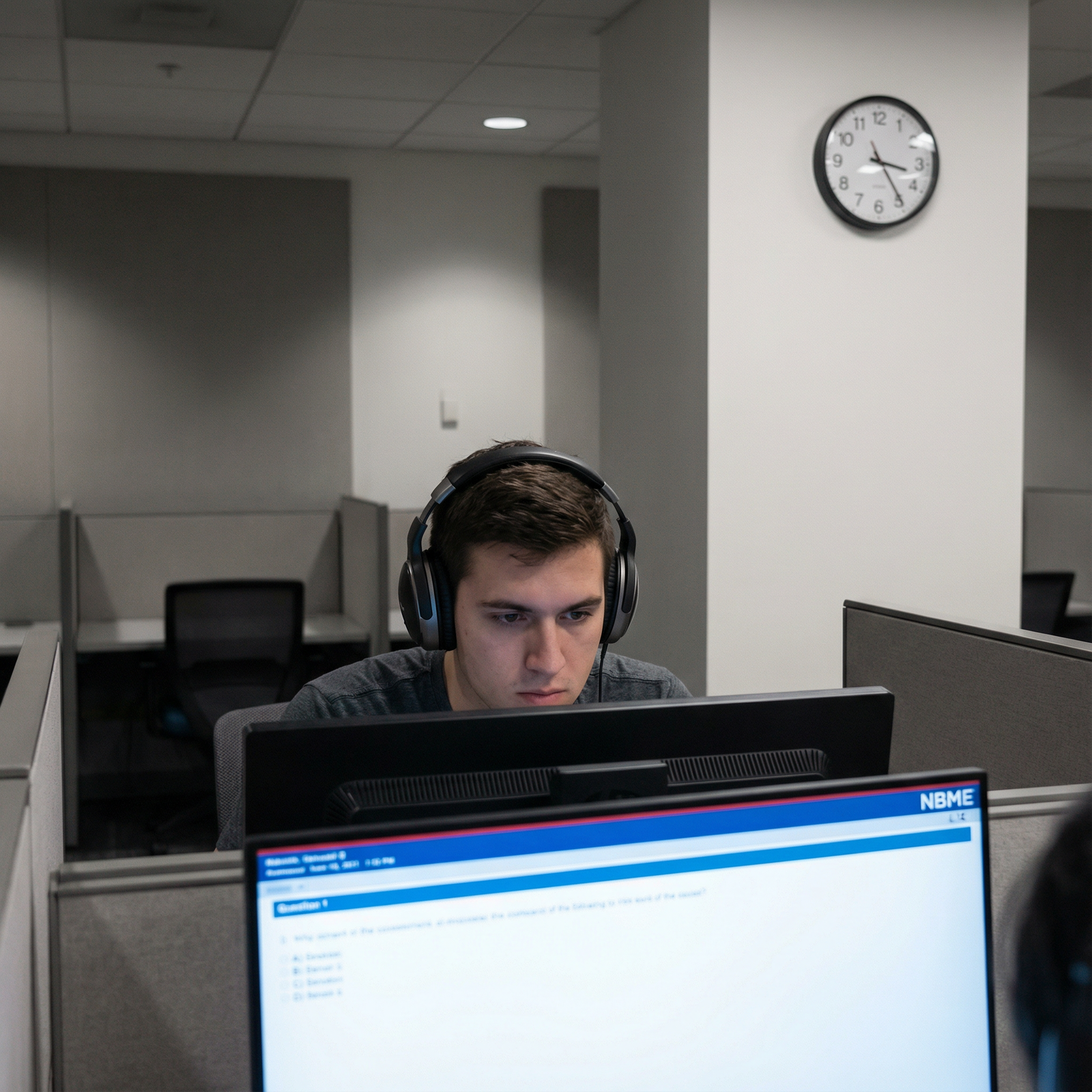
Top scorers don’t wait until the last moment to test themselves under real conditions. They build in regular practice exams and learn aggressively from them.
Choosing and Timing Practice Exams
Common exam options:
NBME Comprehensive Basic Science Self-Assessments (CBSSAs)
- Most predictive of actual Step 1 performance.
- Typically used 2–4 times during dedicated.
UWorld Self-Assessments (UWSA)
- Helpful additional data points and realistic question style.
Typical usage pattern (for a ~6–8 week dedicated):
- Week 1–2: Baseline NBME or UWSA
- Mid-dedicated: NBME to assess progress and guide adjustments
- Final 1–2 weeks: 1–2 more self-assessments to confirm readiness and fine-tune
Reviewing Practice Exams Effectively
Your learning happens in the review, not just in the score:
Categorize errors:
- Knowledge gap (didn’t know the concept)
- Misreading or rushing through question
- Misapplying a concept or falling for distractors
For knowledge gaps:
- Go back to First Aid/Pathoma/Sketchy or your notes.
- Add 1–3 targeted Anki cards if needed.
For test-taking errors:
- Practice reading stems carefully, underlining key phrases.
- Develop a consistent approach to eliminating wrong answer choices.
Record trends: for example, “Consistently missing endocrine pharmacology and biostatistics questions.” Then deliberately allocate extra time to those in the coming week.
Simulating the Real Test Day
At least once or twice during dedicated:
- Do a full day of multiple timed blocks with short breaks, mimicking test-day timing.
- Sit at a desk or library table, use a mouse and keyboard, and avoid phone use between blocks.
- Practice your break strategy: when you’ll eat, hydrate, and reset mentally.
This reduces anxiety on the actual exam day because your body and mind already know the rhythm.
Continuous Reflection and Iteration
Top scorers treat their Step 1 preparation like a quality improvement project:
Weekly reflections
- What went well this week?
- Where did I fall short of my plan, and why?
- What changes will I make for the upcoming week?
Adjust resources and strategies
- If a resource isn’t adding value, consider cutting it.
- If you struggle with a subject, add a targeted video series or extra QBank blocks.
Seek feedback
- Talk with peers who have already taken Step 1.
- Consult advisors, tutors, or faculty if your practice exam scores plateau.
The goal is not to rigidly follow someone else’s schedule, but to continuously optimize your own.
FAQ: USMLE Step 1 Study Techniques and Exam Preparation
How long should I study for USMLE Step 1?
Most students spend 3–6 months in serious preparation, including pre-dedicated and dedicated phases. For many:
- 2–3 months of integration with coursework + Anki and light QBank use
- 4–8 weeks of full-time dedicated review and intensive question practice
Your ideal timeline depends on your school curriculum, how well you learned material during preclinical years, and your personal pace.
What is the single most important resource for Step 1?
Most top scorers consider UWorld question bank and First Aid for the USMLE Step 1 together as their core. UWorld builds clinical reasoning and exam familiarity; First Aid organizes and consolidates high-yield facts. Many also strongly recommend Pathoma for pathology and Sketchy for micro/pharm.
How many practice questions should I complete before Step 1?
A common target is to complete 100% of UWorld (approximately 2,000+ questions) with thorough review, plus additional questions from another QBank if time allows. Many students end up doing 2,000–3,500 questions total, including practice exams, but quality of review is more important than raw numbers.
Should I study alone or with a group for Step 1?
Most high performers use a hybrid approach:
- Primarily solo study for deep focus, QBank blocks, Anki, and core content review.
- Small, focused group sessions 1–2 times per week to discuss difficult topics, teach each other, and review challenging questions.
If group sessions become inefficient or stressful, it is appropriate to reduce or discontinue them.
How often should I take full-length practice exams?
During dedicated, many students take a full practice exam every 1–2 weeks, especially in the latter half of their study period. This helps you:
- Track progress and predict readiness
- Build endurance and timing skills
- Identify and correct persistent weak areas
Space them out enough to learn from each exam before taking the next.
By aligning your Study Techniques with those of top USMLE Step 1 scorers—structured scheduling, active learning, strategic resource use, and deliberate self-assessment—you can transform your preparation from overwhelming to intentional. Combine consistency with reflection, protect your mental health, and you will walk into your Step 1 exam prepared, focused, and confident.