
It is 11:47 p.m. in the library. Your exam is four weeks away. You open UWorld, click into a random block, and your stomach drops. You realize you have been avoiding these questions for months. You saved “the hard banks” for later, and now “later” is sitting in front of you like a brick wall.
This is the mistake I see over and over: students protecting their ego and their average percentage by hoarding the most valuable resource they have—high‑quality, difficult question banks—and pushing them to some imaginary future “perfect time.”
By the time that “perfect time” arrives, it is too late.
Let me be blunt: saving hard question banks for later is one of the most quietly destructive choices you can make in Step 1 preparation. It feels reasonable. It feels strategic. It is neither.
You are underestimating how much damage this one habit can do.
Why “I’ll Save UWorld/Hard Banks for Later” Is So Dangerous

The logic sounds harmless:
“I do not want to waste UWorld when I am still weak.” “I will do the easy banks first, then hit UWorld when I am ready.” “I want my UWorld percentage to look good for my confidence.” “I will save the tough questions for the dedicated period.”
All of that is code for the same problem: avoidance wrapped in fake strategy.
Here is what actually happens when you push hard banks to the end of prep:
- You delay reality testing. You do not learn what real Step questions feel like until the clock is already running out.
- You build false confidence off low‑yield or poorly written questions.
- You never develop the stamina and pattern recognition that only top‑tier banks provide.
- You compress the hardest learning into the narrowest time window—when you are already tired and stressed.
I have watched good students lose 20–30 points of potential score because they “did not want to burn UWorld early.” They protected a question bank instead of protecting their score.
That trade is insane.
The Hidden Psychological Trap: Protecting Your Ego, Not Your Score
Let me strip away the polite language.
Most students who “save UWorld for later” are not being strategic. They are scared of low percentages and red blocks. They want to feel competent for a while before facing reality. They want to open UWorld and see 70–80% right, not 48% and red bars everywhere.
So they bargain with themselves: “I will warm up with AMBOSS, or with the school’s question sets, or with random online questions. Then when I am stronger, I will attack UWorld.”
You know what you are really doing? Delaying discomfort.
Here is the problem: Step 1 does not care about your feelings. It does not care whether you gradually build “confidence” on easy questions. It cares whether you have actually seen and worked through the patterns it tests. That happens in the hard banks.
There are three big psychological mistakes here:
- Confusing comfort with progress. Getting 80% on a junk question bank feels good. It does not mean you are learning high‑yield concepts the way the exam will test them.
- Treating question banks like a performance metric instead of a learning tool. UWorld is not your resume. It is your training ground. The only meaningful metric is what you understand afterwards, not the percentage that pops up at the end of a block.
- Trying to protect your self‑image as “good at questions.” So you avoid the thing that could temporarily puncture that illusion—hard, high‑quality questions—until the last minute.
That is how you end up with students who are “70% on [random easy bank]” and then get destroyed the first week they actually try UWorld.
The earlier you let UWorld punch you in the mouth, the better your final score will be. Waiting for a “perfect time” is procrastination dressed up in strategy language.
The Math Problem: You Physically Will Not Finish
Let us step away from feelings and look at cold numbers.
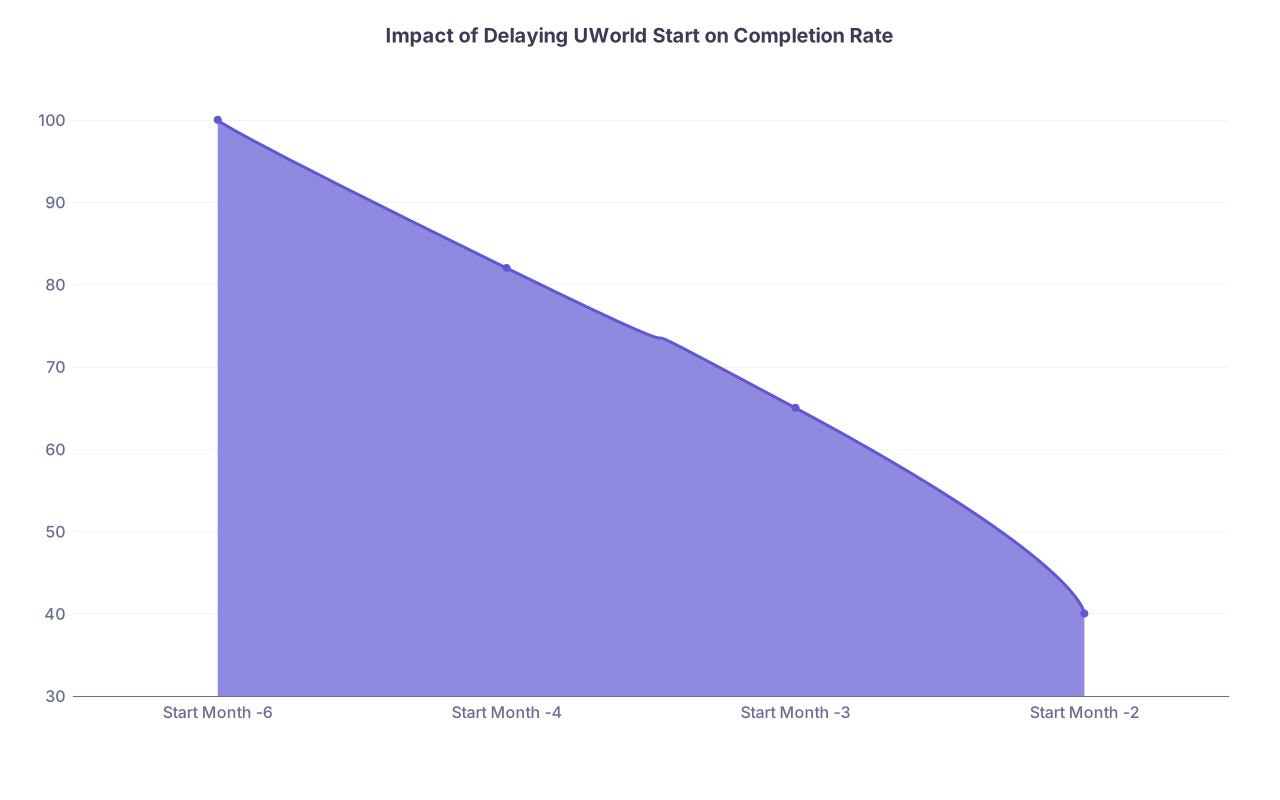
| Category | Value |
|---|---|
| Start Month -6 | 100 |
| Start Month -4 | 82 |
| Start Month -3 | 65 |
| Start Month -2 | 40 |
Students imagine they can:
- Do other resources during pre‑dedicated.
- Save UWorld (or AMBOSS, or NBME‑style banks) for dedicated.
- “Crush UWorld in 4–6 weeks” before the exam.
I wish you could see my inbox after March every year. It is full of messages that all sound roughly like this:
“Dedicated started 2 weeks ago. I have 1100 UWorld questions left, plus 3 NBMEs and half of Pathoma. Is it realistic to finish?”
You already know the answer.
Let us say you have 2,000 UWorld questions and 42 days of dedicated. That is about 48 questions per day if you plan to finish the entire bank once. On paper, sounds fine. In real life, here is how it plays out:
- Half the days you are too fried to seriously review all explanations.
- You lose entire days to NBME exams, school obligations, exhaustion, illness.
- Some blocks take 4 hours because you get stuck reading explanations.
By week 3 you are behind. So you start rushing. You skim explanations. You guess more. You rationalize skipping blocks in weak areas because “you do not have time.”
The hardest learning—sitting with confusing vignettes, reading long explanations, comparing similar answer choices—cannot be compressed infinitely. Your brain has a limit. You cannot brute force deep understanding into the last 10 days.
Students who start high‑quality banks early have a totally different trajectory. They finish the first pass before dedicated, then use dedicated to:
- Redo missed and marked questions.
- Do targeted blocks by subject/system.
- Layer in NBME exams without panic.
They are editing and consolidating during dedicated. You are trying to build the entire structure from scratch in six weeks.
Guess which group performs better.
Why Early Exposure to Hard Questions Changes Everything

Using hard question banks early is not about masochism. It is about getting access to reality as soon as possible.
Several critical advantages:
- You calibrate your thinking to exam style early. Step 1 questions are not flashcards. They are layered vignettes that test synthesis, not trivia. UWorld/AMBOSS/NBME‑style questions force you to think the way the exam wants you to think.
- You discover your true weak systems and concepts. Not “I forget random enzyme names,” but “I cannot reason through renal physiology when it is mixed with acid‑base changes and lab interpretation.”
- You build pattern recognition slowly, which is the only way it actually builds. You do not get pattern recognition by bingeing 400 questions in three days. You get it by grinding 10–20 questions a day for months and actually learning from them.
- You desensitize yourself to being wrong. Early in second year, if UWorld tells you 52% and a bright red block, fine. That is a data point, not a crisis. Six weeks before the exam, that same number feels existential.
There is also the boring neuroscience part: memory consolidation takes time and repetition. You want to learn high‑yield concepts, see them in varied contexts, and revisit them weeks later. That cycle requires months, not a panicked block of time near the end.
Short version: you cannot cram genuine understanding of complex vignettes. Spaced exposure to high‑quality difficulty is non‑negotiable.
Common Variants of This Mistake (That Look Smart but Are Not)
Students rarely say “I am doing this wrong.” They say:
- “I am going to use Rx/Kaplan for content first, then UWorld later.”
- “I will save NBME‑style questions for the last 2–3 weeks so they are fresh.”
- “I heard you should not ‘waste’ UWorld during classes.”
Let me go through a few of these.
“I’ll do an easier bank first, then graduate to UWorld.”
This is the single most common flavor.
Translation: “I want to feel good at questions before I do the ones that matter.”
The problem:
- Easier banks are often low‑fidelity. Bad stems, unrealistic answer choices, over‑testing minutiae.
- You build bad habits: reading too fast, relying on buzzwords, not learning to parse subtle distractors.
- When you finally switch to UWorld, your “70%” drops to 50‑55%, and your confidence tanks right when you need it most.
If you absolutely insist on using an easier bank, it should be:
- Early in second year, in low volume.
- As a supplement, not the main dish.
- Stopped once it starts feeling easy or repetitive.
But UWorld / AMBOSS / high‑quality NBME‑style questions must enter the rotation far earlier than most students are comfortable with.
“I’ll save NBME forms until right before the exam.”
Using NBMEs late for score prediction is fine. Hoarding all NBMEs until the last 3–4 weeks is not.
NBME questions are the closest you will ever get to the real exam. Waiting until the end to see how they phrase things, what they emphasize, and where you actually stand is like waiting until the dress rehearsal to learn your lines.
Stagger them. Use some earlier to calibrate content and question style. Use later ones for score check and fine‑tuning. But do not pile 5 NBMEs into the last two weeks. I have seen that schedule, and it is usually attached to a meltdown.
“I don’t want to waste UWorld during systems; I’ll do it all in dedicated.”
No. You are not “wasting” questions by using them while you take systems courses.
You are embedding what you learn in class into exam‑style scenarios. You are attaching facts to vignettes. That is exactly how you want your brain to store this information.
What is a true waste? Memorizing details in isolation during courses, then having to relearn how to use them during dedicated because you never saw them in realistic questions.
A Simple Framework: When and How to Use Hard Question Banks
You want something concrete, not vague warnings. Fair.
Here is a basic structure that prevents the “save for later” trap.
| Phase | UWorld / Hard QBank Target |
|---|---|
| Early MS2 (6–9 months out) | 10–15 questions per weekday |
| Late MS2 (3–6 months out) | 20–30 questions per day |
| Start of dedicated (6–8 weeks) | Finish first pass or within 20–30% |
| Mid-dedicated | Redo incorrects / marked questions |
This is not sacred. But the principle is non‑negotiable: hard, high‑quality questions must be in your life for months before the exam, not weeks.
How to do this without burning out:
- Start small. In systemic pathophys courses: 10–15 questions after you finish each major topic (e.g., valvular disease, nephrotic vs nephritic, obstructive vs restrictive).
- Always, always review explanations. The learning is not in clicking “next.” It is in the messy, annoying, time‑consuming explanation reading where you realize exactly why you missed it.
- Use random‑timed mode earlier than feels comfortable. System‑based is fine early, but do not cling to it all year. Step 1 is random. Your brain needs that chaos.
And the most crucial part: do not hoard unused questions. Seeing “1,600 unused” at the start of dedicated is not an asset. It is a liability.
Red Flags You’re Already Making This Mistake
Here is how you know you are drifting into the danger zone:
- You catch yourself saying, “I’ll start UWorld after this block / after this exam / after the holidays.”
- Your current daily questions are all from easier, school‑provided, or low‑fidelity banks.
- You feel a little dread when you open UWorld or AMBOSS, so you click on something else instead.
- You are more focused on your “percentage” than on how much time you spend reading explanations.
If you recognize yourself in any of those, good. You can still fix it.
If you are more than 3–4 months from your exam, the fix is simple: start integrating 10–20 UWorld/AMBOSS questions per day now. Not “next week.” This week.
If you are already in dedicated and have barely touched high‑quality banks, stop playing with side resources. Cut the fluff. Your priority is:
- High‑fidelity QBank (UWorld/AMBOSS).
- NBME exams at regular intervals.
- One central content source (FA/Boards & Beyond/Pathoma style videos or notes).
Everything else is a distraction.
The Emotional Crash at the End (And How to Avoid It)
Here is the part people do not talk about enough.
Students who postpone hard banks pay twice:
- In lost learning and score potential.
- In sheer psychological pain.
I have watched strong, competent people unravel in the last weeks because their first intense exposure to real Step‑level difficulty happened at exactly the wrong time. They did not have space to process being wrong, to adjust, to adapt. They just saw disappointing scores, over and over, with the exam 2–3 weeks away.
Contrast that with the student who has been seeing UWorld for 6–9 months. They have already ridden the initial dip. They remember when they were scoring 48% and can look at their current 65–70% and say, “I have improved. I know what progress feels like.”
You want your emotional low point to happen months before your exam, when there is room to fix it. Not 10 days out when you are stuck with whatever knowledge you have.
What You Should Do Today
I will not leave you with generic “start early” nonsense. Here is something concrete you can do in the next 24 hours.
- Open your tracker (Anki, spreadsheet, Notion, whatever you are using).
- Write down:
- How many unused UWorld/AMBOSS questions you have.
- Your exam date (or rough timeframe).
- Do the basic math: questions left ÷ weeks left.
- If that number is higher than 40–50 per day and you have not started serious daily blocks yet, you are already in the danger zone.
Then do this: Schedule your first real block of hard questions for tomorrow. Random. Timed. 10–20 questions. Commit to fully reading every explanation, right and wrong. No arguing with the questions. No coddling your ego.
You are not “burning” questions. You are cashing them in for exactly what you need: early pain, early feedback, and enough time to actually improve.