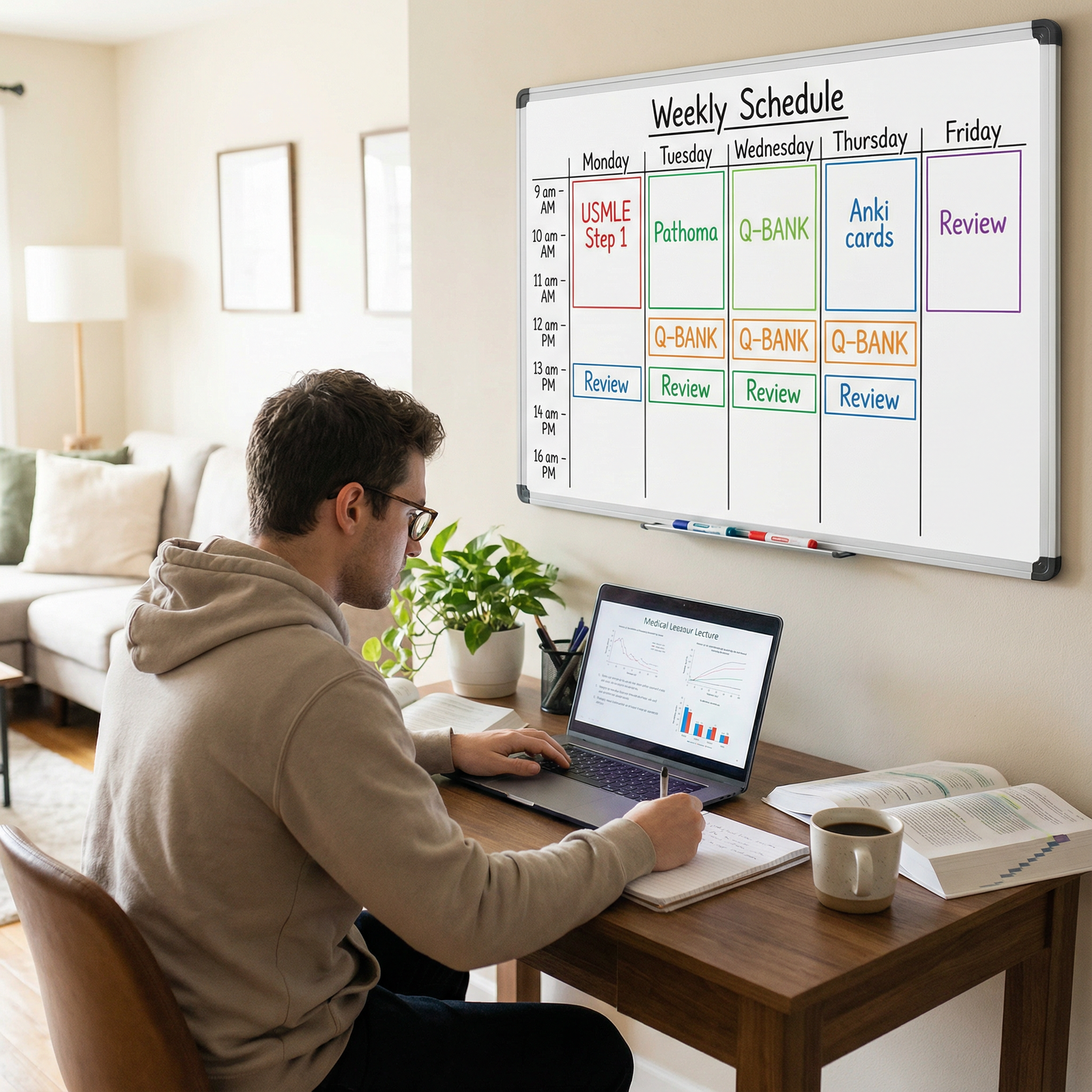
It’s 11:47 p.m. Your UWorld block from “after dinner” is still half-finished. You’re re-watching a Pathoma video you swear you already understood last week. Your Anki reviews are backed up to 1,200.
Your NBME scores? Flat. Or worse—dropping.
You’re “studying all the time,” but your Step 1 progress feels frozen. This is where a lot of smart students mess up. Not because they’re lazy. Because they fall into subtle traps that feel productive and safe but quietly wreck their score trajectory.
Let’s walk through seven of the most common Step 1 study traps I’ve seen sabotage people. And how to avoid joining them.
Trap 1: Treating Videos Like a Security Blanket
You know this one.
You tell yourself: “I’ll start serious questions after I finish all of Boards and Beyond / Sketchy / Pathoma / [insert video series]. I just need to build my foundation first.”
Three weeks later:
- You’ve watched hours of videos
- Your notebook is full of detailed bullet points
- Your UWorld completed percentage is… 9%
- Your NBME? You’re scared to even open one
This “foundation first” mindset is the classic silent score-killer. Because Step 1 doesn’t care if you’ve watched every video. It cares if you can retrieve and apply information under pressure.
Red flags you’re in the video trap:
- You feel uneasy stopping videos because you’ll “miss something high-yield”
- You pause every few minutes to take obsessive notes
- You restart videos whenever you feel shaky, instead of doing questions on that topic
- You keep pushing your first NBME “until I’m more ready”
You’re confusing exposure with learning.
How to avoid this trap
Cap your video time daily.
Something like:- Pre-dedicated: 1–2 hours max
- Dedicated: 1–1.5 hours, ideally as targeted review after questions
Link every video to an active task.
- Watch path video → immediately do 5–10 related UWorld questions
- Watch Sketchy micro → test yourself by drawing the sketch from memory
If you’re not forced to retrieve what you watched, it will evaporate.
Kill perfectionism.
You will never feel “ready” to stop watching videos. The students who do best accept partial understanding and fill gaps through questions and error review, not endless rewatching.
If your UWorld percentage is under 25% completed and your dedicated is more than halfway over, you’re not “being thorough.” You’re stalling.
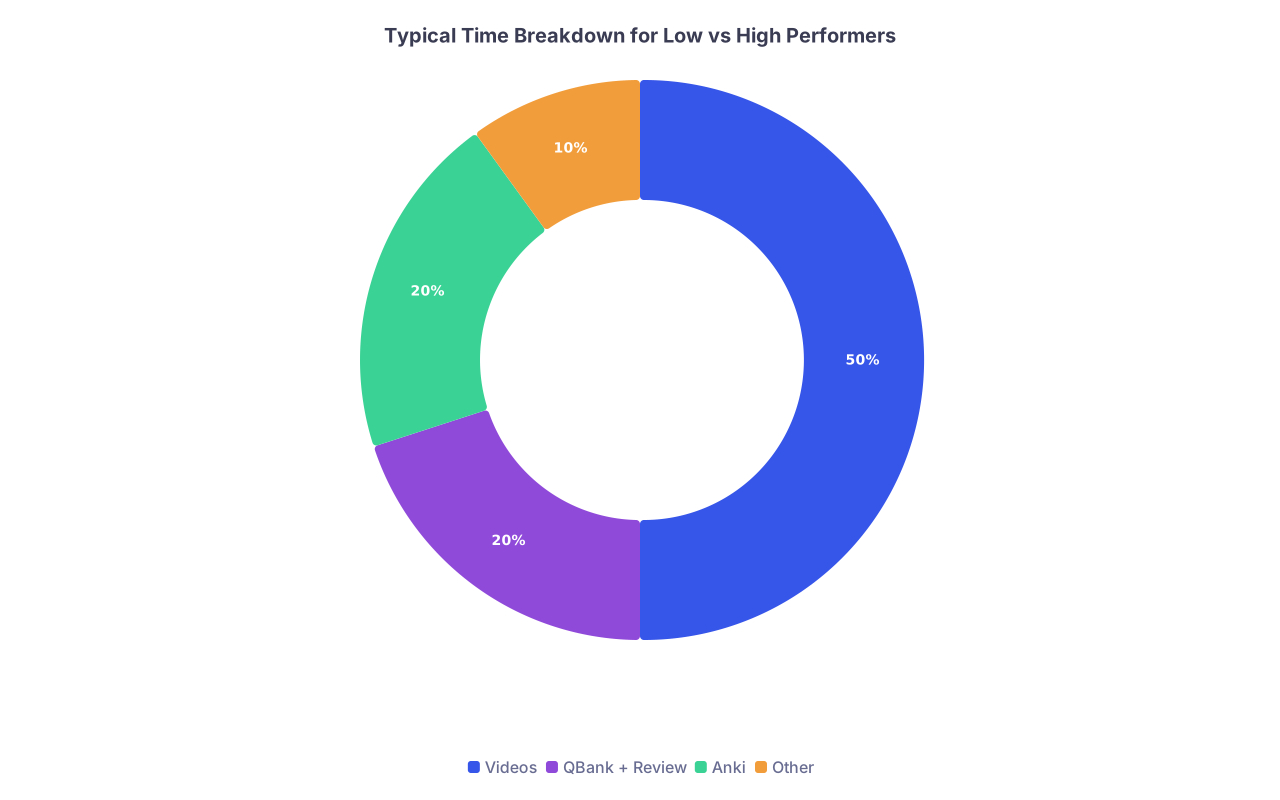
| Category | Value |
|---|---|
| Videos | 50 |
| QBank + Review | 20 |
| Anki | 20 |
| Other | 10 |
(If your real week looks more like 50% videos, 20% questions, your progress will be painfully slow.)
Trap 2: Doing Questions Without Actually Learning From Them
You’ve seen this on group chat:
“I’m on my second pass of UWorld, bro” from someone who can’t explain why they miss the same cardiac phys questions every time.
Here’s the mistake: treating question banks as an item checklist instead of a learning engine.
Common patterns that destroy value from QBank:
- Rushing through 40-question blocks in <45 minutes “to simulate test time” while you’re still weak on content
- Skimming explanations just to see the right answer, ignoring the rest
- Not writing down (or tagging) patterns and principles from missed questions
- Immediately redoing questions you missed to “fix” your percentage
(You’re memorizing answers, not concepts)
Your score doesn’t go up because you “finished UWorld.” It goes up because you deeply processed why you were wrong, and rewired that mistake.
What “learning from a question” actually looks like
If you miss a UWorld question on hyponatremia in a patient with small cell lung cancer, you should:
- Understand:
- What the question was really testing (SIADH mechanism, not just sodium level)
- Why each wrong choice was wrong
- Extract:
- One or two generalizable principles: e.g., “SIADH → low serum osmolality, inappropriately concentrated urine, euvolemic”
- Capture:
- One Anki card or brief note that forces recall, not re-reading the whole explanation
If your “review” is just nodding along thinking, “Ah, okay, makes sense now,” and you move on—you’re setting yourself up to miss the exact same question type on test day.
Fixing this trap
- Pre-dedicated:
- Do smaller blocks (10–20) untimed, high-quality review
- Early dedicated:
- 40-question timed blocks are fine, but plan 2–3x that time for review
- During review:
- For every missed question, be able to state out loud:
- “I chose X because I thought ___, but the question stem was pointing to Y because ___.”
- For every missed question, be able to state out loud:
If you can’t clearly articulate the thought error, all you’ve done is read another explanation.
Trap 3: Disrespecting Anki (or Using It in the Most Inefficient Way Possible)
Some of you are overdoing Anki. Some of you are ignoring it. Both are problems.
The trap version looks like this:
- 2,000+ reviews per day
- You’re still adding 100 new cards daily deep into dedicated
- You mechanically flip through cards while half-distracted on your phone
- Or the opposite: you “don’t like Anki,” so you rely on passive rereading and feel your knowledge leak by the next morning
Let me be blunt: spaced repetition is non-negotiable. You don’t have to use Anki specifically. But if you’re not systematically revisiting information, you’re gambling your score on short-term memory.
Two equally bad approaches
-
- You do reviews for 4–5 hours a day
- You refuse to bury or suspend low-yield or obviously mastered cards
- You’re too exhausted to do questions afterwards
This is “busy,” not productive.
The Anki Denier
- You keep convincing yourself you’ll “just remember” because it made sense when you read it
- You rely on last-minute cramming and rewatching
This works until… it doesn’t. Usually around the time of your third NBME.
How to use Anki without letting it run your life
- Cap daily reviews. For most students:
- 1.5–2 hours of focused Anki is plenty
- Be ruthless about:
- Suspending trash cards
- Editing clunky cards into simpler Q&A
- Deleting pure trivia you will never care about again
- Anki is support, not the main show:
- QBank + review deserves the prime energy block of your day
- Anki fits into “warm-up” or “cool-down” slots
If your daily schedule is:
- 3–4 hours Anki
- 2 hours questions
- 1 hour videos
You’re handcuffing your score progress.

Trap 4: Hiding From NBMEs and Reality
This is one of the most dangerous traps emotionally. And I see it over and over.
The logic goes like this:
- “I’ll take an NBME once I’ve finished First Aid / UWorld / BnB”
- “No point wasting an NBME when I know I’m not ready”
- “I don’t want to freak myself out with a low score”
So they avoid NBMEs until 3–4 weeks before their exam. Then they finally take one. And it’s 35+ points below where they wanted to be. Cue panic, reschedule attempts, frantic last-minute strategy shifts.
Avoiding NBMEs is emotional self-protection. I get it. But it’s also self-sabotage.
You need early NBMEs—even if they hurt
NBMEs are not just score predictors. They are:
- A reality check on how effective your study methods are
- A filter for which systems and question types are bleeding your score
- A practice in mental stamina and test-day focus
If you only start checking your trajectory at the end, there’s no time left to change course.
Minimum NBME rule of thumb
You want a series of data points, not one unpleasant surprise.
| Phase | When | Purpose |
|---|---|---|
| Pre-dedicated | 8–10 weeks out | Baseline + plan adjust |
| Early dedicated | 4–6 weeks out | Check if strategy works |
| Mid dedicated | 2–3 weeks out | Fine-tune weak areas |
| Late dedicated | 1 week out | Confirm readiness |
Even if your first NBME is ugly—good. Now you know. Now you can adapt.
If thinking about NBMEs makes you anxious, that’s a sign you need to deal with them sooner, not later.
Trap 5: “Reviewing” Wrong—Turning Review Into Passive Re-reading
A lot of people will admit, “Yeah, I review my incorrects.”
Then you watch them “review” and realize why they’re stuck.
Their version of review:
- Re-reading the entire explanation, maybe highlighting a couple sentences
- Screenshotting a nice diagram
- Copy-pasting a long chunk of text into a document called “Renal Stuff”
- Never actively recalling any of it again
That’s not review. That’s digital hoarding.
The brain doesn’t care how pretty your OneNote looks. It cares how many times it’s been forced to struggle to recall and apply a concept.
A better model for review
For each impactful miss (not pure trivia), ask:
What was the core concept?
- e.g., “Hypercalcemia in sarcoidosis is due to increased 1-alpha hydroxylase in macrophages”
What was my wrong mental model?
- “I thought hypercalcemia in granulomatous disease was from bone breakdown, but it’s actually increased vitamin D activation”
How will I see this again?
- One or two Anki cards max
- Or a short handwritten summary you’ll force yourself to recite later
You want review that:
- Is short
- Is painful (in a good way—effortful recall)
- Shows up again on a spaced schedule
If your review process leaves you feeling “that was easy,” it probably didn’t change your brain very much.

| Step | Description |
|---|---|
| Step 1 | Do Question Block |
| Step 2 | Identify Missed Qs |
| Step 3 | Analyze Thought Error |
| Step 4 | Extract Core Concept |
| Step 5 | Create Recall Prompt (Anki/Note) |
| Step 6 | Spaced Review |
| Step 7 | Retry Similar Qs |
Trap 6: Over-Scheduling and Burning Out Before the Real Exam
This one hits the planners. The ones who love their color-coded Notion or Excel timelines.
The trap looks like:
- Every day blocked from 7 a.m. to 11 p.m. with zero slack
- A huge “Must Do Daily” list that no human could consistently accomplish
- After 4–5 days, the whole thing collapses and you feel like a failure
- You restart a new “perfect plan” instead of fixing the underlying problem
Burnout for Step 1 doesn’t usually arrive dramatically. It creeps.
You start:
- Cutting corners on review
- Skipping weak topics because they feel heavy
- Staying up later to “catch up,” then performing worse the next day
And your NBMEs flatline or drop. Not because you’re dumb. Because your brain is cooked.
Signs your schedule is a trap
- You almost never finish your daily plan even when you work hard
- You have zero buffer time for “unexpectedly slow” topics
- Days off are “if I finish everything this week” (translation: never)
- You feel guilty any time you stop working, even when exhausted
A safer schedule philosophy
- Plan 80–85% of your realistic daily capacity, not 110% of your fantasy self
- Protect:
- Sleep like it’s high-yield content
- At least half a day off every 1–2 weeks—even in dedicated
- Build in:
- One flex hour per day for spillover or decompression
During dedicated, the goal is sustained pressure, not maximum short-term output. I’ve watched plenty of people peak 3 weeks before their test and slide backwards because they refused to adjust when fatigue hit.
If your study plan only works for a superhuman robot on its best day, it’s a bad plan.
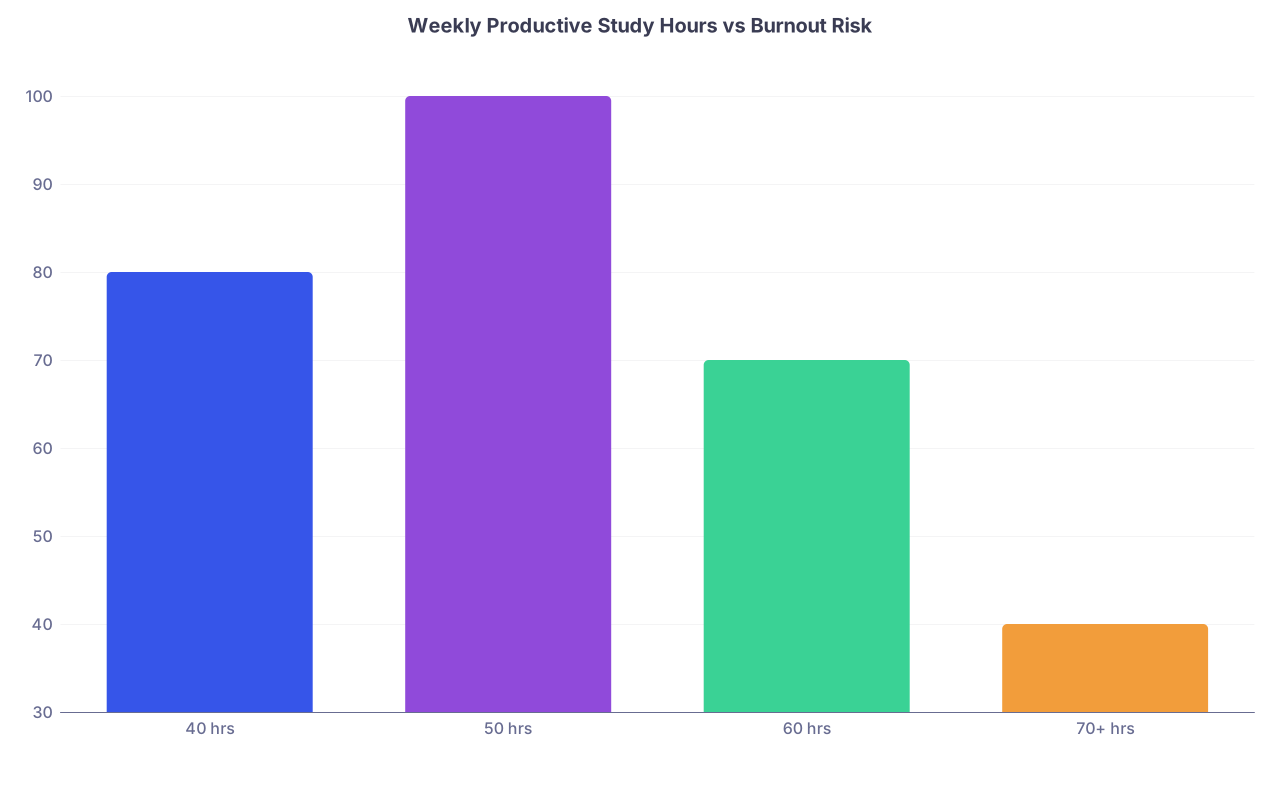
| Category | Value |
|---|---|
| 40 hrs | 80 |
| 50 hrs | 100 |
| 60 hrs | 70 |
| 70+ hrs | 40 |
(At ~50 focused hours/week you’re usually in the sweet spot. Past 60, quality and retention drop hard for most people.)
Trap 7: Studying for “School Exams” Instead of the Step 1 Exam
This is especially brutal in systems-based preclinical curricula.
You start out well-intentioned:
- “I’ll focus on my school’s resources and exams now and worry about Step later.”
Then:
- School emphasizes random details, obscure pathways, lecturers’ pet topics
- You cram lecture slides, neglect board-style integration
- Your brain gets wired to memorize lists instead of solving vignettes
When you finally pivot to true Step 1 prep, it feels like learning medicine all over again.
School exam brain vs Step 1 brain
School exam brain:
- “What list of causes did Dr. X say?”
- “What obscure enzyme was mentioned in that one slide?”
- Memorizing details tied to professor quirks
Step 1 brain:
- “What is the mechanism that explains these lab findings + symptoms?”
- “What is the next best step or most likely diagnosis?”
- Pattern recognition across phys, path, pharm, micro
If your daily studying is 90% lecture slides and 10% board resources, you are training the wrong test-taking muscle.
Blending school and Step without sinking your score
For each system/block:
- Use a board resource as your spine (First Aid, Boards & Beyond, Pathoma, Sketchy, etc.)
- Map lectures onto that structure, not the other way around
For every major topic:
- Do at least a few board-style questions (AMBOSS, UWorld, Anki question cards) during the block
- Don’t wait until “after finals” to see how that topic shows up in questions
And if your school exams are completely insane and non-board-like? Fine. Cram what you must for the grade. But protect at least a few hours a week for Step-aligned studying. Or you’ll pay for it during dedicated—with interest.

How to Know Which Trap You’re Actually In
Most people don’t suffer from all seven at once. They have one or two dominant traps that quietly erode their progress.
Here’s a quick litmus test. If you recognize yourself in these statements, that’s your priority problem:
- “I watch so many videos but freeze on questions.” → Trap 1
- “I finish my blocks but still miss the same stuff.” → Trap 2 / 5
- “Anki dictates my entire day.” → Trap 3 (Anki Zombie)
- “I avoid NBMEs because I’m scared of the score.” → Trap 4
- “I’m always behind schedule and exhausted.” → Trap 6
- “I crush school exams but get wrecked by NBME-style questions.” → Trap 7
Fixing just one of these can move your NBME by 10–20 points over a few weeks. I’ve seen it repeatedly.
Your Next Step: Do a Ruthless 24-Hour Study Audit
Do not just nod along to this and go back to whatever you were doing. That’s how people stay stuck for months.
Here’s what you do today:
Write down everything you did for Step in the last 24 hours
- How much time on:
- Videos
- QBank (doing + review separately)
- Anki / flashcards
- NBMEs / full-length practice
- Random note re-reading / lecture slides
- How much time on:
Circle the biggest time-suck that is least correlated with score movement
- For most: it’s either videos or inefficient review / Anki
Decide on one concrete change for the next 3 days
- Examples:
- “No more than 60 minutes of videos per day. Extra time goes to question review.”
- “For every missed question, I’ll create one recall prompt (Anki or written) before moving on.”
- “I will schedule my first NBME this Saturday and not move it.”
- “I’m cutting my daily new Anki cards in half and protecting 2 high-quality blocks of questions.”
- Examples:
Put that change into your schedule for tomorrow—hour by hour.
Open your calendar or planner right now.
Pick your one trap to attack.
Block out when you’ll do your next full, honest NBME or UWorld block + deep review under the new rule.
Do not wait for the “perfect time” to fix your process. The perfect time is exactly when you notice your progress has stalled—like right now.