
The most dangerous Step 1 mistake is not a bad NBME score. It is misreading what that NBME is actually telling you.
I have watched students with 250+ potential postpone for months because of fake “plateaus” that were just noise. I have also seen people sit for Step 1 because “NBME says 65% correct = safe,” then miss the pass line by a mile. Same data. Different interpretation. One outcome salvages a career. The other forces remediation and an ugly email from the dean.
This is what you are up against: NBME forms are powerful tools that students routinely misinterpret, then build huge decisions on top of those misreads. You cannot afford that.
Let’s walk through the most common NBME misinterpretations that derail Step 1 readiness calls—and how to avoid each one.
1. Treating Every NBME as a Crystal Ball Instead of a Snapshot
The first big mistake: believing a single NBME equals your Step 1 destiny.
Here is what actually happens:
Student takes NBME 28. Converts to a predicted score of 203. Panic. They cancel their exam, delay 4–6 weeks, and tear up an entire study plan based on one 4-hour sample.
That is reckless.
NBMEs are:
- Sampled questions, not the entire exam universe
- A noisy measurement with day-to-day variance
- Influenced by sleep, timing, food, mood, and test-taking mistakes
They are not:
- A guaranteed Step 1 score
- A permanent label on your ability
- A prediction that ignores context and trajectory
Here is the mistake sequence I see all the time:
- Take first NBME (cold, no timing practice, poor sleep).
- Score comes back “fail range” (for example, 52% correct, estimated 192).
- Student (and sometimes advisor) decides: “I am nowhere near ready. I must extend 2–3 months.”
- Instead of identifying trainable issues (timing, anxiety, dumb errors), they tear up the plan and go back to passive content review.
The right way:
- Use multiple NBMEs over a few weeks.
- Look for trend + pattern, not one isolated number.
- Ask: “Is this score consistent with my recent work and other metrics (UWorld %, Anki retention, prior NBMEs)? Or is it an outlier?”
If NBME 25 = 205, NBME 26 = 208, NBME 28 = 204, that is not “I am stuck at 205 forever.” That is simply noise around a real ability that probably sits around low 200s.
The real question then:
“Given this trajectory, do I have enough runway to push my true score safely above the pass line or my target range?”
If you treat each NBME as gospel, you will either overreact to noise or ignore meaningful trends. Both are lethal.
2. Misreading the “Passing” Line and Safety Margins
The second trap is confusing “barely above the NBME pass projection” with “safe to sit.”
Here is where people blow themselves up: they anchor on the scaled score only, without thinking in terms of buffer.
For Step 1 (pass/fail), you must think in risk bands, not just “pass” or “fail.”
| NBME Range | Risk Level | Typical Advice |
|---|---|---|
| < 190 | Extremely high | Do not sit; major content and strategy gaps |
| 190–199 | Very high | Postpone; need significant work |
| 200–209 | High | Only sit if forced and trending sharply up |
| 210–219 | Moderate | Borderline; confirm with more data |
| ≥ 220 | Lower | Reasonable buffer if trend is stable |
Here is how students misinterpret this:
- “NBME says I am estimated 202, and the pass is around 196–197. That means I am passing. I am good.”
- No. That means if you have an off day, sleep badly, change test center, or get slightly different content distribution, you can absolutely fail.
You would never accept a “barely pass” margin on a hemodynamically unstable patient. Do not accept it for your own exam.
Three common wrong assumptions:
“NBME doesn’t lie; if it says pass, I will pass.”
Reality: NBME gives a probable range, not a promise. That range crosses the fail line when your buffer is small.“My worst case on test day will be equal to my lowest NBME.”
Reality: On a true high-stress day, with new vignettes and full pressure, things can go worse than any practice.“My score will automatically go up in the final week.”
Reality: Last-week jumps are not guaranteed. For many, that last week is about consolidation, not miracles.
I always tell students:
- For Step 1 pass/fail, you want at least two recent NBMEs
- Both:
- Above the pass line by a meaningful margin (ideally 10–15+ points)
- Taken under realistic conditions (timed, no pausing, exam-like environment)
If you are living in the 198–205 band with no real cushion, that is not “ready.”
That is “praying the error bars fall in your favor.”
3. Obsessing Over “Percent Correct” and Ignoring Question Mix
The next misinterpretation: staring at “percent correct” in isolation as if 65% always means the same thing.
It does not.
NBME percent correct is affected by:
- Question difficulty
- Question mix (heavy pharm vs heavy behavioral)
- Whether you got the easy questions right and missed the experimental/style ones, or vice versa
Two students:
- Student A: 65% correct, but almost all misses are obscure detail questions; core pathology and mechanisms are strong.
- Student B: 65% correct, but misses are foundational path, classic organ system vignettes, common Step 1 themes.
Same percent. Different readiness.
You are making a serious mistake if you say, “NBME 29 was 64%, passed. NBME 30 was 63%, failed. I am regressing.”
You are not reading the anatomy of your misses.
The smarter approach:
Categorize your incorrects after each NBME:
- Core concept vs. obscure detail
- Misread question vs. true knowledge gap
- Poor elimination vs. completely lost
Then ask:
- “If Step 1 tomorrow looked like this test but with different versions of the same core concepts, would I be okay?”
- “Are my misses fixable with targeted review, or do they show fundamental weakness in big-ticket systems (renal, cardio, neuro)?”
Do not let the raw percentage bully you. Context is everything.
4. Overreacting to NBME-to-NBME Score Swings
Another classic misstep: declaring victory or disaster based on a small jump or dip.
I have watched this exact scenario:
- Week 1: NBME 25 – 205
- Week 3: NBME 27 – 215
- Week 5: NBME 28 – 210
Student sees that 210 and freaks out: “My score is dropping, my plan stopped working, I must reset everything.”
No. That is classic noise.
Scores typically bounce within a range, not a straight line.
Here is what most realistic trajectories look like:
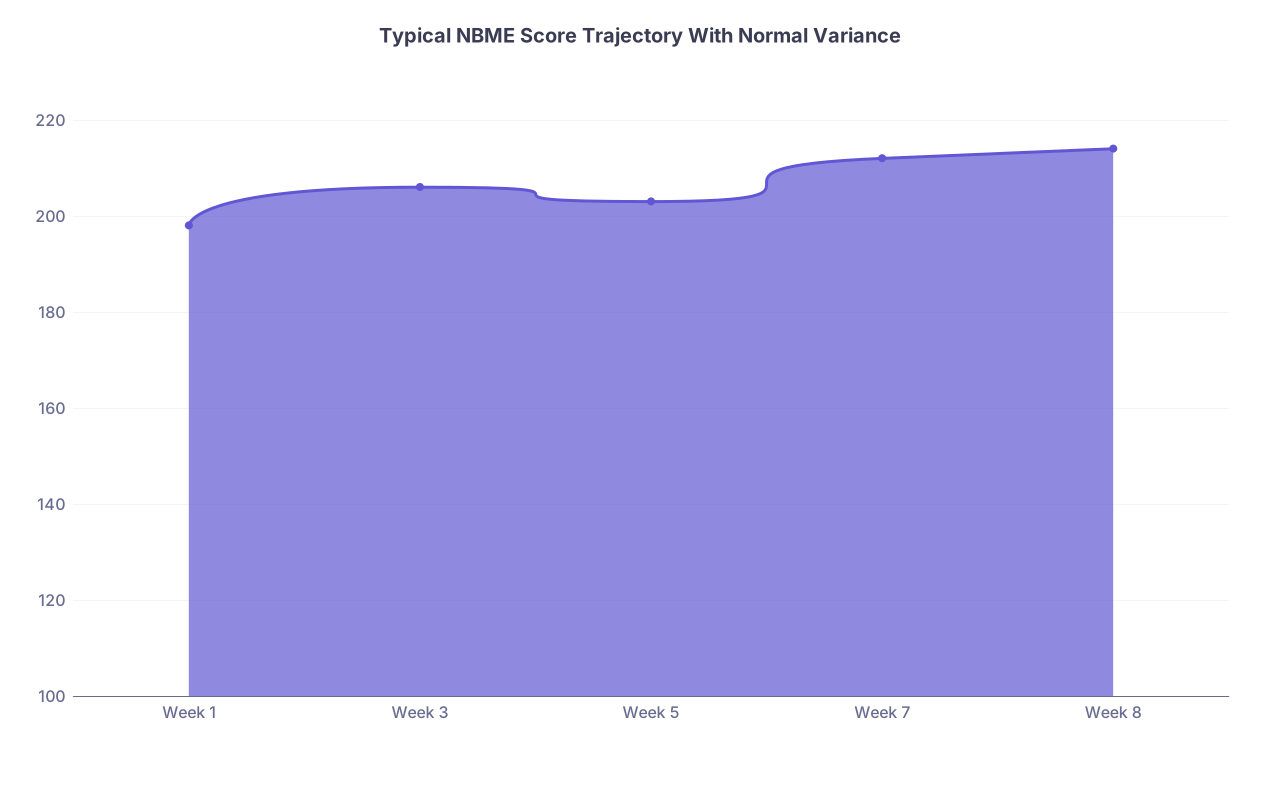
| Category | Value |
|---|---|
| Week 1 | 198 |
| Week 3 | 206 |
| Week 5 | 203 |
| Week 7 | 212 |
| Week 8 | 214 |
That is not “Yo-yo.” That is normal.
Major error: treating any downward bump as catastrophic.
When to worry:
- Drop of 10–15+ points with no obvious external reason (illness, no sleep, disruptive environment)
- Drop associated with obvious burnout, cognitive fatigue, or a big change in your study routine (for example, you stopped doing UWorld and went “all videos” again)
- Multiple NBMEs in a row trending downward
When not to overreact:
- 3–7 point shifts up or down
- Slightly different content balance (more psych + ethics = often feels worse)
- A “harder feeling” form that still sits within your typical score band
The mistake is not in watching your trend. The mistake is panic-based plan changes every time the number moves.
5. Ignoring Form Differences and Question Style
NBME forms are not identical clones. Some forms:
- Hit specific systems harder (for example, one is neuro-heavy, another is weirdly metabolism-heavy)
- Lean toward vague, high-level conceptual questions
- Include more ethics/behavioral questions that many students find demoralizing
I have seen students experience this:
- NBME 29: 215, “felt fair, classic Step 1 style”
- NBME 30: 207, “felt vague and brutal, tons of psych and ethics”
They assume: “I forgot everything in a week.” No. They just hit a different question profile.
Your job is to separate:
- “I did worse because the form exposed a real weakness”
- Example: Heavy renal phys and you fell apart. You actually do not understand RAS or clearance.
- Versus “I did worse because the style/content shifted, but my core strengths are intact.”
How to avoid the mistake:
After each NBME, list:
- 2–3 systems that felt disproportionately tested
- 2–3 question styles that gave you trouble (long multi-step reasoning, ethics stems, micro image questions, etc.)
Then ask:
- “Did this form simply spotlight a known weak system (for example, I always avoid renal)?”
- “Or did I see normal content and just fail because my foundation is not there?”
You sit for whatever version of Step 1 shows up. If different NBME forms consistently expose the same weak domains, that is a red flag, not just “oh this form was weird.”
Do not hide behind “this form was unfair” if every “unfair” form crushes you in the same two systems.
6. Misusing the NBME Score Report: Looking at Colors, Not Patterns
Most students glance at the NBME performance profile (the bar chart with systems/domains) and see:
- “Yellow, green, red.”
- “I am bad at X, okay at Y.”
That is not analysis. That is color-coding your anxiety.
The mistake: treating each bar in isolation and not understanding relative weight and clustered weakness.
Common bad interpretations:
- “I am in the low bar for ‘multisystem processes’, so I must spend a week memorizing all the random syndromes.”
- “Behavioral science bar is low, let me rewatch every biostatistics video from scratch.”
Meanwhile, cardiovascular, renal, and neuro are mediocre but not disaster-level, and the student does not give them any focused structural work.
What you should be asking from every NBME report:
- Which 2–3 domains consistently underperform across forms?
- Are those high-yield systems for Step 1 (renal, cardio, neuro, endocrine, immuno, micro) or fringe topics?
- Are the misses honest “I never learned this” or sloppiness (“I misread the question and changed the right answer to wrong at the last second”)?
Most dangerous mistake: chasing low-yield red zones while leaving core systems half-baked.
Here is a rough prioritization reality check:
| Domain Weakness | Priority Level | Typical Response Needed |
|---|---|---|
| Cardio/Renal/Neuro/Endo | Critical | Structured re-teach + questions |
| Immunology/Micro | High | Focused mechanistic review |
| Biostats/Ethics | Moderate | Targeted drills, not full reset |
| Musculoskeletal/Skin | Lower | Clean up major patterns only |
| Rare Syndromes/One-offs | Very Low | Do not chase exhaustively |
If your NBMEs are screaming “you do not really understand renal,” and your response is “I will grind 300 more biostats questions,” you are misusing the report.
7. Treating NBME Explanations Like UWorld and Missing the Lesson
NBME forms do not give rich, teaching-style explanations like UWorld.
Students see that as a license to barely review their NBMEs.
That is a mistake.
Here is the misuse pattern:
- Student finishes NBME.
- Opens each missed question.
- Reads the short rationale: “The correct answer is X because Y.”
- Nods. Moves on. Does not rebuild the underlying concept.
They act like they are “done” once they understand why that question was wrong. Step 1 does not care if you can now answer that exact question. It never shows up again.
You must extract transferable insight, not just “oh, I misclicked B instead of C.”
Better way to review NBMEs (and where almost everyone is lazy):
For each missed question:
- Identify the core concept being tested (for example, “RAAS regulation of efferent arteriole,” “Type II hypersensitivity,” “statistical power”).
- Ask: “Do I fully understand this at the level of cause → mechanism → effect?”
For truly high-yield misses:
- Revisit that topic in your primary resource (Pathoma, Boards & Beyond, First Aid).
- Do 2–3 related questions from UWorld or another bank that hit the same idea in a different scenario.
Track patterns:
- “Four separate misses related to nephritic vs nephrotic physiology.”
- That is a cue to sit down and re-teach yourself the whole topic, not just memorize the four answers.
You cannot afford to treat NBME review like a checkbox. Each form is an x-ray of your knowledge structure. If you scan it like a BuzzFeed quiz, you will walk into Step 1 with the same fractures.
8. Ignoring Non-Cognitive Factors the NBME Is Exposing
Sometimes the NBME is not telling you “you do not know enough.” It is telling you “you cannot perform under realistic test conditions.”
Students miss this constantly.
Patterns I see:
- Consistent high performance on tutor-mode question banks, long breaks, unlimited time.
- Then NBME: large dip, tons of incomplete questions at the end of each block.
- Student response: “I must not know enough content; let me rewatch all of physiology.”
No. Your content may be fine. Your test-taking fitness is not.
Red flags on NBMEs that are not primarily “knowledge” issues:
- Finishing 5–8 questions short in multiple blocks
- Huge clustering of wrong answers in the last 10 questions of a block
- Dramatically worse performance on the last half of the exam vs first half
- Clear fatigue symptoms: rereading questions, zoning out, second-guessing everything
You cannot fix that with more Anki cards.
What this NBME is really saying:
- “You cannot yet operate like an athlete on game day for 7+ hours.”
- “Your timing strategy, endurance, and stress management are insufficient.”
If your readiness call ignores these factors and only tracks the scaled score, you will green-light students who are theoretically ready and practically doomed.
You must:
- Simulate real conditions: no phones, no pausing, realistic breaks.
- Develop a timing plan (for example, 1–1.1 minutes per question on first pass, mark and move, second pass for the remaining few).
- Train stamina with longer sets, not endless single blocks.
The NBME is testing your system, not just your knowledge.
9. Basing the Readiness Call on “Hope,” Not Evidence
The most destructive misinterpretation is not about any single number or bar. It is about narrative.
The story students tell themselves:
- “My NBME is 204, but I am just bad at practice tests.”
- “I always overthink; I will do better when it counts.”
- “I know more than this score shows, I just have test anxiety.”
Then they (or the dean’s office under pressure to keep schedules) decide to sit “and see what happens.”
This is not strategy. It is gambling with your career.
Your Step 1 readiness call should not be:
- “I feel like I know more now.”
- “My friend improved 20 points in two weeks.”
- “This test did not reflect my true ability.”
It should be built on:
- Multiple data points (2–3 NBMEs + question bank performance)
- Consistent conditions (all tests timed, realistic, no cheating)
- Pattern analysis (same strengths/weaknesses showing, not chaos)
Here is a brutally honest way to pressure-test your decision:

| Step | Description |
|---|---|
| Step 1 | Last 2 NBMEs taken under real conditions |
| Step 2 | Postpone & fix core issues |
| Step 3 | Reasonable to sit for Step 1 |
| Step 4 | Both above pass by >=10? |
| Step 5 | Scores stable or rising? |
| Step 6 | Major unaddressed system weaknesses? |
If you have:
- One NBME above the pass line by 3 points
- One NBME below the pass line
- A feeling that “it will be fine”
That is not enough. That is the kind of thinking that creates preventable fails.
10. Letting Social Media and Anecdotes Override Your Own NBME Data
Last mistake: letting other people’s screenshots and stories override what your own NBME data clearly shows.
You have seen these posts:
- “I was stuck at 205 on NBME for 3 weeks, then took the real thing and got 235. Trust the process.”
- “NBME underpredicts by 20 points; do not worry.”
- “I failed every practice but passed Step 1. You will be fine.”
You know what those are? Survivorship bias on steroids.
For every student who “beat” their NBME by 20+ points, there are many more who matched or underperformed their practice range. They do not go brag about their near-miss or fail on Reddit.
You cannot make your readiness call based on the outlier story that feels comforting.
The only legitimate questions are:
- What are your NBME trends?
- Under your test conditions, with your anxiety profile, how stable are your scores?
- Are you clearly and reliably above the danger zone?
Your NBMEs are data. Social media is noise.
Final Tight Summary: What You Must Not Get Wrong
Do not let NBME misreads wreck your Step 1 outcome. Keep these non-negotiables:
- A single NBME is a snapshot, not your fate. Make decisions based on patterns, buffers, and trends, not one number.
- “Barely passing” NBME scores are not safe. You need a real buffer (10–15+ points) from the pass line across multiple recent forms under realistic conditions.
- Use NBME reports to identify core, high-yield weaknesses and performance issues, not to chase minor red bars or justify wishful thinking. Your readiness call must be built on your data, not on hope or Reddit.
If you avoid these interpretation traps, your NBME forms will stop being sources of panic and start being what they were meant to be—hard, honest feedback that protects you from walking into Step 1 unprepared.