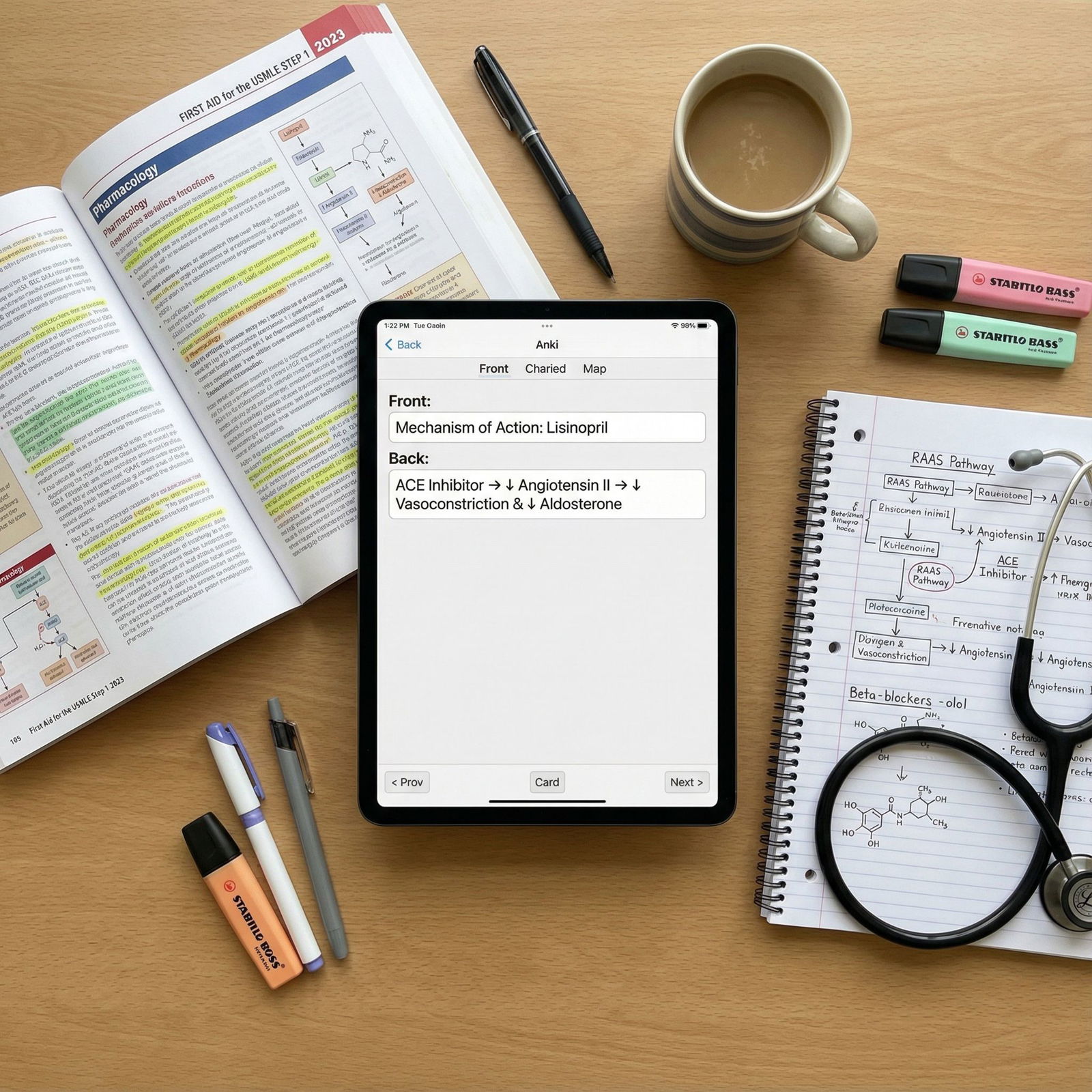
What if the single “productivity hack” you’re most proud of for Step 1 prep is actually the reason your scores are stuck?
I’m talking about the classic trap: rewriting First Aid. Front to back. Summarizing it. “Making it my own.” Color-coded, beautiful, and almost completely useless for most people’s Step 1 score.
You’re not the first. You will not be the last. But you don’t have to be the next.
Let me walk you through why this is one of the biggest Step 1 mistakes I see—and how to avoid sinking 50–150 hours into a project that gives you maybe 5 hours’ worth of benefit.
The Fantasy: “If I Rewrite First Aid, I’ll Really Learn It”
Here’s the usual story.
You buy First Aid. You hear everyone say it’s the Step 1 bible. You crack it open and feel your soul leave your body when you see how dense and cryptic it is.
So you think:
- “I just need to rewrite it in my own words.”
- “If I copy the important things into a notebook, I’ll remember them.”
- “I’ll summarize each system, then do questions later.”
Sounds reasonable. Feels productive. You can show people the huge stack of pages you “crushed.” You feel in control.
Except you quietly ignore one problem: Step 1 doesn’t care what you can copy. It cares what you can retrieve and apply under time pressure.
Rewriting First Aid is a handwriting competition. Step 1 is not.
The Harsh Math: How Rewriting First Aid Eats Your Score
Let’s be cold and quantitative about this.
Most students who “rewrite” First Aid fall into something like this pattern:
- 2–3 hours per day
- 5–6 days per week
- 4–8 weeks
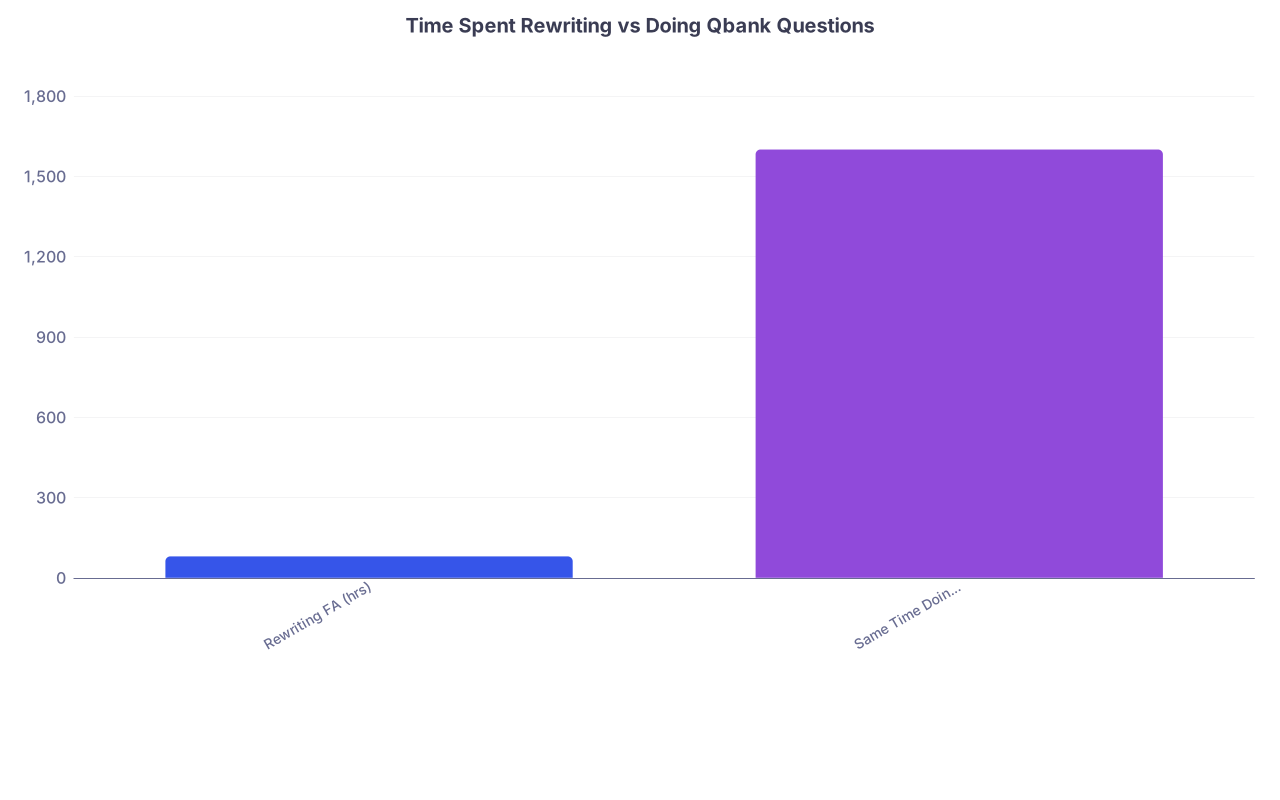
That’s 40–120 hours of pure transcription plus “decorating” (highlighting, underlining, color-coded arrows, fancy headings). Some go past 150 hours without blinking.
Now compare that to what those hours could be:
| Category | Value |
|---|---|
| Rewriting FA (hrs) | 80 |
| Same Time Doing Qbank (questions) | 1600 |
Eighty hours of rewriting could be:
- 1,600+ high-quality Qbank questions (at 3 minutes per question including review), or
- 25+ NBME-style blocks with deep review
You know this intuitively: doing questions boosts scores. Copying words doesn’t. Yet a lot of smart people choose the copying.
Why? Because it feels safer. Lower ego risk. No percentage at the end telling you “You’re not ready.”
So you distract yourself with neat handwriting instead of reality testing with questions.
That’s how people walk into dedicated with 2,000+ pages of “personalized notes” and a weak foundation in actually answering questions.
The Cognitive Problem: Writing ≠ Learning
Here’s where people get fooled by their own brain.
Yes, physically writing something can help memory. But only if:
- You’re thinking hard about the material while writing it, and
- You’re forced to retrieve or transform information, not just pass it through your hand
Most Step 1 “First Aid rewrites” fail both conditions.
What usually happens:
You look at First Aid. You copy the line. Maybe you change a few words. Maybe you add an extra detail from a video or from class. You underline a few things. Then you move on.
That’s not “making it your own.” That’s formatting.
The science here is brutal. Study after study shows:
- Active recall (testing yourself, flashcards, questions) and
- Spaced repetition (seeing material again over time)
crush passive strategies like rereading and copying for long-term retention.
Copying First Aid is just fancy rereading with hand cramps.
You’ll feel like you understand because the material looks familiar. Then a question phrases it slightly differently, or combines two concepts, and suddenly you choke.
That’s the illusion of competence. Rewriting First Aid feeds it.
The Timing Disaster: When Rewriting First Aid Steals Your Dedicated
The timing is where this mistake gets lethal.
I’ve seen this exact scenario more times than I’d like:
- Student A finishes M2, takes a short break, then starts dedicated with a plan: “Two weeks to rewrite/summarize First Aid by system, then heavy UWorld.”
- They underestimate how long rewriting takes. Two weeks becomes three. Then four.
- By the time they really start hammering questions, they’ve already burned half or more of dedicated. Their first NBME shakes them: way below target.
- Panic kicks in. Now they try to do questions on top of an already overloaded day of “finishing notes.” Burnout follows.
Here’s a basic breakdown of how people intend vs actually use time:
| Activity | Planned (%) | Reality for Many (%) |
|---|---|---|
| Qbank + Review | 50 | 20–30 |
| NBMEs/Assessments | 10 | 5 |
| Rewriting/Summarizing FA | 15 | 40–50 |
| Video Review | 15 | 10–15 |
| Anki/Flashcards | 10 | 5–10 |
That “just 1–2 weeks to rewrite FA” balloon eats the exact time you need for Qbank and NBME practice. The two things most predictive of your eventual performance.
So by the time you realize rewriting isn’t translating into questions, it’s too late to fix the deficit without extending your test date—or going in underprepared.
You don’t want that conversation with your dean.
The Emotional Hook: Why Smart People Fall For This
You’re not rewriting First Aid because you’re lazy. You’re doing it because you’re scared. And you’re trying to regain control.
Let me spell out the emotional payoff of rewriting:
- Feels concrete. You can measure pages written. Pages highlighted. It’s visible progress.
- Feels safer than Qbank. No score yelling at you. No “your percentile is 35%.”
- Feels customizable. “I’m tailoring First Aid to my learning style.” (Usually code for “I’m avoiding the uncomfortable parts of studying.”)
I’ve literally heard students say:
“UWorld makes me feel stupid. So I’m going to spend a couple of weeks really getting First Aid down first, then I’ll start questions.”
They never feel “ready enough.” So questions get pushed back. Again and again. While the notebook stack grows taller and more useless.
You need to recognize this for what it is: an avoidance behavior dressed as productivity.
When Rewriting First Aid Is Especially Dangerous
There are a few red-flag profiles where rewriting First Aid is extra catastrophic.
1. The Below-Average Test Taker
If your school exams, CBSE, or early NBMEs are weak, you need more reps with questions, not more beautifully transcribed facts.
You’re struggling not just with recall, but with:
- How questions are written
- How to identify the actual tested concept in a long stem
- How to eliminate trap answers
Rewriting First Aid does nothing for any of that.
2. The Chronically Behind Student
If you were behind on content during M2, you don’t have the luxury of wasting 80+ hours rewriting what you barely understood the first time.
You need rapid cycles of:
- Watch targeted explanation (Pathoma, Boards & Beyond, etc.)
- Do related Qbank questions
- Fix your holes immediately
Writing “non-caseating granulomas → sarcoidosis” in prettier ink isn’t going to save you from a question that cross-links sarcoid with vitamin D metabolism, hypercalcemia, and weird presentation.
3. The Perfectionist
The perfectionist rewriter is the one I worry about most.
They’ll say:
- “I can’t move on until I’ve organized this page exactly how I want.”
- “I need every high-yield detail in one place, or it feels incomplete.”
- “My GI section isn’t done yet—I can’t start those questions.”
Then suddenly it’s 11 p.m., they’ve done 10 questions all day, but 6 pages look gorgeous.
That perfectionism feels like “high standards.” It’s not. It’s slow-motion self-sabotage.
The Rare Exceptions: When Rewriting Might Actually Help
Let me be fair. There are a few narrow cases where targeted rewriting of First Aid–type content can be useful. But these are not what most people are doing.
Helpful versions look like:
Micro lists you keep forgetting.
Example: You write out the different atypical pneumonias, associated organisms, and treatments on one sheet because you keep missing those questions. You quiz yourself from that single sheet for a week. Then you’re done.Targeted tables for truly confusing areas.
Like one consolidated table for nephritic vs nephrotic syndromes, or for vasculitides, because you’ve already done Anki and questions and still mix them up. Again: one page, limited scope, constant self-testing.End-of-system “cheat sheet” when you’re still early in M2.
After finishing cardio in school, you create a 1–2 page summary to tie your class notes + First Aid + Pathoma together. You then actively quiz from that sheet and integrate it into your spaced repetition.
Notice what all of these have in common:
- They’re short.
- They’re targeted at specific weak points.
- They’re meant for recall practice, not for “feeling productive.”
That’s very different from “I’m rewriting First Aid cover to cover so it’s in my own words.”
What You Should Do Instead of Rewriting First Aid
Let me give you a concrete structure so you’re not just abandoning rewriting into a void.
1. Use First Aid as a Map, Not a Project
First Aid should:
- Tell you what exists
- Provide a checklist of topics
- Serve as a quick reference when you miss a question
It should not:
- Be recopied
- Be your main “learning” tool
- Dictate your whole schedule
Use it as a spine to hang your understanding on, not a textbook to rebuild from scratch.
2. Replace Rewriting with Active Recall
If your plan says “rewrite FA cardio section,” replace it with “actively test myself on cardio content.”
That might look like:
- 40 related Qbank questions
- 1 hour of Anki specific for cardio cards
- 15–20 minutes of rapid-fire, out-loud recall:
- “Name all the left-to-right shunts.”
- “List major causes of secondary hypertension.”
- “What are the murmurs that increase with inspiration?”
You want your brain working, not copying.
3. Build Micro-Notes Only for Persistent Weak Areas
Instead of a 200-page rewrite, consider something like a 10–20 page running document of “stuff that still doesn’t stick even after questions and Anki.”
Categories like:
- Mechanisms you keep mixing up (e.g., diuretics, TB drugs)
- Look-alike diseases you confuse (vasculitides, anemias)
- High-yield charts distilled into 1–2 pages per system
Then you quiz from that doc every few days. If a section becomes solid, delete it. Ruthless trimming.

| Step | Description |
|---|---|
| Step 1 | Miss question |
| Step 2 | Review concept |
| Step 3 | Add 1-2 lines to micro-notes |
| Step 4 | Move on |
| Step 5 | Quiz from micro-notes every few days |
| Step 6 | Delete from notes |
| Step 7 | Still confused after review? |
| Step 8 | Now solid? |
That’s how notes help your score. Small, brutal, and focused on what your questions expose as weak.
How to Tell If You’re Already in the First Aid Rewriting Trap
If you’re not sure whether you’re in this hole yet, sanity-check yourself:
- Are you spending more time writing than answering questions right now?
- Do you feel guilty starting Qbank because you “haven’t finished your notes”?
- Do you avoid NBMEs because you’re “not done organizing First Aid yet”?
- Have you rewritten more than 30–40 pages of anything related to First Aid?
- Do you “summarize” by basically copying with slightly different wording?
If you answered yes to more than one of those: you’re in the trap.
Time to get out before your dedicated disappears into pretty binders.
A Simple Reboot Plan If You’ve Already Rewritten a Ton
Let’s say you’ve already sunk 60+ hours into rewriting. Painful. But you can still salvage this.
Here’s how I’d reboot someone in that situation:
- Stop rewriting today. Not “after I finish this section.” Today.
- Take one of your rewritten sections (say, renal) and test it:
- Do 20–40 renal questions
- Be brutally honest about your performance
- As you review each question, link everything back to:
- First Aid pages
- Your existing notes (if they add clarity, great; if not, stop using them)
- Use those same notes only as a quick review sheet, not an active project. No more expanding them.
- Shift 70–80% of your serious study hours to:
- Qbank
- NBME-style assessments
- Spaced repetition (Anki or equivalent)
Then, once a week, you can briefly scan your written summaries for pattern recognition. But they’re no longer the main event.
Visualizing a Smarter Step 1 Study Balance
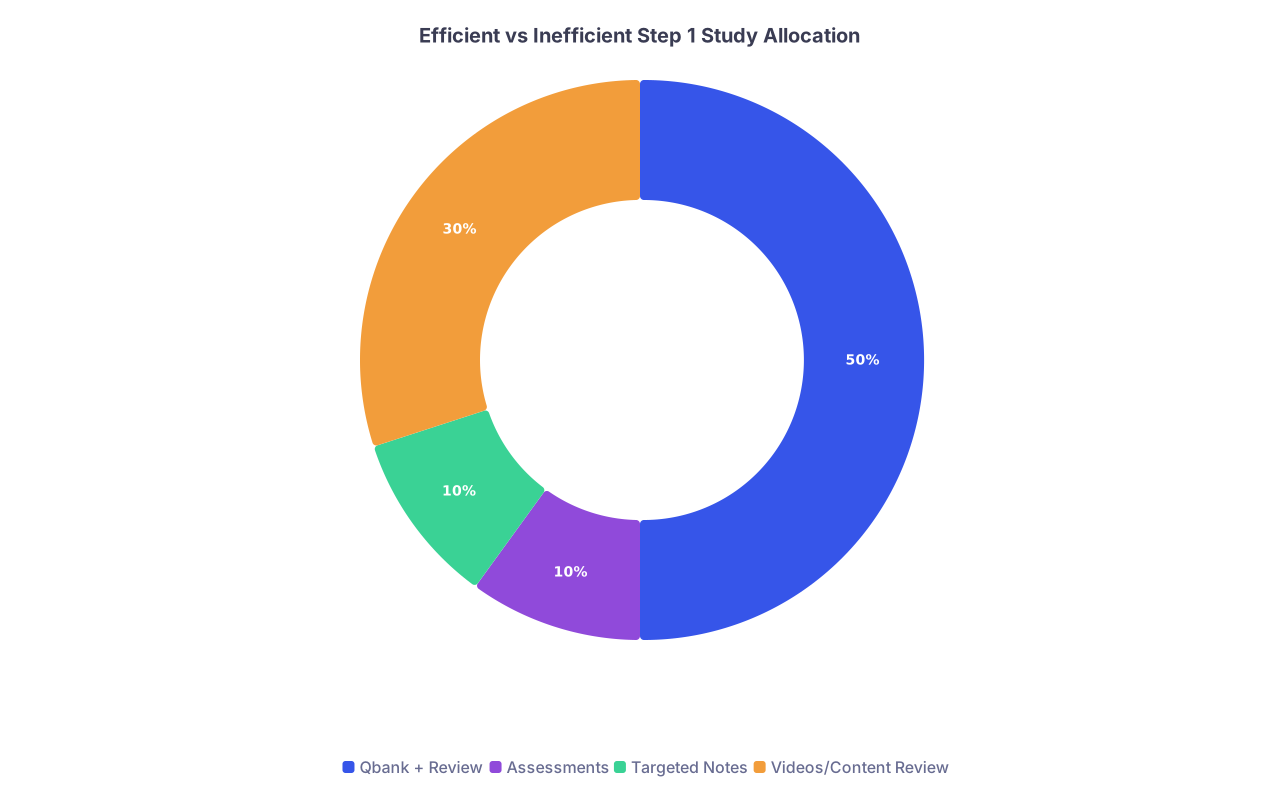
Let’s be concrete about what a healthy allocation of intense prep might look like vs a rewrite-heavy one:
| Category | Value |
|---|---|
| Qbank + Review | 50 |
| Assessments | 10 |
| Targeted Notes | 10 |
| Videos/Content Review | 30 |
Above is a more efficient balance:
- About half on questions + deep review
- Some on assessments
- A sliver on targeted notes
- A chunk on concept-building videos if needed
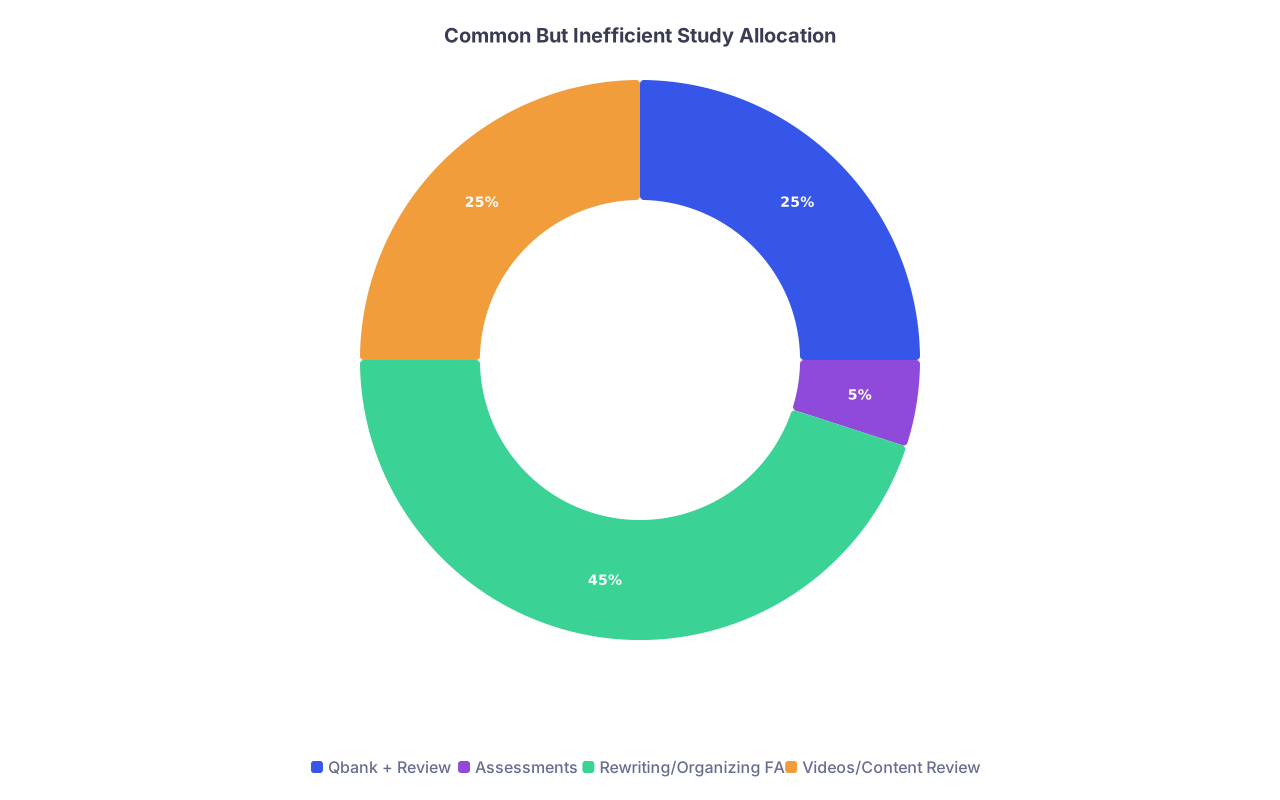
Now compare that to what I typically see from chronic rewriters:
| Category | Value |
|---|---|
| Qbank + Review | 25 |
| Assessments | 5 |
| Rewriting/Organizing FA | 45 |
| Videos/Content Review | 25 |
Almost half their time is going into rewriting, organizing, making things look nice. Their test performance reflects that.
Don’t be that person.
FAQ: Rewriting First Aid and Smarter Step 1 Study
1. If I don’t rewrite First Aid, how do I “learn” it?
Use it as a reference and checklist, not a textbook. Learn through:
- High-quality videos (Pathoma, Boards & Beyond, Sketchy, etc.)
- Qbank questions with meticulous review
- Spaced repetition (Anki, or your own flashcards)
Then use First Aid to:
- Check off topics you’ve seen
- Look up a fact you missed
- Quickly remind yourself how things are organized
You’ll “learn” First Aid by using it alongside questions, not rewriting it.
2. What about annotations in First Aid—are those a waste too?
Not necessarily. Minimal, targeted annotations can be powerful:
- One extra line clarifying a confusing term
- A small diagram you draw in the margin
- A note linking a fact to a classic question pattern
The mistake is turning annotations into a second textbook. If your marginalia are overflowing and you can barely see the printed text anymore, you’ve gone too far.
3. I’ve always learned by rewriting in undergrad. Why is this different?
Because Step 1 is:
- Far more volume than any single undergrad class
- Application-heavy, not just regurgitation
- Long-term retention over months, not days before an exam
Your old method might have worked for cramming a biochem midterm. Step 1 punishes that style. You need recall practice over time, not elegant summaries.
4. How many pages of personal notes are “reasonable”?
As a rough upper bound during M2 + dedicated:
- Around 10–20 pages of high-yield, heavily pruned micro-notes by test day
- Anything beyond ~30–40 pages is usually more for your comfort than your score
If you’re past 80–100 pages of self-made Step 1 notes, I’d bet money you’re underperforming on questions relative to your potential.
5. What should I do today if my plan was to start rewriting First Aid?
Drop that plan. Today, do this instead:
- Pick one system (e.g., cardio).
- Watch 1–2 high-yield videos or review a trusted resource briefly.
- Do 20–40 system-based Qbank questions.
- For every missed/guessed question:
- Read the explanation
- Cross-check the concept in First Aid
- If it’s still confusing after that, add one line to a micro-note doc
- Schedule those micro-notes for review in 2–3 days.
That’s a study day that actually moves your score.
Open your Step 1 study plan right now and find any line that says “rewrite,” “summarize FA,” or “re-copy notes.” Replace it with a concrete number of Qbank questions plus review. That single change can save you dozens of hours—and very likely several points on your score.