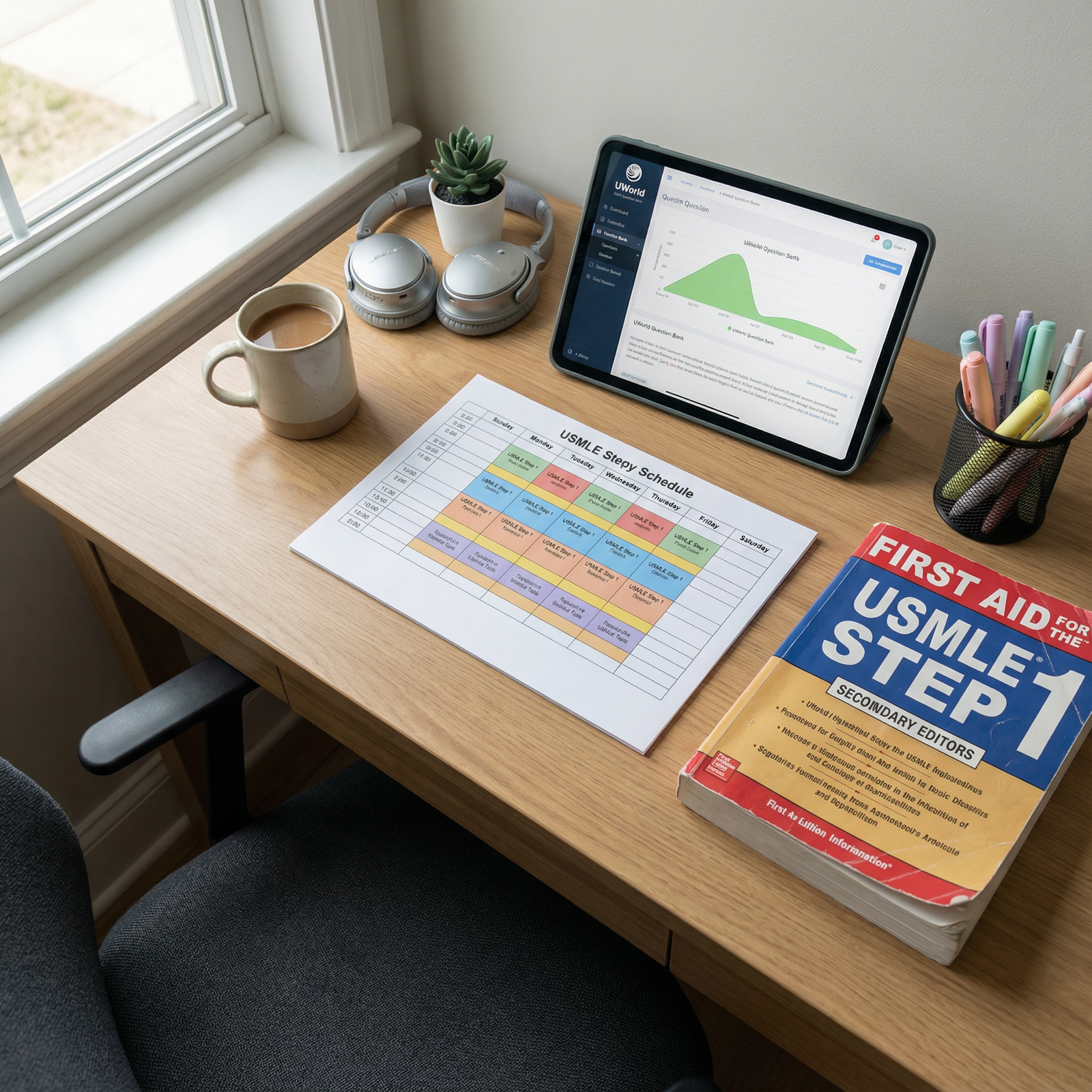
It’s 11:47 p.m. You’re on your third cup of coffee, UWorld is open, and you’re convinced every other person in your class has some secret Step 1 system that you somehow missed. You’re cycling between question banks, half-finished Anki decks, a First Aid PDF, and a YouTube video you swear you’ve watched three times without actually processing.
And hanging in the back of your mind is this thought: attendings did this once. They survived. Why does it feel like nobody told you how they actually studied?
Let me be blunt: most attendings didn’t “figure it out.” They white‑knuckled it. They brute‑forced Step 1 with bad habits, excess time, and sheer panic. Years later, when they’re overworked, trying to read a paper after a 14‑hour day and failing, they look back and realize: I never learned how to study like a professional.
You’re not just studying for Step 1. You’re building (or breaking) the habits that will determine whether staying sharp as an attending is doable… or hell.
These are the habits attendings wish they’d learned before they ever walked into a Prometric center.
Habit #1: Treat Question Banks Like a Longitudinal Course, Not a Crash Diet
Every attending will tell you some version of: “I wish I’d started questions earlier.” They’re not just talking about finishing the bank. They’re talking about the way they used those questions.
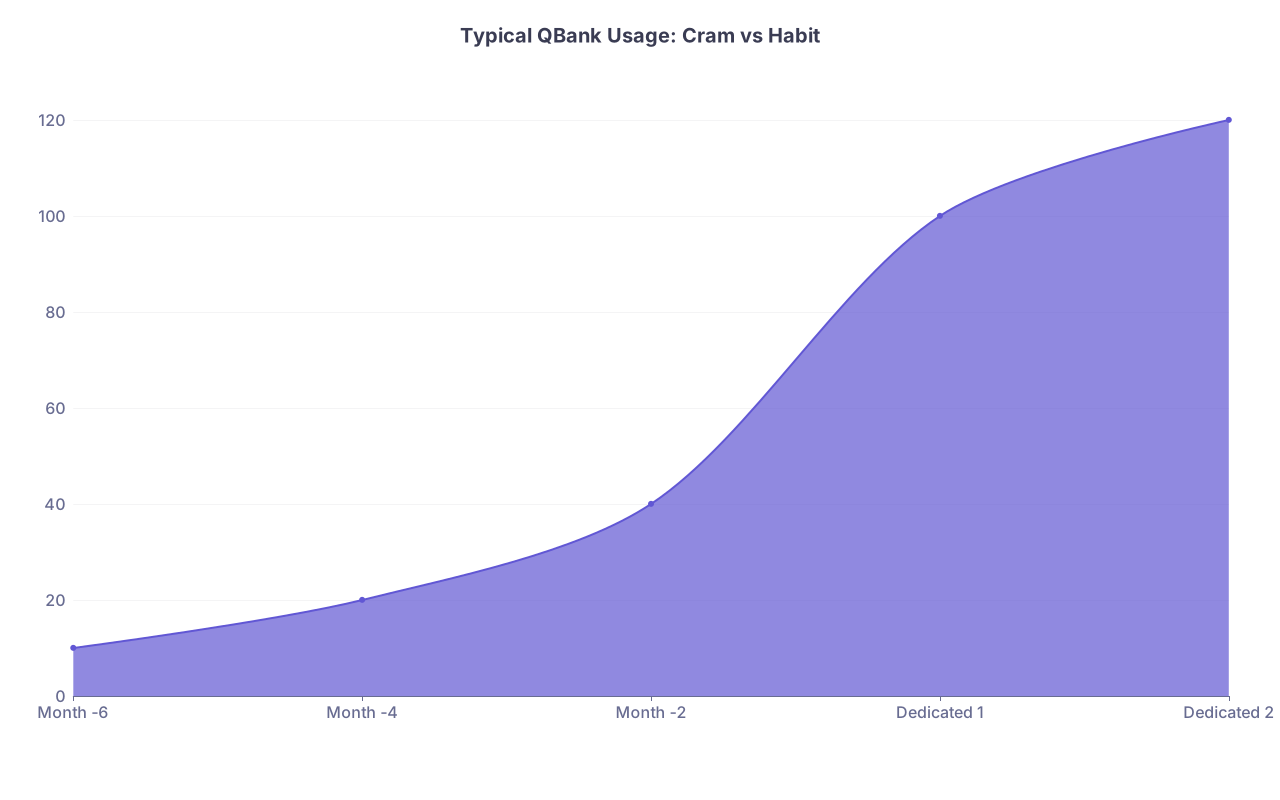
Most med students use question banks like this: cram them in a 6–8 week “dedicated” period, blast through 80–120 questions a day, and call it a strategy. That’s not a strategy. That’s damage control.
Here’s what the good habits actually look like.
Start doing fewer questions earlier and keep doing them consistently for months. Attendings who are now effective learners figured this out late, usually during boards studying for specialty exams. They realized that their brain retains much better from small, daily, high‑quality question exposure than from a frantic avalanche.
If you asked a seasoned IM attending what they wish they did in M2, they’d tell you: 20–40 UWorld‑style questions a day, starting the moment systems started in school. Not all-giant mixed blocks at first. Early on, you do system-based blocks synced to your course. Later, you transition to mixed blocks that resemble the exam.
Here’s the behind‑the‑scenes truth from program directors: they’ve watched residents with “great Step 1 scores” fall apart when they have to prep for boards again. Why? Because their only gear is “panic + cram + question binge.” No consistent, sustainable Q‑bank rhythm.
You want a professional habit? Build a non‑negotiable daily question dose.
- Pre‑dedicated: 20–40 questions/day, 5–6 days/week.
- Dedicated: 60–80/day, but structured and reviewed properly, not just blasted and forgotten.
You’re not learning to “do questions.” You’re learning to build a permanent daily question practice you can carry into residency when no one gives you protected time.
| Category | Value |
|---|---|
| Month -6 | 10 |
| Month -4 | 20 |
| Month -2 | 40 |
| Dedicated 1 | 100 |
| Dedicated 2 | 120 |
Habit #2: Review Questions Like a Clinician, Not a Score Chaser
Most students think, “I missed this, I need to memorize this fact.” That’s how you end up knowing that Pseudomonas is oxidase positive but still getting the question wrong.
Attendings who are actually good at teaching — the ones residents respect — review clinical decisions, not just facts. They ask: Why did I think this was the answer? Why is that thinking wrong? What pattern did I miss?
If you watched a strong attending on rounds, they don’t list facts. They run mental algorithms. Step 1 questions are testing exactly that — and your review should too.
When you review a block, this is what a grown‑up review looks like:
- Before reading the explanation, articulate out loud (or in writing) why you chose your answer.
- Pinpoint the error type:
- Misread question stem?
- Missed a key word?
- Didn’t know a fact?
- Knew the fact but failed to apply it?
- Then ask, “What will I do differently on the next question like this?” Very specific. Almost like you’re writing a new rule for your internal algorithm.
The attendings who say “I wish I’d learned how to think, not just memorize” are talking about this exact skill. They didn’t build it in med school. They built it the hard way — getting wrecked on wards when their knowledge didn’t translate to decisions.
So you can be the student who reads explanations for 2 minutes each and forgets 80% of them. Or the one who spends 5 minutes on a missed question and rewires how they read stems, interpret labs, and eliminate distractors.
One more thing insiders see all the time: residents who “did fine” on Step 1 but crumble on in‑service exams because they never learned to do this metacognitive review. Program directors absolutely notice the difference.
Habit #3: Build an Aggressive, Realistic Spaced Repetition System
Attendings are obsessed with this in hindsight. Ask them how often they actually do spaced repetition now. Most will laugh, glance at the stack of New England Journal articles on their desk, and say, “I wish.”
Here’s what a lot of them did during Step 1 prep:
- Wrote notes in margins.
- Highlighted entire chapters of First Aid.
- Watched videos and “felt” like they understood.
- Then tried to re‑read everything in 4 weeks.
That system doesn’t work when you’re 35, post‑call, trying to remember some obscure therapy change from last year’s guidelines. It didn’t really work for Step 1 either — they just compensated with time and stress.
The secret they wish they’d internalized earlier: spaced repetition isn’t optional. It’s the only way to keep high-yield information alive while your brain is being constantly bombarded with new material.
You already know the tool: Anki or something similar. The problem is that most students treat it either like a religion or like a fad. Neither is right.
What attendings now understand — too late — is that the system matters more than the deck.
You need three things:
- A controlled daily review limit that you will actually do, even on bad days.
- Cards that test recall and application, not trivia sentences.
- Integration of Q‑bank miss concepts into your system, not separate “graveyard notes” you never revisit.
The truth from faculty who watch residents: the ones who didn’t build a sustainable review habit in med school struggle to maintain clinical knowledge long‑term. You don’t magically become someone who can review 100 flashcards a day when you’re exhausted and have two kids. You either built that muscle or you didn’t.
So during Step 1 prep, stop asking “Which deck is best?” and start asking, “What daily review load can I sustain for 12 months without exploding?” Then ruthlessly prune low‑yield or redundant cards, and add only the highest‑leverage Q‑bank misses.
You’re training your future self to maintain a brain that actually remembers things under pressure. That’s the attendings’ regret: they built beautiful one‑time knowledge mountains and no maintenance systems.
Habit #4: Use Resources Like an Attending Uses Consults — Selectively and With a Clear Question
There is a phrase faculty say constantly behind closed doors: “Too many cooks, no chef.” They’re talking about consult‑happy medicine — when everyone weighs in and no one owns the decision.
You’re doing the same thing with resources.
You’re “using”:
- Boards & Beyond
- Sketchy
- Pathoma
- First Aid / Boards book
- UWorld
- AMBOSS
- Two different Anki decks
- Random YouTube channels
That’s not a study strategy. That’s a consult list.
Attendings figure out, painfully, that you don’t call every consult on every patient. You identify: what problem am I trying to solve, and what’s the smallest, highest-yield input I need?
Translate that to Step 1:
- Use one primary conceptual resource per domain. For example: B&B for broad systems, Pathoma for pathology, Sketchy for micro/pharm if that style works for you.
- Use one primary Q‑bank as your anchor (usually UWorld).
- Use a concise reference (First Aid or equivalent) as your physical or digital “index.”
Everything else should answer a specific question, not be part of your daily baseline.
Attendings wish they’d learned this when they were you. Instead, they wasted hours bouncing between resources, which felt like studying but didn’t build deep schemas. Then, as attendings, they had to re‑learn how to go to one UpToDate article, extract the key info, and move on.
Program directors can tell who’s still stuck in “resource tourism.” Those residents show up having “read a lot” but can’t commit to a clear answer or plan. They behave the same way they studied: scattered, non-committal, overwhelmed.
So in med school, do what they wish they’d done: brutally limit your core resources. Treat every extra видео or app as a consult: “What exactly am I trying to clarify, and how fast can I get in and out?”
| Role | Resource Example |
|---|---|
| Core Concept | Boards & Beyond |
| Core Path | Pathoma |
| Core QBank | UWorld |
| Reference Text | First Aid |
| Supplement | AMBOSS / Sketchy |
Habit #5: Align Your Daily Schedule With How Your Brain Actually Works
Here’s something attendings never say publicly but admit quietly: a huge amount of their “productivity” is just abusing caffeine and willpower to push through tasks at the wrong time of day.
They didn’t learn to work with their own brain, because med school never forced them to. Step 1 prep is your chance to fix that.
Most students build study schedules around:
- When friends are studying.
- When lectures are posted.
- When the library opens.
- When they feel guilty.
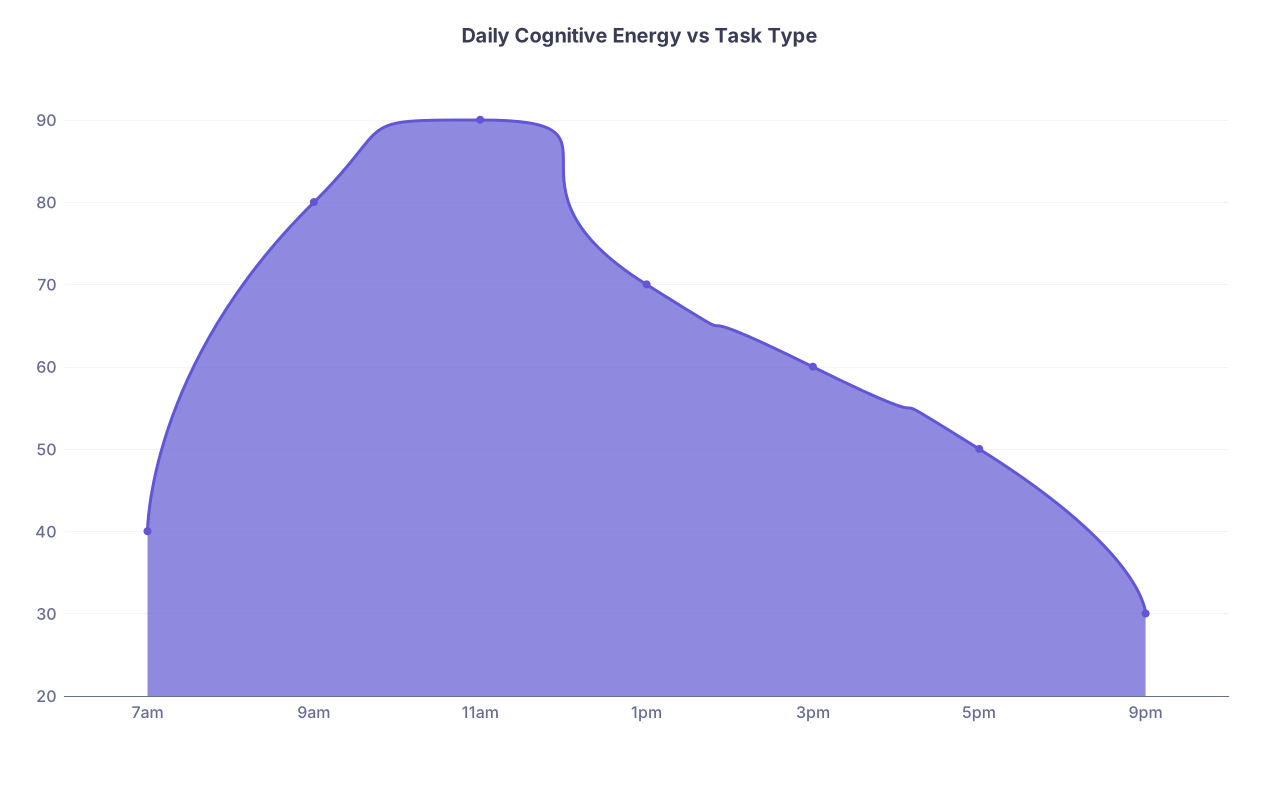
Attending life doesn’t care about that. You have one resource: your cognitive peak windows. For most people, that’s 2–4 hours in the morning, maybe another shorter one later in the day.
You want to know what attendings wish they’d done? They wish they’d protected those windows ruthlessly and put their hardest cognitive work there: practice questions and deep review. Not video watching. Not highlighting. Not “organizing” their Anki.
Your Step 1 day should look more like how you’ll eventually structure a serious board review month as an attending:
- Peak brain slots: full, timed Q‑blocks and hard review.
- Medium brain slots: content learning from your core resources.
- Low brain slots: light Anki, passive review, cleanup.
| Category | Value |
|---|---|
| 7am | 40 |
| 9am | 80 |
| 11am | 90 |
| 1pm | 70 |
| 3pm | 60 |
| 5pm | 50 |
| 9pm | 30 |
You’re not just trying to survive dedicated. You’re training your brain to respect its own natural rhythm and plan your work accordingly. Attendings who never learned this end up writing notes, answering messages, and reading articles at 11 p.m. because they abused their good hours with nonsense tasks.
You can avoid that fate. But you have to build the habit now: hardest work when you’re sharpest. Non‑negotiable.
Habit #6: Practice Test‑Day Conditions Early and Often
Here’s the thing nobody tells you until after residency: being able to perform on demand — tired, stressed, uncomfortable — is a core attending skill. Step 1 is just the earliest, clearest version of that test.
When you see a confident attending nail a complicated case at 3 a.m., you’re not watching “raw intelligence.” You’re watching someone who, over years, repeatedly trained themselves to perform under imperfect conditions.
Most med students do the opposite in Step 1 prep. They build unrealistically protected, ideal test environments and then are shocked when the real thing feels like a war zone.
Attendings I know who crushed their later boards (after struggling on earlier exams) all independently did one thing differently: they started practicing full‑length, or near-full-length, blocks way earlier than they “needed” to. Not for content. For stamina, focus, and emotion management.
You want that habit now:
- Start doing 40‑question timed blocks in realistic conditions well before dedicated.
- During dedicated, string multiple blocks together at least once a week.
- Do at least a few “ugly” practice days: not enough sleep, mild headache, some background noise. Not torture, but not perfect.
Why? Because attendings know the truth: your performance floor matters more than your performance ceiling. On test day you’ll be closer to your floor.
Faculty on CCC committees (Clinical Competency Committees) talk about this all the time: the resident who only functions when the stars align is a liability. The one who’s learned to deliver safe, solid performance even when wrecked — that’s who they trust with the sick patient at 5 a.m.
You train that now by not babying your test practice. Put your brain in real exam mode regularly. Treat NBMEs like scrimmages, not mystical score oracles.
Habit #7: Reflect Like a Professional, Not a Panicked Student
There’s a quiet skill the best attendings have that most students never practice: structured reflection. Not journaling for vibes. Cold, clean self‑audit.
The attendings who keep getting better, even 10–20 years in, do something like this: every few weeks they ask themselves, “What am I consistently messing up? What’s my plan to fix it?” They don’t wait for annual reviews. They run their own.
You can steal that now with a very simple, very underused Step 1 habit: a weekly diagnostic.
Once a week — same day, fixed time — you sit down and answer a few questions in writing:
- What topics or question types wrecked me this week?
- What patterns do I see in my misses? (e.g., multi‑step path questions, pharm toxicity, biostats)
- What is the one specific adjustment I’m going to test next week?
Not five adjustments. One.
Maybe it’s: “This week, every time I see a metabolic disease question, I will pause and explicitly write the deficient enzyme before reading the answer choices.” Or: “For every cardio question, I will spend 15 seconds drawing the pressure–volume loop before committing.”
Program directors wish their residents did this. Most don’t. They show up to semiannual reviews surprised by feedback that has been obvious for months.
You don’t have to be that person. Use Step 1 as your training ground for becoming someone who self‑corrects faster than the system can correct you.

| Step | Description |
|---|---|
| Step 1 | Finish Study Week |
| Step 2 | Review QBank & NBME Data |
| Step 3 | Identify 1-2 Weak Patterns |
| Step 4 | Choose 1 Specific Adjustment |
| Step 5 | Apply Adjustment Next Week |
| Step 6 | Reassess in Next Reflection |
Habit #8: Protect Your Sleep and Mood Like a Future Attending, Not a Martyr
This part you probably expect, but not for the reasons you’ve been told.
Students are told “sleep is important” like a health class slogan. Attendings learn the hard way: chronic sleep debt and unmanaged mood are direct threats to your license, your decision‑making, and your sanity.
During Step 1 prep, you are running a controlled experiment on how you’ll behave under pressure in your future career. If your response to stress is: cut sleep, cut movement, isolate socially, and power through with caffeine — that script will come back later on call months. Harder.
Behind closed doors, faculty talk about this more candidly. They know exactly which residents are on the edge: snappy, constantly tired, can’t focus on presentations, missing details in notes. Those habits usually started as “just for boards” or “just for this exam block.”
You want boring, grown‑up habits now:
- Minimum sleep floor you do not cross unless absolutely forced (and Step 1 studying does not qualify as “forced”).
- Some kind of movement most days — not for fitness, but for brain maintenance.
- A tiny bit of non‑med life preserved, even in dedicated: one friend, one hobby, one walk, something.
This isn’t wellness poster talk. It’s pragmatic performance engineering. Exhausted brains do not consolidate complex integration. They memorize brittle facts and drop them under stress.
Attendings will tell you, if you catch them off‑guard: “I wish I’d taken my own brain as seriously as I took my UWorld completion percentage.”
FAQ (Exactly 5 Questions)
1. How early should I start “real” Step 1 studying if I want these habits to stick?
If you’re in pre‑clinicals, you’re already in it. “Real” studying doesn’t mean cramming First Aid. It means: starting a modest but consistent Q‑bank habit, integrating spaced repetition tied to your courses, and limiting yourself to a small set of core resources. Six months before your dedicated period, you should already be comfortable doing at least one 40‑question timed block a few days per week.
2. Is it a mistake to use more than one Q‑bank?
It depends on your timeline and discipline. Attendings who did this well usually had one primary bank (often UWorld) and, only after finishing it with high‑quality review, used a second bank (like AMBOSS) for targeted reinforcement. If using two means you rush explanations or skip review, it’s a net negative. Mastery of one bank with deep review beats superficial exposure to two every time.
3. How many hours a day should I study during dedicated if I’m using these habits?
Most students overestimate their productive capacity. The attendings who look back and say “I actually learned” were in the 6–8 hours of real work range, not 12–14 hours of half‑focus. If you’re doing 2–3 solid Q‑blocks, thoughtful review, some Anki, and focused content reinforcement, you’re at capacity. Beyond that, the returns drop off fast, and you start building bad efficiency habits you’ll regret later.
4. What if my school curriculum is terrible — do these habits still matter?
Yes, maybe even more. A weak curriculum means you can’t rely on lectures to structure your learning. That’s exactly when professional‑grade habits — consistent Q‑bank usage, a tight resource stack, spaced repetition, and weekly reflection — become your safety net. Program directors do not care how good your curriculum was. They care whether you can synthesize, retain, and apply. These habits are how you bridge that gap.
5. How do I know if my Step 1 system is actually working and not just “busy”?
Two signs. First, your NBME practice scores trend upward or at least stabilize at an acceptable level over several weeks. Second, your internal experience during questions changes: you start recognizing patterns, feeling less surprised by stems, and can often articulate why other answer choices are wrong. If your hours go up but scores are flat and questions still feel random, your system is noise. Cut resources, slow down review, and tighten your reflection loop.
If you remember nothing else, remember this:
- Treat questions and spaced repetition as your long‑term training ground, not a short‑term emergency measure.
- Limit your core resources and schedule your hardest work into your sharpest hours — like a professional, not a panicked student.
- Use Step 1 prep to build the reflection, stamina, and self‑maintenance habits you’ll desperately wish you had when you’re an attending at 3 a.m. making real decisions on real patients.