
The study resources you choose for Step 1 are not neutral. They are a personality test you do not realize you are taking.
Faculty, clerkship directors, and residents absolutely judge what you use—and how you use it. They may not say it to your face, but they talk about it in offices, on committees, and in those casual hallway conversations where your name comes up.
Let me tell you what is actually being said.
The Hidden Language of Step 1 Resources
Students think Step 1 prep is about “what works best for my learning style.”
Faculty think Step 1 prep is about:
Can this person filter information? Can they commit to a plan? Are they grounded in fundamentals, or chasing hacks?
Your resources are a shorthand signal of your maturity, clinical potential, and how you’ll function as a resident.
Programs do not care which specific Anki deck you used. But they care whether you were the type of person who lived entirely in a deck and could not answer a basic pathophys question on the wards.
They do not care if you used Sketchy vs. Boards & Beyond vs. Pathoma. They care whether you used them as crutches or tools.
And yes, attendings notice when you quote UWorld explanations like scripture but cannot think through a simple differential without pattern-matching.
The “Core Four” and What They Signal
Let’s start with the four classic Step 1 resources: First Aid, UWorld, Pathoma, and Anki. Faculty know these names. They hear them constantly. They have feelings about them.
1. UWorld (or any primary question bank)
To most faculty, UWorld is like scrubs: if you are not using it, there had better be a very good reason.
Using UWorld as a mainstay signals:
- You understand that application > memorization
- You are willing to struggle through hard questions
- You get that Step is about pattern recognition and reasoning
Where it goes wrong—what faculty actually complain about—is how you relate to it.
There is a big difference between:
- Student A: “I used UWorld to see what I didn’t understand and then went back to my notes and lectures.”
- Student B: “I did UWorld twice, memorized the questions, and my score plateaued.”
Faculty (especially those who sit on promotions or remediation committees) have a mental model:
- Heavy QBank, with review and note-taking → likely to become a decent intern
- Pure QBank grinding, no concept-building → likely to struggle when cases are not textbook
I’ve sat in meetings where a course director said, “She keeps telling me she did 3,000 questions, but she still can’t explain why a beta-blocker helps in this situation. That’s not studying. That’s gambling.”
Using only UWorld, without pairing it with real content review, signals you might be good at test-taking but shallow on understanding. That image follows you into clinical evaluations whether you like it or not.
2. First Aid (or equivalent master outline)
First Aid has a strange status. Students worship it. Faculty… respect it, but with suspicion.
Here is what your First Aid usage signals:
If you annotate it with insights from lectures and QBank explanations:
You understand integration. You are trying to tie school to Step. That is viewed positively by most faculty.If you carry it everywhere, dog-eared, highlighted neon on every page, and can quote tiny tables but can’t reason through a basic case:
You look like a memorizer. Faculty translate that as: “Good for Step, mediocre on wards.”
Program directors talk about this more than you think. I’ve heard, word-for-word:
“She was clearly a First Aid machine. Great test score. But on rounds, if the patient didn’t match a board question she’d seen, she froze.”
If First Aid is your spine for organizing knowledge, that signals discipline and structure.
If First Aid is your only source of truth, that signals insecurity and fragility.
3. Pathoma / Boards & Beyond / similar content videos
These video series are the faculty’s replacement, whether they admit it or not.
Using them signals that you:
- Recognize that your school lectures might not be optimal for Step
- Are able to seek high-yield external structure
- Are willing to invest time upfront in concept-building
Many path or medicine attendings quietly love Pathoma. Some literally say, “Just watch Sattar for this section; he explains it better than I do.”
But they also see patterns:
- Student who watches Pathoma/B&B, takes notes, then practices questions → usually strong on rounds, able to explain mechanisms coherently
- Student who binge-watches videos at 1.75x as “passive study,” then crams QBank at the end → usually weak under pressure, memorized but not internalized
So your choice to rely on these as a core strategy is not the issue. It’s whether you use them like lectures (active) or like Netflix (background noise).
4. Anki and the flashcard obsession
Let me be blunt. Faculty are divided on Anki, and the division is generational.
Younger attendings and recent grads often used Anki themselves. They know its power.
Older attendings and some basic scientists view it with skepticism or outright annoyance.
What it signals when you are “an Anki person”:
- Positive signal: You understand spaced repetition. You are organized. You build long-term memory deliberately.
- Negative signal: You may be over-reliant on micro-facts. You might struggle to synthesize and prioritize.
What faculty actually see is this: the student who can recite the complement pathways flawlessly, but cannot handle a new, messy clinical vignette without flailing.
And yes, we notice when your brain is so wired to flashcard-level recall that your presentations sound like pre-made scripts instead of clinical reasoning.
If you tell a faculty member, “I just do my 1,000 Anki reviews every day and I’ll be fine,” many will hear:
“I’m more focused on protecting my card streak than on understanding patients.”
On the other hand, if you say, “I use Anki mainly to keep pharm and details fresh, but my real learning is from questions and explaining concepts out loud,” that lands very differently. That sounds mature.
The Red Flag Resources: What Makes Faculty Raise an Eyebrow
Some resources themselves aren’t bad. The way students use them makes faculty quietly worried.
Constantly-Changing, Trend-Driven Resources
Every year, there’s a “hot” resource. A new QBank, a new book, some flashy online course the MS2s swear by.
Faculty see the pattern: the more you chase trends, the more you signal you lack a core strategy.
The student who says:
“I started with Rx, then switched to UWorld, then added AMBOSS, then I’m thinking of trying this new QBank that just came out…”
is telling us, very clearly: “I panic. I cannot commit. I think the resource is the magic, not the work.”
That is exactly the kind of person who disintegrates in residency when the plan changes on a sick patient.
Ultra-Niche “Hacks” Resources
Buying every “high-yield” secrets PDF, obscure mnemonics course, or some influencer’s “Step 1 in 30 days” plan sends one loud message:
You’re trying to bypass the grind.
Faculty know these products exist. Some of us have seen them. Many of us roll our eyes at them. We have also watched students who buy them crash and burn.
I’ve heard a program director say:
“If I see a student quoting some YouTuber’s shortcut during morning report instead of understanding the actual physiology, I start questioning their judgment.”
You can absolutely use one or two targeted, well-curated extras. But if your resource list starts sounding like a Kickstarter catalog, it sounds like you’re collecting magic keys instead of learning medicine.
Over-Reliance on School Notes Alone
This one may surprise you. A small subset of students proudly say, “I study only from my school’s lectures and notes. That’s enough.”
To basic science faculty, that can be flattering.
To clerkship directors and residency leadership, it can sound naive.
What it signals:
- You might lack awareness of national standards
- You may not understand that Step is a different game than your block exams
- You could be resistant to external feedback or broader perspectives
Programs want people who know how to look beyond their own institution’s walls. Students who refuse to touch any national resource signal a kind of intellectual provincialism.
How Resource Choices Show Up in Clinical Years
Here’s where the secret really lives: faculty do not form their opinions of Step resources in a vacuum.
They form them after years of watching students on the wards and tracking what those students used to study.
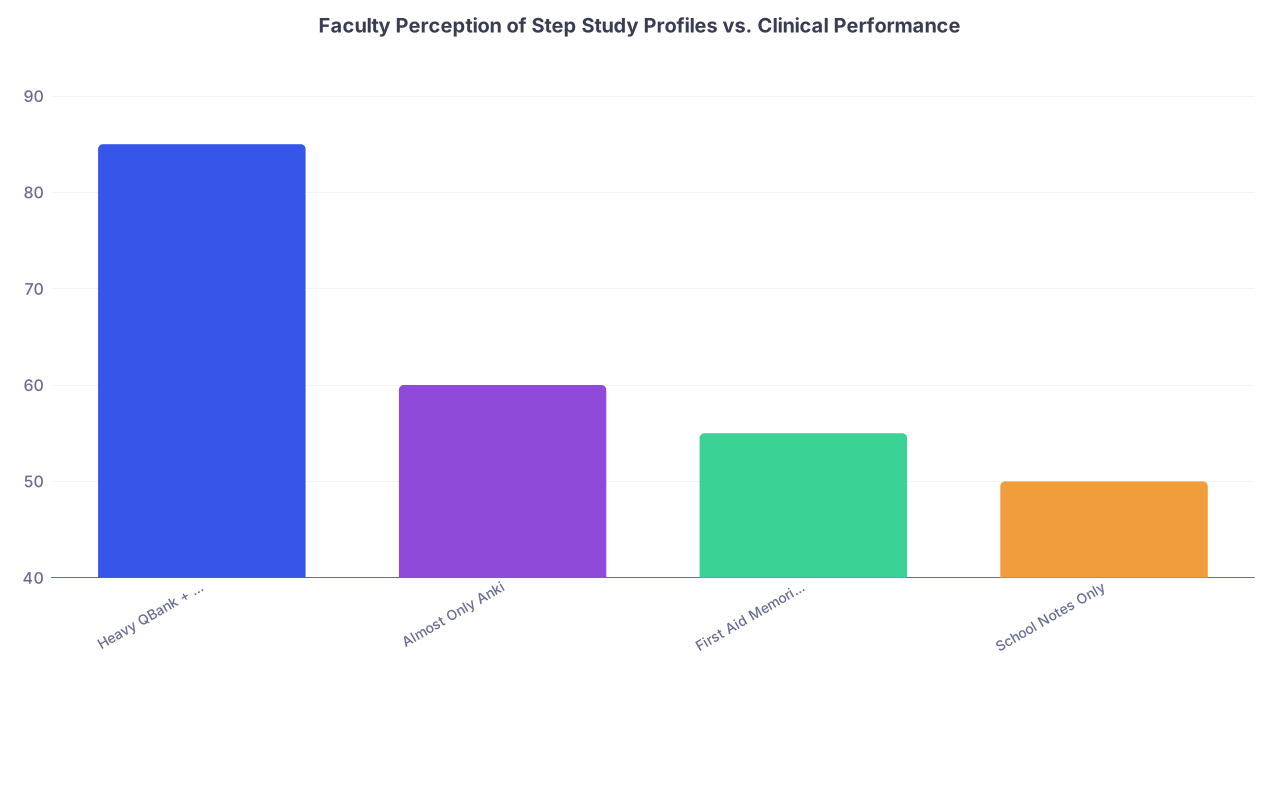
Over time, patterns show up. And yes, some of us informally track them.
| Category | Value |
|---|---|
| Heavy QBank + Concept Videos | 85 |
| Almost Only Anki | 60 |
| First Aid Memorizer | 55 |
| School Notes Only | 50 |
(Values represent approximate perceived likelihood, in %, that a student will perform strongly on the wards, based on faculty anecdotes and impressions—not formal data.)
What we repeatedly see:
Students with a balanced mix of QBank + solid concept videos + some form of spaced repetition tend to handle uncertainty well. They can argue through a case. They might not know every rare enzyme, but they can treat a real patient.
Students who live almost entirely in Anki often crush tiny details but struggle with big picture: prioritizing problems, recognizing “sick vs not sick.”
Students who are pure First Aid memorizers often shine in oral pimp sessions early but fade when asked to integrate multiple systems in real time.
Students who cling to school notes, ignoring national resources, are hit-or-miss. A few do well if their school is strong; many are blindsided by how different real clinical reasoning feels from pre-clinical exams.
On evaluation forms, this shows up in subtle ways:
“Struggles to apply knowledge”
“Relies heavily on pattern recognition”
“Could not generalize beyond textbook scenarios”
Those phrases track back, more often than not, to unbalanced resource strategies.
What Your Choices Signal About Professionalism and Judgment
Step 1 resources do not just tell us how you study. They tell us what kind of doctor you are likely to be.
Faculty read your choices for clues about:
- Can you filter the noise?
- Do you fall for hype?
- Do you build a foundation or chase shortcuts?
- Are you honest about your weaknesses?
If you openly say to a mentor:
“I bought way too many resources at first. I realized I was using them to cope with anxiety, not to actually learn. I cut down to a core of three and my understanding got better.”
That signals insight. Judgment. Growth.
If you defend a clearly chaotic, scattershot approach with, “Well, everyone online says this resource is essential,” that signals a follower, not a future leader. Programs notice.
How to Talk About Your Step 1 Resources So You Sound Like an Adult
You will be asked—directly or indirectly—about how you studied. On sub-internships. During mentorship meetings. Sometimes even in residency interviews.
The way you describe your resources matters almost as much as the resources themselves.
Here is the difference in how it lands:
“I used everything—Pathoma, B&B, Sketchy, all the QBanks, plus a couple of new courses I saw on Reddit.”
Faculty translation: scattered, anxious, lacks discernment.
versus
“I picked a primary QBank and a main concept resource. I tried a couple of others early on, but they didn’t add much so I dropped them and focused on mastering my core tools.”
Faculty translation: focused, reflective, coachable.
Or:
“I’m an Anki person. I just did my reviews and trusted the spaced repetition.”
Faculty hear: maybe rigid, maybe too dependent on a specific method.
versus
“I relied on Anki for pharm and some micro, but I realized I also needed to understand mechanisms at a deeper level, so I paired that with Pathoma and lots of UWorld review.”
Now we’re hearing balance and integration. That’s the kind of person we want in our program.
A Sane Framework: What Your Mix Should Signal
Here is the profile that quietly impresses most faculty, even if they never say this out loud.
| Resource Type | What It Signals If Used Well |
|---|---|
| Primary QBank | Application, resilience, clinical thinking |
| Concept Videos | Foundation-building, respect for mechanisms |
| Condensed Outline | Organization, synthesis, structure |
| Spaced Repetition | Long-term memory, discipline |
| Limited Extras | Judgment, ability to filter noise |
The exact brands do not matter as much as this structure. You could swap UWorld for AMBOSS, Pathoma for another strong path course, Anki for a different spaced tool.
What faculty want to see (or infer) is:
You picked a few strong, complementary resources.
You committed.
You used them thoughtfully.
You did not panic-add five new tools every time a friend scored higher than you.
That signals maturity. That maturity is more predictive of your success as a resident than whether you used Sketchy or not.
How to Course-Correct If Your Current Setup Sends the Wrong Signal
If you’re reading this recognizing yourself in the “too many resources,” “trend-chaser,” or “Anki tunnel-vision” categories, you are not doomed.
Faculty care less about where you started and more about how you adjust.
A practical reset looks like this:
- You admit, to yourself or a mentor: “My setup is more about anxiety than learning.”
- You choose 1 primary QBank, 1 main concept resource, 1 outline/summary tool, and a targeted spaced repetition method.
- You intentionally cut 2–3 “nice to have” or ego-boost resources.
Then, if a faculty member asks you what you used, you can honestly say:
“I began with way too many resources, but after a few weeks I realized I wasn’t going deep. I trimmed down to a focused system and stuck with that. My practice scores and confidence both improved when I did that.”
That is exactly the kind of story that makes an attending think: this person learns. This person will adjust when an ICU rotation slaps them in the face.
The Thing No One Tells You
Years from now, nobody on your team will care whether you used Pathoma or Boards & Beyond. They will care whether you can walk into a room, see a sick patient, and make sense of what’s happening.
Your Step 1 resources are not just about passing an exam. They are your first real test in how you curate information in a world drowning in it.
That’s what faculty are reading when they look at how you studied. Not the brand names on your books. The judgment behind them.
Years from now, you won’t remember the exact flashcards or question stems. You’ll remember whether you built a way of learning that actually made you into a physician instead of just a test-taker.