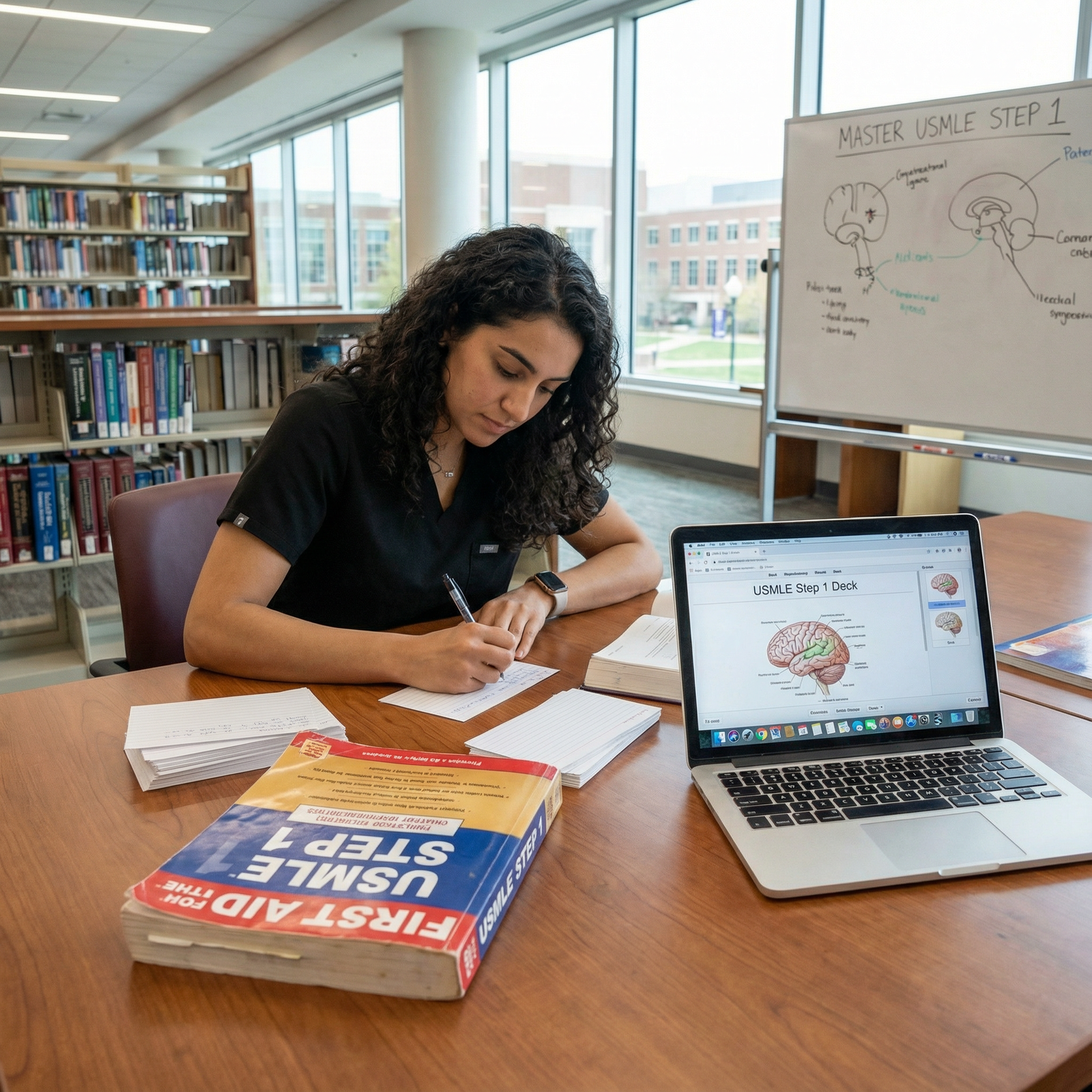
Introduction: Why Flashcards Are Essential for USMLE Step 1 Recovery
USMLE Step 1 remains one of the defining exams in medical education, even in the pass/fail era. Whether you’re recovering from a disappointing practice exam, rebuilding after a failed attempt, or simply trying to strengthen weak areas, you need a study method that is both efficient and durable. Flashcards—when designed and used correctly—are one of the most powerful Active Learning tools for Step 1 recovery.
But not all flashcards are created equal. Random, bloated, or poorly structured cards can waste precious time and add to your stress. Thoughtfully crafted, high-yield flashcards, on the other hand, convert dense resources into retrievable, exam-ready knowledge.
This guide walks you through a structured, evidence-based approach to Flashcard Creation specifically tailored for USMLE Step 1 recovery. You’ll learn not just what to put on your cards, but how and why, using principles from cognitive science and medical education.
Understanding USMLE Step 1 and How Flashcards Fit In
Before you start building a massive deck, you need to understand what you’re building for. The design of your flashcards should mirror the design of the exam.
Core Features of USMLE Step 1
Content Domains:
- Anatomy, histology, embryology
- Physiology
- Biochemistry and molecular biology
- Pharmacology
- Microbiology and immunology
- Pathology
- Behavioral sciences, biostatistics, and epidemiology
- Interdisciplinary clinical vignettes integrating multiple systems
Question Style:
- Long, clinical vignettes
- Require integration of multiple concepts
- Often test mechanism, not just memorized facts
- Emphasis on application: “Given this patient, what’s the most likely mechanism / next step / diagnosis / drug effect?”
Why Flashcards Work for Step 1 Recovery
Flashcards are excellent for Step 1 recovery because they:
- Support Active Learning and active recall, strengthening memory retrieval pathways.
- Are ideal for spaced repetition, which is crucial when you’re rebuilding long-term knowledge.
- Help convert overwhelming resources (First Aid, question banks, lecture notes) into manageable “knowledge atoms.”
- Allow targeted review of weak systems and high-yield topics after NBME or UWorld performance analysis.
Your flashcard strategy should be aligned with how you’re tested: not just “What is X?” but “In this clinical scenario, what does X mean, cause, or change?”
Step 1: Gather and Prioritize High-Yield Resources
High-quality inputs lead to high-quality flashcards. Before you start typing cards into Anki or writing on index cards, clarify what you’re pulling from—and why.
Essential Resources for USMLE Step 1 Flashcard Creation
Core Review Books
- First Aid for the USMLE Step 1: Still the gold standard roadmap for high-yield content.
- Supplementary texts (e.g., Pathoma, BRS Physiology, Sketchy, microbiology/pharmacology resources) for deeper understanding.
Question Banks
- UWorld, AMBOSS, or similar:
- Your errors and marked questions are prime flashcard material.
- Turn missed concepts, frequently confused differentials, and “gotcha” mechanisms into cards.
- UWorld, AMBOSS, or similar:
Lecture / Course Notes
- Especially important if your school’s curriculum emphasizes certain areas that often appear on Step 1.
- Use lectures to clarify mechanisms that feel vague in review books.
Official Practice Exams
- NBME, UWSA, Free 120:
- After each exam, list concepts you missed or guessed.
- Create flashcards directly from those gaps.
- NBME, UWSA, Free 120:
Prioritizing Content During Recovery
When rebuilding for Step 1:
Start with Weak Systems
Use your NBME or UWorld performance profiles to identify bottom quartile systems (e.g., renal, neuro, behavioral sciences).Focus on High-Yield and Frequently Tested Concepts
- Classic pathologies (MI, DKA, nephritic/nephrotic syndromes, shock types).
- Core pharmacology: autonomics, cardio, antibiotics, psych drugs.
- High-yield microbiology organisms and their classic presentations.
Avoid Copying Books into Cards
- Your goal is distillation, not transcription.
- Each flashcard should capture a key idea, mechanism, or comparison—not a whole page of text.
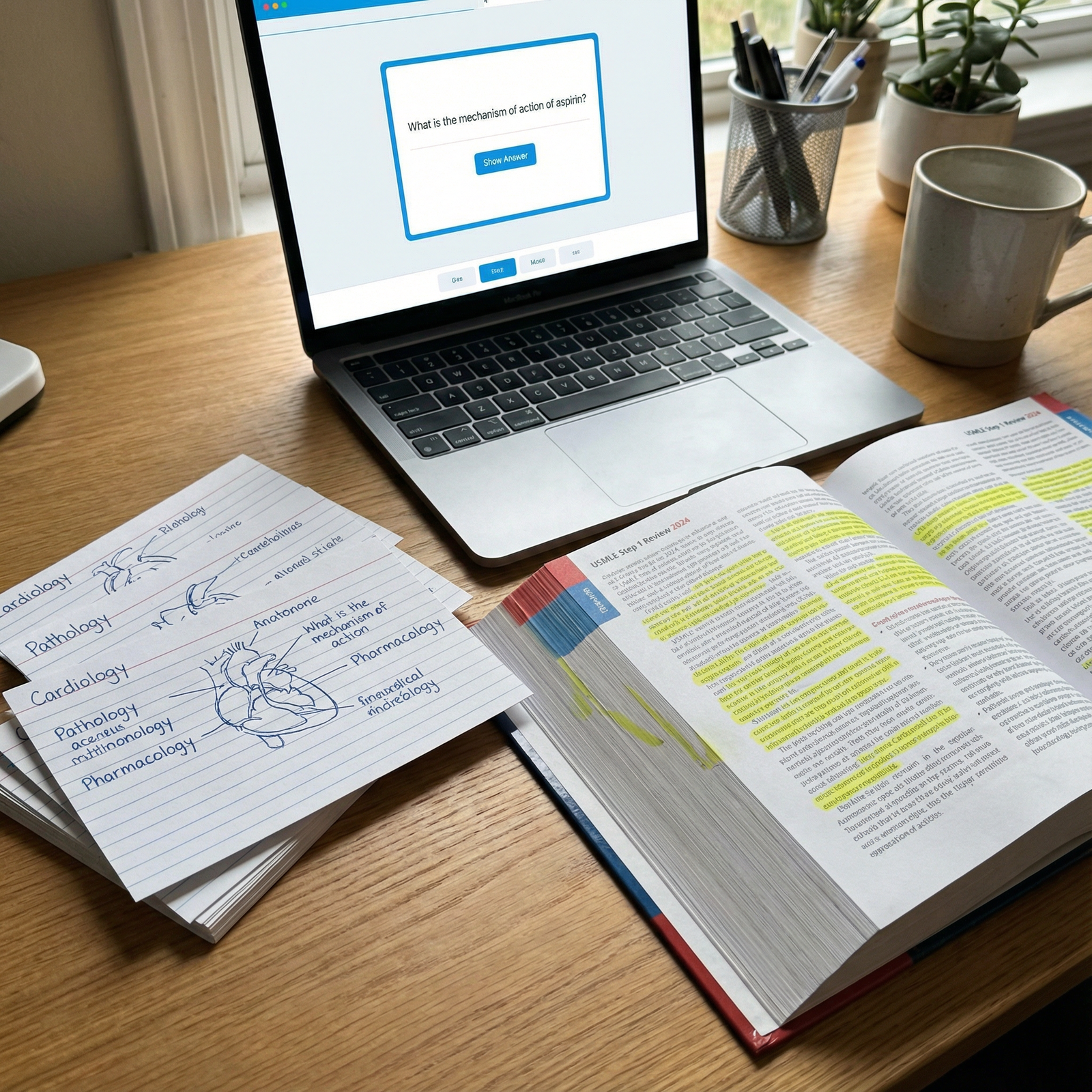
Step 2: Identify and Define High-Yield Concepts for Cards
Effective Study Tips start with knowing what actually deserves a flashcard. Overproduction leads to burnout; underproduction leaves dangerous gaps.
Use a Simple Selection Rule: “Will Future Me Need to Recall This?”
Turn information into flashcards if it is:
- Frequently tested (seen in multiple Qbank items or practice exams)
- Easy to confuse (similar drugs, bugs, pathologies)
- Mechanistic and foundational (Starling forces, second messengers, autonomic pathways)
- A common “got wrong” or “guessed” item in your practice questions
Skip or minimize flashcards for:
- Trivial minutiae that you rarely see tested
- Overly detailed numbers (e.g., rare lab values)—unless they’re repeatedly tested
- Long lists with minimal clinical relevance
Apply Bloom’s Taxonomy to Flashcard Levels
Instead of only making fact-recall cards, incorporate higher-level thinking:
- Remembering (Basic Recall)
- Example: “What organism causes whooping cough?”
- Understanding (Explain / Summarize)
- Example: “Explain why β-blockers are contraindicated in cocaine-associated chest pain.”
- Applying (Use in a Scenario)
- Example: “A patient on a nonselective β-blocker develops wheezing. What receptor blockade caused this?”
Aim to build a mix:
- 50–60% basic recall (foundation)
- 30–40% mechanism and explanation
- 10–20% application to short, focused vignettes
Step 3: Use Active Learning Principles in Card Design
Flashcards for USMLE Step 1 should embody Active Learning, not passive rereading.
Card Structure: Question First, Reasoning on the Back
Example: Pharmacology
- Front:
“Mechanism of action of β-blockers in decreasing myocardial oxygen demand?” - Back:
“Block β1-adrenergic receptors → ↓ heart rate and contractility → ↓ myocardial oxygen consumption. Also prolong diastole → ↑ coronary perfusion time.”
This design:
- Forces you to retrieve from memory (active recall)
- Reinforces both the core fact and the “why,” improving long-term retention
Use Short, Focused Clinical Vignettes
You don’t need full-length UWorld-style vignettes, but adding clinical framing boosts exam transfer.
Example: Pathology
- Front:
“25-year-old with periorbital edema, hematuria, and RBC casts 2 weeks after strep throat. What is the underlying immunologic mechanism?” - Back:
“Type III hypersensitivity reaction—immune complex deposition in glomerular basement membrane → complement activation and inflammation (post-streptococcal glomerulonephritis).”
Visual and Diagram-Based Cards
For visual learners and complex processes:
- Sketch small pathways (e.g., urea cycle, glycolysis rate-limiting steps).
- Use images (radiology, dermatologic rashes, histopath slides) if your software supports it.
- For micro: pair organism with characteristic image or stain (e.g., India ink for Cryptococcus).
Example: Physiology Diagram Card
- Front: “Draw and label the Starling curve for a normal heart vs. heart failure.”
- Back: Small diagram + concise explanation of shift and clinical implications.
Mnemonics and Memory Aids
Use mnemonics strategically for:
- Drug side effects (e.g., “Hot as a hare…” for anticholinergic toxicity)
- Cranial nerves, brachial plexus, or complex lists
- Microbiology virulence factors
Include both:
- The mnemonic, and
- The decoded list, so you don’t remember only the phrase.
Step 4: Keep Cards Concise, Targeted, and “One-Bite”
Overloaded cards are one of the most common flashcard mistakes in medical education. The brain learns better from small, well-defined units.
One Concept per Card
Avoid this:
- Front: “Types of hypersensitivity reactions and examples.”
- Back: A wall of text listing all four types and multiple examples.
Instead, break it down:
- Card 1: “Type I hypersensitivity—mechanism.”
- Card 2: “Type I hypersensitivity—classic clinical examples.”
- Card 3: “Type II hypersensitivity—mechanism.”
- Card 4: “Type II hypersensitivity—example: autoimmune hemolytic anemia.”
This approach:
- Makes reviews faster
- Improves accuracy tracking (you know which type you’re weak on)
- Reduces frustration and cognitive overload
Use Shorthand and High-Yield Phrasing
- Abbreviations: “↑, ↓, ⬆, ⬇, Na+, K+, ACh, β1, β2, Gq, Gs, Gi”
- Keep sentences tight and to the point.
- Bold or highlight the highest-yield phrase if your platform allows.
Example:
- Front: “Mechanism of ARBs in treating hypertension?”
- Back: “Block AT1 receptors → ↓ vasoconstriction and ↓ aldosterone secretion → ↓ BP, ↓ afterload.”
Step 5: Implement Spaced Repetition as Your Core Study Engine
Creating flashcards is only half the battle. Reviewing them efficiently using spaced repetition is what drives your USMLE Step 1 recovery.
Why Spaced Repetition Matters for Step 1
Spaced repetition exploits the brain’s forgetting curve:
- Reviewing information right before you would forget it dramatically strengthens memory.
- Over time, intervals between reviews grow longer → long-term, durable retention.
For Step 1 recovery, this is key because:
- You’re re-learning old material while adding new.
- You must retain content over months, not days.
Practical Setup (e.g., Anki or Similar Tools)
Daily Review Commitment
- Make flashcard review a non-negotiable daily task.
- Protect your review time like clinic hours—no skipping.
Limit New Cards per Day
- For recovery: 40–80 new cards/day is typical, adjusted to your schedule.
- Balance new learning with reasonable review load.
Tag and Organize by System and Topic
- Tags like:
cardio,renal,pharm_Autonomics,micro_Gram+,biostats. - This allows focused review blocks when a system is lagging.
- Tags like:
Use the Rating System Honestly
- Mark cards “easy” only if you instantly and confidently knew them.
- If you hesitated or partially guessed, choose a more conservative rating.
Step 6: Build Connections and Integrate Concepts Across Systems
USMLE Step 1 is not a pile of isolated facts; it’s an integrated exam. Your flashcards should help you think in networks, not silos.
Comparative and “Versus” Cards
These are excellent for differentiating look-alike concepts:
Example: Pharmacology
- Front: “Differences between ACE inhibitors and ARBs: mechanism and side effect profile.”
- Back:
- ACEi: block conversion of Ang I → Ang II; ↑ bradykinin → cough, angioedema.
- ARBs: block AT1 receptor; no effect on bradykinin → less cough/angioedema.
Example: Pathology
- “Nephritic vs. nephrotic syndrome—key clinical differences.”
Integration Cards: Linking Path, Phys, and Pharm
These cards mirror the exam’s integrated clinical scenarios.
- Front:
“How do β-blockers benefit patients with chronic stable angina at the level of myocardial oxygen supply and demand?” - Back:
“↓ HR and contractility (β1 blockade) → ↓ O2 demand. Longer diastole → improved coronary perfusion → relatively ↑ O2 supply. Net effect: symptom relief and better exercise tolerance.”
You can create similar cards for:
- Shock types + hemodynamic changes + treatment
- Endocrine disorders + lab findings + management
- Microorganism + host response + key drug choice
Step 7: Use Flashcards to Test Yourself and Drive Question Bank Performance
Flashcards are not a replacement for question banks—but they make your Qbank time much more productive.
Self-Testing with Cards
- Aim for active, eyes-closed recall:
- Look at the front.
- Say the answer out loud or in your head before flipping.
- If you’re unsure, still commit to an answer, then check.
Teach-Back Method
- After reviewing a set of related cards (e.g., heart failure drugs), close your deck.
- Explain the topic as if teaching a classmate:
- Mechanism, indication, side effects, contraindications.
- Note gaps and create new cards or refine existing ones.
Linking Cards to Qbank Errors
After each Qbank session:
- Review your incorrect and guessed questions.
- Ask: “What single concept, mechanism, or comparison would have helped me answer this?”
- Create 1–3 targeted cards per missed question, not 10.
Over time, your deck becomes a personalized, high-yield map of your weaknesses turned strengths.
Real-World Application: A Step 1 Recovery Example
Consider a student who failed Step 1 on the first attempt with weak performance in renal, cardio, and biostatistics. For their recovery plan, they:
- Analyzed old NBMEs and UWorld blocks to identify patterns of missed concepts.
- Built a focused Anki deck of ~4,000 cards over 3–4 months, mostly from:
- Missed Qbank questions
- First Aid high-yield bullet points
- Classic pathophysiology mechanisms they previously “sort of knew”
- Committed to:
- 250–300 review cards per day
- 40–60 new cards per day
- 2–3 timed Qbank blocks daily
Result:
- Their follow-up NBMEs showed progressive improvement, particularly in previously weak systems.
- They passed Step 1 comfortably on the second attempt, reporting that their daily flashcard routine was the backbone of their recovery and confidence.

FAQ: USMLE Step 1 Flashcards, Study Tips, and Active Learning
1. What is the best flashcard application for USMLE Step 1 preparation?
Most students preparing for USMLE Step 1 use Anki because it:
- Has a powerful built-in spaced repetition algorithm.
- Supports tags, images, LaTeX equations, and add-ons.
- Syncs across devices (phone, tablet, computer).
Other options (e.g., Quizlet, Brainscape) can work, especially if you prefer simpler interfaces or collaborative decks, but Anki is generally considered the most robust for long-term medical education.
2. How many flashcards should I create for effective Step 1 recovery?
There is no magic number, but some guidelines:
- Quality over quantity. It’s better to have 3,000–5,000 high-yield, well-designed cards than 15,000 bloated, repetitive ones.
- Use your Qbank and NBME errors to determine how many you truly need.
- If your review burden is unmanageable (e.g., >500–600 reviews/day constantly), you may need to:
- Suspend low-yield cards.
- Merge or delete redundant cards.
- Be more selective in what you convert into flashcards.
3. How often should I review my USMLE Step 1 flashcards?
For optimal retention:
- Review every day, including weekends.
- Let the spaced repetition algorithm determine intervals, but:
- Do not let large backlogs accumulate.
- Adjust your new card limit downward if reviews become overwhelming.
- During the last 4–6 weeks before your exam, focus more on:
- Reviews of mature cards
- Card sets tagged to your weakest systems
- Integrated practice exams and Qbank blocks
4. Should I use premade decks or make my own flashcards?
Both approaches can work, and many students combine them:
- Premade decks:
- Pros: Broad coverage, time-saving, often aligned with popular resources.
- Cons: Not personalized; you may learn content you don’t really need.
- Your own deck:
- Pros: Tailored to your gaps, your wording, your curriculum, and your Qbank errors.
- Cons: Time-consuming to build from scratch.
A practical approach:
- Use a trusted, condensed premade deck as a base for high-yield coverage.
- Add your own cards specifically from:
- Missed Qbank questions
- Concepts you repeatedly struggle with
- Unique school or lecture content that clarifies mechanisms for you
5. How can I avoid burnout while using flashcards daily?
To minimize burnout:
- Set realistic daily targets for new cards and reviews.
- Mix flashcards with other study modalities: Qbank blocks, videos, short review sessions from First Aid or Pathoma.
- Build in short breaks: Pomodoro-style (25–50 minutes work, 5–10 minutes rest).
- Periodically prune your deck:
- Delete or suspend low-yield or redundant cards.
- Simplify cards that you often rate as “hard.”
By aligning your Flashcard Creation strategy with the structure of USMLE Step 1 and leveraging Active Learning and spaced repetition, you can turn Step 1 recovery into a structured, manageable process. Thoughtful, concise, and clinically oriented flashcards will not only boost your exam performance but also strengthen the foundational medical knowledge you’ll rely on throughout residency and beyond.