It’s February of your second year. You’d planned all along to be COMLEX-only. Your school pushed COMSAE, your friends talk in COM questions, and you’ve got Savarese practically memorized.
Then you talk to a resident in your dream specialty. They say, “Honestly, most of our DO residents had a USMLE score.”
Now you’re staring at your calendar, your already-tight COMLEX study plan, and thinking: “Can I realistically add Step 1 now without wrecking COMLEX? And if I do this, how do I not drown?”
This is exactly the situation I’m going to walk you through: you’re a DO student who planned COMLEX-only and now wants (or needs) to add USMLE Step 1. Not in theory. In practice. How to adjust this semester and these next few months.
Step 1: Decide if Adding USMLE Is Actually Worth It for You
Before you start blowing up your schedule, you need a hard answer to one question: is this switch actually strategic or just FOMO?
Here’s how I’d think about it.

Programs and specialties where Step 1 really matters
Step 1 is very often worth it if:
- You’re seriously considering any competitive or moderately competitive specialty:
- Dermatology, ortho, ENT, plastics, neurosurgery, urology, ophtho
- EM, anesthesia, radiology, gas/IM subspecialties in competitive locations
- You want academic/university programs or big-name institutions
- You’re targeting competitive geographic areas (major coastal cities, big-name hospital systems)
Many PDs are too polite to say it bluntly, but here’s the reality: a lot of MD programs either:
- filter DOs without USMLE, or
- just don’t know what to do with COMLEX-only.
They may say they “accept COMLEX,” but what they use to compare applicants is USMLE.
When COMLEX-only can still be fine
Staying COMLEX-only is usually reasonable if:
- You’re 95% set on:
- FM, IM (community), psych (non-top-tier), peds, neurology (non-elite), PM&R, pathology, etc.
- You’re okay matching primarily at:
- Community-based programs
- DO-friendly programs historically taking a lot of COMLEX-only DOs
- Your school has a strong local network where DOs match well without USMLE
Hard cut: reasons not to add Step 1 right now
You should not tack on Step 1 if:
- Your COMLEX prep is behind and you’re already struggling on school exams
- You’re at genuine risk of failing COMLEX Level 1 (not just “my friends have 600s and I don’t” insecure—actual low practice scores)
- You’re inside 4–6 weeks of your COMLEX date and have not started USMLE-style prep yet
- You do not have the bandwidth mentally. Burnout is real, and a failed USMLE looks worse than no USMLE.
You’re allowed to say: “For my priorities and mental health, COMLEX-only is my play.” That’s not cowardice. That’s strategy.
Step 2: Understand the Real Differences Between COMLEX and USMLE
You can’t just “study a little extra” and call it Step prep. The exams are similar but not identical, and the differences matter for how you study.
| Feature | COMLEX Level 1 | USMLE Step 1 |
|---|---|---|
| Format | Pass/Fail score report | Pass/Fail score report |
| Style | Longer stems, more vague | Tighter, more precise |
| OMM Content | Heavy | None |
| Biostats/Epi | Moderate | More rigorous |
| Media (images) | Less intense | Heavy on imaging/path pics |
Style differences that affect your prep
Stuff I see trip DO students switching late:
- USMLE questions are more focused and “testable.” Less “hand-wavy” than COMLEX.
- More emphasis on:
- Mechanisms (enzymes, receptors, pathways)
- Classic presentations tied to specific diagnoses
- Biostats with actual calculations and confidence intervals
- Path images, radiology, ECGs, dermatology pics, peripheral smears
COMLEX has more:
- OMM and biomechanical jargon
- Vague wording where multiple answers sound plausible
- Ethics, professionalism, “what’s the next best step” with weird phrasing
So your plan needs explicit USMLE-style exposure. Not just taking COM-style questions and hoping it transfers.
Step 3: Build a Combined Resource Strategy (Without Duplicating Everything)
If you try to run “COMLEX study” and “USMLE study” as two separate jobs, you’ll burn out and do poorly on both. The trick is overlap.
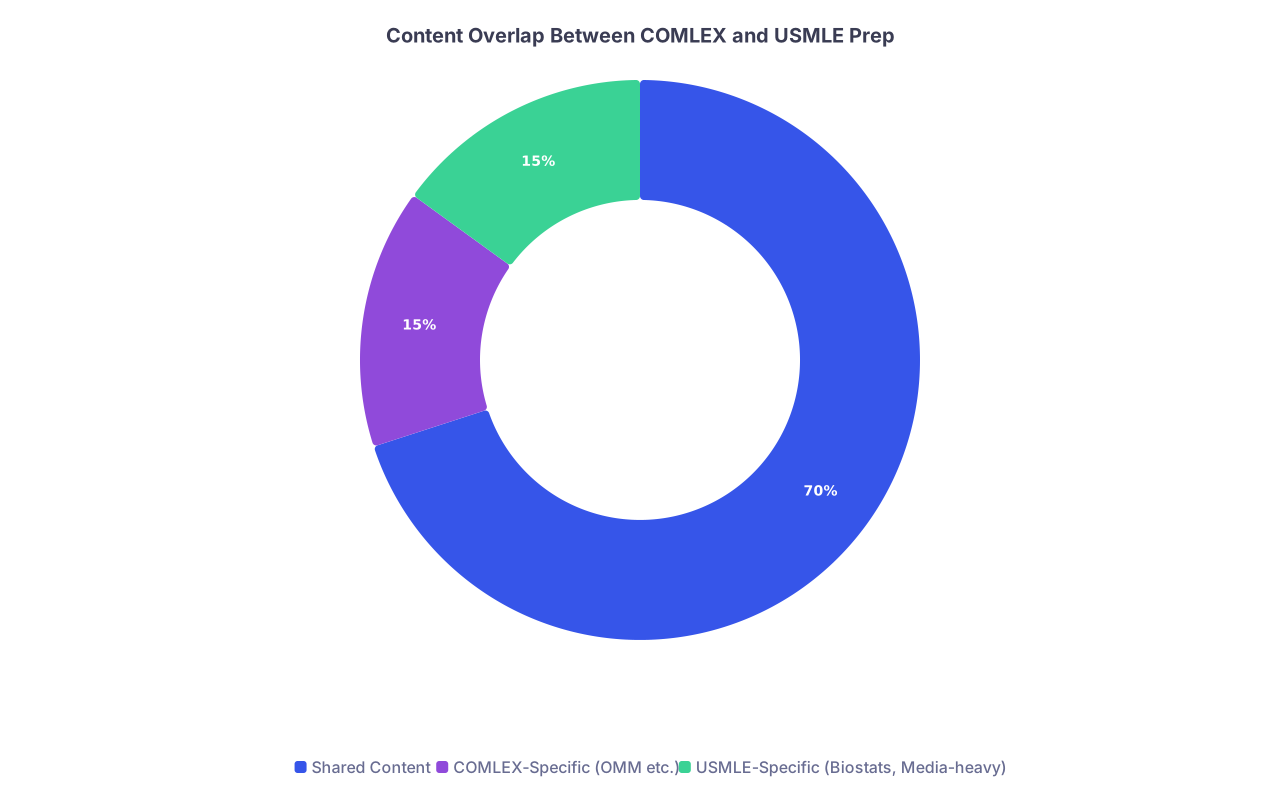
| Category | Value |
|---|---|
| Shared Content | 70 |
| COMLEX-Specific (OMM etc.) | 15 |
| USMLE-Specific (Biostats, Media-heavy) | 15 |
Core resources that work for both
If you’re not already using these, fix that first:
- UWorld (Step 1) – non-negotiable if you’re adding USMLE
- Boards & Beyond or Pathoma + an additional phys resource (e.g., B&B physio)
- Anki:
- Lightyear, AnKing, or your school’s Step deck
- First Aid / UFAPS-style reference:
- Old-school but still a decent spine for topics you’re weak on
These are your shared spine. They raise both COMLEX and Step performance.
COMLEX-only resources to keep
You do not drop your DO-specific resources:
- Savarese (OMT Review)
- COMQUEST or TrueLearn COMLEX QBank
- COMSAE practice exams closer to your COMLEX date
These are “add-ons” once your USMLE-style fundamentals are solid.
What changes now that you’re adding Step?
If you were previously:
- Doing only COMLEX question banks → You must add UWorld Step 1.
- Only watching COMLEX-focused videos → Add at least Pathoma + targeted Boards & Beyond.
- Barely touching biostats/ethics → You need a dedicated USMLE-style biostats resource (e.g., UWorld biostats, a short biostats review PDF or video series).
Step 4: Adjust Your Timeline – 3 Common Scenarios
Here’s where people panic. “I already picked an exam date!” Relax. You have options.

| Step | Description |
|---|---|
| Step 1 | Want to Add Step 1 |
| Step 2 | Take Step 1 ~2-3 weeks before COMLEX |
| Step 3 | Take Step 1 ~1 week before COMLEX |
| Step 4 | Defer Step 1 or Skip |
| Step 5 | Time Until COMLEX |
Scenario 1: You have 10+ weeks before COMLEX
This is the best-case late-switch.
Suggested structure:
Weeks 1–6: Heavy USMLE + shared content
- Main QBank: UWorld (40–80 questions/day)
- Videos: Pathoma + weak systems on B&B
- Anki daily
- Minimal OMM/COM-specific – just maintenance
Week 7: First full USMLE practice test (NBME or UWSA)
- If you’re comfortably in passing range → lock in Step 1 date for week 8–9
- If you’re borderline → consider pushing Step 1 closer to COMLEX or rethinking entirely
Week 8: Step 1 exam
Weeks 9–10: Pivot hard into OMM + COMLEX-style vignettes
Scenario 2: You have 6–10 weeks before COMLEX
This is tight but still doable if your baseline is strong.
- First 3–4 weeks:
- 60–80% USMLE-focused (UWorld + core videos)
- 20–40% COMLEX-specific (OMM + a few COM-style blocks)
- Step 1 date:
- Target ~7–10 days before COMLEX
- Final 1–2 weeks:
- Go 80–90% COMLEX mode:
- OMM review
- COMSAE + COMBANK/TrueLearn
- Rapid-fire ethics/professionalism style questions
- Go 80–90% COMLEX mode:
Scenario 3: You’re <6 weeks out from COMLEX
You’re in the danger zone for adding Step 1.
Here’s my honest recommendation:
- Default: Do not add Step 1 now.
- Exception: You’re crushing everything:
- COM practice scores very strong
- UWorld blocks (if you’ve already started) are going well
- And you’re mentally stable enough to add another test
You could:
- Take Step 1 within 3–5 days before COMLEX (ride the momentum, one big push)
- But I’ve watched students bomb both trying this when they weren’t ready
If you’re not absolutely confident, protect COMLEX and revisit Step 2 as your USMLE option later.
Step 5: Daily Workflow – How to Study for Both Without Losing Your Mind
This is where people either sink or swim. You need a daily structure that acknowledges both exams without splitting you in half.
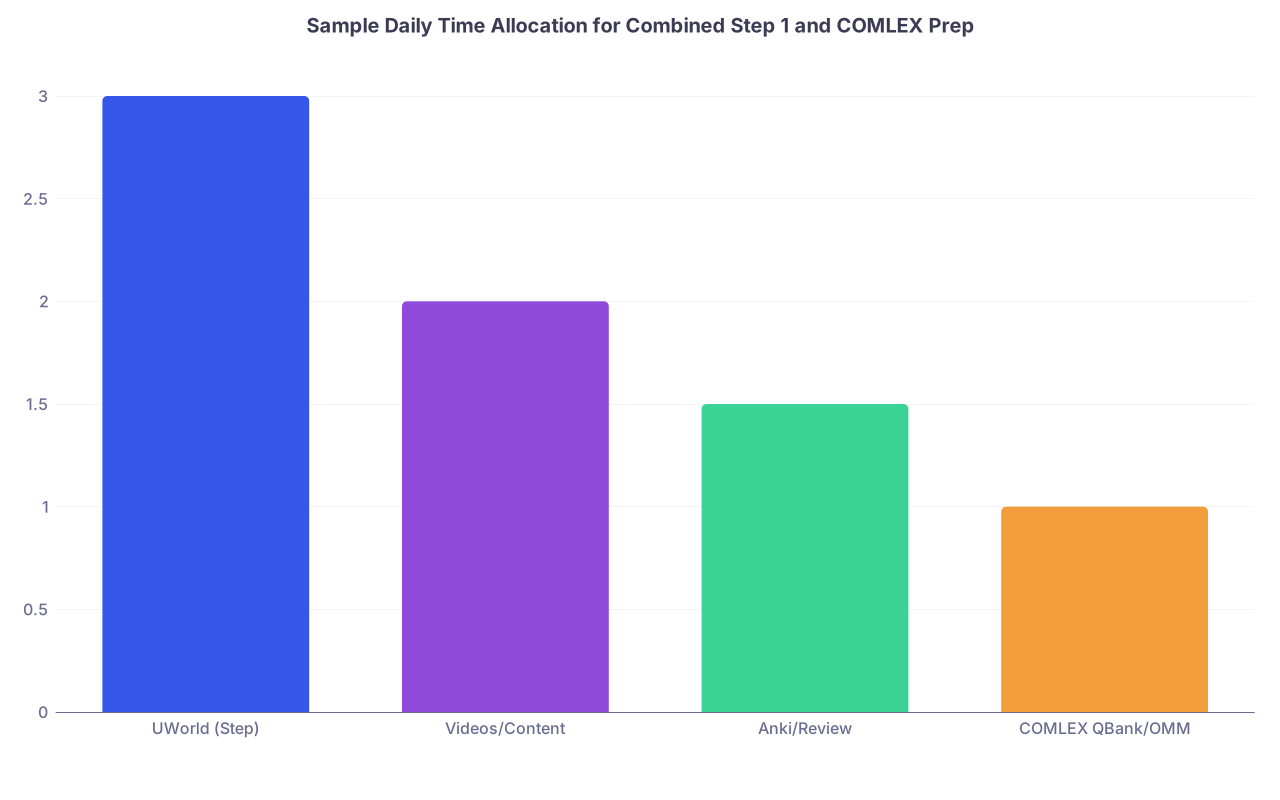
| Category | Value |
|---|---|
| UWorld (Step) | 3 |
| Videos/Content | 2 |
| Anki/Review | 1.5 |
| COMLEX QBank/OMM | 1 |
A realistic weekday during dedicated (early phase)
Example (about 8–9 focused hours):
Morning (3–4 hours)
- 2 blocks of UWorld Step 1 (timed, random, 40qs each if possible)
- Immediate review after each block (this is where the learning is)
Early afternoon (2–3 hours)
- Pathoma or B&B on the systems you just hit in questions
- Make or update Anki from your misses
Late afternoon (1–2 hours)
- OMM / COMLEX-specific:
- 15–20 COMLEX questions (TrueLearn/COMQUEST)
- 30–60 min Savarese or OMM notes review
- OMM / COMLEX-specific:
Evening (1–1.5 hours)
- Anki reviews
- Very light content fill-in on your weakest topic
You’ll tweak these ratios as COMLEX gets closer (shift more time to OMM, ethics, weird COM-style stuff).
USMLE question review: how it’s different
When you review UWorld for Step 1, you should be:
- Writing down:
- The one high-yield fact per missed question
- The physiology mechanism (not just the name of the disease)
- Asking yourself:
- “If they twisted this question slightly, what else could they be asking here?”
This level of precision is what boosts both exams, because COMLEX still tests content. Even if the question style is annoying.
Step 6: Practice Tests – How to Use Them Now That You’re Doing Both
Do not wing this part. Exams are pass/fail on paper, but you still need a buffer. A “barely passing” NBME is not the same as “chill, I’m good.”
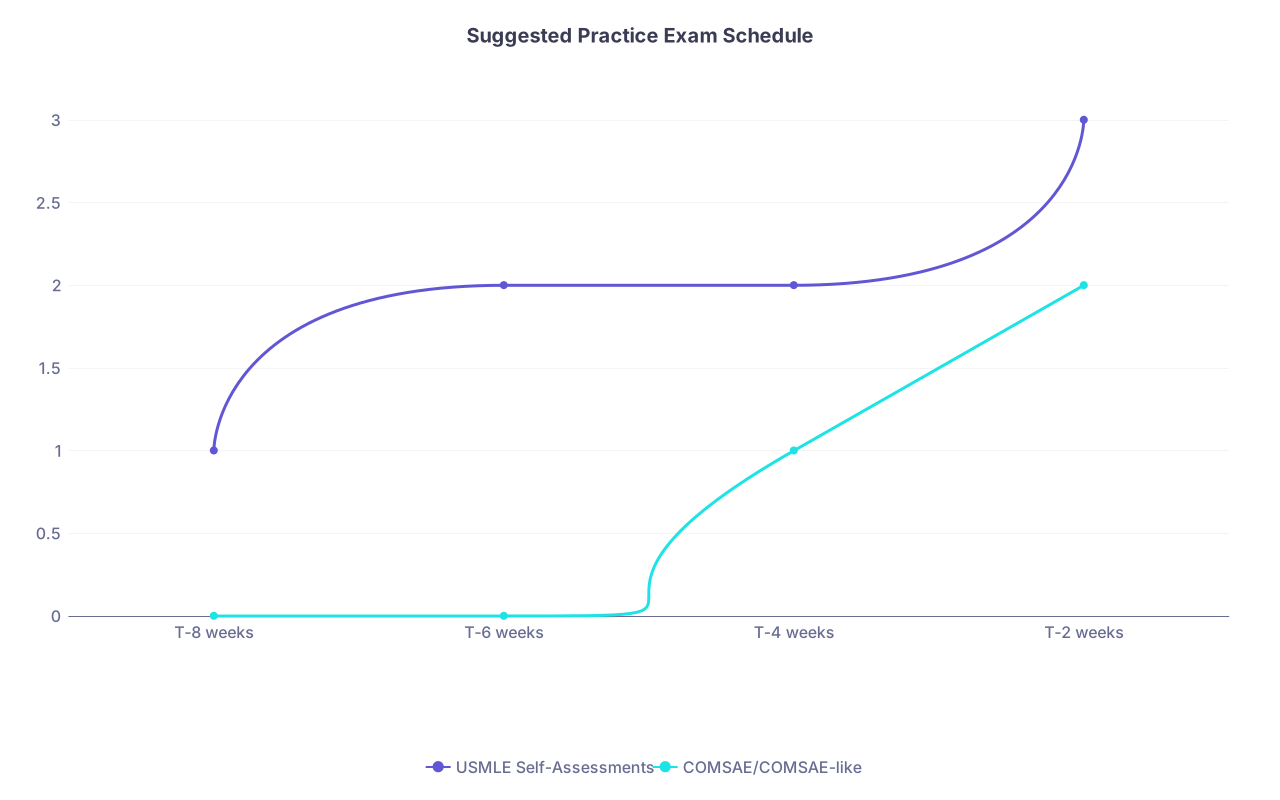
| Category | USMLE Self-Assessments | COMSAE/COMSAE-like |
|---|---|---|
| T-8 weeks | 1 | 0 |
| T-6 weeks | 2 | 0 |
| T-4 weeks | 2 | 1 |
| T-2 weeks | 3 | 2 |
For Step 1
Use:
- NBME forms (if available to you)
- UWSA 1 and 2 closer to test day
Targets:
- You want consistent passing-equivalent performance, not just one lucky test.
- For a pass/fail exam: I like to see you with at least a small cushion above passing (think: a margin where one bad day doesn’t sink you).
For COMLEX Level 1
Use:
- COMSAE exams
- Your COMLEX QBank’s self-assessments, if they have them
Be aware:
- COMSAE predictive value is… variable. But:
- Strong COMSAE + decent Step-style practice performance = usually safe territory
- Weak COMSAE + strong USMLE practice = you probably neglected OMM/COM-style thinking
Plan your last 3 weeks roughly like:
- 3 weeks out: Step-focused practice test
- 2 weeks out: COMSAE
- 1 week out: Another Step or COMLEX practice depending on which test is first
- Last few days: Minimal new content, maximum consolidation and sleep
Step 7: Common Traps DO Students Fall Into When Adding Step 1
I’ve seen the same mistakes on repeat.
Trap 1: Treating Step as “just more questions”
USMLE questions test how you think. If you do UWorld but never adapt your reasoning style, you’ll keep getting the same question types wrong.
Fix it:
- After each block, do a “meta-review”:
- What kind of question did I miss? Mechanism? Diagnosis? Next step?
- Am I missing the same concept across multiple systems?
Trap 2: Ignoring OMM until the last week
You do UWorld for 6 weeks, peek at Savarese with 5 days left, and realize you forgot what a type II dysfunction is. Too late.
Fix it:
- Minimum OMM maintenance:
- 4–5 days/week, 30–45 minutes
- Hit:
- Autonomics
- Chapman’s points
- Fryette’s principles
- Counterstrain tender points for the big ones (ribs, lumbar, etc.)
- Viscerosomatic reflexes
Trap 3: Over-correcting into “USMLE-only” mode
Some DO students get high on how much better UWorld questions are and subconsciously start treating COMLEX as an afterthought.
Result? They pass Step and get humbled by COMLEX’s weirdness.
Fix it:
- Last 2–3 weeks before COMLEX:
- Move to at least 50% COMLEX-style questions
- Do at least 2–3 full COMLEX-length practice days (question volume, breaks, timing)
Trap 4: Emotional spiral from UWorld percentages
You switch to Step 1, your UWorld % is low at first (which is normal), and you start doubting the whole plan.
Fix it:
- Focus on trend, not absolute %
- Use system-wise reset:
- If cardio is a disaster, don’t keep randomly hitting it mixed with other systems.
- Block off 2–3 days: cardio videos + cardio-only UWorld + Anki, then return to mixed.
Step 8: Talking About Being COMLEX + Step 1 in Applications (Briefly)
You’re not there yet, but this is in the back of your mind: “If I add Step 1, how do I explain this combo later?”
Simple:
- You’re a DO, so COMLEX is required. Step 1 is you showing you can perform on the same metric as MDs.
- Programs like:
- Clear evidence you challenged yourself
- Consistency: strong COMLEX + strong Step signals you’re the real deal
- What they do not like:
- A failed or barely-passed Step 1 that contradicts a decent COMLEX
So again: do Step 1 if you can prepare well for it. Not just to say you took it.
If You’re Sitting Here Right Now – What To Do This Week
Let’s make this concrete.
This week, you should:
- Pull your current calendar and exam dates.
- Decide which scenario you’re in (>10 weeks, 6–10 weeks, <6 weeks to COMLEX).
- Choose your USMLE base:
- If you don’t have UWorld Step 1 yet, buy it. Today.
- Pick: Pathoma vs Boards & Beyond as your video spine.
- Block out:
- 2 UWorld blocks/day on at least 4 days this week.
- 4 OMM sessions of 30–45 minutes.
- Schedule a self-assessment date (USMLE-style) 3–4 weeks from now as a checkpoint.
Then reassess after that practice test and adjust.
FAQ (Exactly 4 Questions)
1. My school strongly discourages USMLE and only supports COMLEX. Do I still add Step 1?
You don’t owe your school blind obedience. You owe yourself a viable match. Many DO schools are still weirdly COMLEX-centric because it’s administratively easier for them.
If you’re targeting competitive fields or MD-heavy programs, I’d lean toward adding Step 1 if you have enough time and capacity to prep properly. You may have to self-organize resources and timing more than your classmates, but that’s normal for DOs going after more competitive options.
2. Should I do a separate USMLE-specific QBank besides UWorld?
Usually no. UWorld is plenty if you actually do it thoroughly and review it well.
If you’re extremely ahead and crave more, NBME practice exams + a small second bank (like Amboss) can help fine-tune. But most students do not suffer from “not enough question banks.” They suffer from “didn’t actually learn from the one they had.”
3. What if my COMLEX practice scores are fine but USMLE practice looks borderline?
That’s your warning light. It means your foundation is softer than COMLEX made it seem, or your problem-solving style hasn’t adapted yet.
You have two choices:
- Delay Step 1 to give yourself more time to build up, or
- Skip Step 1 and double-down on being a strong COMLEX-only applicant and choosing specialties/programs accordingly.
Do not walk into Step 1 “hoping” it works out. There is no benefit to a marginal pass if it almost didn’t happen; and a fail hurts.
4. If I already passed Level 1, is it still worth taking Step 1, or should I wait for Step 2?
This is trickier. For many DOs who are late to the USMLE party, Step 2 ends up being the main equalizer. Step 1 is pass/fail now, so the “wow” factor is gone; Step 2 still gives a numeric score.
If you’ve already passed COMLEX Level 1 and you’re close to clinicals, I usually recommend:
- Focus on crushing your rotations and then
- Take USMLE Step 2 and COMLEX Level 2 with serious effort.
Unless a specific mentor/program director explicitly tells you Step 1 would still help you at this stage, Step 2 is often the better play.
Open your study calendar right now and mark one concrete change: either the date you’ll take your first USMLE-style practice test or the week you’ll start daily UWorld blocks. Put it in writing. This switch from COMLEX-only to adding Step 1 doesn’t happen by intention; it happens by schedule.