
The fantasy that you can grind for Step 1 while your life is falling apart is dangerous. You cannot out-Anki a personal crisis.
If you’re in the middle of Step 1 prep and something big hits—death in the family, breakup, serious illness, mental health crash, financial disaster—you are not dealing with a “study problem.” You’re dealing with survival first, then exam strategy.
Let’s handle it like that.
1. First 48 Hours: Stop Pretending This Is Normal
If a real crisis hits during Step 1 prep, your first mistake will be trying to “power through” like nothing happened. That’s how people end up failing or burning out so hard they need a leave of absence.
For the first 24–48 hours, your job is not to “keep up.” Your job is to:
- Stabilize your basic life needs.
- Notify the right people.
- Freeze academic expectations.
Step 1: Hit the Emergency Brake On Your Schedule
You do this immediately:
- Close your question bank.
- Pause your Anki reviews. Yes, all of them.
- Stop trying to hit any of your planned daily targets.
Tell yourself clearly: “For the next 48 hours, my only Step goal is not to make this worse.” That means no panicked 2 a.m. UWorld sessions and no guilt-scrolling through Reddit score reports.
Step 2: Deal With the Non-Negotiables In Real Life
What “crisis” looks like in real life:
- Your parent is in the ICU and you’re the decision-maker.
- Your partner of 5 years leaves, and you suddenly need to move.
- You’re having daily panic attacks and not sleeping more than 3 hours.
- You get a call: your board date has to coincide with a major family event (wedding/funeral/visa issue), and everyone expects you there.
Immediate priorities:
- Where am I sleeping?
- Who do I need to inform (family, partner, roommates)?
- Do I have food, meds, transportation?
If you cannot answer those clearly, that is your full-time job right now. Not glycolysis.
Step 3: Send the Minimum Set of Emails
Within that 24–48 hours, you need three categories of people looped in:
- School
- Testing body / scheduling
- Personal support
A. Your School
Send something like this (adjust details):
Subject: Urgent – Step 1 Prep and Personal Crisis
Dear [Dean/Student Affairs/Academic Support],
I’m scheduled to take Step 1 on [date]. I am currently facing a significant personal crisis (details I’m happy to share privately if needed) that is disrupting my ability to prepare and function normally.
I want to stay on track, but I’m concerned that without adjustments, both my performance and my mental health will suffer.
I’d like to schedule a brief meeting to discuss options (temporary schedule changes, potential extension or leave, or other supports).
Thank you,
[Name, MS2]
You’re not committing to a leave of absence. You’re opening the door to options instead of waiting until you’ve already tanked your exam.
B. NBME/Prometric/Testing Center (If Needed)
If the crisis directly affects your test date (travel issues, funerals, hospitalizations), go read your exam’s rescheduling policy today. Even if you do nothing yet, you need to know:
- Deadlines for rescheduling
- Fees
- Documentation they might want
C. One Trusted Person
Not a group chat. One human who can filter for you.
Message something like:
“I’m in the middle of Step 1 prep and [crisis]. I may go quiet or act weird. I might need a reality check or practical help. Can I lean on you for that for the next few weeks?”
You need someone who will say, “You need to sleep” or “You should email your dean again,” not, “Bro just grind harder.”
2. Decide: Postpone, Push Through, or Pause?
After the initial shock settles a little, you have to make a call. Not based on ego. Based on capacity.
Here’s the decision tree I use with students in this mess.

| Step | Description |
|---|---|
| Step 1 | Personal crisis during Step 1 prep |
| Step 2 | Strongly consider postponing |
| Step 3 | Keep date but scale back goals |
| Step 4 | Short pause, then reassess |
| Step 5 | Test within 4 weeks? |
| Step 6 | Can you study 70-80% of planned time? |
| Step 7 | Crisis likely to improve in 2-3 weeks? |
Let’s translate this to real decisions.
| Situation | Likely Best Move |
|---|---|
| Test ≤ 2 weeks + severe crisis | Postpone if at all possible |
| Test 3–5 weeks + moderate crisis | Short pause, then lower-score target |
| Test ≥ 6 weeks + crisis likely to settle | 3–7 day full pause, then rebuild plan |
| Ongoing/long-term crisis (illness, caregiving) | Restructure prep for long-haul or formal delay |
When You Should Seriously Consider Postponing
You should lean hard toward postponing if:
- You’re sleeping under 4–5 hours regularly and not by choice.
- You cannot focus enough to get through a 40-question block with at least semi-honest effort.
- You’re missing basic self-care: eating, hygiene, responding to urgent messages.
- The crisis requires your time (e.g., you’re the only caregiver, legal paperwork, travel).
I’ve seen people white-knuckle through anyway. They almost always end up in one of two places:
- They postpone very late, lose fees, and waste weeks of low-yield “studying”
- They take it, underperform badly, and spend a year trying to dig out of a score they knew did not reflect them
Postponing is not a moral failure. It is a strategic choice to avoid turning a personal crisis into a permanent scar on your residency application.
When Keeping the Date Is Reasonable
You might keep your date if:
- The crisis is time-limited (e.g., 1 week of travel for a funeral, then you’re home).
- Your concentration dips, but you can still do:
- 40–80 honest questions a day, and
- Review them without crying or dissociating.
- You have at least 2–3 weeks left and some buffer built in.
If that’s you, the move is not “business as usual.” The move is: keep the date, lower the ceiling, protect the floor. Meaning:
- Stop chasing a 250+ if you’re now barely holding 230s on practice.
- Aim for “solid pass / safe score” ranges, not perfection.
3. Build a “Crisis-Safe” Step 1 Study Plan
You cannot run a normal Step 1 schedule on a brain that’s bleeding emotional bandwidth. You need a crisis-safe plan: simple, modular, and ruthlessly prioritized.
Think: fewer moving parts, more protective scaffolding.
Step 1: Identify Your Non-Negotiables
In a crisis, your effective daily capacity drops. A lot. If you used to do 8–10 hours of work, you might now realistically have 3–5. Pretending otherwise just creates shame.
At this point, your non-negotiables should look like:
- UWorld (or your primary Qbank)
- Anki (or spaced repetition) for high-yield/core facts
- One core resource (First Aid/Boards & Beyond/Pathoma, not all three)
Everything else becomes “nice to have.”
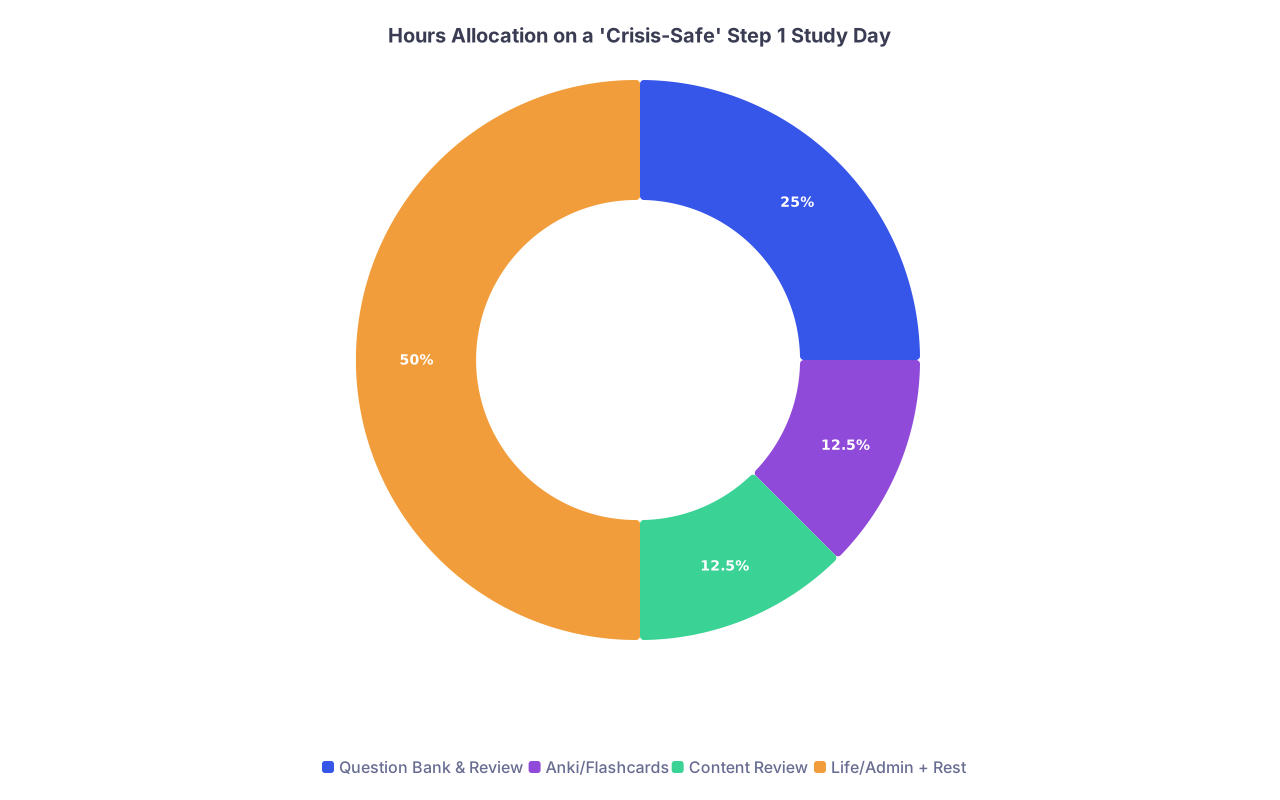
A Sample “Crisis-Day” Schedule (Still On Track, Lower Volume)
| Category | Value |
|---|---|
| Question Bank & Review | 3 |
| Anki/Flashcards | 1.5 |
| Content Review | 1.5 |
| Life/Admin + Rest | 6 |
For a 12–14 hour wake-time day, here’s how that might look:
- 3 hours: Question bank (40–80 questions max)
- 1–2 hours: Anki/core flashcards (cap reviews; do not let them explode)
- 1–2 hours: Focused content review of weak areas (video or reading)
- The rest: actual life stuff + non-negotiable sleep
If you’re working with even less capacity, cut content review before you cut questions.
Step 2: Protect the Start and End of Your Day
In crisis mode, if your day starts wrong, it’s gone.
Morning rules:
- No phone scrolling in bed. Especially not family group chats or doom news.
- First 60–90 minutes: low-friction, structured task
- Example: Light Anki while drinking coffee, then 20-question block.
Evening rules:
- Hard stop time. I like 2 hours before bed with:
- No board-style questions
- No obsessing over scores
- Light review or no studying at all
One of the fastest ways to crash in a crisis is sacrificing sleep to “catch up.” You’re not catching up. You’re borrowing from tomorrow’s brain.
4. Adjusting Expectations Without Lying to Yourself
You need to be brutally honest and strategically kind at the same time.
The lie many students tell: “I can still crush this. I just have to work harder.”
Reality: you don’t have the same brain, time, or emotional bandwidth as before.
You have to downgrade some goals to protect the bigger ones.
Recalculate Your Target
Let’s say pre-crisis:
- NBME practice: 235–245 range
- Goal: 250+
Now crisis hits, you lose 1–2 weeks to chaos, plus ongoing emotional weight.
Smarter reset:
- New realistic range: 225–235
- New priority: safe pass / solid score > dream score
This is not giving up. It’s triage.
You can still match into competitive specialties from a good-but-not-perfect Step 1 if the rest of your app is strong. You cannot easily fix a failure or severe underperformance.
Use Practice Exams As Reality Checks, Not Ego Punches
Use NBME forms or UWSA not to prove you’re a genius, but to answer:
- “Am I safe to test?”
- “What sections are falling apart specifically?”
If your practice is:
- Within 5–10 points of your pre-crisis average → you’re probably okay.
- Down 15–20 points and staying there → you need to reconsider timing or drop your target.
Do not hide from the data “because I’m scared what it will show.” I’ve watched that turn a manageable situation into a disaster more than once.
5. Mental Health: When This Stops Being About an Exam
Sometimes the crisis is your mental health. Sometimes the crisis triggers it. Either way, Step 1 cannot be your only focus if:
- You’re having daily panic attacks
- You’re having suicidal thoughts, self-harm, or “it wouldn’t matter if I got hit by a car” thoughts
- You’re so numb you’re barely functioning
At that point, the primary exam question is: “How do I not break myself permanently over a test?”
This is where you pull in heavier supports:
- School counseling / mental health services
- Off-campus therapist or psychiatrist (preferably one who’s seen med students before)
- Your primary care provider (sleep, meds, physical symptoms)
If you’re thinking “If I postpone, everyone will think I’m weak,” understand this:
What program directors see as weak is:
- Failing Step 1
- Taking leaves with no explanation then having poor performance
- Burning out so badly you cannot function on rotations
What they see as mature:
- Managing a documented crisis responsibly
- Taking time, then coming back and passing with stability
- Showing insight and judgment about your limits
Short version: get help early, not after you crash.
6. Handling Specific Common Crises
Let’s talk through a few actual scenarios I’ve seen (with identifying details changed).
A. Death in the Family 3 Weeks Before Step
Typical pattern: student tries to bring First Aid to the funeral, studies on planes, doesn’t sleep, scores tank on practice exams, but refuses to move test date because “I’ll disappoint everyone.”
Better approach:
- Immediately email school + consider rescheduling.
- Take 3–5 full days off for travel, logistics, and grief. Zero studying.
- Come back, take 2–3 days to re-establish routines:
- Light questions
- Smaller Anki sets
- Do one NBME after a week back. Decision point:
- If within ~5–7 points of prior scores → keep date, adjusted target
- If down 15–20+ points → strongly lean toward postponing
B. Major Breakup Right in Dedicated
This one derails more students than they’ll admit. It hits sleep, concentration, self-worth.
What to do:
- Give yourself 48–72 hours grace: lower volume, not zero, if possible.
- Shift to “mechanical” tasks when emotional pain is raw:
- Anki
- Watching videos at 1x speed
- Avoid high-stakes self-judgment during the worst 3–5 days (no “must-hit-75%” ultimatums).
- Consider moving relationship processing to scheduled windows:
- E.g., “From 8–9 pm I write, cry, talk to friends. The rest of the day, I treat it as background noise.”
You’re not a robot. But you also don’t need to let your ex own your exam outcome.
C. Personal Health Crisis (New Diagnosis, Flare, Hospitalization)
If your body is the thing on fire:
- Treat Step 1 as secondary until you know:
- What your diagnosis/flare pattern looks like
- What your treatment/symptom timeline is
- Get documentation. This matters if you need:
- Testing accommodations
- Formal leave of absence
- Variance in your school’s policies
Once acute issues calm slightly, build a “low inflammation” schedule:
- Shorter blocks (e.g., 10–20 questions at a time)
- Built-in rest periods
- Non-negotiable sleep windows
Chronic illness plus Step 1 is a marathon with ankle weights. Totally possible. But only if you pace it.
7. Communication: What You Tell Whom
You don’t owe everyone the full story. But you do need a working communication plan.
To Your School
More detail is fine here, especially with student affairs or a trusted dean. They can:
- Adjust timelines
- Help with leaves / reduced course loads
- Provide documentation letters if needed
To Friends/Classmates
You can keep this simple:
“I’ve got some serious stuff going on outside school right now. I’m not ghosting you. I’m just on survival mode and trying to keep Step from completely falling apart.”
Pick 1–2 people you update weekly. Everyone else can wait.
To Family (Especially if They’re Part of the Crisis)
If family is stressed, demanding, or doesn’t “get” Step 1, set a clear boundary:
“I care about what’s happening, and I’m trying to help where I can. But this exam is critical for my future. I need protected study time each day where I’m not fielding calls or tasks. Let’s set up specific times to talk.”
They may not love it. That doesn’t make it wrong.
8. After the Exam: Debriefing the Wreckage
One more truth: Sometimes, even with a decent plan, your score won’t reflect your full potential. Because you were taking an 8-hour exam in the middle of a life storm.
Post-exam, a few moves matter:
Take 3–7 days of real rest before obsessively analyzing performance.
When the score comes:
- If it’s in a safe/pass range but below your original goal → it’s not the end of your career. It’s a data point in context.
- If it’s a fail or much lower than expected → talk to your dean and a trusted advisor within a week about:
- Retake strategy
- How to frame the crisis in future applications (without sounding like an excuse factory)
Write down your version of “what actually happened.” Not for admissions. For you.
- What worked despite the crisis
- Where you ignored early warning signs
- What you would do differently next time you’re hit with life during high-stakes prep
You’ll have more big exams. Shelf exams. Step 2. In-training exams. Boards. Whatever specialty throws at you. Learning how to steady yourself during crisis now is unfortunately very transferable.
You’re trying to pass (or excel on) Step 1 while part of your life is on fire. That’s not a “motivation” issue. It’s a logistics and triage problem.
Your job is not to pretend the crisis doesn’t exist. Your job is to:
- Stabilize yourself
- Be honest about capacity
- Protect long-term career goals, not just short-term pride
Handled well, this won’t be the story of “the exam that ruined my career.” It’ll be the story of “the time everything went sideways and I still found a way through.”
With that crisis-tested mindset, Step 1 becomes one hard chapter, not the whole book. The next chapters—clinical rotations, Step 2, residency—will ask just as much of you. How you move through this moment will shape how you handle those. But that’s a challenge for the next version of you, on the other side of this exam.
For now: stabilize, simplify, and choose the path that protects both your score and your sanity.