
What if the very thing you think is protecting your Step 1 score is the reason your practice numbers are stuck… or dropping?
That “thing” is resource hoarding. And for Step 1, it is one of the most common, quiet, self‑inflicted disasters I see.
You probably know the mindset:
“I’ll use:
- UWorld
- AMBOSS
- Kaplan Qbank
- Boards & Beyond
- Sketchy
- Pathoma
- Anki (three decks, obviously)
- First Aid
- Divine podcasts
- maybe Bootcamp or USMLE-Rx... just to be safe.”
Safe? No. That plan is radioactive. Let’s dismantle it before it wrecks your prep.
The Core Problem: Confusing “Coverage” With Learning
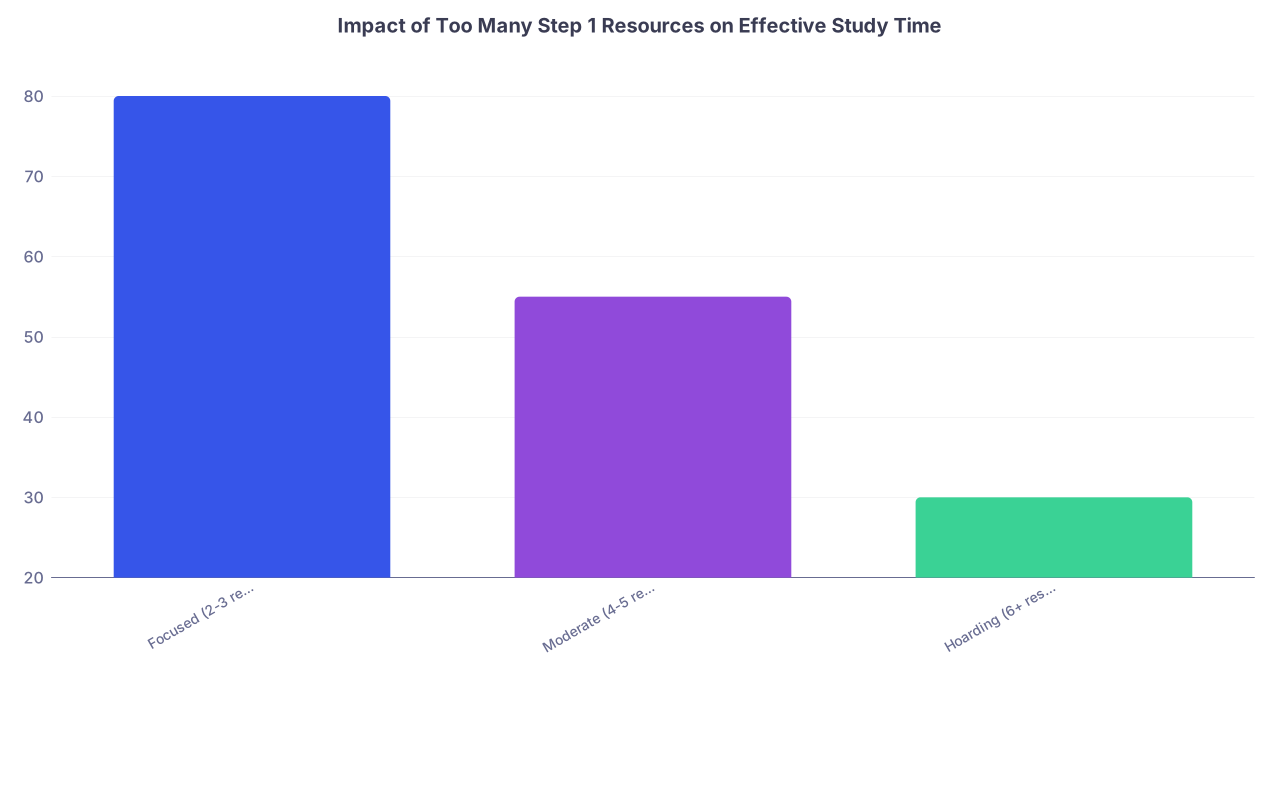
| Category | Value |
|---|---|
| Focused (2-3 resources) | 80 |
| Moderate (4-5 resources) | 55 |
| Hoarding (6+ resources) | 30 |
The biggest lie Step 1 prep culture sells you is this: “If I use more resources, I’ll miss fewer questions.”
Reality is uglier. Once you cross a certain line, every new resource costs you more in:
- Context switching
- Cognitive load
- Fragmented review
- Anxiety
…than it gives you in actual understanding.
I have watched this pattern repeatedly:
- Student starts with a sensible plan (e.g., UWorld + AnKing + one video series).
- First NBME looks bad. Panic.
- They add “just one more” Qbank. A new video series. Another deck.
- Their schedule explodes. Review lags. Scores stall. Anxiety spikes.
- To “fix” it, they add still more resources.
That is the hoarder spiral.
You are not under-resourced. You are over-diluted.
The exam does not care how many platforms you paid for. It cares whether you can recognize mechanisms, patterns, and core concepts under pressure. Hoarding blocks that because your brain never stays with anything long enough.
Red Flags You’re Hoarding Resources (And Hurting Yourself)
Let me be blunt: most students in trouble do not say, “I hoarded resources.” They say:
“I just did not have enough time to see everything.”
Yes. Exactly. Because you tried to see everything everywhere.
Here are the clearest warning signs.
1. You Have More Than One “Primary” of Anything
If you can finish this sentence in more than one way, you have a problem:
“My primary Qbank is ______.”
“My primary video resource is ______.”
“My primary deck is ______.”
If you are saying things like:
- “I’m doing UWorld and Kaplan fully, then AMBOSS for extra.”
- “I watch Boards & Beyond and Sketchy and Pathoma for all topics.”
- “I’m using AnKing, Zanki, and a custom deck from my school.”
You are not “comprehensive.” You are scattered.
Pick one primary for each category. Everything else must be truly supplemental, not parallel.
2. Your Day Looks Like a Streaming Service Menu
You jump like this:
Morning: 40 UWorld questions
Then: 2 hours of Boards & Beyond
Then: 1 hour of Sketchy
Then: Half an hour flipping through First Aid
Then: 500+ Anki reviews from three decks
Then: Some random YouTube explanation videos
That is not depth; that is channel surfing.
If you rarely spend 2–3 contiguous hours in a single mode (e.g., just questions + review), you are not consolidating anything. You are entertaining your anxiety by touching everything superficially.
3. You “Preview” and “Review” With Different Resources Constantly
Here is a nasty trap:
- “I’ll preview cardio with Boards & Beyond.”
- “Then I’ll do UWorld cardio questions.”
- “Then I’ll review misses using AMBOSS.”
- “Then I’ll reinforce with First Aid cardio chapter.”
- “And then Anki from three decks on top.”
So you hit the same topic four different ways, with slightly different wording and emphasis, and never maintain a coherent mental model. You are constantly re-learning the framing instead of deepening the concept.
One preview, one practice, one review method per topic is usually enough.
4. You Have a Growing Graveyard of “Half-Started” Resources
Ask yourself:
- How many video series did you stop after 20–30%?
- How many decks did you “start fresh” and abandon?
- How many Qbanks are sitting at 5–25% completed?
That graveyard is not harmless. Each abandoned start cost you time and cognitive switching that never paid off.
5. Your Practice Scores Plateau Despite “Doing More”
Huge red flag:
- Practice blocks per day ↑
- Number of resources ↑
- Hours studied ↑
- NBME / UWSA scores: flat or even ↓
This is the classic pattern when someone spreads themselves across too many tools. They start missing easy questions because their brain is tired and their recall pathways are overcomplicated.
The Psychology Behind Hoarding: It Feels Safe But Kills Focus

You are not doing this because you are lazy or reckless. You are doing it because you are scared.
Step 1 (pass/fail or not) still controls your future options. That fear pushes you to chase:
- “Coverage” – the illusion that if you have seen a word somewhere, you are safe
- “Redundancy” – telling yourself, “If one resource misses it, another will cover it”
- “What if” insurance – “What if the exam loves micro and I did not do Sketchy enough?”
Here is the mistake: you think risk is “not enough resources.”
The real risk is:
- Not reviewing what you already missed
- Not mastering any single Qbank’s patterns
- Not cycling content deeply enough for retention
- Burning out early and peaking 4–6 weeks before the exam
You are trying to manage exam risk by multiplying tools instead of improving your use of any one tool. That is like a surgeon buying more scalpels instead of practicing technique.
What Actually Works: A Lean, Brutal Core
Let me give you a structure that avoids the hoarder trap. You can adjust details, but the principle stands: fewer primaries, tighter loops, ruthless review.
| Plan Type | Qbanks | Videos | Anki/Notes | Extras |
|---|---|---|---|---|
| Lean Core | 1 (UWorld or AMBOSS) | 1 main series | 1 main deck or notes | Occasional reference |
| Borderline | 2 Qbanks (one is light) | 1–2 series | 1 deck + light extras | Strict time caps |
| Hoarder | 3+ Qbanks | 2–3+ full series | 2–3 major decks | Multiple “must use” extras |
A Reasonable Core Setup
For most students, something like this is both sufficient and efficient:
Primary Qbank:
- UWorld OR AMBOSS (not both fully, not in parallel)
Primary content / video:
- Boards & Beyond OR something equivalent from your school
- Pathoma for pathology if you like it (this one is lightweight and high-yield)
Primary recall system:
- ONE: AnKing OR a tightly curated personal deck OR written notes you actually review
References / secondary:
- First Aid or AMBOSS library / UWorld explanations as references, not cover-to-cover bibles
- Sketchy ONLY if you commit to it as your micro/pharm backbone and accept the time cost
The important part is not which specific names you choose. It is this: you commit to a small number of primaries and stop collecting.
How To De-Hoard Without Freaking Out
You might already be knee-deep in resource chaos. Fine. You can still salvage this, but you cannot do it while clutching everything.
Here is the process I walk struggling students through.
Step 1: Audit Your Current Stack
Write it down. All of it. No hiding.
- Every Qbank you “intend” to use
- Every video series you “plan to finish”
- Every deck you have touched
- Every “must read” book or course
Then mark:
- What you are actively using (this week)
- What you have started but paused
- What you have not really touched
This list is usually horrifying. That is the point.
Step 2: Make Hard Choices: One Primary Per Category
You must choose your primaries:
- Qbank: pick ONE to do thoroughly before test day. UWorld or AMBOSS.
- Video/content: pick ONE main series plus maybe Pathoma.
- Recall: ONE deck or system.
Everything else becomes “optional, if time, for weak areas only.”
And no, “I already paid for it” is not a valid reason to keep something in the primary set. Sunk cost is a trap. Money is gone either way. Time is not.
Step 3: Kill or Park the Rest
There are three buckets:
- Keep (primary) – used almost every day.
- Park (secondary) – used for specific topics only, <10–15% of total time.
- Kill – log out, uninstall, unsubscribe, or at least bury the login info.
Students hate this step. They always try to renegotiate.
“I’ll just do a few Kaplan questions after I finish my UWorld blocks each day.”
No. That is how hoarding creeps back. If a resource is not clearly defined as secondary for specific weaknesses, it needs to go.
Step 4: Rebuild Your Daily Structure Around Depth, Not Variety
Your new day should look more like this:
- 40–80 questions from your ONE primary Qbank + thorough review
- 1–2 hours of your ONE main content source for your scheduled topics
- Anki/recall for only those systems, from ONE deck or your notes
- Short, targeted use of references when you do not understand something
Not:
- 20 UWorld + 20 Kaplan + 20 AMBOSS
- 1 hour of B&B + 1 hour of Sketchy + 1 random YouTube video
- Anki from AnKing + Lightyear + your school deck
- Reading random First Aid pages “for comfort”
When “Just One More Resource” Is Actually Smart
I am not saying all extras are bad. I am saying unsupervised proliferation is bad.
There are situations where a tightly targeted extra resource helps:
- You are consistently weak in micro and cannot retain bugs → Adding Sketchy micro (and dropping something else) can be justifiable.
- You are doing poorly on NBMEs in biostatistics → A small, focused biostats resource or dedicated question set is reasonable.
- Your school integrated exam is heavy on a specific faculty resource → You might need that for class purposes, but separate what is for school vs Step.
The rule: When you add something, you must remove or downshift something else. Your total daily load should not inflate.
Use a simple question: “What am I willing to do less of to make space for this?”
If the answer is “nothing,” you are hoarding again.
Pass/Fail Temptation: A Different Flavor of the Same Mistake
Some students think pass/fail Step 1 solved this.
It did not. It changed the flavor.
Now, many students either:
- Over-hoard because they think they “must absolutely pass,” so they stack every resource to avoid failure.
- Or under-structure and drift through multiple resources without ever mastering any, because the bar is “only pass.”
Both are problems. Pass/fail actually increases the value of efficiency. You want to clear Step 1 with as little damage to your mental health and M2/M3 learning as possible.
Hoards burn you out early. Burnout wrecks your Step 2 CK preparation later, which still matters for residency competitiveness.
Timeline Reality Check: You Physically Cannot Do Everything
Let us be brutally quantitative for a moment.
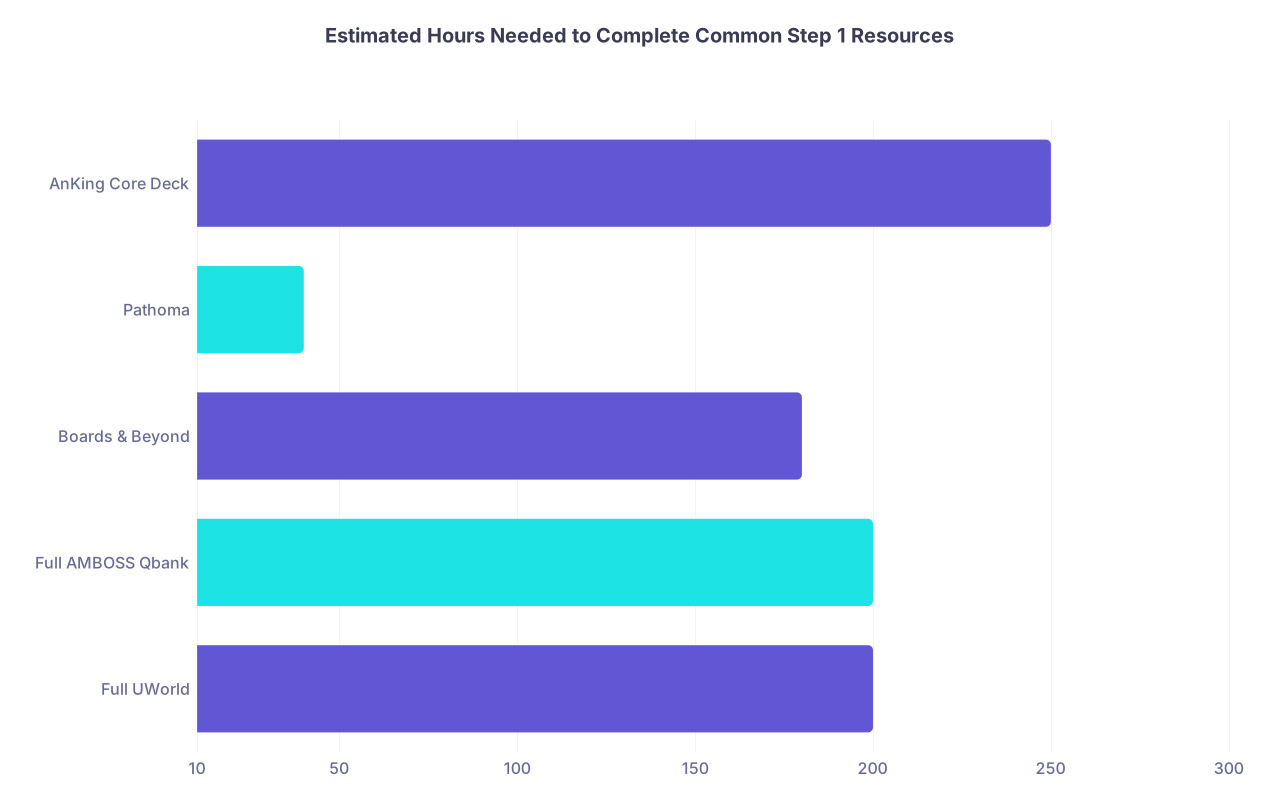
| Category | Value |
|---|---|
| Full UWorld | 200 |
| Full AMBOSS Qbank | 200 |
| Boards & Beyond | 180 |
| Pathoma | 40 |
| AnKing Core Deck | 250 |
Those are approximate, but close enough:
- UWorld full pass with real review: 200–250 hours
- AMBOSS full pass: another ~200 hours
- Boards & Beyond: 150–200+ hours if watched at normal speed with notes
- Pathoma: 25–40 hours
- AnKing / large deck: 200–300+ hours to seriously mature cards
Now remember: many students think they will do two Qbanks, watch two or three video series, “go through” First Aid, and “keep up with” huge Anki decks. In 10–12 dedicated weeks. On top of classwork if pre‑dedicated.
The math does not work. You will either:
- Rush through everything and retain little
- Or do 30–50% of everything and master nothing
Neither path is compatible with high performance. Or with sanity.
Protect Yourself: Questions To Ask Before Adding Anything New
Pause before you click “buy now” or “start new course.”
Ask:
- Which current primary resource is failing me, specifically?
- Is my problem really lack of coverage, or poor review of what I already miss?
- What will I stop doing (or do less of) to make room for this?
- How will I measure whether this new resource is actually helping (in 2–3 weeks)?
- Am I adding this because data shows a need, or because I am anxious and saw someone on Reddit mention it?
If you cannot answer these cleanly, do not add it. Hoarding often masquerades as “being thorough.” You need to catch it early.
FAQ: Step 1 Resource Hoarding
1. Is it ever okay to use two full Qbanks for Step 1?
Yes, but only under specific conditions. If you have enough time, have already done one Qbank thoroughly (with good review and reflection), and your scores are trending up but you want additional exposure, a second Qbank can be useful. The trap is doing both in parallel from the start. Do not split your focus early. Finish and learn deeply from one before touching the second, and if you do add a second, you still prioritize review of mistakes over “finishing all the questions.”
2. How many Anki cards per day is a red flag?
There is no universal number, but when students routinely cross 800–1000 reviews per day, quality collapses. The red flag is not just the count; it is the impact. If Anki is consuming so much time and mental energy that you are rushing through Qbank review or skipping practice exams, you are using too much. A sane range for most is 300–600 focused reviews, with cards aggressively suspended or edited when they are low value. “More cards” is not better if you are clicking through in a haze.
3. Do I need both First Aid and AMBOSS/UWorld explanations?
Need? No. Can they complement each other? Yes, if used correctly. First Aid is a decent structural outline, but the days of memorizing it cover-to-cover as the sole bible are gone. High-quality Qbank explanations (and integrated library articles like in AMBOSS) often do the job better. If you find yourself reading three different explanations for the same question just to feel safe, you are overdoing it. Use one main explanation source and keep the other as a reference, not a mandatory parallel read.
4. What if my school requires a certain video series or Qbank?
Then treat the school resource as a separate obligation, not as part of your main Step 1 arsenal. You might need to pass a course that uses Kaplan questions or a specific video library. Fine. Do what you must for the grade, but decide explicitly: “This is for school, not my Step 1 core.” Your Step 1 primaries should still be limited. If the school resource is genuinely excellent and overlaps with what you planned to use, consider making it your primary and dropping the others. But do not unconsciously stack them.
5. How do I know if my current resource set is working?
Ignore feelings and look at data. Are your practice exam scores (NBMEs/UWSAs) improving over 3–4 week intervals? Are your UWorld or AMBOSS blocks trending upward in percentage correct, especially on repeated concepts? Are you remembering mechanisms and rationales weeks later, or re-learning the same topics every time? If scores are stagnant or you feel perpetually behind despite massive hours, your setup is failing you. The usual fix is not “add more.” It is “cut to a smaller core, review more deeply, and protect your focus.”
Key points to walk away with:
- More resources do not equal more points; beyond a small core, each extra tool usually dilutes your focus and retention.
- Pick one primary in each category (Qbank, content, recall), and be ruthless about killing or parking the rest.
- When scores stall, fix depth and review, not “coverage.” Hoarding is a fear reaction. Do not let it quietly sabotage your Step 1 prep.