Most Step 1 anxiety advice is vague, feel-good nonsense. You do not need more “just relax” or “trust your preparation.” You need a protocol. A playbook for when your heart is racing, your hands are sweating, and block 3 just punched you in the face.
This is that playbook.
I am going to walk you through exactly what to do:
- The week before the exam
- The night before
- The morning of
- During each block
- When you panic mid-question or mid-block
- When you walk out of the exam and your brain is screaming that you failed
No theory. Just specific behaviors and scripts you can actually run in real time.
1. Understand What You Are Up Against (So You Can Beat It)
Anxiety on Step 1 day is not random. It follows a pattern I have seen over and over:
Pre-test spiral
- “I peaked two weeks ago.”
- “My last NBMEs were all over the place.”
- “If I screw this up, my career is done.”
Block 1 overload
- New interface, unfamiliar questions, time pressure.
- You feel behind by question 8.
- Inner monologue: “I am moving too slow; I am already losing.”
Mid-exam crash (blocks 3–5)
- Mental fatigue + first hard block.
- You walk out thinking: “That was a disaster.”
- Urge to give up or rush to “get it over with.”
End-of-day desperation (last 1–2 blocks)
- You are tired, over-caffeinated, and catastrophizing.
- Small mistakes feel catastrophic.
- You start rereading questions but not actually processing them.
That pattern is predictable. Which means it is controllable. You will not erase anxiety. You will contain it and prevent it from sabotaging the exam.
2. The Week Before: Lock In a Stable Baseline
This is where people quietly ruin exam day. They change everything.
2.1 Non-Negotiables for the Final Week
You are not “cramming.” You are optimizing your brain for one day of performance.
Do this:
Freeze your wake time
- Decide your exam-day wake time (e.g., 6:30 am).
- Wake at that exact time for at least 5–7 days before test day.
- No more “I’ll sleep in since I’m exhausted from UWorld.” Your brain hates sudden schedule changes.
Run 2–3 “mock mornings”
At least twice in the final week, simulate exam morning:- Wake at your exam-day time.
- Light breakfast similar to what you will eat on test day.
- Sit down and do 2–3 blocks with timed mode and minimal breaks.
- Include one short break with a snack to test how your stomach behaves.
You are training your nervous system to say: “We have done this before.”
Back off intensity, not structure
- Three to four medium-effort blocks/day max.
- No heroic 10-hour review days.
- Protect sleep: 7–9 hours, consistently.
Pre-decide your “good enough” level
Write this down on paper:- “My preparation is enough because:
– I completed X% of UWorld with ___%
– My last 3 NBMEs were: ___, ___, ___
– I reviewed weak areas in ___ and ___.”
- “My preparation is enough because:
You will use this as a weapon against “I did not do enough” thoughts.
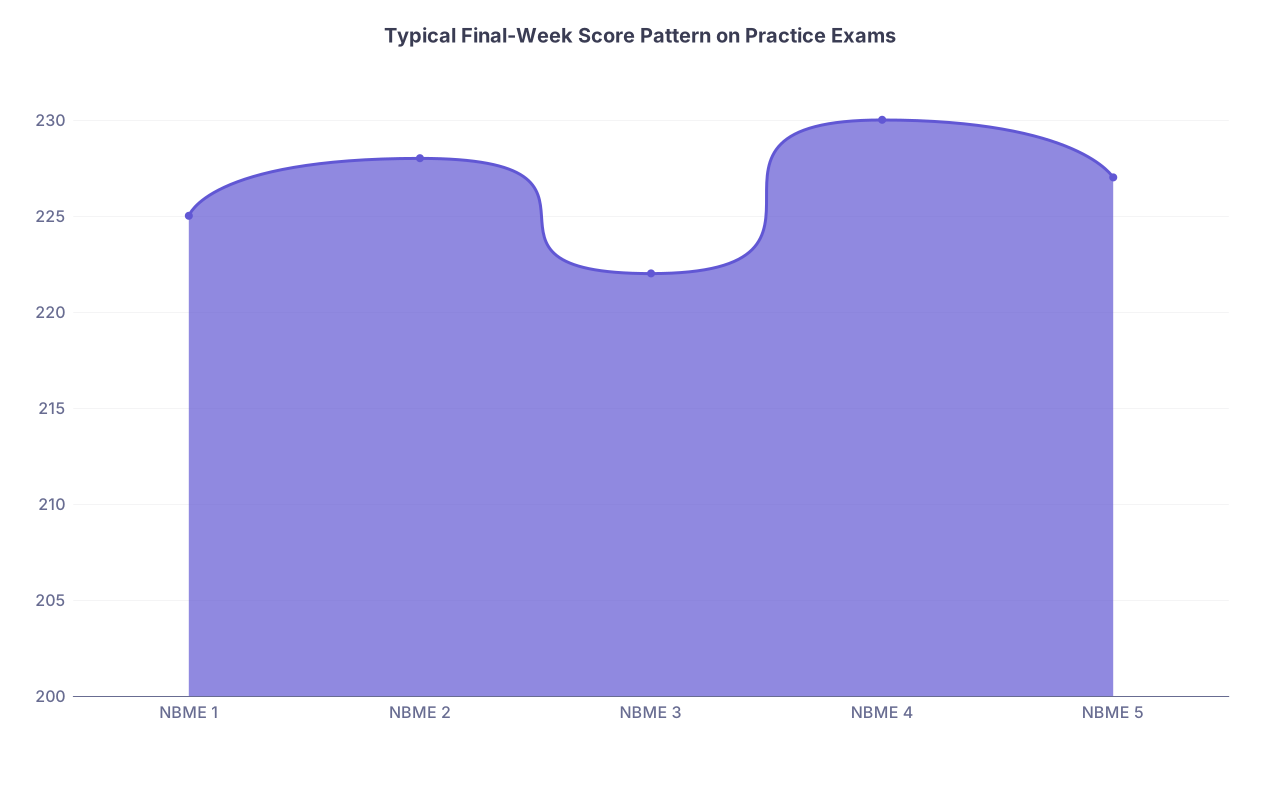
| Category | Value |
|---|---|
| NBME 1 | 225 |
| NBME 2 | 228 |
| NBME 3 | 222 |
| NBME 4 | 230 |
| NBME 5 | 227 |
Notice: scores fluctuate. That is normal. You are aiming for a range, not a perfect upward line.
3. Night Before: Your Anti-Panic Script
The night before Step 1 is when rational thought tends to vanish. You need structure.
3.1 What To Do (Concrete Checklist)
Pack everything by early evening
By 7–8 pm, your bag should be fully ready:- ID
- Confirmation email (printed or on phone)
- Car keys / transport plan
- Earplugs (if allowed in your region), glasses/contacts
- Simple snacks: banana, nuts, granola bar, water bottle (nothing you have never eaten before)
- Light sweater / layers (testing centers are unpredictable)
Walk through exam-day logistics
- Look up the testing center on Maps.
- Check parking / public transit.
- Decide departure time with a 30–45 minute buffer.
- If possible, physically drive by the center earlier in the week. Removes uncertainty.
Set up a “brain dump” page
One piece of paper. One side max.
Write:- 3–5 things you tend to forget (e.g., RTA types, murmur maneuvers, complement deficiencies, glycogen storage diseases).
- 3 self-reminders:
– “One question at a time.”
– “I do not need to feel confident to get questions right.”
– “Finishing calmly beats rushing in a panic.”
You will look at this in the morning. Then let it go.
- Cut off studying
Hard stop: 7–8 pm. Reading lightly after that is usually just self-soothing, not learning.
If you cannot sit still, flip very casually through Anki or a short notes document, but no new content.
3.2 What To Say To Yourself (And What To Ignore)
Your brain will try these lines on you:
- “You did not review enough cardio.”
- “Your last NBME was lower.”
- “You’re not ready yet; you should move the exam.”
Your response script (say it out loud if needed):
“Too late to be perfect. Right on time to perform. My job now is not to prepare more. My job is to execute with the knowledge I already have.”
You are turning off “student mode” and turning on “test-taker mode.”
4. Morning Of: Build a Stable Pre-Exam Routine
You want a ritual you can run almost on autopilot. Not improvisation.
4.1 Timing Framework
Work backward from your exam start time.
Example: Exam at 8:00 am
- 6:15 – Wake
- 6:30 – Light breakfast
- 6:45–7:00 – Short walk / stretching + 3–5 minutes breathing (see below)
- 7:00 – Get dressed, final logistics
- 7:20 – Leave, targeting 7:45 arrival
- 7:45–8:00 – Bathroom, check-in, small sip of water
4.2 What To Eat
This is not the morning to “try intermittent fasting” or slam a huge greasy breakfast.
Rule of thumb:
- Moderate carbs + some protein + minimal fat.
Examples:- Oatmeal + banana + spoon of peanut butter
- Whole grain toast + egg + fruit
- Greek yogurt + fruit + a few nuts
Caffeine:
- Same amount you usually drink in the morning.
- Do not double your normal dose “for extra focus.” That is how you get tremor + tachycardia at 9:00 am.
4.3 The 4–4–6 Reset Breath (Do This)
This is your go-to physiological reset. Simple, fast, and actually works.
- Inhale through nose for 4 seconds
- Hold for 4 seconds
- Exhale through mouth for 6 seconds (like a slow sigh)
- Repeat 5–8 cycles
Use it:
- Once at home after breakfast
- Once in the car / bus before entering
- Once or twice during the tutorial screen
This technique is not some mystical mindfulness hack. It is a direct signal to your autonomic nervous system: “We are not in danger. Stand down.”
5. Inside the Testing Center: Structure Your Day Like a Pro
The exam is long. Anxiety spikes are inevitable. Your structure controls the damage.
5.1 Break Strategy: Decide It Before You Sit Down
You have 7 blocks and a fixed amount of break time (usually around 60 minutes total including an optional tutorial). You should not wing it.
Smart default break plan:
- Before exam: Skip or shorten tutorial (you already know the interface). Add that time to breaks.
- After Block 1: 5–7 minutes – snack + bathroom
- After Block 2: 3–5 minutes – quick reset
- After Block 3: 10 minutes – bigger snack, deep breathing
- After Block 5: 5–7 minutes – stretch, bathroom
- Optional after Block 6: 3–5 minutes if needed
You adjust based on how you feel, but you do not decide from zero each time. Decision fatigue is real.
| Block | Planned Break | What To Do |
|---|---|---|
| 1 | 5–7 min | Bathroom, water, snack |
| 2 | 3–5 min | Walk, 4–4–6 breathing |
| 3 | 10 min | Snack, stretch, reset |
| 4 | 0–3 min | Micro-break if needed |
| 5 | 5–7 min | Bathroom, water |
| 6 | 3–5 min | Breathing, brief walk |
| 7 | End | You are done |
5.2 Break-Time Behavior: A Mini-Protocol
On each break, follow a simple 4-step routine:
Step away physically
Walk to the bathroom or just down the hallway if allowed. Change your visual environment.Do one physical release
- Roll shoulders backward 10 times.
- Shake out hands and forearms.
- Neck stretch: gentle side to side.
Run 3–5 cycles of 4–4–6 breathing
Quietly. Standing or sitting. No one cares; everyone is stressed.Use a tight self-script
Example:- “That block is over. I do not get graded per block. My job is the next question only.”
No discussion with other test-takers. No “How was that block?” That is poison. I have watched students wreck their confidence by chatting in the hallway.
6. In-Block Tactics: What To Do When Anxiety Hits Mid-Question
This is the core of your toolkit. What you do in the 10–20 seconds when panic hits determines the trajectory of the block.
6.1 Time Management Guardrails
You want objective anchors so your brain cannot scream “You are behind!” every 3 minutes.
For a typical Step 1 block (40 questions / 60 minutes):
- Aim for ~1 minute 20–25 seconds per question.
- Quick rule-of-thumb checkpoints:
- At 45 minutes left → around Q10
- At 30 minutes left → around Q20
- At 15 minutes left → around Q30
You do not check every question. Just glance at the clock:
- If you are within 2–3 questions of these anchors → you are fine.
- If you are more behind → you slightly speed up, but you do not panic.
6.2 The “Two-Pass” Micro-Strategy
Instead of trying to brute-force every question on the first pass:
First pass: 60–75 seconds max
For each question:- Read stem and question first.
- Scan options.
- Eliminate obvious wrongs.
- If you have a decent idea → pick and move.
- If you are truly stuck after ~75 seconds → mark, choose best guess, move on.
Second pass: Last 5–10 minutes
Come back to marked questions if time allows:- You are calmer.
- You have “warmed up” to similar concepts across the block.
- Sometimes another question jogs your memory.
This prevents a single monster question from poisoning 5 others.

| Step | Description |
|---|---|
| Step 1 | Start Question |
| Step 2 | Eliminate + Answer |
| Step 3 | Next Question |
| Step 4 | Mark + Best Guess |
| Step 5 | Review Marked Qs |
| Step 6 | Understand in 45-60s? |
| Step 7 | Time Left > 5-10 min? |
6.3 What To Do When Your Heart Starts Racing Mid-Block
Scenario: You hit 3 hard questions in a row, you suddenly feel hot, your brain starts going blank.
Protocol (takes about 20–30 seconds, and it is worth it):
Hands off
Take your hand off the mouse. Sit back slightly. You are interrupting the “panic motor pattern.”One deep 4–4–6 breath
Just one cycle. Not five. You do not have that kind of time right now.Short grounding statement
Pick one line now, so it is ready:- “This is just one question.”
- “I have missed hard questions on every NBME and still scored fine.”
- “I only need enough right answers, not all of them.”
Re-enter at the question stem
- Re-read only the last 2–3 lines of the stem + the actual question.
- Decide: “Can I eliminate 1–2 options?” If yes, do that and move.
- If no, mark + best guess in under 20 more seconds.
The goal is not to feel calm. The goal is to function while anxious.
7. Specific Anxiety Traps and How To Counter Each
Here are the exact mental traps I see on test day, and how to respond.
7.1 “This Exam Feels Harder Than My NBMEs – I Am Failing”
You will almost certainly think this at some point.
Counter:
- Remember: Everyone says real Step 1 “felt harder” than practice. That is baked into the design.
- You are a terrible judge of your performance while stressed.
- Script:
“Perceived difficulty is not a score. I am not qualified to grade myself right now. My only job is the next question.”
7.2 “I Just Realized I Missed An Earlier Question”
This is a nasty one. You remember a fact halfway through the block and realize you probably got Q7 wrong.
Protocol:
- If there is time at the end of the block:
- Mark the current question (if mid-thought), quickly jump back, fix Q7, jump forward.
- If there is not time, or you are unsure:
- You do not chase it.
- Script:
“One miss does not matter. Chasing it will cost me three more.”
7.3 “I Am Behind On Time, I Need To Rush”
If you hit a checkpoint and you are several questions behind:
- Micro-adjust, do not sprint
- Target slightly shorter per question for the next 10 questions.
- Move from ~80 seconds per question to ~65–70 seconds.
- Simplify your approach on easier items
- Questions with obvious buzzwords or easy one-step physiology: trust your first reasonable answer and move.
- Refuse to reread entire long stems unless absolutely necessary
- Focus on the actual question → then selectively scan stem for relevant data.
8. Physical Symptoms: Sweaty Hands, Nausea, Shaking
You will not “mindset” your way out of pure physiology. You need practical tricks.
8.1 Sweaty or Shaky Hands
- Wipe hands briefly on clothing between questions.
- Rest your forearm lightly on the desk to stabilize the mouse.
- Adjust your grip to use your fingers more than your whole hand.
8.2 Nausea or Stomach Discomfort
Prevention:
- Eat light but sufficient breakfast.
- Avoid new foods, heavy fat, or large dairy servings.
- Do not chug water right before the exam; sip consistently instead.
During the exam:
- On break, small sips of water only.
- Take half your usual snack portion instead of full.
- 2–3 deep slow breaths through the nose, longer exhale through the mouth.
If you feel like you might actually vomit:
- Raise your hand, tell the proctor, and step out.
- Once outside, cool water on your wrists or back of neck can help reset.
8.3 Headache or Eye Strain
- Use at least one break to close your eyes for 60–90 seconds.
- Roll your eyes in circles, look far away for 10–15 seconds.
- Small sip of water and a light snack (blood sugar drops make this worse).
9. Mental Scripts That Actually Work Under Pressure
You need short, sharp phrases that cut through noise. Not inspirational posters.
Here is a small “script bank.” Pick 3–5 that feel right and memorize them now:
- “One question at a time.”
- “I have done hundreds of these. This is just another block.”
- “Anxiety is allowed to be here. It does not get to touch the mouse.”
- “I only need enough right answers, not perfection.”
- “Feeling unsure does not mean I am wrong.”
- “Keep moving. Future me can review marked questions.”
Use them:
- While walking back from breaks
- During the 4–4–6 breathing
- When you catch yourself thinking “I am blowing this”
10. After Each Block and After the Exam: Contain the Post-Mortem
10.1 Between Blocks
Absolutely forbidden:
- Counting “definitely wrong” questions.
- Trying to estimate your score.
- Replaying specific questions in your head.
Replace with a simple mini-ritual:
- Stand up.
- Physical reset (stretch, walk).
- 3 deep breaths.
- One script: “New block. New start.”
- Sit, adjust chair and monitor, reset posture, begin.
10.2 After the Exam Ends
Your brain will immediately start screaming: “You failed.” It does this to almost everyone.
Your job post-exam is not to know your score. Your job is to protect your mental health.
Protocol for the first 24–48 hours:
- Do not go to Reddit, Discord, or group chats for question-by-question discussion. This is where people convince themselves they failed based on random strangers.
- Do not try to “rebuild” the test from memory. You will distort it and selectively remember what you got wrong.
- Plan a decompression activity in advance. Meet a friend (non-med ideal), order food, walk, movie, anything that pulls you out of your head.
Script:
“My interpretation of that exam is not accurate right now. My only rational move is to wait for the official score.”
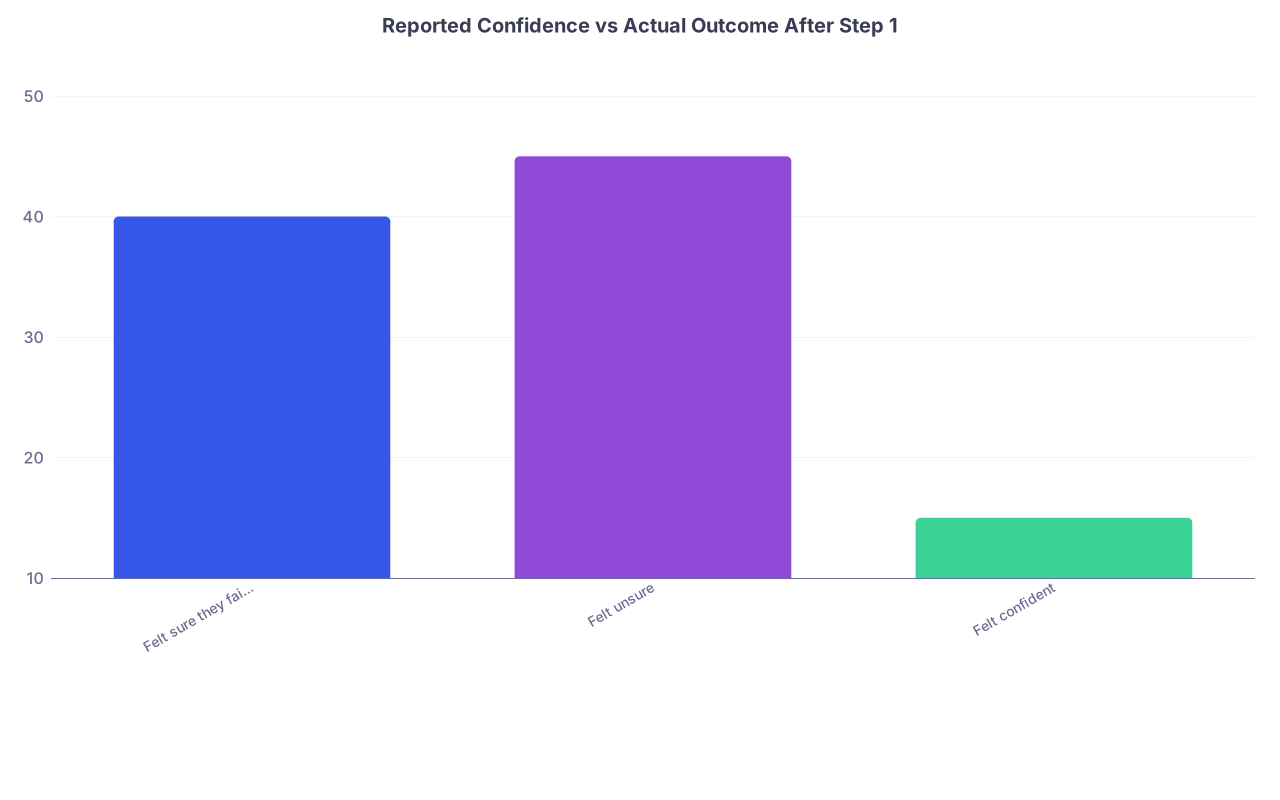
| Category | Value |
|---|---|
| Felt sure they failed | 40 |
| Felt unsure | 45 |
| Felt confident | 15 |
Plenty of students who “felt sure they failed” land completely acceptable scores. The feeling is noisy data. Ignore it.
11. A Compact “On-the-Day” Checklist
You can copy this, print it, and look at it the night before and morning of.
Pre-Test Evening
- Bag packed (ID, snacks, water, sweater, confirmation email)
- Transport and timing planned (arrival 30–45 minutes early)
- One-page “brain dump” + self-reminders written
- Studying stopped by 7–8 pm
- Bedtime set to allow 7–9 hours of sleep
Test Morning
- Wake at planned time
- Normal caffeine, not extra
- Light, familiar breakfast
- 3–5 cycles of 4–4–6 breathing after breakfast
- Leave with enough buffer time (traffic, check-in delays)
During Exam
- Use pre-planned break schedule
- On breaks: walk, stretch, 4–4–6 breathing, short self-script
- In blocks: two-pass method, 60–75 seconds/question first pass
- When panicking: hands off, one deep breath, short script, then act
- Do not talk about content with anyone until you are home and have calmed down (and honestly, there is no benefit even then)
12. Final Thoughts: You Are Not Trying To Feel Calm
A lot of students make one fundamental mistake: they think success equals “I felt calm on exam day.”
No.
Success is:
- You felt anxious.
- You showed up anyway.
- You executed your plan despite that anxiety.
- You protected your time, your focus, and your decision-making.
You do not need to eliminate anxiety to crush Step 1. You need to contain it and keep it out of the way of your hands on the mouse.
Keep three ideas in your head:
- You are not aiming for perfection. You are aiming for “enough right answers.”
- Performance is about process under pressure, not how you feel.
- You already did the hard part in months of preparation. Exam day is execution, not transformation.
Run your protocol. One question at a time. Then walk out and let the score come when it comes.