
The panic you feel after scoring 40% on UWorld for Step 1 is completely understandable—and badly misinterpreted by most students.
The brutal truth about a 40% UWorld score
Let me be blunt: a 40% average on UWorld does not mean you are doomed for Step 1. It means two things:
- Your foundation is leaky.
- Your process is broken.
Fix both, and 4 weeks is enough to move from “this is a disaster” to “this is under control.”
I have seen people go from:
- UWorld 38–45% → Pass Step 1
- NBME 52% → Passing score equivalent (and comfortably)
in about a month. Not by working harder in some vague way. By following a tight, disciplined recovery plan.
That is what you are getting here: a 4-week, step-by-step protocol for turning a 40% UWorld score into a passing-level performance.
Step 1: Diagnose the real problem (Day 0–1)
You cannot fix what you have not defined. “I am just bad at questions” is not a diagnosis. It is an excuse.
You have four likely failure points:
- Weak content foundation
- Sloppy question strategy
- Poor retention (you forget what you cover)
- Time and energy mismanagement
We will quickly identify which ones are killing you.
1. Pull the data from UWorld
Open UWorld and actually look at your performance, not just your average.
You want:
- Overall % correct (you already know ~40%)
- Performance by system
- Performance by discipline
- Recently missed topics you repeatedly see (e.g., renal physiology, immunology basics, biostatistics)
Then write down the 3 lowest systems and 2 lowest disciplines.
Example:
- Systems: Renal 33%, Neuro 35%, Endocrine 37%
- Disciplines: Physiology 32%, Pharmacology 36%
Those are not “weaknesses.” Those are your triage targets.
2. Take a reality-check NBME
If you have not taken a recent NBME, you are flying blind.
- Take an NBME Comprehensive Basic Science (any current form).
- Do it timed, standard pacing.
- Do it now, not 3 weeks from now.
Why?
- UWorld % is not a real predictor by itself.
- NBME gives you a realistic snapshot of where you stand relative to passing.
You do not need to dissect every NBME question yet. Just note:
- Your estimated score / pass likelihood
- Your weakest content areas from the NBME score report
Combine that with UWorld data. You will usually see the same offenders popping up. Good. Now we know what to hit first.
Step 2: Reset your approach to UWorld (Day 1)
Right now, you are using UWorld like a slot machine: press start, get random pain, hope next time will be better. That is not preparation. That is self-torture.
We are going to turn UWorld into a learning tool, not a scoreboard.
Change these UWorld settings immediately
Mode: Tutor mode for now (yes, tutor). You are rebuilding.
Blocks: 10–20 questions per block, not 40.
- 40-question blocks encourage rushing and shallow review.
Random vs system-based:
- Week 1–2: Mixed, but biased toward weak systems (select your lowest 3–4 systems more frequently).
- Week 3–4: Fully mixed questions.
Notes: No paragraphs. You are not writing a textbook. For missed questions:
- 1–3 bullet points: what you missed, what the fact actually is.
Example:
- Missed: SIADH vs cerebral salt wasting
- I confused volume status.
- SIADH = euvolemic / slightly hypervolemic, low serum Na, high urine Na, high urine osmolality.
- CSW = hypovolemic, low serum Na, high urine Na, high urine output.
That is enough. Anything beyond that is procrastination disguised as productivity.
Step 3: The 4-week structure (overview)
Assuming:
- You have 4 weeks until your exam.
- You can give this 6–8 focused hours per day (actual studying, not “sitting near a book”).
We split your time into:
- Daily Questions: 40–80 UWorld Qs (starting lower if your review is slow)
- Targeted Content Repair: 2–4 hours
- Anki / Spaced Repetition: 30–60 minutes
- NBME/Assessment Review: specific days only
| Week | UWorld Focus | Content Focus Priority | Assessment |
|---|---|---|---|
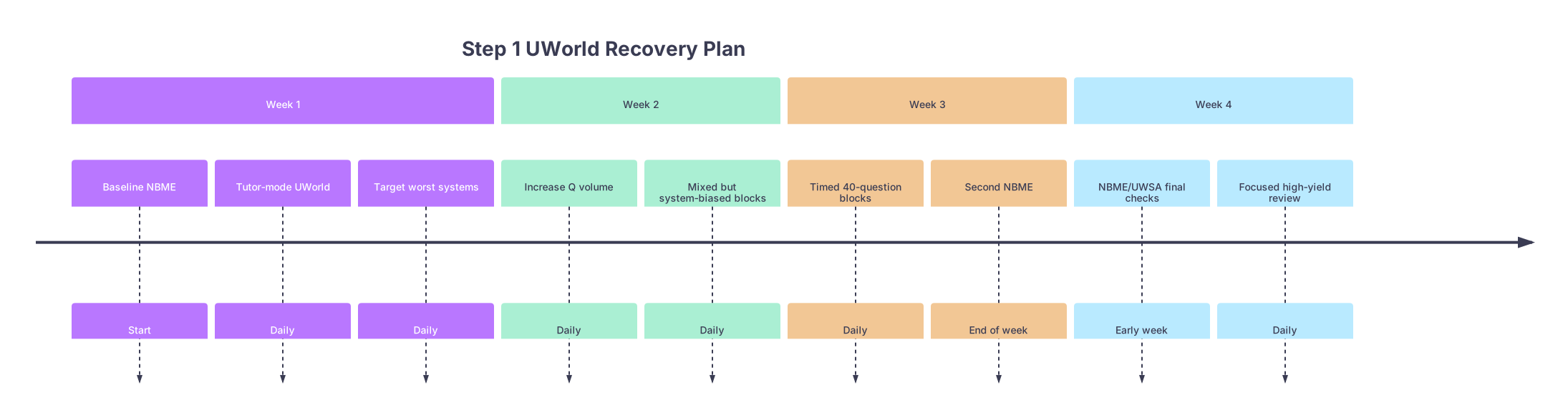
| 1 | 40–50 Q/day, tutor | Lowest 3 systems, high-yield basics | Baseline NBME (Day 1) |
| 2 | 60–70 Q/day, tutor | Remaining weak systems | — |
| 3 | 60–80 Q/day, timed | Integration, multi-system topics | NBME (end of week) |
| 4 | 60–80 Q/day, timed | Final patching, high-yield review | NBME + UWSA |
Yes, this is aggressive. But you are not here for gentle.
Week 1: Stabilize and patch the worst leaks
Goal of Week 1:
Stop bleeding points in your worst systems and clean up your UWorld process.
Daily structure (Week 1)
Aim for something like this:
- Block 1: 10–20 UWorld Qs (tutor, mixed but weighted toward weak systems)
- Review Block 1: Detailed, 2–3x as long as it took to answer
- Content repair: 2 hours on your weakest system (video + quick reference)
- Block 2: 10–20 UWorld Qs
- Review Block 2
- Anki: 30–45 minutes (old + new from missed Qs)
- Optional Block 3 (10–15 Qs) if your speed and focus allow
How to review a missed question properly
If you do not fix this, nothing else matters.
For each missed (or guessed) question:
Classify the failure:
- Did not know the concept at all
- Knew concept but misread question
- Got baited by distractor
- Rushed / time pressure
Write a 1–sentence “diagnosis”:
- “I do not know nephron segment physiology.”
- “I ignored the age and jumped to the wrong disease.”
- “I mixed up side effects of carbamazepine vs valproate.”
Extract 1–3 key facts (max) that would have led you to the right answer.
Explain to yourself out loud why each wrong option is wrong. Fast, not a lecture:
- “A: wrong because this is obstructive, not restrictive. B: wrong because this would decrease DLCO, but here DLCO is normal.”
This trains you to think like Step 1, not like a trivia contest.
- “A: wrong because this is obstructive, not restrictive. B: wrong because this would decrease DLCO, but here DLCO is normal.”
Only then add Anki cards for:
- Patterns you keep missing
- Pure-fact weaknesses (pharm mechanisms, enzymes, cytokines, etc.)
Content repair: what to use
You do not have time to fully re-watch 200 hours of lectures. You need surgical strikes:
Good options:
- Boards & Beyond: short targeted videos (physiology, pathophys)
- Sketchy: micro and pharm where your % is low
- Pathoma: core pathology chapters for systems you are bombing
Pick 1–2 resources. Commit. Jumping among 5 is how people fail.
Week 2: Scale up and integrate more systems
Goal of Week 2:
Increase volume without trashing quality.
You should notice:
- Your review is faster (you are not writing essays).
- Recurring patterns of mistakes are shrinking.
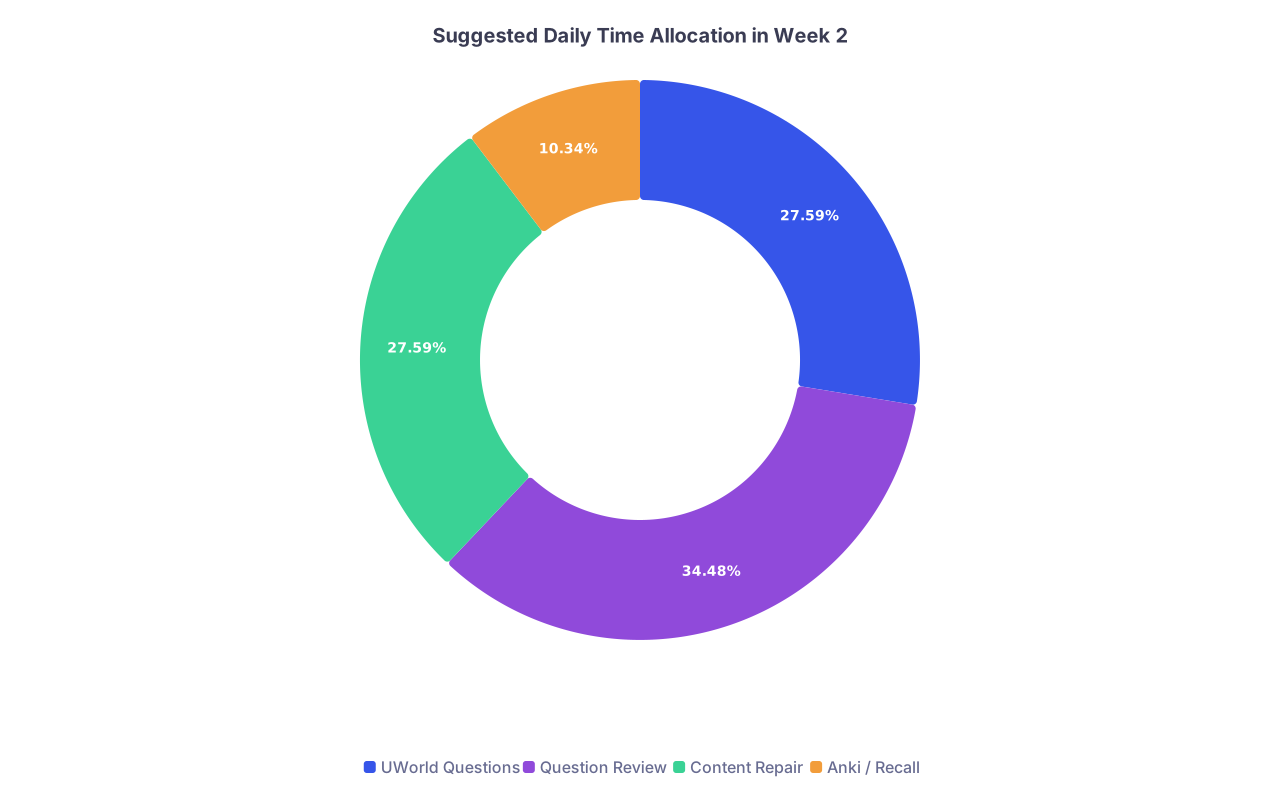
Daily target (Week 2)
- 60–70 UWorld Q/day:
- 3 blocks of 20–25 Qs
- First block in tutor mode, second and third can start shifting to timed if you are stable.
- Content repair:
- 2–3 hours focusing on remaining weak systems
- Anki:
- 45–60 minutes
| Category | Value |
|---|---|
| UWorld Questions | 120 |
| Question Review | 150 |
| Content Repair | 120 |
| Anki / Recall | 45 |
Times in minutes. Adjust a bit, but keep the proportions.
Shift to more mixed questions
By late Week 2:
- Move from heavily system-targeted blocks to mostly mixed.
- Still, keep one “focused” mini-block a day for your absolute worst system.
Why mixed? Because Step 1 is mixed. If you only do system-based until the last week, you will crack when the test throws 5 organ systems at you in one block.
Week 3: Simulate the real exam and close knowledge gaps
Goal of Week 3:
Operate in timed mode, handle full-length blocks, and identify any remaining landmines.
Big moves in Week 3
Switch UWorld to timed mode (at least half your blocks)
- Full 40-question blocks now.
- End of Week 3: you should be tolerating 2–3 full blocks in a day without your brain melting.
Take another NBME near end of Week 3
- Timed conditions, exam-like.
- Compare:
- Did your weakest systems improve?
- Are your mistakes more “narrowly wrong” (picked between 2 good choices) rather than completely off?
Review NBME immediately and surgically
- For each missed:
- Identify topic → match to your notes / Anki.
- Ask: “Is this a one-off weird detail, or a core concept I keep missing?”
- Weird detail: understand once, move on.
- Core concept (renal phys, endocrine feedback, immunology basics): schedule 1–2 hours of focused repair.
- For each missed:
Week 3 daily rhythm
- 80–100 UWorld Qs per day (if stamina allows; minimum 60–80)
- At least 1–2 full timed blocks daily
- Content review is now high-yield and surgical, not broad:
- Multi-system concepts: acid–base, shock types, endocrine axes, immunodeficiencies, vasculitides, neoplasia hallmarks.
Week 4: Sharpen, do not panic-cram
Goal of Week 4:
Consolidate what you know, stop making dumb mistakes, and avoid burning out before the actual exam.
This week is where many students go wrong. They:
- Cram random PDFs
- Start entirely new resources
- Sleep less
- Spiral into anxiety
You will not do that.
What Week 4 should look like
Assessment(s) early in the week
- One NBME OR UWorld Self Assessment (UWSA).
- If you can, do:
- NBME early in Week 4
- UWSA 1 or 2 around 3–4 days before the exam
Refine, do not rebuild
- No new giant resources.
- Loop through:
- Missed-question notebook
- High-yield fact lists (pharm, micro, endocrine, cardio)
- Your highest-yield Anki decks
UWorld usage
- 40–80 Q/day, mostly timed, mixed.
- Prioritize:
- Wrong / marked questions.
- Unseen questions if you have not finished the bank, but do not race to finish at the expense of review.
| Period | Event |
|---|---|
| Week 1 - Baseline NBME | Start |
| Week 1 - Tutor-mode UWorld | Daily |
| Week 1 - Target worst systems | Daily |
| Week 2 - Increase Q volume | Daily |
| Week 2 - Mixed but system-biased blocks | Daily |
| Week 3 - Timed 40-question blocks | Daily |
| Week 3 - Second NBME | End of week |
| Week 4 - NBME/UWSA final checks | Early week |
| Week 4 - Focused high-yield review | Daily |
Fixing the 3 core problems behind 40% scores
Let me address the underlying issues directly.
Problem 1: You do not have a consistent question strategy
Right now you probably:
- Read the stem too fast
- Jump to answer choices
- Chase buzzwords
You need a simple, repeatable process per question. For example:
Read the last line of the question first.
- “What is the most likely diagnosis?” vs “Which enzyme is deficient?” vs “Which drug is contraindicated?”
Then read the stem once, calmly, and:
- Note age, sex, time course (acute vs chronic).
- Underline key vitals and lab abnormalities.
- Convert prose into a concise mental summary:
- “Young woman, hyperthyroid symptoms, low TSH, high free T4, exophthalmos → Graves.”
Before looking at answers, think of 1–2 likely diagnoses / mechanisms.
Then scan answers and:
- Actively eliminate ones that contradict key facts in the stem.
- Choose the one that matches your pre-formed idea, unless a clearly better one appears.
Train this on every single question this month. It feels slower at first. Then it becomes automatic.
Problem 2: You are not retaining what you see
Doing 80 questions a day with garbage retention is just stress cardio.
You need:
Spaced repetition (Anki or similar). Not 10 new decks. Just:
- A core premade Step 1 deck (AnKing / Lightyear / similar) OR
- A tight, curated set of your own cards from missed questions.
Active recall during review:
- Cover the explanation text.
- Ask: “What is the mechanism? What would they test instead? What if this was an older patient? Different lab value?”
You should feel mentally “tired” after review. That is the sign you actually engaged.
Problem 3: Your time and energy are mismanaged
Some of you are trying to study:
- 12–14 hours a day
- With 5 resources open
- While doomscrolling Reddit about Step 1 scores
Then you wonder why your UWorld performance stagnates.
You are better off with 8 tightly focused hours than 14 hours of chaos.
A reliable daily framework:
Morning (fresh brain):
- Timed or tutor UWorld block(s)
- Deep review
Midday:
- Content repair targeting your worst systems
- A smaller block of UWorld afterward
Late afternoon / early evening:
- Anki
- Light review of weak topics / sketch rewatch
Night:
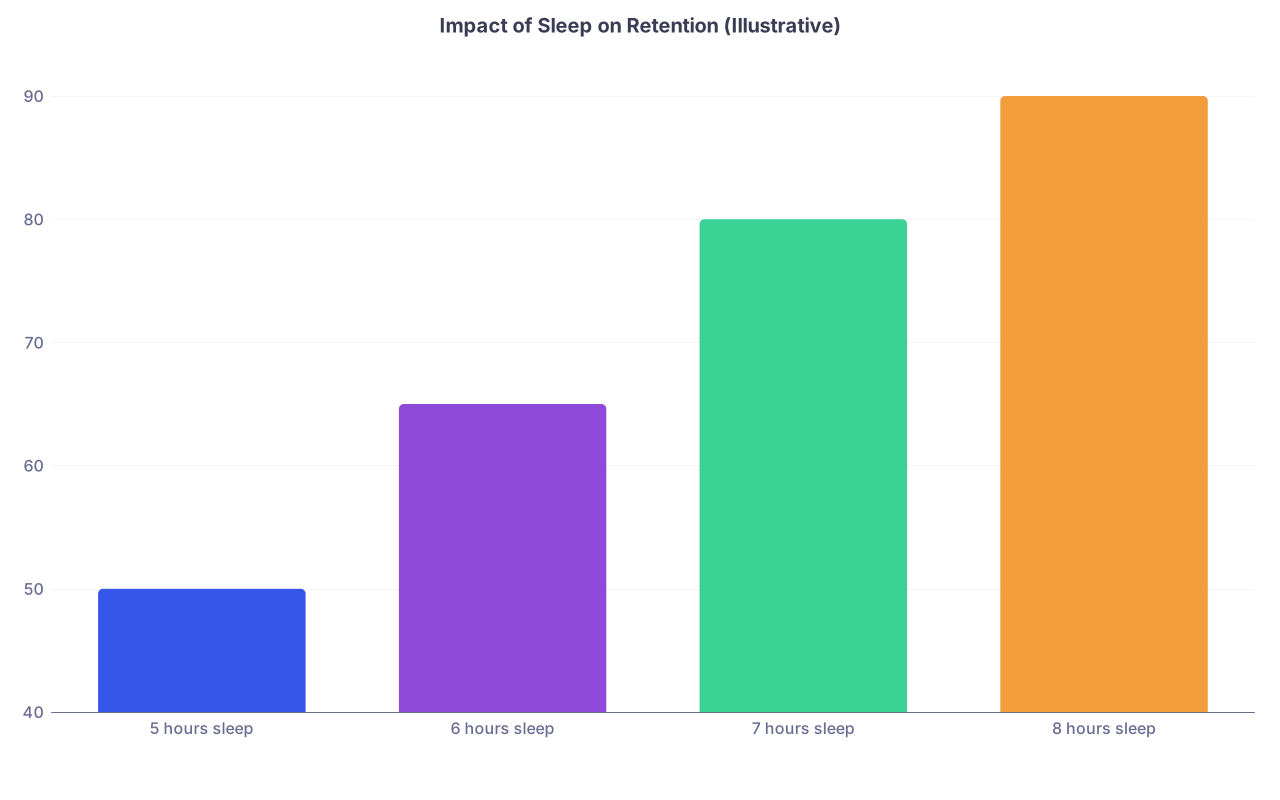
- Stop. Sleep like you are trying to protect your hippocampus. Because you are.
| Category | Value |
|---|---|
| 5 hours sleep | 50 |
| 6 hours sleep | 65 |
| 7 hours sleep | 80 |
| 8 hours sleep | 90 |
(Arbitrary numbers to make the point. You get the idea.)
What improvement is realistic in 4 weeks?
Let me set expectations properly.
For a student at ~40% UWorld with:
- No catastrophic life distractions
- 6–8 hours solid study per day
- Willingness to change their approach
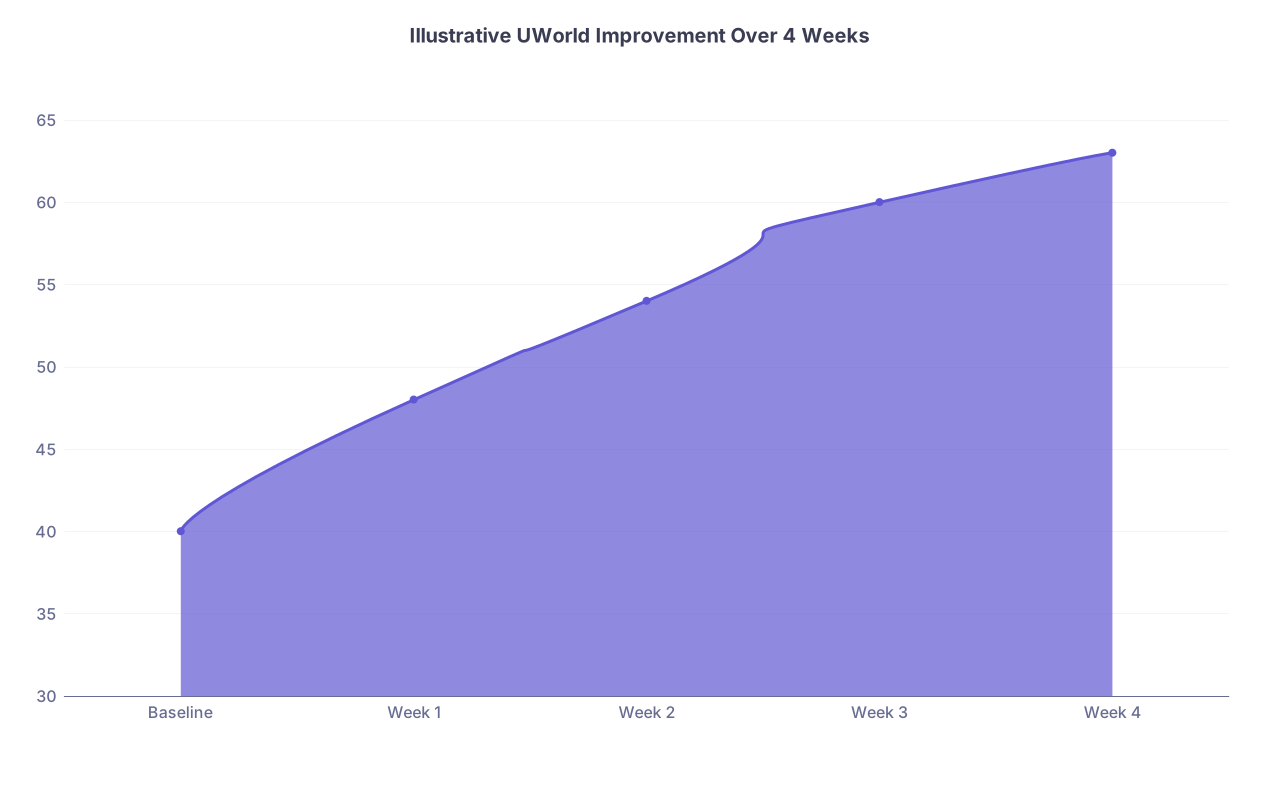
In 4 weeks, I have seen:
- UWorld averages climb into the 55–65% range on mixed blocks.
- NBME scores move from “borderline fail” to “likely pass.”
| Category | Value |
|---|---|
| Baseline | 40 |
| Week 1 | 48 |
| Week 2 | 54 |
| Week 3 | 60 |
| Week 4 | 63 |
Is this guaranteed? No. But it is absolutely possible.
The students who fail to improve usually:
- Keep doing huge blocks with superficial review.
- Refuse to change what obviously is not working.
- Spend more time on forums than in their question bank.
You are not going to be that person.
A concrete 1-day sample schedule (you can start tomorrow)
Here is a template you can literally steal.
08:30–09:45 – UWorld Block 1 (20 questions, timed or tutor)
09:45–11:45 – Review Block 1 deeply (annotate, Anki cards)
11:45–12:15 – Break, food, short walk
12:15–13:30 – UWorld Block 2 (20 questions)
13:30–15:00 – Review Block 2
15:00–16:30 – Targeted content session
- Example: Renal physiology (Boards & Beyond + quick notes)
16:30–17:00 – Anki / flashcards (focus: last 2–3 days of missed concepts)
If you still have mental bandwidth:
17:00–18:00 – Light block (10–15 Qs, tutor mode) from your worst system, fast review.
That is it. Clean, focused, repeatable.
Quick sanity checks before test day
Three days before your exam, ask yourself:
- Have my NBME / UWSA scores moved closer to or above the passing line?
- Can I:
- Sit through at least 3–4 blocks in a row without mentally shutting down?
- Explain my top 10 weak topics reasonably well if someone quizzed me?
- Are my recent UWorld mixed blocks:
- 55–65%+ with understanding of mistakes?
- Or still stuck at 40–45% with random guessing?
If everything is still stuck at 40–45% despite focused work, you should have a serious talk with your dean or advisor about postponing. That is not failure. That is good judgment.
But if you are trending upward and your assessments are near or above passing equivalent, stop catastrophizing. You are on track.
Key takeaways
- A 40% UWorld score is not a death sentence. It is a signal that your foundation and process need urgent repair—and 4 weeks is enough to make real progress if you are ruthless about how you work.
- The fix is not “more hours.” It is:
- Structured daily UWorld with aggressive, high-quality review
- Targeted content repair on your worst systems
- Consistent spaced repetition and exam-like timed practice.
- You must change how you think during questions—slow down, predict before you look at answers, and train your brain to eliminate wrong choices systematically.
Follow the 4-week framework above, and you will not feel “ready” in some magical, confident way. Almost nobody does. But you will be prepared enough to pass, which is the only thing Step 1 cares about.