
Weak biostats is not a personality trait. It is a fixable systems problem—and one of the easiest 10–15 points you can add to your Step 1 score if you stop winging it and start treating it like a skill.
You already know the pattern. You do a block of UWorld. The biostats question appears. Your eyes glaze for a second. “Ugh, I hate these.” You click something that “feels” right and move on. Then on review, the explanation has three formulas, some Greek letters, and your brain quietly leaves the room.
This is solvable. And you do not need to become a statistics nerd to crush Step 1 biostats.
Here is the plan: turn biostats from “random math questions” into a small, clearly defined set of playbooks that you can run in your sleep.
Step 1: Understand What Step 1 Biostats Actually Tests
First fix: stop studying everything. Start studying what the exam actually asks.
Biostats and epidemiology on Step 1 are ridiculously pattern-based. The writers recycle the same structures with different window dressing.
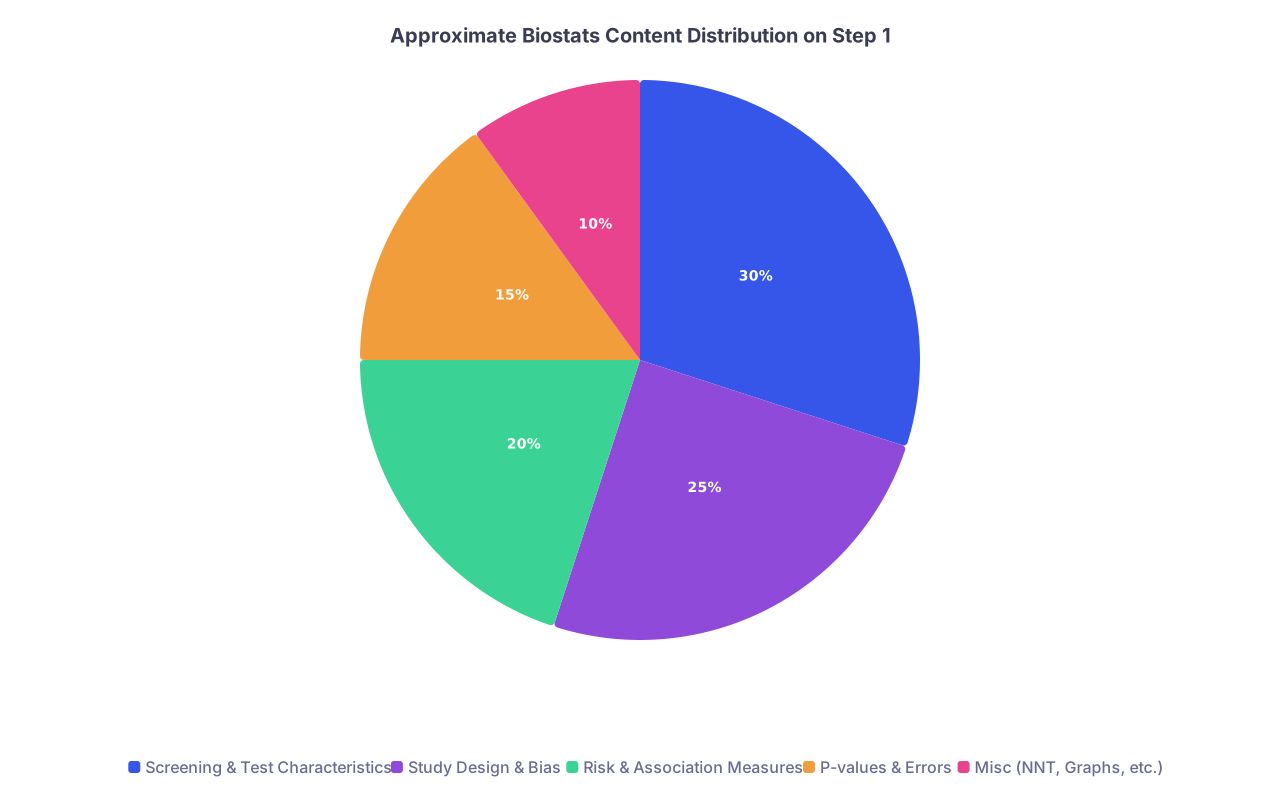
| Category | Value |
|---|---|
| Screening & Test Characteristics | 30 |
| Study Design & Bias | 25 |
| Risk & Association Measures | 20 |
| P-values & Errors | 15 |
| Misc (NNT, Graphs, etc.) | 10 |
Here is what shows up over and over:
Diagnostic test characteristics
- Sensitivity, specificity, PPV, NPV
- Likelihood ratios
- How changing prevalence affects PPV/NPV
- Reading 2×2 tables quickly
Study design & interpretation
- Case-control, cohort, RCTs, cross-sectional, ecologic
- Confounding vs effect modification
- Selection bias, recall bias, Berkson bias, etc.
- Intention-to-treat vs per-protocol
Risk and association
- Absolute risk, relative risk, odds ratio
- Attributable risk, relative risk reduction, absolute risk reduction
- NNT, NNH
Inference and hypothesis testing
- Type I and II errors
- Power, alpha, beta
- Confidence intervals and what “includes 1” or “includes 0” means
- P-values (and what they do not mean)
Graph and data interpretation
- Kaplan–Meier curves
- ROC curves
- Histograms, boxplots, scatter plots
If your study plan does not explicitly target these categories, it is broken.
Quick audit: how bad is your biostats?
Grab 20–25 biostats/epi questions from:
- UWorld (Biostats + Ethics section)
- AMBOSS “Biostatistics and epidemiology”
- NBME self-assessment (if you have one available)
Track only two things:
- Did you get it right? (Y/N)
- Why did you miss it?
- Did not know formula
- Knew formula but misread question
- Misinterpreted graph/CI/p-value
- Confused bias/study design concept
That second column is more important than your raw score. It will tell you exactly what to fix.
Step 2: Build a Tiny Biostats Formula Toolbox (Not a Textbook)
You do not need 40 formulas. You need about 10–12, flawlessly.

Core diagnostic test formulas
From a 2×2 table:
| Disease + | Disease - | |
|---|---|---|
| Test + | a | b |
| Test - | c | d |
You must be able to write these from memory in under 15 seconds:
- Sensitivity = a / (a + c)
- Specificity = d / (b + d)
- PPV = a / (a + b)
- NPV = d / (c + d)
Do not memorize them by letters only. Attach meaning:
- Sensitivity: “Of those with disease, how many test positive?”
- Specificity: “Of those without disease, how many test negative?”
- PPV: “Given a positive test, what is probability of disease?”
- NPV: “Given a negative test, what is probability of no disease?”
Write them down daily for a week. Yes, literally.
Risk and association formulas
Memorize and apply:
- Risk in exposed = a / (a + b)
- Risk in unexposed = c / (c + d)
From there:
- Relative Risk (RR) = [a / (a + b)] ÷ [c / (c + d)]
- Odds ratio (OR) for case-control = (a × d) / (b × c)
- Absolute risk reduction (ARR) = control event rate − treatment event rate
- Relative risk reduction (RRR) = ARR / control event rate
- Number needed to treat (NNT) = 1 / ARR
- Number needed to harm (NNH) = 1 / attributable risk
Write them once. Then do 10 practice questions where you compute them without a calculator. Your brain will hate you for one day. Then it becomes automatic.
Confidence intervals and hypothesis testing
You need conceptual handles, not proofs.
95% CI: range of values that likely contains the true population parameter.
Interpretation rule for Step questions:
- If RR or OR CI includes 1 → not statistically significant
- If mean difference CI includes 0 → not statistically significant
Type I error (α): false positive. Reject a true null. “Seeing an effect that is not there.”
Type II error (β): false negative. Fail to reject a false null. “Missing a real effect.”
Power = 1 − β. Higher power → lower chance of Type II error.
You must be able to:
- Look at a CI like 0.7–1.4 for an RR and say: “Not significant; includes 1.”
- Look at a p-value of 0.03 when α = 0.05 and say: “Reject null; statistically significant.”
Make a one-page “CI & errors” sheet that you review every 2–3 days.
Step 3: Turn Common Question Types into Scripts
Most students fail biostats not because of knowledge, but because they improvise their approach on every problem. That is slow and fragile.
You want scripts. Short, repeatable algorithms.

| Step | Description |
|---|---|
| Step 1 | Biostats Question |
| Step 2 | Identify 2x2 or Risks |
| Step 3 | Choose Formula |
| Step 4 | Compute & Match Answer |
| Step 5 | Identify Topic |
| Step 6 | Recall Definition |
| Step 7 | Eliminate Wrong Choices |
| Step 8 | Numbers or Concepts? |
| Step 9 | Study Design or Bias or Errors? |
Script 1: Any 2×2 table / diagnostic test question
- Redraw the table with a, b, c, d labeled correctly.
- Underline what they are asking: sensitivity? PPV? NPV? likelihood ratio?
- Write the formula beside your table.
- Plug in numbers. Do not do this in your head if it is even slightly messy.
- Estimate if needed. You do not need 4 decimal precision—pick the closest option.
You must force yourself to rewrite the table for a week. After that, you will not need it every time.
Script 2: RR vs OR questions
Key idea: case-control vs cohort.
- Case-control: you start with cases and controls → you cannot compute risk directly → use OR
- Cohort / RCT: you start with exposed and unexposed groups and follow them → use RR
Script:
Identify design:
- “Patients with disease and without disease were selected…” → case-control → OR
- “A group of smokers and non-smokers were followed…” → cohort → RR
If they give a CI:
- Does it include 1? If yes → no significant association.
If they ask “interpretation”:
- RR = 2.0 → “Exposed group has twice the risk of disease compared with unexposed.”
- OR = 3.0 → “Odds of exposure are three times higher in cases than controls.”
Do 15–20 of these in a row one afternoon. Your brain will stop mixing them up.
Script 3: Bias questions
Bias questions are pattern recognition. The exam likes certain clichés.

Most-tested biases:
- Selection bias: non-random sample. Hospital-based sample, volunteers, loss to follow-up that is unequal.
- Recall bias: retrospective questions about exposure, especially in parents of sick children.
- Berkson bias: hospitalized patients as cases and controls.
- Lead-time bias: screening detects disease earlier but does not change survival.
- Length-time bias: screening more likely to detect slow-progressing disease.
- Confounding: a third variable distorts association.
- Observer (measurement) bias: knowledge of exposure status influences measurement.
Script:
Underline key phrases:
- “Hospitalized patients only,” “people who respond to survey,” “lost to follow-up” → selection issues.
- “Mothers of children with cancer were asked…” → recall bias.
- “Screening makes survival appear longer but mortality unchanged” → lead-time.
Ask: is this about who is in the study, how exposure is remembered, when disease is detected, or a third variable?
Then match to:
- Who is in study → selection/Berkson.
- Memory of past exposure → recall.
- Earlier diagnosis but same outcomes → lead-time.
- Different disease speed → length-time.
- Third variable explanation → confounding.
You do not memorize obscure biases. You hammer these few high-yield ones until you cannot miss them.
Step 4: Convert Weakness into a Dedicated Micro-Block
Biostats will not fix itself by osmosis while you “do more questions in general.” It needs a dedicated, time-boxed micro-block in your schedule.
| Day Range | Focus Area |
|---|---|
| 1–2 | Core formulas & 2×2 tables |
| 3–4 | RR, OR, ARR, NNT, CIs |
| 5–6 | Study design & major biases |
| 7 | Mixed question set + review sheet |
| 8–9 | Advanced interpretation (graphs) |
| 10–11 | Timed blocks (mixed UWorld) |
| 12–14 | Weak area clean-up and repetition |
You can implement this even in the middle of a busy dedicated period.
What a focused 45-minute biostats session looks like
Stop doing random, unfocused “I should read First Aid biostats tonight.” That does not stick.
Concrete 45-minute block:
- 5 minutes – Rewrite key formulas from memory on scrap paper.
- 20 minutes – Do 8–10 biostats questions by topic (e.g., only screening tests).
- 15 minutes – Review every question in detail, especially the wrong ones.
- 5 minutes – Update a 1-page “biostats errors log” (I will show you what goes in it).
Three of these sessions per week for 2–3 weeks will radically change your performance—if you are intentional.
Step 5: Use the Right Resources the Right Way
Most students either:
- Overkill with a 300-page biostats PDF they never finish, or
- Underkill with a quick skim of First Aid and hope for the best.
You want the middle path: targeted, question-driven learning.
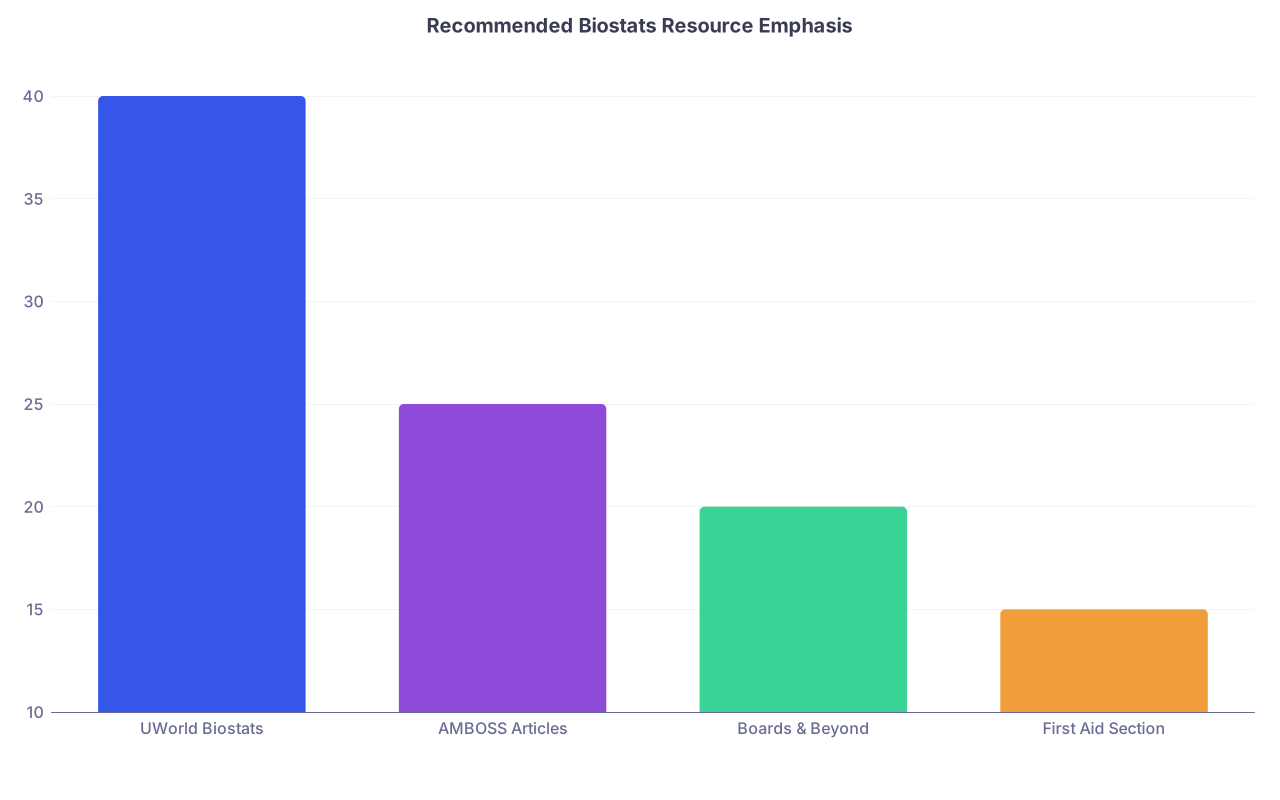
| Category | Value |
|---|---|
| UWorld Biostats | 40 |
| AMBOSS Articles | 25 |
| Boards & Beyond | 20 |
| First Aid Section | 15 |
Core resources and how to actually use them
UWorld Biostatistics and Epidemiology questions
- Do all of them at least once.
- When you miss one, read the explanation until you can explain it back in 2–3 sentences without looking.
- Tag particularly good ones for review during your last 1–2 weeks before the exam.
AMBOSS Biostats/Epi articles and questions
- Use the articles as targeted reference, not bedtime reading.
- Example: After missing 3 confounding questions, read the confounding and bias articles, then immediately do 10–15 related questions.
Boards & Beyond (or similar) Biostatistics videos
- Watch these once at 1.25–1.5× speed with a pen in hand.
- Pause only to write formulas and 1-line summaries for each concept.
First Aid Biostatistics section
- Treat it as a checklist, not a textbook.
- Go line by line: “Can I explain this in one sentence and do a question on it?”
- Whatever you hesitate on goes into your “needs practice” list.
Step 6: Build a Simple Biostats Error Log That Actually Works
Most “error logs” are graveyards: long, unread lists of every possible mistake.
Your biostats log needs to be small and brutal.

Set up a one-page table (paper or digital) with only 4 columns:
- Question type (e.g., “2×2 / sensitivity,” “RR vs OR,” “confounding bias”)
- My mistake (what you mentally did wrong)
- Correct idea or formula (short, 1–2 lines)
- Trigger phrase (what in the question stem should remind you next time)
Example entries:
Type: RR vs OR
- My mistake: Used RR in case-control study.
- Correct: Case-control → use odds ratio only.
- Trigger: “Cases and controls were selected…”
Type: Confounding
- My mistake: Chose effect modification.
- Correct: Confounding = third variable distorts association; effect modification = real difference in effect between subgroups.
- Trigger: “Association disappears after stratifying…”
Review this single page twice a week. Add to it, but cap it at one page. When it gets full, consolidate similar mistakes.
Step 7: Train for Speed and Pattern Recognition
Knowing formulas is not enough. On exam day, you have ~90 seconds per question on average and you cannot let one Kaplan–Meier curve eat 5 minutes.
You need to practice under pressure.
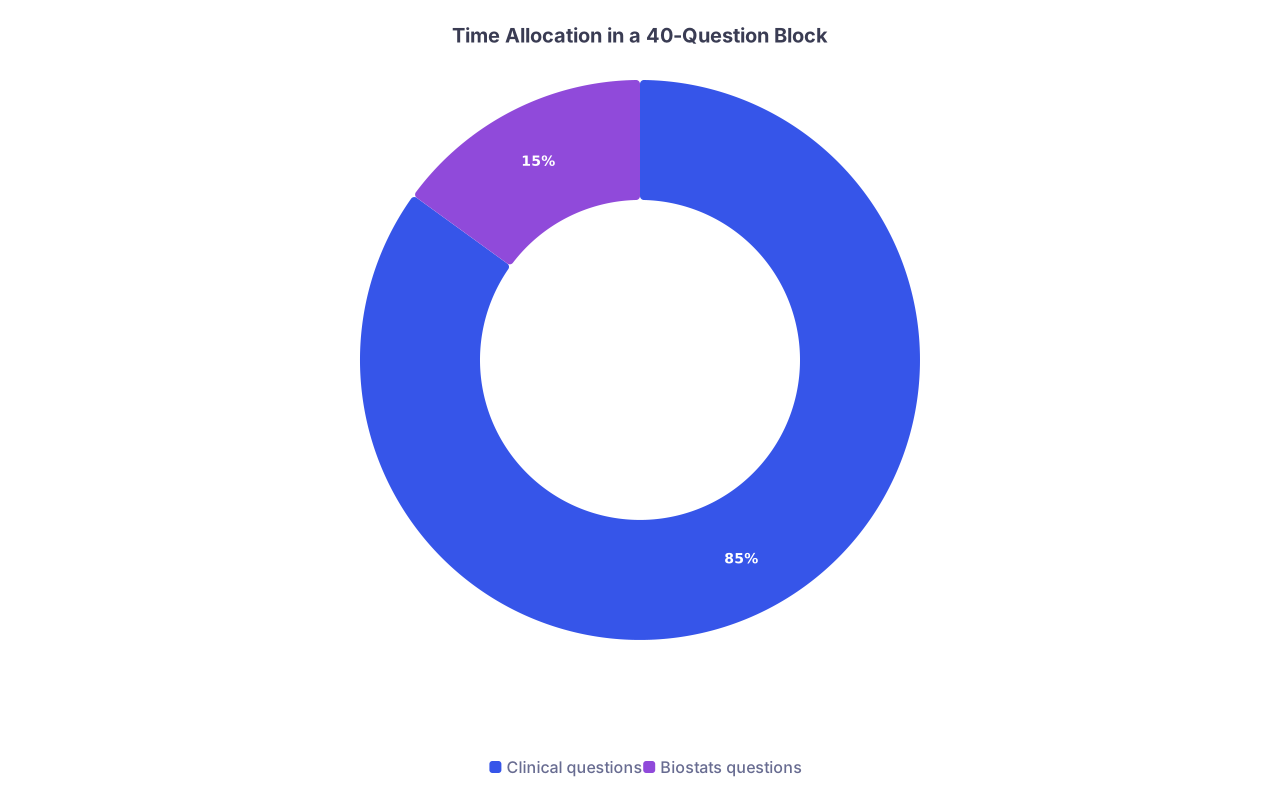
| Category | Value |
|---|---|
| Clinical questions | 34 |
| Biostats questions | 6 |
Timed biostats mini-blocks
Once you know the basics:
- Create 10-question biostats-only blocks from UWorld or AMBOSS.
- Set a timer for 15 minutes.
- Do the block. If you hit 15 minutes, stop wherever you are.
- Track:
- How many you completed.
- How many correct.
- Where you lost time (e.g., “stared at ROC curve for 3 minutes”).
Goal: Reach a consistent 80%+ accuracy at <1.5 minutes per question on average.
Common speed killers—and how to kill them
Re-deriving formulas
- Fix: Write them daily for 7 days. Use a small formula card during question review until you instinctively know them.
Over-calculating instead of estimating
- Step 1 answers are usually not within 0.01 of each other. You can often:
- Round numbers to 1–2 significant digits
- Compare ratios qualitatively (e.g., “this is clearly about double”)
- Step 1 answers are usually not within 0.01 of each other. You can often:
Over-reading long stems
- Biostats questions often bury the key data in a table or one sentence.
- Strategy: skim question stem until you see:
- The table
- The p-value / CI
- The described bias or design phrase
- Then stop. Go to the actual question line and answers. Work backward from there.
Step 8: Treat Biostats as a Confidence Anchor on Test Day
When you walk into the exam, you want certain question types to feel like free points. Biostats can be that—if you have done the work.
Pre-test warm-up
Morning of the exam (or the night before), do a tiny warm-up:
- 5–6 biostats questions from your “marked” UWorld/AMBOSS set
- One quick scan of your 1-page:
- Formulas
- Bias definitions
- Hypothesis testing summary
This is not “learning.” It is priming the scripts you have already built.
On the exam: how to handle a tough biostats question
If you get a nasty-looking statistics question:
Label what it is about in your head:
“This is a study design / this is RR vs OR / this is a CI significance question.” Naming it calms the brain.Apply the script, not your feelings:
- 2×2 table → draw it, plug formula.
- RR/OR with CI → case-control vs cohort; see if CI includes 1.
- P-value vs alpha → compare and decide reject/not reject.
If it is genuinely unclear and eating time, mark it and move on.
- You are not required to master every biostats nuance to get a great score.
- Do not sacrifice 4 clinical questions for 1 borderline biostats guess.
Step 9: Quantify the Score Boost
You are not doing this for fun. You are doing this for points.
You want to see the payoff.
Before and after your 2–3 week biostats focus:
- Do a 20-question biostats-only assessment (from random unused questions).
- Record:
- % correct
- Average time per question
Reasonable improvement targets:
- If you started at ~40–50% → you can realistically reach 70–80%+
- Time per question can drop from 2+ minutes to ~1–1.3 minutes
That is a meaningful bump. On a full exam, strong biostats can:
- Add 8–15 points to your 3-digit equivalent score
- Free extra minutes you can spend on brutal path/phys questions
Step 10: If You Are Really Math-Averse
I have worked with plenty of students who say, “I am just not a numbers person.” Fine. Then you adapt.
You do not need to love math to handle Step 1 biostats. But you do need coping strategies.
Focus on:
Conceptual interpretation questions
- “Which of the following best explains…”
- “What is the most likely type of bias?”
- “How should this study be redesigned?”
Recognition rules instead of derivations
- RR or OR CI including 1 → not significant.
- P < α → reject null.
- Screening with earlier diagnosis but unchanged mortality → lead-time bias.
Minimal computation
- Emphasize comparison questions where the exact number does not matter, only whether risk went up/down, or which group has higher PPV/NPV.
- Use rounding aggressively.
If you can at least get conceptual questions mostly right, you will already be better than a large share of test-takers.
What To Do Right Now
Do not “plan to work on biostats later.” Later never shows up.
Here is your next concrete step for today:
Open your question bank, filter for biostatistics/epidemiology, and do a 10-question timed block. Then build a one-page error log from the mistakes you made.
That single action will tell you exactly where your biostats is bleeding points—and it gives you the raw material to start fixing it systematically tomorrow.