
It is 11:30 p.m. You have UWorld open, a half-finished Anki queue, and you just missed yet another question about some T-helper subset secreting some cytokine that does some thing to some cell. You know the words. You just cannot hold the pathways in your working memory long enough to use them.
Let me be direct: Step 1 immunology is not about obscure facts. It is about a limited set of high-yield patterns that get recycled in different disguises. If you lock those in, the rest becomes noise.
I am going to walk you through exactly what shows up, what you must know cold, and how the common traps are built.
1. The Core Map: Innate vs Adaptive and the Big Cells
If your mental map of the immune system is fuzzy, every cytokine question will feel random. So we begin with the skeleton.

| Step | Description |
|---|---|
| Step 1 | Pathogen |
| Step 2 | Macrophages / DCs |
| Step 3 | Neutrophils |
| Step 4 | NK cells |
| Step 5 | Antigen presentation to CD4+ T cells |
| Step 6 | Antigen presentation to CD8+ T cells |
| Step 7 | Th1 / Th2 / Th17 / Treg differentiation |
| Step 8 | B cell help and class switching |
| Step 9 | Cytotoxic killing |
| Step 10 | Innate immune sensors |
You need three big contrasts in your head.
Innate vs adaptive
- Innate: minutes to hours, no memory, pattern recognition (TLRs, complement, NK cells, neutrophils, macrophages).
- Adaptive: days, specific, memory (T cells, B cells, antibodies).
MHC I vs MHC II
- MHC I: all nucleated cells, endogenous antigens (viruses, tumor), presents to CD8+ T cells.
- MHC II: APCs (dendritic cells, macrophages, B cells), exogenous antigens, presents to CD4+ T cells.
CD4 vs CD8 vs B cell
- CD4+: “conductors” – secrete cytokines, orchestrate responses.
- CD8+: “hitmen” – kill virally infected and tumor cells via perforin/granzyme, FasL.
- B cells: antibody factories, antigen presentation, memory.
On exam questions, they love to:
- Describe a deficiency or mutation that selectively impairs one arm.
- Ask what infection type becomes recurrent.
- Then tie it to a specific pathway (IFN-γ, IL-12, etc).
So keep this overarching rule in mind:
Patterns of infection + specific pathway defect = diagnosis + cytokine consequences.
2. T-Helper Cell Subsets: The Money Section
If you only master one immunology table for Step 1, it is this: Th1, Th2, Th17, and Treg. What drives them, what they secrete, and what they do.
The High-Yield Th Subset Table
| Subset | Driven by | Main Cytokines Secreted | Main Functions |
|---|---|---|---|
| Th1 | IL-12, IFN-γ | IFN-γ, IL-2 | Activate macrophages, CD8+ T cells; intracellular killing |
| Th2 | IL-4 | IL-4, IL-5, IL-13 | Class switch to IgE/IgA; eosinophils; allergy/parasites |
| Th17 | TGF-β, IL-6, IL-23 | IL-17, IL-21, IL-22 | Recruit neutrophils, mucosal defenses; extracellular bacteria/fungi |
| Treg | TGF-β, IL-2 | IL-10, TGF-β | Immune tolerance, anti-inflammatory, prevent autoimmunity |
Now, let me unpack the ones Step 1 likes to test.
Th1 – Intracellular Hit Squad
Think: viruses, TB, intracellular bacteria, granulomas.
- Driven by: IL-12 (from macrophages, dendritic cells) and IFN-γ.
- Secretes:
- IFN-γ: activates macrophages, increases MHC expression, promotes more Th1, inhibits Th2.
- IL-2: T-cell growth factor, supports CD8+ expansion.
Classic Step 1 scenario:
- Recurrent mycobacterial infections in a child.
- Lab reveals defective IL-12 receptor, or anti-IFN-γ antibodies.
- That is breakdown of the IL-12 → Th1 → IFN-γ axis.
You should be able to answer:
- Which cytokine is reduced? (IFN-γ)
- Which infections increase? (Mycobacteria, Salmonella, intracellular pathogens)
- Which treatment? Sometimes IFN-γ therapy.
Th2 – Allergy and Parasites
Think: asthma, atopy, helminths.
- Driven by: IL-4.
- Secretes:
- IL-4: class switching to IgE and IgG.
- IL-5: eosinophil activation and growth, class switching to IgA.
- IL-13: mucus production, airway hyperreactivity.
Clinical clues:
- Eosinophilia, high IgE, atopic dermatitis, allergic asthma.
- Parasite infection with elevated IL-5 and eosinophils.
Exam trick:
They will describe allergic asthma and ask which cytokine mediates class switching to IgE (IL-4) or eosinophil activation (IL-5).
Remember: Th1 and Th2 cross-inhibit each other.
- Th1 (IFN-γ) inhibits Th2.
- Th2 (IL-4, IL-10) inhibit Th1.
This is how they tie in lepromatous vs tuberculoid leprosy: weak Th1 vs strong Th1 responses.
Th17 – Neutrophils and Mucosal Defense
Underappreciated, but they keep testing it more frequently.
- Driven by: TGF-β + IL-6 + IL-23.
- Secretes:
- IL-17: recruits neutrophils, stimulates epithelial cells to produce chemokines.
- IL-22: enhances barrier function, epithelial integrity.
- IL-21: autocrine support.
Key pathology to know: Job syndrome (Hyper-IgE syndrome)
- Deficient Th17 differentiation due to STAT3 mutation.
- Clinical picture:
- “Cold” staphylococcal abscesses (noninflamed, poor neutrophil recruitment).
- Recurrent lung infections.
- Eczema.
- Retained primary teeth.
- High IgE.
Translation: Th17 lost → IL-17 low → neutrophils never show up properly.
Treg – Brakes of the System
Think: tolerance, autoimmunity, IPEX.
- Driven by: TGF-β and IL-2.
- Secretes:
- IL-10: anti-inflammatory, inhibits Th1, decreases MHC and costimulatory molecules on APCs.
- TGF-β: immune regulation, fibrosis, tolerance promotion.
Classic high-yield disease: IPEX syndrome (Immune dysregulation, Polyendocrinopathy, Enteropathy, X-linked).
- FOXP3 mutation → dysfunctional Tregs.
- Clinical: early-onset autoimmunity, diabetes in infancy, severe diarrhea, eczema.
3. Cytokines by Function: What Each One “Smells” Like on Questions
Let me break down the Step 1-famous cytokines the way you actually recall them: by what the vignette looks like.
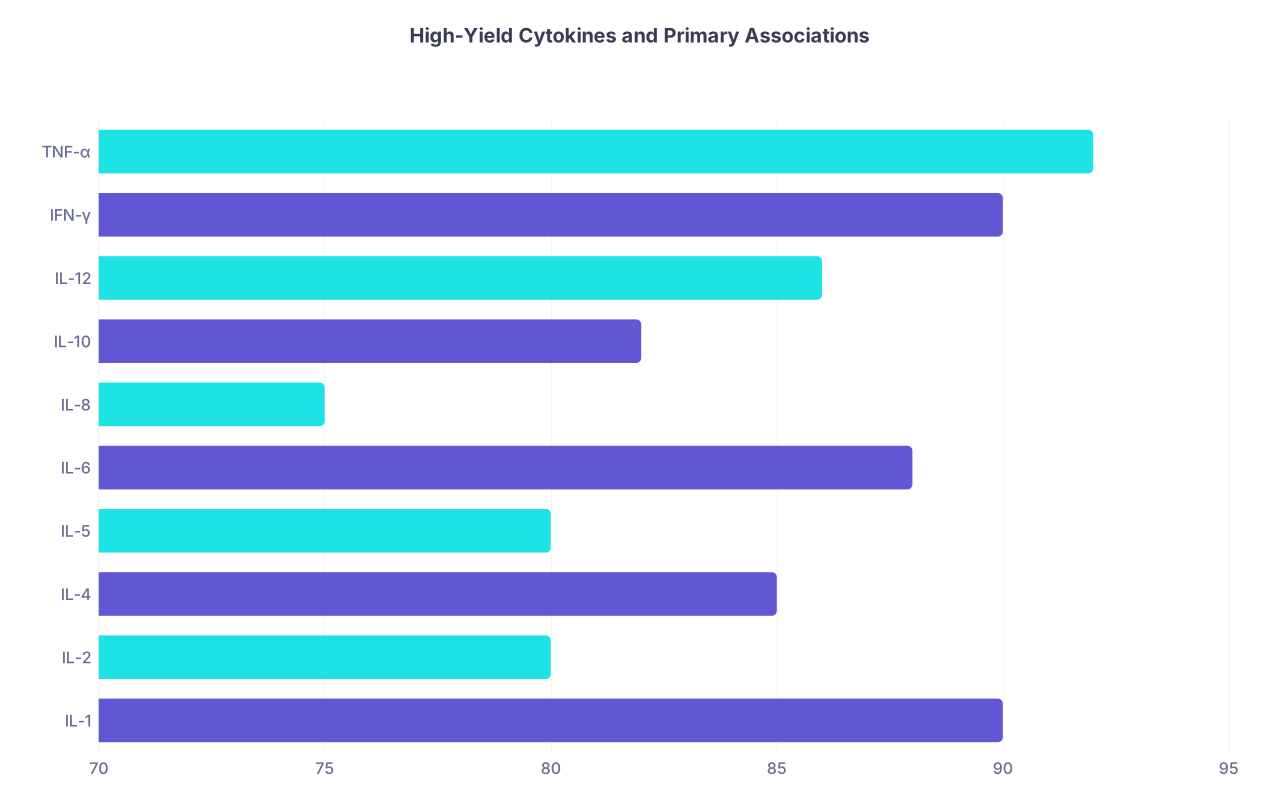
| Category | Value |
|---|---|
| IL-1 | 90 |
| IL-2 | 80 |
| IL-4 | 85 |
| IL-5 | 80 |
| IL-6 | 88 |
| IL-8 | 75 |
| IL-10 | 82 |
| IL-12 | 86 |
| IFN-γ | 90 |
| TNF-α | 92 |
The “Hot” Cytokines: IL-1, IL-6, TNF-α
These drive systemic inflammation. Think fever, acute phase reactants, cachexia, septic shock.
IL-1 – “hot” cytokine.
- Fever, acute inflammation.
- Increases adhesion molecules on endothelium.
- Secreted by macrophages.
- Vignette: patient with infection, fever, high ESR/CRP.
IL-6
- Major inducer of acute-phase reactants (CRP, fibrinogen) in the liver.
- Also causes fever.
- Secreted by macrophages and T cells.
- Vignette: RA patient with high CRP, IL-6 targeted by tocilizumab.
TNF-α
- Secreted by macrophages.
- Activates endothelium, promotes leukocyte recruitment.
- Mediates CACHEXIA in chronic disease and malignancy.
- High levels → septic shock, vascular leak, DIC-like picture.
Exam favorite: Anti-TNF therapy (infliximab, etanercept) increasing risk of reactivation of TB.
Link: TNF-α is needed to maintain granulomas.
IL-2 – T Cell Growth Factor
- Produced by activated T cells (mostly CD4+).
- Stimulates growth of:
- T cells (CD4+, CD8+).
- NK cells.
- Some B cell proliferation.
Therapeutic angle: High-dose IL-2 (aldesleukin) used for metastatic RCC and melanoma in the past.
On Step 1: If they describe a cytokine used to increase proliferation of T cells and NK cells in cancer immunotherapy → IL-2.
IL-3 – Bone Marrow Support
Less heavily tested, but:
- Supports growth and differentiation of bone marrow stem cells.
- Like GM-CSF–ish.
- Secreted by T cells.
Usually a distractor answer, but sometimes they throw it in as “multilineage hematopoiesis support.”
IL-4 & IL-5 – Allergy and Parasites
We covered them in Th2, but Step 1 likes rote recall questions here too.
IL-4
- Induces differentiation into Th2 cells.
- Promotes class switching to IgE and IgG.
- Inhibits Th1 response.
IL-5
- Promotes growth and differentiation of eosinophils.
- Class switching to IgA (especially in mucosal immunity).
Common patterns:
- Asthma/allergic rhinitis: IL-4 and IL-13 → IgE, mucus.
- Eosinophilia in parasitic infection: IL-5.
IL-8 – “Come here, neutrophils”
- Secreted by macrophages, endothelium.
- Strong chemoattractant for neutrophils.
- Neutrophils “clean up on aisle 8.”
Q-style: Tissue infection with neutrophil-rich exudate; which chemokine is recruiting them? → IL-8.
IL-10 & TGF-β – The Anti-Inflammatory Duo
IL-10
- Secreted by Tregs, Th2 cells, macrophages.
- Decreases expression of MHC II and B7 on APCs.
- Inhibits inflammatory cytokines (IL-12, TNF-α, etc).
TGF-β
- Multifunctional:
- Immune regulation (Treg induction).
- Fibrosis and scar formation.
- Secreted by many cells; strongly associated with chronic inflammation leading to fibrosis.
- Multifunctional:
Any question about “inhibits Th1 response and decreases MHC expression on APCs” → IL-10.
IL-12 & IFN-γ – The Mycobacteria Axis
This is one of the highest-yield pairs.
IL-12
- Secreted by macrophages and dendritic cells.
- Induces differentiation of naive T cells into Th1.
- Increases production of IFN-γ.
IFN-γ
- Produced by Th1 cells and NK cells.
- Enhances macrophage killing, increases MHC I and II expression.
- Important for granuloma formation.
Classic exam cluster:
- IL-12 receptor deficiency.
- IFN-γ receptor deficiency.
- Presentation: disseminated mycobacterial or BCG infection after vaccination.
They will ask:
- What cytokine would be decreased? (IFN-γ).
- What infection risk? (Mycobacteria, some Salmonella).
- Which cells normally produce IFN-γ? (Th1, NK).
4. Interferons: Type I vs Type II
Students often blur these. Step 1 does not.
Type I Interferons: IFN-α and IFN-β
Think: antiviral state.
- Produced by virus-infected cells.
- Actions:
- Decrease viral protein synthesis in neighboring cells.
- Activate RNase that degrades viral mRNA.
- Increase MHC I expression.
Therapeutic uses:
- IFN-α: chronic hepatitis B and C (historically; now less), Kaposi sarcoma, hairy cell leukemia, condyloma acuminatum.
- IFN-β: multiple sclerosis.
They like to describe a viral infection, upregulation of antiviral proteins in neighboring cells, and ask which cytokines: IFN-α and IFN-β.
Type II Interferon: IFN-γ
We already hammered this, but recap:
- Produced by Th1 and NK cells.
- Strong macrophage activation.
- Granuloma maintenance.
- Increased MHC I and II.
Different theme from Type I: more “cell-mediated immunity” than direct antiviral state.
5. Costimulation and Tolerance: B7–CD28, Anergy, and CTLA-4
Now we move from “which cytokine?” to “which signal?”
Step 1 repeatedly tests a few key receptor-ligand pairs.
T cell activation: Two-signal rule
Signal 1 – antigen recognition
- TCR + CD4 or CD8 binds antigen-MHC complex on APC.
Signal 2 – costimulation
- B7 (CD80/86) on APC binds CD28 on naive T cell.
Without signal 2, T cells become anergic.
This is where tolerance questions come in.
B cell activation and class switching
- B cells present antigen to Th cells via MHC II.
- T cell recognizes antigen (signal 1).
- CD40 (B cell) binds CD40L (CD154) on Th cell (signal 2).
- Then Th secretes cytokines (IL-4, IL-5, etc) to drive class switching.
Key disease: Hyper-IgM syndrome
- Defective CD40L on Th cells.
- Cannot class switch.
- Labs: high IgM, low IgG/A/E, recurrent sinopulmonary infections, opportunistic infections.
They will present that picture and ask:
- Which interaction is impaired? → CD40–CD40L.
- Which process is defective? → class switching and germinal center formation.
CTLA-4 and PD-1: Immune Checkpoints
Not as deep on Step 1 as Step 2/3 oncology, but worth a brief anchor.
- CTLA-4 on T cells competes with CD28 for B7 on APCs; provides inhibitory signal.
- PD-1 on T cells interacting with PD-L1 on tumors/APCs → T cell exhaustion.
Checkpoint inhibitor drugs (ipilimumab – anti–CTLA-4; nivolumab/pembrolizumab – anti–PD-1) → unleash T cells, lead to autoimmunity-type side effects.
On Step 1, the theme: blocking these breaks tolerance and increases T cell activity against tumors.
6. Complement: Pathways, Key Factors, and Classic Deficiencies
You do not need the entire complement cascade in excruciating detail. You do need the high-yield anchors and classic deficiencies.
Complement Pathways: Classical, Lectin, Alternative
Classical: activated by antigen–antibody complexes (IgG or IgM).
- “GM makes classic cars” – IgG and IgM activate the classical pathway.
Lectin: activated by mannose-binding lectin binding to pathogen surfaces.
Alternative: spontaneous hydrolysis, microbial surfaces stabilize it.
All converge on C3 convertase → C3b → C5 convertase → MAC (C5b-9).
Big Functions of Complement Components
C3b – opsonization.
- “C3b binds bacteria” for phagocytosis by neutrophils and macrophages.
C5a – chemoattractant for neutrophils; also anaphylatoxin.
C3a, C5a – anaphylatoxins (mast cell degranulation, vasodilation, permeability).
C5b-9 – Membrane Attack Complex, lysis of Gram-negative bacteria.
Classic Complement Deficiencies
If you know these 4 patterns, you are fine.
C1 esterase inhibitor deficiency
- Hereditary angioedema (nonpitting, nonurticarial swelling of skin, airway, GI tract).
- ACE inhibitors are contraindicated (can worsen angioedema).
C3 deficiency
- Recurrent severe pyogenic sinus and respiratory infections.
- Increased susceptibility to type III hypersensitivity (immune complex) diseases.
C5–C9 (MAC) deficiency
- Recurrent Neisseria infections (especially meningococcal).
DAF (CD55) deficiency / complement regulatory protein problem
- Paroxysmal nocturnal hemoglobinuria (PNH).
- Hemolysis, thrombosis, hemoglobinuria, pancytopenia.
They frequently wrap PNH into heme questions, but the tie-in is complement-mediated lysis of RBCs at night due to missing GPI-anchored protective proteins.
7. Cytokines and Hypersensitivity Reactions
Step 1 loves linking immunology pathways to the four hypersensitivity types.

| Step | Description |
|---|---|
| Step 1 | Type I |
| Step 2 | IgE, mast cells, Th2, IL-4, IL-5 |
| Step 3 | Type II |
| Step 4 | IgG/IgM vs cells, complement, ADCC |
| Step 5 | Type III |
| Step 6 | Immune complexes, complement, neutrophils |
| Step 7 | Type IV |
| Step 8 | Th1, Th17, CD8, IFN-γ, macrophages |
Type I – Immediate, IgE-mediated
- Th2-dominated, IL-4 and IL-13 drive IgE production.
- Mast cell and basophil degranulation → histamine, tryptase.
- Late-phase reaction: eosinophils recruited by IL-5.
Example questions:
- Allergic rhinitis, anaphylaxis, atopic dermatitis.
- Ask: which cytokine responsible for class switching to IgE? IL-4.
- Which cells mediate late-phase? Eosinophils, Th2 cytokines.
Type II – Antibody-mediated cytotoxic
- IgG or IgM against cell surface or basement membrane.
- Mechanisms:
- Opsonization and phagocytosis.
- Complement-mediated lysis.
- ADCC via NK cells.
Cytokines are less central here; complement and antibodies are the stars.
Type III – Immune complex-mediated
- Antigen–antibody complexes deposit in tissues.
- Complement activation (C3a, C5a) → neutrophil recruitment and damage.
Examples:
- Serum sickness.
- Post-strep GN.
- SLE (some manifestations).
Classic exam twist: low C3, low CH50 in active disease due to complement consumption.
Type IV – Delayed-type, T cell-mediated
- No antibodies.
- Th1 and Th17 cells, CD8+ T cells.
- Cytokines: IFN-γ, TNF-α, IL-17.
Examples:
- Contact dermatitis (poison ivy).
- PPD skin test.
- Granulomatous inflammation (TB, sarcoidosis).
They will: describe a 48-72 hour response with induration, infiltrate of mononuclear cells → Type IV, IFN-γ, Th1.
8. High-Yield Immune Deficiencies with Cytokine Angles
Let me group a few that specifically tie back to cytokines or T cell help.
| Disorder | Defect | Cytokine/Signal Consequence | Classic Infection Pattern |
|---|---|---|---|
| IL-12 receptor deficiency | IL-12R on Th cells | ↓ Th1 response, ↓ IFN-γ | Disseminated mycobacterial infections |
| IFN-γ receptor deficiency | IFN-γR on macrophages | Macrophages unresponsive | Severe mycobacterial, Salmonella |
| Hyper-IgE (Job) | STAT3 mutation, Th17 defect | ↓ IL-17, ↓ neutrophil recruitment | “Cold” abscesses, lung infections |
| Hyper-IgM | CD40L deficiency (Th cells) | No class switching, low IgG/A/E | Recurrent bacterial, opportunistic infections |
| IPEX | FOXP3 mutation (Tregs) | Loss of IL-10/TGF-β regulation | Early autoimmunity, endocrinopathies |
You do not need every obscure syndrome. You do need to instantly connect:
- “Cold abscesses + eczema + high IgE + retained primary teeth” → Th17 and IL-17 → Job.
- “BCG vaccine → disseminated infection” → IL-12 or IFN-γ pathway.
- “Recurrent infections + high IgM + low other Igs” → CD40L → no class switch.
9. How to Actually Memorize This for Step 1 (Without Losing Your Mind)
Let me be blunt: reading cytokine tables over and over does not work. You have to wire them into patterns you see in questions.
Here is a focused approach that I have seen work for students who were struggling badly with immunology:
Build one master page
- One side: Th subsets with drivers, secreted cytokines, and main bugs they fight.
- Other side: the “star cytokines” with single key phrases (IL-1: fever; IL-2: T cell growth; IL-4: IgE; IL-5: eosinophils; IL-6: acute phase; IL-8: neutrophils; IL-10/TGF-β: anti-inflammatory; IL-12/IFN-γ: mycobacteria; TNF-α: cachexia, granulomas).
Tie every UWorld immunology question back to that sheet
- Every time you miss or hesitate: mark which cytokine or pathway was being tested, and add a one-line note under it.
- Over a week or two, you stop seeing random facts and start seeing the same 10–12 patterns.
Use association phrases
- “IL-8 – clean up on aisle 8 (neutrophils).”
- “GM makes classic cars – IgG and IgM activate classical complement.”
- “C3b binds bacteria – opsonization.”
- “Th1 – IFN-γ – macrophages – mycobacteria.”
- “Th2 – IL-4/5/13 – IgE, eosinophils, allergy.”
Anki for the annoying ones
- IL-3, IL-7, weird growth factors. Keep them in cards, but do not overemphasize them relative to the big hitters above.
Repetition in context
- Rapidly skim First Aid immunology tables weekly.
- But more importantly, see them in vignettes: immunodeficiency questions, hypersensitivity questions, vaccine questions, biologic therapy side-effect questions.
If you are two weeks out from your exam and immunology still feels abstract, your job is not to read more. It is to reduce everything to these recurring pathways and rehearse them until they feel boring.
FAQ (Exactly 4 Questions)
1. Do I really need to memorize every single cytokine in First Aid?
No. You must know the core set cold: IL‑1, IL‑2, IL‑4, IL‑5, IL‑6, IL‑8, IL‑10, IL‑12, IFN‑α/β, IFN‑γ, TNF‑α. The others should at least ring a bell, but questions overwhelmingly cluster around that group plus Th subset patterns.
2. How detailed does complement need to be for Step 1?
You need to know the three pathways conceptually, the role of C3b (opsonization) and C5a (chemoattractant), and the classic deficiencies: C1 esterase inhibitor (hereditary angioedema), C3 deficiency, C5–C9 deficiency (Neisseria), and PNH as a problem with complement regulation. Full biochemical pathways are overkill.
3. How often are T-helper subsets actually tested?
Constantly, but often indirectly. Many immunodeficiency, vaccine, autoimmunity, and infection-susceptibility questions are just Th1/Th2/Th17/Treg questions in disguise. If you understand those four subsets, a surprising number of “hard” immunology vignettes become straightforward.
4. What is the best way to review immunology in the last week before Step 1?
Do not start new resources. Take 1–2 hours to rewrite (from memory) a one-page summary: Th subsets, key cytokines with one-line functions, complement highlights, and 4–5 classic immunodeficiencies. Then do mixed UWorld or NBME-style blocks and, for every immunology question, force yourself to connect it back to that page. You are reinforcing patterns, not chasing new trivia.
Key points to walk away with:
- Step 1 immunology is driven by a small core of pathways: Th subsets, IL‑12/IFN‑γ axis, Th2/allergy cytokines, and a few inflammatory mediators (IL‑1, IL‑6, TNF‑α).
- If you can map infections and diseases to those pathways – mycobacteria to Th1/IFN‑γ, allergy to Th2/IL‑4/IL‑5, “cold abscesses” to Th17 – the vignettes stop feeling random and start feeling repetitive.