
The belief that you can “fix everything in dedicated” for Step 1 is not just naive. It is dangerous.
I have watched strong students reduce their entire preclinical curriculum to a fantasy: “Once dedicated starts, I’ll lock in, grind UWorld, and it will all come together.” Then 2 weeks into dedicated, they realize the truth. There is nothing to “pull together” because there was nothing built in the first place. Just scattered facts and a clock that will not stop.
Let me walk you through the landmines before you step on them.
The Myth: “I’ll Fix It in Dedicated”
The script is familiar:
- MS1/MS2 is chaos. Anatomy labs, mandatory small groups, random quizzes, research, maybe a job, maybe family responsibilities.
- You fall behind in some blocks. Then most blocks.
- You start skipping lectures, skipping consolidation, skipping question practice because “it is not Step-style anyway.”
- You tell yourself, and everyone else:
“It’s fine. Dedicated is 6–8 weeks. I’ll fix it then.”
This is the lie.
Dedicated is not:
- A magic boot camp where weak foundations somehow solidify
- Enough time to learn all of path, pharm, micro, and physio from scratch
- A safe window to brute-force UWorld twice and watch 200 hours of videos
Dedicated is:
- A forced sprint that assumes you already know how to walk and run
- A stress amplifier; whatever gaps you bring into it become bigger
- A period where your emotional bandwidth is minimal and your margin for error is small
If you walk into dedicated still saying “I’ll finally really understand cardiac physiology then,” you are already in trouble.
Why This Mindset Fails: The Math You Are Ignoring
Let us be cold and quantitative for a second, because Step 1 does not care about your intentions.
A typical scenario:
- UWorld questions: ~3,000
- Anki / review cards: 5,000–20,000, depending on deck
- First Aid / equivalent pages: ~800–1,000 pages of dense material
- Pathoma / other videos: 30–60+ hours of video
- Dedicated: 6 weeks (often less, sometimes 4–8)
You cannot honestly fit “learning + consolidating + spaced repetition + practice questions + reviewing questions” for an entire medical curriculum into that window without something breaking. Usually that something is:
- Your sleep
- Your mental health
- Your accuracy
Or all three.
Here’s what happens when people try to cram it all into dedicated:
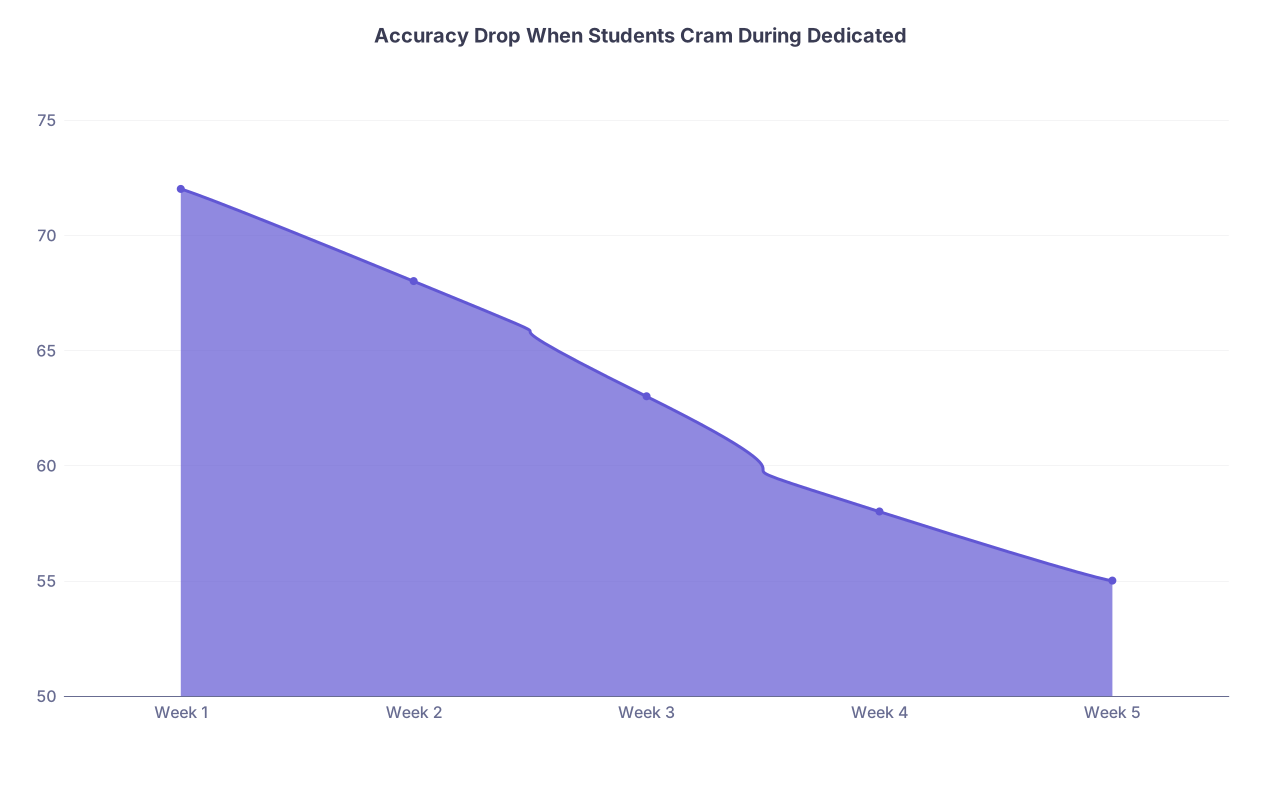
| Category | Value |
|---|---|
| Week 1 | 72 |
| Week 2 | 68 |
| Week 3 | 63 |
| Week 4 | 58 |
| Week 5 | 55 |
I have seen this pattern too many times:
- Week 1: Energy is high, you hit 70–75% in UWorld because you are starting with the easiest systems or tutor mode.
- Week 3–4: Fatigue, new content overload, old content forgotten. Scores fall.
- Week 5: Panic; people start guessing, skipping review, doubling down on volume instead of comprehension.
And under all of this? The same original problem. They went into dedicated still trying to “learn cardio” instead of refining cardio.
You cannot “fix it in dedicated” because learning for the first time is slow, messy, and cognitively expensive. You will not have that kind of capacity during the most stressful academic period of your life so far.
The Real Cost: What Actually Breaks During Dedicated
The “I’ll fix it later” crowd tends to underestimate which things collapse under stress.
1. Your Ability to Reason, Not Just Recall
When your foundation is thin, you lean on memorization. That works for:
- Simple recall questions (“What is the mechanism of action of drug X?”)
- Flashcard-style micro facts (“What organism causes rusty sputum pneumonia?”)
Step 1, even as pass/fail, still punishes you on:
- Multi-step reasoning: linking pathology → physiology → pharmacology
- “Best next step” style clinical questions
- Integrating across systems
If you never really understood renal physiology but told yourself you would “cram B&B renal during dedicated,” you are setting yourself up for this:
- You watch hours of video.
- It feels understandable while watching.
- Two days later, a question shows up: complex acid–base with comorbidities.
- You have fragments of knowledge, no coherent model.
- You guess.
Watching 10 hours of video in dedicated does not replace actually wrestling with concepts during the year. Crammed understanding is brittle. Under exam pressure, it fails.
2. Your Emotional Stability
Students underestimate how much emotional damage this myth causes once reality hits.
You reach Week 2–3 of dedicated and start to notice:
- You cannot finish all the blocks you planned.
- Your Anki backlog is a mountain you will never clear.
- You are missing entire topics you vaguely remember “meaning to learn later.”
This triggers:
- Guilt (“I wasted MS2, this is my fault.”)
- Shame (“Everyone else is more prepared than I am.”)
- Panic behavior (“Maybe I should start another video series.”)
Once panic kicks in, people make impulsive decisions that make things worse:
- Switching resources mid-dedicated
- Adding new decks
- Stopping sleep to “catch up”
- Abandoning review of wrong questions because “I need more volume”
Your performance is no longer limited by your intelligence. It is limited by your ability to think clearly under stress. Going into dedicated under-prepared is like starting a race already hypoxic.
3. Your Schedule Becomes Fiction
Students who rely on “fixing it in dedicated” always build fantasy schedules.
They look like this:
- 80–120 UWorld questions per day
- Full review of every question
- 3–5 hours of video
- 1–2 hours of Anki
- CR (content review) blocks on weak areas
- Exercise, meals, and sleep somehow still intact
It never survives first contact with reality.
By Week 1:
- The 80 questions take 5–6 hours instead of 3–4.
- Review takes 3 more hours because everything feels new.
- Videos get pushed later and later.
- Anki is sacrificed first “just for a few days.”
- Exercise vanishes.
You end up with a schedule that looks rigorous on paper and is a disaster in practice. All because you assumed dedicated would transform you into a superhuman version of yourself. It does not. It makes you a more exhausted version of your current self.
Where This Myth Starts: The Subtle Missteps in MS1–MS2
No one wakes up and says, “I will consciously sabotage my Step 1 prep.” The slide is gradual.
Common early mistakes that feed the myth:
- Treating preclinical exams as completely separate from Step 1
(“Our school tests random minutiae, so why bother studying well?”) - Doing zero board-style questions during the year because “that’s for dedicated”
- Using Anki without discipline:
- Adding every card
- Not doing reviews consistently
- Letting 1,000+ reviews pile up, then giving up
- Binge-watching lecture recordings on 2x speed with no active recall
- Telling yourself: “I just need to pass this block. Step comes later.”
Then, reality intrudes:
- A friend starts UWorld in January and talks about their 65–70% scores.
- You realize you cannot remember half of first-year physiology.
- You try one random NBME and score far lower than you expected.
Instead of adjusting early, you double-down on the myth: “Ok, this just proves I really need dedicated. Once I can study full-time, I will fix it.”
You are just postponing the reckoning.
What Students Who Do Not Rely on Dedicated Do Differently
Let me contrast two types of students. I have seen both.
| Habit | Dedicated Crammer | Slow Builder |
|---|---|---|
| Question banks | Saves for dedicated | Starts early, low volume |
| Anki | Inconsistent, huge backlogs | Daily, small manageable sets |
| Lectures | Passive watching | Integrates with First Aid/boards |
| NBME practice | Only in dedicated | One or two before dedicated |
| Weak topics | “Will fix later” | Revisited during the year |
The “slow builder” does not work dramatically more hours. They work differently:
- They start UWorld or another board bank lightly during MS2 (even 5–10 questions a day).
- They connect block content to Step-style material instead of siloing it.
- They maintain at least some spaced repetition of high-yield facts.
- They are brutally honest about weaknesses and patch them while stress is lower.
So once dedicated begins, they are not trying to learn cardiac murmurs, renal transporters, and immunodeficiencies from zero. They are rehearsing, reinforcing, and integrating.
They use dedicated for what it is designed for:
- Sharpening reasoning
- Filling in remaining gaps (not all gaps)
- Building exam stamina
You do not need to be a genius to adopt this approach. You just need to stop pretending a future version of you, in a more stressful environment, will suddenly be more disciplined and efficient than the current version.
Common “Dedicated Fix” Plans That Backfire
Here are several specific “I’ll fix it then” strategies that consistently blow up.
1. “I’ll Save UWorld for Dedicated”
Fatal mistake. Saving all of UWorld for dedicated is one of the fastest ways to realize you miscalculated.
Problems:
- UWorld is not just an assessment tool; it is a teacher.
- Doing it for the first time in dedicated means:
- You are slow.
- Every explanation is new.
- The cognitive load is enormous.
A better approach:
- Start UWorld or a different question bank during MS2.
- Use:
- Low daily volume (5–20 questions)
- System-based, aligned with your curriculum
- Treat it as:
- Early exposure to style and depth
- A diagnostic tool to see what your school is not giving you
Do not rely on UWorld as your first and only education during dedicated.
2. “I’ll Actually Learn Path + Pharm in Dedicated”
No, you will not.
Pathology and pharmacology are not 2-week topics. They underpin essentially every Step 1 question.
Trying to learn them from scratch:
- You will spend most of your time watching videos.
- Little time left for questions and application.
- Retention will be miserable because you are rushing.
Dedicated is for:
- Refining mechanisms you already basically understand.
- Filling gaps like “I always confuse nephritic vs nephrotic features.”
- Cleaning up pharm side effect associations, not memorizing drug classes en masse.
If you hate pharm right now and have been pushing it aside, that will not magically change when the calendar says “dedicated.”
3. “I’ll Use Three Question Banks in Dedicated to Cover Everything”
Overkill that turns into under-learning.
- Using multiple Qbanks is fine if:
- You started one earlier.
- You have a realistic plan to finish meaningful portions.
- Using three for the first time during dedicated is a fantasy.
The usual outcome:
- You do a fraction of each.
- You review poorly because you are chasing volume.
- You never see questions enough times to recognize patterns.
One Qbank done well with deep review beats three Qbanks half-finished and barely reviewed.
How to Fix This Now (Before Dedicated Starts)
If you are still pre-dedicated, you are not doomed. But you do need to stop repeating the same comforting lies.
Here is a sane, protective adjustment strategy.
Step 1: Reality Check – Where Are You Actually Weak?
Do not guess. Data, not vibes.
- Take:
- A low-stakes NBME or school-provided comprehensive exam.
- Or a short mixed block of 40–80 Step-style questions.
- Identify:
- Systems where you are lost, not just “rusty.”
- Topics you never truly learned (e.g., immunology, biostats, renal).
Write them down. Not in your head. On paper.
Step 2: Pick One or Two Non-Negotiable Daily Habits
You do not need a perfect system. You need consistent, small actions.
For example:
- 10–20 board-style questions per day, 5 days per week
- 60–90 minutes of Anki or other spaced repetition, every day
That is it. Protect those. Relentlessly.
Do not:
- Suddenly commit to 100 questions a day while still in classes.
- Add three new resources at once.
You are building a floor, not a prison.
Step 3: Integrate, Do Not Duplicate
Stop treating “school stuff” and “Step stuff” as separate universes.
Instead:
- For each block you are in (cardio, renal, neuro), tie it to:
- First Aid (or equivalent)
- A small UWorld set in that system
- A handful of high-yield Anki cards
You are basically running Step prep in parallel:
- Lower intensity
- Longer timeline
- Far better retention
Step 4: Decide Now What Dedicated Is For
You must answer this question in writing:
“By the time dedicated starts, what do I want to already be true?”
Examples of good answers:
- “I have already seen every system in UWorld at least once in tutor mode.”
- “I have stable recall on core micro/pharm facts through Anki.”
- “I know my worst 2–3 systems from prior practice exams.”
Then define dedicated as:
- Time to:
- Increase question volume.
- Focus on integration, not first exposure.
- Take and review full-length practice exams.
If your answer to that question is: “I want to actually learn everything,” then you are still clinging to the myth.
A Simple Mental Reframe That Saves People
Stop calling it “dedicated study time” like it is a separate phase where different rules apply.
Call it what it is:
Concentrated review time.
If you cannot honestly use the word review for a topic (because you never understood it), that topic needs attention before dedicated.
This reframe forces you to ask:
- “Can I review cardio in dedicated?”
If you already have some working understanding: yes. - “Can I review biostats in dedicated?”
Only if you have at least touched sensitivity/specificity, likelihood ratios, bias types, etc., during the year.
Review is fast. First learning is slow. Dedicated is fast. Your myth assumes it is slow.
Red Flags You Are Still Secretly Banking on Dedicated
Let me be blunt. If you recognize yourself in several of these, you are relying on the myth:
- You say:
- “I just need to survive this block; I’ll worry about Step after.”
- “I’ll start questions once I’ve gone through all the content.”
- Your Anki has:
- 800+ reviews pending, and you keep adding new cards anyway.
- You still do not know:
- Basic murmurs.
- Basic acid–base patterns.
- Common bacterial/viral patterns.
- You “sampled” UWorld once, got 40–50%, felt bad, and decided to “wait until you were ready.”
- Your planned dedicated schedule requires:
- 10–12 study hours every single day with no slack.
- Near-perfect energy and focus.
Those are all warning signs. Do not ignore them because someone in the class above you “pulled it off” with a month of cramming. Survivorship bias is real, and you only hear from the people who got through, not the ones who barely passed or quietly postponed.
What You Should Do Today
Not next month. Today.
Pick one of these and actually do it:
- Do a 40-question mixed timed block from a board Qbank; honestly review your performance and list your worst two systems.
- Clear your Anki backlog down to a realistic daily number by suspending low-yield or duplicate cards instead of pretending you will magically catch up.
- Write out a one-page document answering:
“What do I want dedicated to be for?” and “What must already be true before it starts?”
Then adjust your current study pattern to support that.
Stop outsourcing your future success to some heroic, mythical version of you who only shows up “during dedicated.” The version of you that will take Step 1 is just…you. Slightly more tired. Slightly more stressed. With whatever foundation you actually built.
Do not let that version of you look back and say, “I knew this was coming, and I still gambled on ‘I’ll fix it in dedicated.’”

| Step | Description |
|---|---|
| Step 1 | Now: MS1/MS2 |
| Step 2 | Light Qbank + Anki |
| Step 3 | Identify Weak Systems |
| Step 4 | Targeted Review During Year |
| Step 5 | Pre-dedicated Baseline NBME |
| Step 6 | Dedicated = Concentrated Review |
| Step 7 | Step 1 Exam |
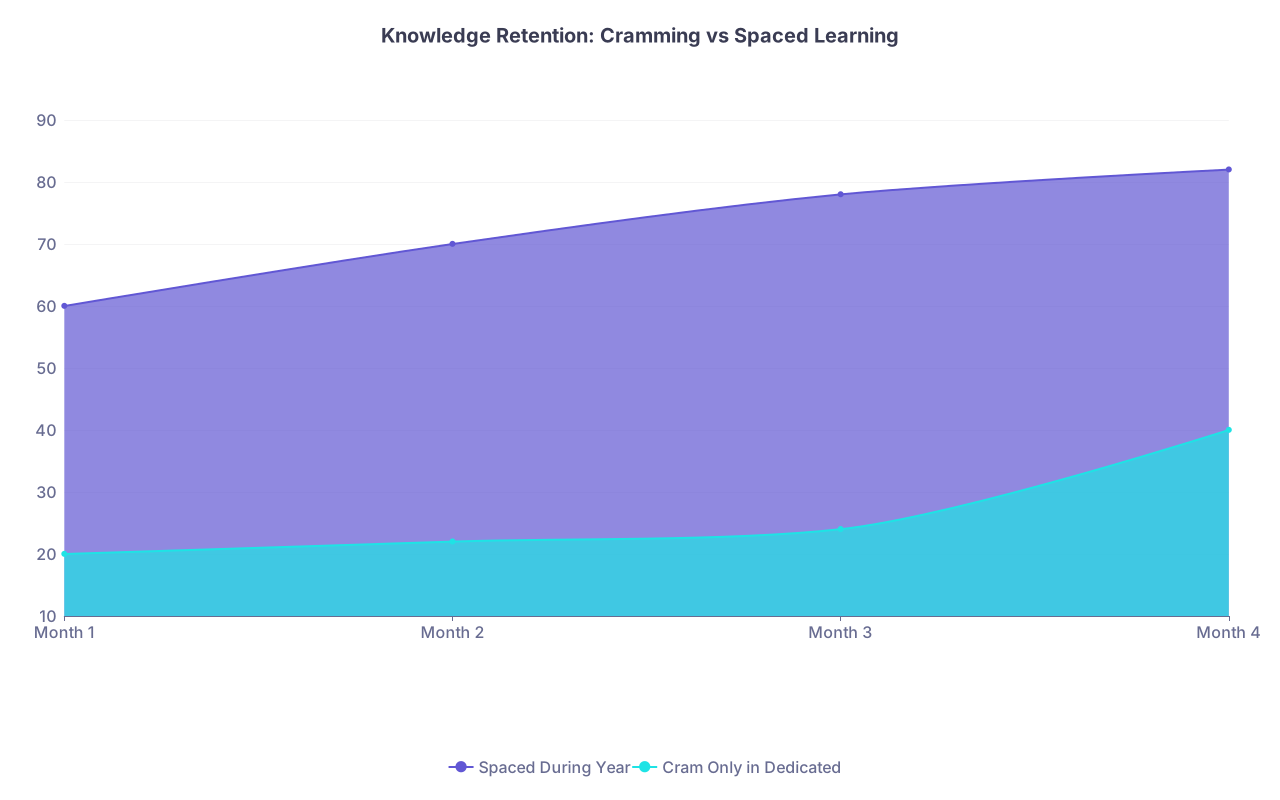
| Category | Spaced During Year | Cram Only in Dedicated |
|---|---|---|
| Month 1 | 60 | 20 |
| Month 2 | 70 | 22 |
| Month 3 | 78 | 24 |
| Month 4 | 82 | 40 |

FAQ (Exactly 3 Questions)
1. If I am already close to dedicated and feel behind, is it too late?
No, but you must drop the illusion that you can learn everything. Ruthlessly prioritize:
- Identify your worst 2–3 systems from an NBME or Qbank blocks.
- Focus your content review there and maintain daily mixed questions.
- Accept that breadth with shallow depth is sometimes safer than perfect depth in one tiny area and total ignorance in others.
Your goal shifts from “master everything” to “eliminate catastrophic blind spots and solidify core high-yield concepts.”
2. Should I delay my Step 1 date if I am clearly underprepared?
Delaying can be the right move, but only if you change your behavior now. Ask yourself:
- Have I already gone through a significant portion of a Qbank?
- Do I have a structured plan for the extra time, not just “more time = better”?
- Am I mentally capable of sustaining another few months of prep?
If the honest answer to all three is “no,” a delay without a strategy just prolongs anxiety. If it is “yes,” a carefully planned delay can convert a likely near-fail into a solid pass.
3. Is starting UWorld early going to “waste” it before dedicated?
No. That thinking is backward. You are not “burning” questions; you are learning from them. Using UWorld (or another Qbank) during MS2:
- Trains you in question style while stakes are lower.
- Exposes gaps that lectures never touched.
- Makes your second pass or mixed blocks during dedicated far more efficient.
What wastes UWorld is rushing through it in dedicated without proper review because you tried to fix two years of under-preparation in six weeks.
Open your calendar right now and circle your dedicated start date. Then ask yourself, out loud: “Am I preparing for review or for first exposure?” If the answer is “first exposure” for more than one or two topics, change something today.