
You're not "just tired." You are burning yourself down in slow motion and calling it discipline.
Step 1 prep does not usually break students with a single terrible week. It breaks them through a series of ignored warning signs that everyone around them normalizes as “grind” or “hustle” or “this is just what med school is.” That is the lie that costs people scores, mental health, and in a few cases, an actual year of their life repeating.
Let me be clear: Step 1 burnout is not weakness. The mistake is pretending you are fine until you are too far gone to fix it before exam day.
This is the guide I wish more students read before they hit the wall.
The Most Dangerous Myth: “Burnout Is Just Being Tired”
Burnout is not feeling worn out after a long UWorld block.
Burnout is a pattern. A predictable progression. And the most dangerous version during Step 1 prep looks like this:
- You start pushing through early signs (fatigue, irritability) with more caffeine and less sleep.
- You stop listening to your own performance data and cling to your calendar instead.
- You lose the ability to adjust because changing the plan now feels like “quitting.”
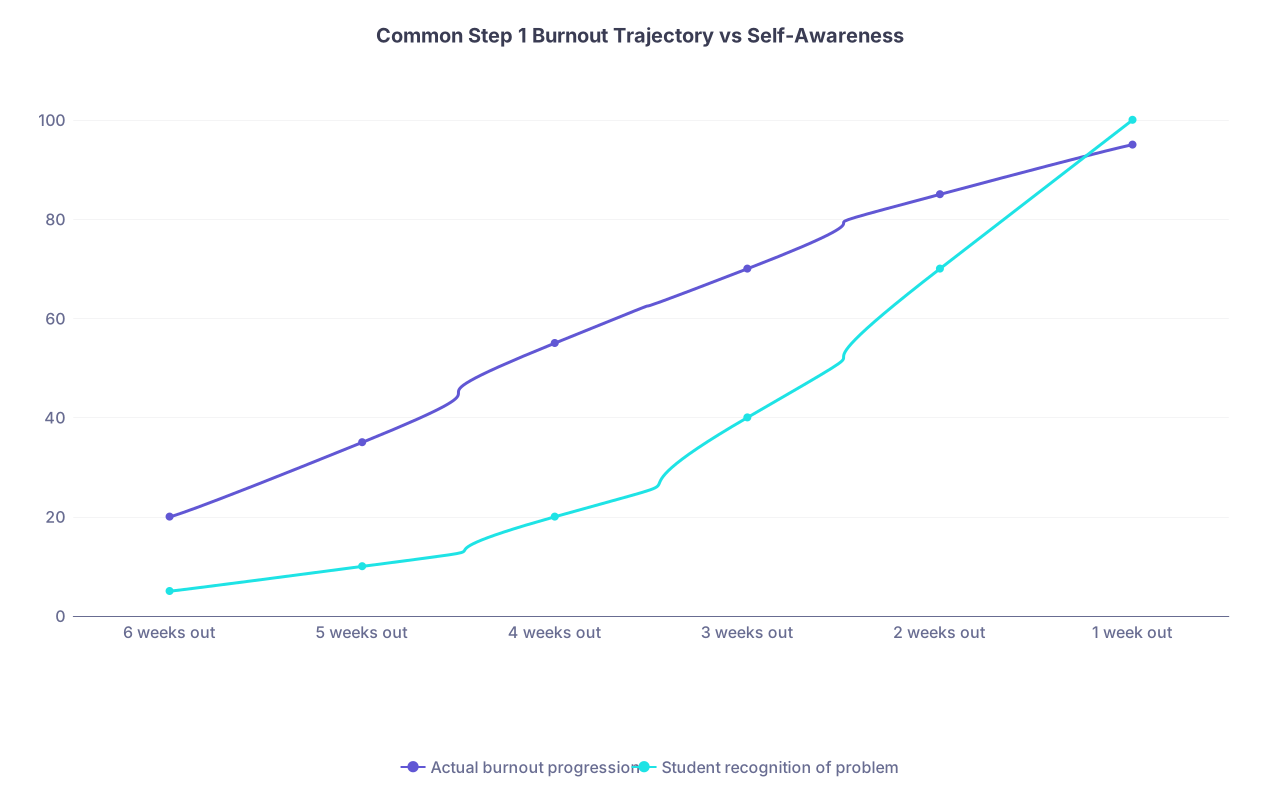
- By the time scores crash, it is 2–4 weeks from test day and you have no gas left.
| Category | Actual burnout progression | Student recognition of problem |
|---|---|---|
| 6 weeks out | 20 | 5 |
| 5 weeks out | 35 | 10 |
| 4 weeks out | 55 | 20 |
| 3 weeks out | 70 | 40 |
| 2 weeks out | 85 | 70 |
| 1 week out | 95 | 100 |
Notice the gap. Most students do not recognize they are in trouble until very late. By then, they are not “one good week” away from fixing it. They are physiologically and cognitively depleted.
Your job is not to be tough. Your job is to be effective. That means treating burnout warning signs as hard data, not personal drama.
Academic Red Flags: When “Working Hard” Stops Working
You will not feel Step 1 burnout first in your emotions. You will see it in your numbers if you bother to look honestly.
1. Plateauing Scores You Explain Away
Here is the pattern I see constantly:
- UWorld % drops from low 70s to mid 60s
- NBMEs hover in the same narrow range for 3–4 weeks
- You respond by adding more hours, more resources, and fewer breaks
That is backwards. A persistent plateau is not always a knowledge problem. Very often it is a processing problem: your brain is not resting enough to consolidate what you are cramming into it.
If you see:
- 2–3 consecutive weeks with no improvement in:
- NBME forms
- UWorld percentage correct
- Anki retention (tons of “Again” / “Hard” cards piling up)
That is not “grind harder” territory. That is “my brain is saturated” territory. Ignoring this is how solid students walk into Step 1 scoring 10–20 points below their potential.
2. Worsening Question Quality Even If Percentages Look Okay
A sneaky sign: you are still getting questions right, but you know you are guessing more. You read the explanation and think, “I did not really understand that; I just eliminated the others.”
Red flags here:
- You increasingly rely on vibe-based guessing (“this sounds endocrine-ish”) rather than anchored concepts.
- You start reading the question stem three times because nothing sticks the first time.
- You get simple, first-order questions wrong, but somehow eke out a few convoluted ones.
This is cognitive fatigue. Not stupidity. If you ignore it, the test will expose it, because Step 1 is long, unforgiving, and designed to punish fragile reasoning.
3. Switching Resources Impulsively
Burned-out students do something very predictable: resource hopping.
Yesterday: “I am a UWorld + First Aid + Pathoma person.”
Two weeks later: they have added Sketchy, Boards & Beyond, another Qbank, three Reddit-anointed Anki decks, and two YouTube channels. Their logic: “Maybe I just need a different explanation.”
What is actually happening: Your brain is too tired to deeply learn from what you already have, but instead of resting, you reach for novelty. It feels productive. It is not.
When you notice yourself rewriting your entire study plan every 3–5 days, that is not strategic flexibility. That is burnout-induced panic.
Behavioral Changes: You Think You’re “Still Functioning” — You’re Not
Burnout rarely starts with a breakdown. It starts with subtle, boring behavior shifts that you rationalize away.

4. “Study Time” That Is Mostly Staring and Scrolling
You may still be logging 10–12 hours “at the desk.” But how many of those are actual focused study?
Clear warning signs:
- You keep the Qbank open but spend 15 minutes between questions.
- You read the same paragraph or explanation three times and retain nothing.
- You find yourself opening Instagram, Reddit, or WhatsApp “just for a second” every few minutes.
Burned-out students lie to themselves about hours. They count time in the chair, not time fully engaged. This is how a “10-hour” day quietly becomes 4–5 effective hours and falling.
If your screen time report looks like a full-time job on your phone during “dedicated,” you are not just distracted. You are avoiding pain. That is burnout in action.
5. Micro-Avoidance of Anything Hard
Watch how you choose tasks:
- You keep pushing “weak” topics to tomorrow’s to-do list.
- You default to re-watching videos because they feel easier than questions.
- You rewrite or decorate your schedule instead of actually following it.
I once watched a student spend a full hour color-coding their Anki tags while insisting they “just needed to get organized.” Their last NBME had dropped 7 points. They were not disorganized. They were exhausted and scared.
When your brain is smoked, it does not want challenge. It wants comfort disguised as productivity. If you find yourself perpetually “getting ready to start,” burnout is already here.
6. Sleep Is No Longer Real Sleep
Another common pattern:
- You fall into bed completely worn out.
- Your brain will not shut up.
- You wake up feeling like you did not sleep, even after “8 hours.”
Or the opposite:
- You start staying up later, not because you are studying, but because the thought of repeating tomorrow’s grind makes you dread going to bed.
- You sleep in, then hate yourself for “wasting time,” so you cut sleep more.
This is the spiral: poor sleep → worse cognition → worse performance → more anxiety → even worse sleep. Students wait until they are having full-on insomnia to admit there is a problem. That is too late.
Emotional and Physical Signals You Keep Calling “Normal”
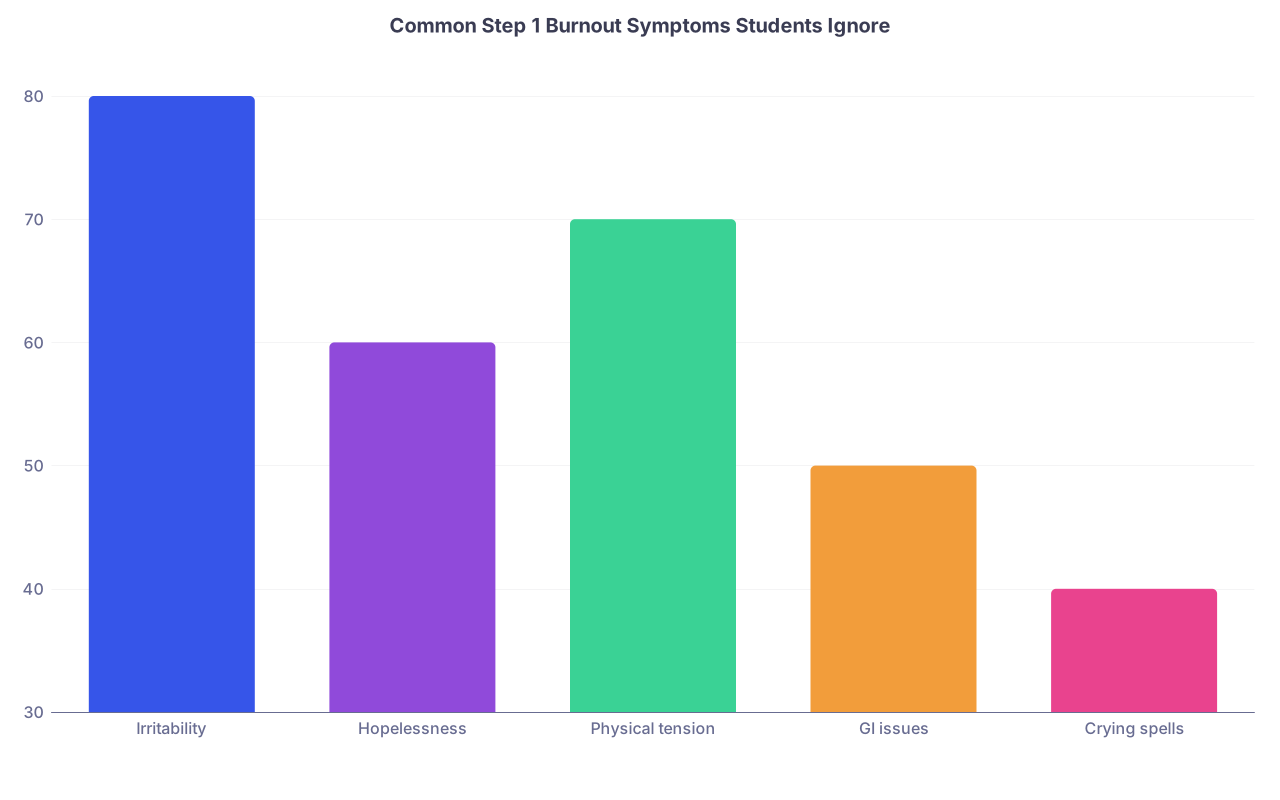
The culture of medicine normalizes suffering. So you will dismiss half of these as “everyone feels that way.” That is how you get trapped.
| Category | Value |
|---|---|
| Irritability | 80 |
| Hopelessness | 60 |
| Physical tension | 70 |
| GI issues | 50 |
| Crying spells | 40 |
(Percentage is rough proportion of students I have seen with each who initially said “this is just stress.”)
7. Irritability That Is Not You
Yes, Step 1 is stressful. But when normally even-tempered students suddenly:
- Snap at partners or roommates over trivial things.
- Get irrationally angry at minor technical issues (NBME site, UWorld crashing).
- Feel a constant, low-level hostility toward faculty, school, or family.
That is not “just being in the zone.” That is an overdriven nervous system.
If you hear yourself saying, “Everyone is annoying me lately,” realize: the common denominator is not everyone.
8. Emotional Numbness and Loss of Perspective
The other side of the coin is not anger. It is nothing.
You start saying:
- “I don’t care anymore. Whatever happens, happens.”
- “If I fail, I fail. I am too tired to worry.”
- “I feel like a robot, just going through motions.”
This is not healthy detachment. It is emotional shutdown. Hope feels dangerous because if you care, you might be disappointed. So your mind protects itself by flattening everything.
The danger? Once you are numb, it becomes very hard to marshal the effort needed to change course. Students at this stage often stay on an obviously failing path because it takes less energy than facing reality.
9. Your Body Is Sending Distress Signals
I do not mean vague “stress.” I mean physical warnings you are almost certainly dismissing:
- Constant tension headaches or jaw pain from clenching.
- New or worsening GI symptoms: nausea, loose stools, “stress stomach.”
- Chest tightness that shows up when you open your Qbank or NBMEs.
- Recurrent minor infections (colds, mouth sores) because your immune system is taking hits.
I have seen students land in urgent care with chest pain convinced they are dying. Workup normal. Diagnosis: anxiety and burnout. They still tried to “get back to studying tonight.”
If your body is screaming, and your response is, “I cannot afford a day off,” you are already making the exact mistake that tanks scores and prolongs suffering.
Dangerous Coping Strategies That Look “Productive”
Burnout rarely arrives alone. It brings bad coping mechanisms that pretend to be solutions.
10. Caffeine Arms Race
You escalate from:
- 1–2 cups of coffee → 4–5 strong coffees → energy drinks or pre-workout “just to push through.”
This buys you maybe an extra 60–90 minutes of alertness while quietly destroying your sleep architecture and baseline anxiety.
If you need high-dose caffeine to get through basic review or a single NBME, your problem is not motivation. It is system overload.
11. Cutting Out Every Restorative Activity
The classic pre-failure sentence: “I’ll stop working out / seeing friends / going to services / calling family until after Step 1. It is only for a few weeks.”
Wrong.
You are removing the only stabilizing forces that keep your brain capable of sustained performance. You are not gaining extra “study time.” You are trading mediocre, foggy hours for a false sense of virtue.
When a student tells me, “I study literally all day, every day, I have no life,” I do not think: impressive. I think: high risk of crash 2–3 weeks out.
12. Hiding Scores and Lying About Progress
One of the ugliest warning signs: you stop sharing your NBMEs. With mentors. With friends. Sometimes even with yourself (not scoring forms you partially completed, avoiding the spreadsheet, refusing to plot scores).
Here is what that usually means:
- You sense things are going poorly.
- You cannot tolerate seeing the evidence.
- You choose ignorance over information.
You cannot steer away from disaster if you refuse to look at the dashboard.
Decision Points You Keep Pushing Off (Until You Have No Options)
Many Step 1 disasters are not caused by one big mistake. They are caused by failing to make three medium-sized decisions at the right time.

| Step | Description |
|---|---|
| Step 1 | Notice warning signs |
| Step 2 | Modify schedule & rest |
| Step 3 | Push through harder |
| Step 4 | Monitor scores & symptoms |
| Step 5 | Seek help & consider delay |
| Step 6 | Targeted fix, protect sleep |
| Step 7 | Better odds of recovery |
| Step 8 | High burnout, low flexibility |
| Step 9 | Adjust now? |
| Step 10 | Scores stable or dropping? |
13. Refusing to Adjust the Plan
Your original dedicated schedule is not sacred. It was a guess, made by a less informed version of you, often copied from someone else.
If:
- Your NBME is not in the range you need 4–5 weeks out.
- You are behind on UWorld and Anki despite working at max effort.
- You are showing multiple burnout warning signs from this article.
Then the correct move is to adjust. That might mean:
- Cutting a resource.
- Reducing daily question load.
- Building sleep and exercise in as non-negotiables.
Students who refuse to do this because “I made a plan and I have to stick to it” confuse stubbornness with discipline. The exam does not reward stubbornness. It rewards functioning neurons.
14. Treating a Possible Delay as Failure Instead of a Tool
Sometimes the bravest, most disciplined decision is to postpone.
Not by two panicked weeks at the end. By 4–8 weeks, proactively, when you see:
- NBMEs consistently below where you need to be for your risk tolerance.
- Burnout so severe that you cannot realistically recover and grow before your current date.
- Life events (illness, family issues) that have gutted your prep time.
The mistake: students wait until they are completely broken, one week out, to consider moving the exam. At that point, they feel ashamed, cornered, and often make a rushed choice.
You should be reassessing your test date explicitly after every NBME, especially in the last 6–8 weeks. Not vaguely thinking “I hope I improve.” Explicitly asking: “On this trajectory, will I be safe by test day?”
Delaying is not always the answer. But refusing to even think about it until you are in pieces is a red flag that ego, not judgment, is driving.
How to Respond When You Recognize Yourself in This
If you read this and felt uncomfortably seen, good. That discomfort can either push you deeper into denial or force a correction while you still have time.
Here is what not to do: scrap everything and write a heroic new 14-hour-per-day schedule to “fix it.” That is how you end up worse.
Instead, treat burnout like a medical problem:
Stabilize the patient (you).
Non-negotiable for the next 7 days:- Minimum 7 hours in bed, preferably 7–8 hours asleep.
- At least 20–30 minutes of actual movement daily (walk, light workout).
- One small non-medical, non-screen activity you enjoy every day.
Reduce cognitive load slightly, not dramatically.
- If you are doing 80–100 questions per day at low quality, drop to 60–70 done well.
- Stop adding new resources. Lock in your core ones.
- Accept that you will feel like you are not doing enough for a week. That feeling is not data.
Objectively reassess after 7–10 days.
- Take a practice exam under real conditions.
- Look at not just the score, but also how your brain felt during blocks.
- If you are still exhausted and flat, you have your answer: you need a larger strategy change, possibly a postponement, and ideally professional support.
Tell someone the truth.
Not the filtered “I am a bit stressed.” The real version:- Your recent scores.
- Your sleep.
- Your worst fears about failing.
This can be a mentor, dean, mental health professional, or an honest peer who is not competing with you. Silence is gasoline on burnout.
The Line Between Normal Stress and True Burnout
You cannot eliminate stress from Step 1 prep. You should not try. Stress is not the enemy. Unchecked burnout is.
Normal Step 1 stress looks like:
- Jitters before NBMEs.
- Occasional rough days where you feel dumb, then recover.
- Temporary frustration with certain topics or question styles.
Burnout looks like:
- Persistent cognitive fog despite sleep and effort.
- Emotional flattening or escalating irritability most days.
- Avoidance of scores, planning, or hard tasks.
- Physical symptoms tied tightly to studying.
If you are honest, you already know which one you are in.
Do not wait until you are crying over a laptop at 2 a.m. two weeks before your exam to finally admit something is wrong. By then, your options are limited and every choice feels like a loss.
Catch it early, and burnout becomes a signal to recalibrate, not a sentence.
Remember 3 things:
- Ignoring burnout does not prove you are strong; it proves you are willing to sabotage your own performance to protect your ego.
- Your scores, sleep, behavior, and body are giving you data. Treat that data like you would in a patient — investigate and adjust.
- Step 1 is not a test of how much suffering you can tolerate. It is a test of how well your brain works on a specific day. Protect that brain like it actually matters.