
The myth that faculty only care about your final Step 1 score is false. They’re reading your NBME score reports like a forensic document, and they’re seeing things you probably don’t even realize you’re revealing.
I’ve sat in those closed-door meetings where clerkship directors, academic advisors, and deans review “problem” students’ NBME histories. I’ve heard the exact phrases they use. And I’ve watched the difference between a student who looks “on track” and one who suddenly gets labeled “high risk” off the same three pages of data.
Let me walk you through what actually happens when someone with authority opens your NBME Step 1 score report.
The First 10 Seconds: The Fast Gut Check
When a faculty member pulls up your NBME history, they do not start by reading every fine-detail item. They do what everyone in academic medicine does when they’re busy and have to make a snap judgment.
They scan.
Here’s what gets processed in those first 10 seconds:
- Where you started
- Where you ended
- How many attempts you needed
- Whether the trajectory looks smooth or chaotic
They’re not thinking in terms of internet-forum fantasies like “NBME 25 means X score.” They’re thinking in risk categories: steady, concerning, or falling apart.
They’ll glance at something like this in their head:
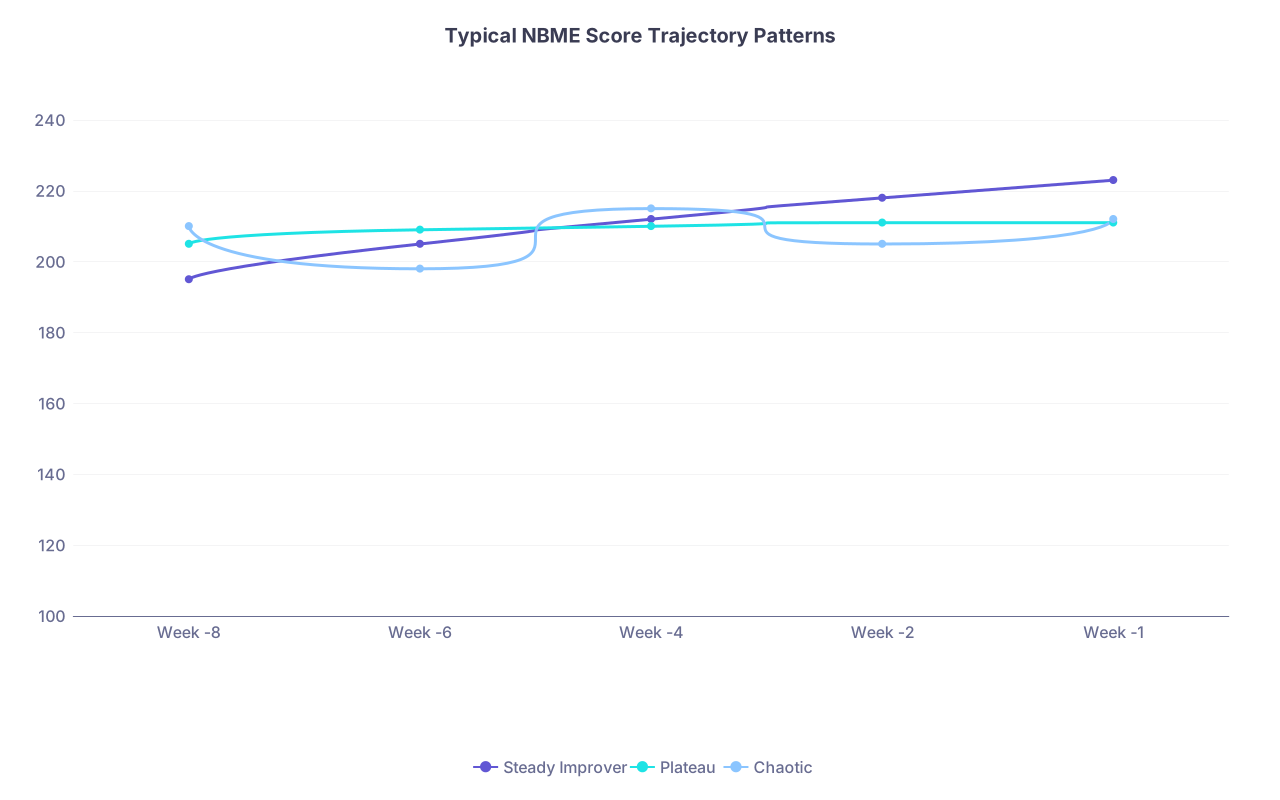
| Category | Steady Improver | Plateau | Chaotic |
|---|---|---|---|
| Week -8 | 195 | 205 | 210 |
| Week -6 | 205 | 209 | 198 |
| Week -4 | 212 | 210 | 215 |
| Week -2 | 218 | 211 | 205 |
| Week -1 | 223 | 211 | 212 |
They may not literally plot it, but the pattern registers quickly.
Here’s how they instinctively label those types:
- Steady improver → “Teachable, coachable, safe to progress.”
- Plateau → “Possible work ethic or strategy problem. Watch more closely.”
- Chaotic → “Test anxiety? Life chaos? Poor insight? Higher risk.”
They do this before they ever talk to you.
What They Care About More Than the Raw Score
With Step 1 pass/fail, the obsession over a single three-digit number has shifted. But do not kid yourself—NBME forms still carry weight. Programs, schools, and committees use them as proxies for how you think, how you prepare, and how you handle pressure.
Here’s what matters more than you think:
1. Trajectory: The Single Most Important Pattern
Directors love trajectories. It’s how they think about residents, board pass rates, even programs themselves: “Are we moving in the right direction or not?”
A classic “good” trajectory for Step 1 NBME looks something like:
- First NBME: borderline or just below passing
- Mid-course NBME: low–mid 200s (back when it was scored)
- Final NBME: comfortably above your school’s internal safety cut
They don’t need perfection. They need evidence you respond to feedback and that your brain is consolidating material over time, not just memorizing question stems.
A real example I’ve seen interpreted in a meeting:
- NBME 1 (10 weeks out): ~195
- NBME 2 (7 weeks out): ~207
- NBME 3 (4 weeks out): ~214
- NBME 4 (2 weeks out): ~214
- UWSA 2 (1 week out): ~220
Admin comments in that room: “Looks fine. Plateaued a bit but still climbing overall. Safe to sit.”
Compare that to:
- NBME 1: 205
- NBME 2: 208
- NBME 3: 206
- NBME 4: 209
- UWSA: 207
Same-ish numbers. Very different conversation: “This student isn’t showing consolidation. Are they actually learning or just treading water?”
That second pattern triggers more questioning, more emails, more “Can you bring them in for a meeting?”
2. Timing: When You Take Each NBME
Faculty absolutely notice when you took your NBMEs. Not just what you scored.
They hate two things:
- Students who wait too long to take a first NBME (“flying blind”)
- Students who panic-test—taking three NBMEs in eight days
I’ve literally heard: “If your first NBME is two weeks before the exam and you’re failing, you didn’t have a test anxiety problem. You had a planning problem.”
They look for a pattern like this:
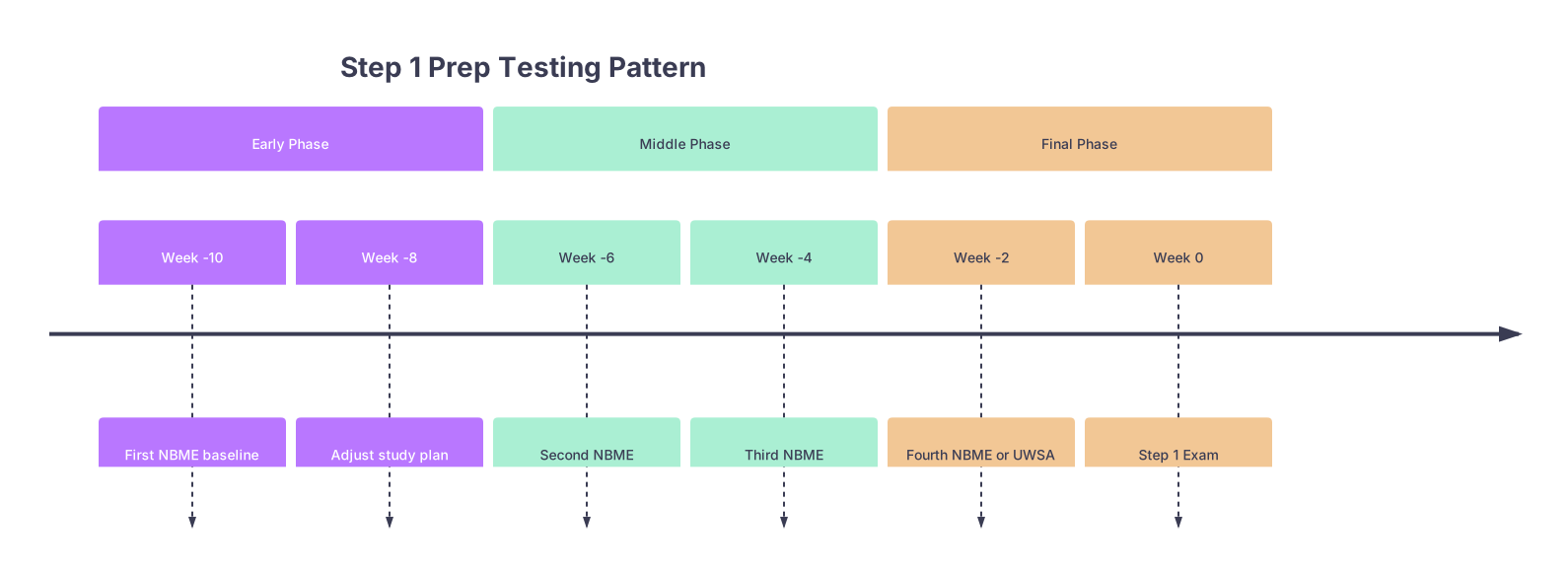
| Period | Event |
|---|---|
| Early Phase - Week -10 | First NBME baseline |
| Early Phase - Week -8 | Adjust study plan |
| Middle Phase - Week -6 | Second NBME |
| Middle Phase - Week -4 | Third NBME |
| Final Phase - Week -2 | Fourth NBME or UWSA |
| Final Phase - Week 0 | Step 1 Exam |
If your dates look bunched up at the end, they assume you were avoiding bad news. And avoidance screams “poor insight” to academic leadership.
Let me put it bluntly:
If you only start generating objective data in the last 2–3 weeks, you look reckless.
The Things You Think Don’t Matter (That Do)
You’re focused on the total score or the pass line. Faculty are not nearly as fixated on that as you are. They’re staring at the subscores and percentiles.
1. Subject Breakdown: What You’re Actually Weak At
Those discipline breakdown bars? Pharmacology, pathology, biochem, etc. That’s where the clinical faculty perk up.
Different people look for different things:
- Internist-type educators zero in on path and pharm
- Surgeons glance at anatomy and pathology
- Student affairs looks at anything that’s deeply red or persistently low across several forms
They’re mentally asking:
- “Is this a global problem (underprepared overall) or a focal problem (neuro is a black hole)?”
- “Is the student systematically weak in something dangerous, like pharm?”
- “Did they improve the weak areas over time or just leave them to rot?”
I’ve seen more than one faculty advisor say, “Your overall score is fine. But your pharm is consistently bottom 10%. That’s a problem for a future intern. We need to fix that now.”
That’s the part students don’t realize: They’re not just thinking “Will you pass Step 1.” They’re thinking “Will I trust you to write orders on my patients in 18 months?”
2. Systems vs. Disciplines: Are You Lopsided?
A lot of students have this pattern: they torch cardiology and pulmonary but get wrecked by neuro and repro.
You’d think, “Whatever, it averages out.” On the faculty side, I’ve heard: “If your neuro and psych are 40th percentile, you’re going to struggle with neurology clinic and psychiatry rotations. That’s foreseeable.”
Different schools weigh this differently, but the best advisors read your NBME like an early warning system for clerkships. And if you’re honest, they’re usually right.
How Many NBMEs You Take: Signals You Don’t Intend To Send
No one tells you this because it makes students anxious, but it’s true: how many NBMEs you take and how you use them sends a message.
Let me translate:
| Pattern | How Faculty Read It |
|---|---|
| 1–2 NBMEs total | Avoidant, under-monitored |
| 3–4 NBMEs over 6–10 weeks | Planned, reflective, appropriate |
| 6–8 NBMEs plus both UWSAs | Anxious but organized, highly engaged |
| >10 NBMEs, multiple repeats | Panic, overtesting, poor metacognition |
Nobody’s formally counting, but they notice extremes.
If you show up with one NBME from 9 days before your test and a failing score, there are not many interpretations that make you look good. Every academic dean I’ve ever worked with would say the same thing: “Why didn’t we know sooner?”
On the other side, the student who burns through 10+ NBMEs and keeps retaking the same form “to see if I’ve improved” looks impulsive and disorganized. They interpret that as poor strategy, not dedication.
What Happens Behind Closed Doors When You Struggle
Here’s where the “insider” part comes in. Let me tell you what actually happens when your NBME data raises red flags.
Picture this: Academic progress committee day. There’s a spreadsheet of borderline students, usually flagged by:
- NBME scores hovering around or below the school’s required cut
- Multiple low practice scores despite extended study
- Repeated postponements or failed first attempts
Your file gets opened. On a shared screen. In a room with people who vote on your fate.
Someone scrolls your NBMEs. And then the commentary starts.
You will hear things like:
- “They’ve been at this level for 6 weeks. I’m not seeing growth.”
- “They only took one NBME. That’s not enough data to clear them.”
- “They were 8 points below our safety line 10 days before the exam and still chose to test. That’s poor judgment.”
- “Their discipline profile is slightly weak but steadily improving. I’d be okay with them proceeding.”
Notice something? People aren’t arguing about exact scores. They’re arguing about patterns and judgment.
I’ve seen students with lower scores but improving trajectories get more grace than students with higher but flat or chaotic trajectories. Because one looks teachable. The other looks stubborn.
The Ugly Truth About “Just Passing” vs. Being Safe
With Step 1 now pass/fail, many students think: “As long as I’m around the passing range on NBMEs, I’m good.”
That’s not how the people signing off on your exam date think.
Most schools quietly set internal “comfort margins” above the NBME’s predicted passing cut. They rarely publicize those numbers, but they exist. Faculty have watched too many students with borderline practice scores miss by a question or two on the real thing.
So they think in buckets like this:
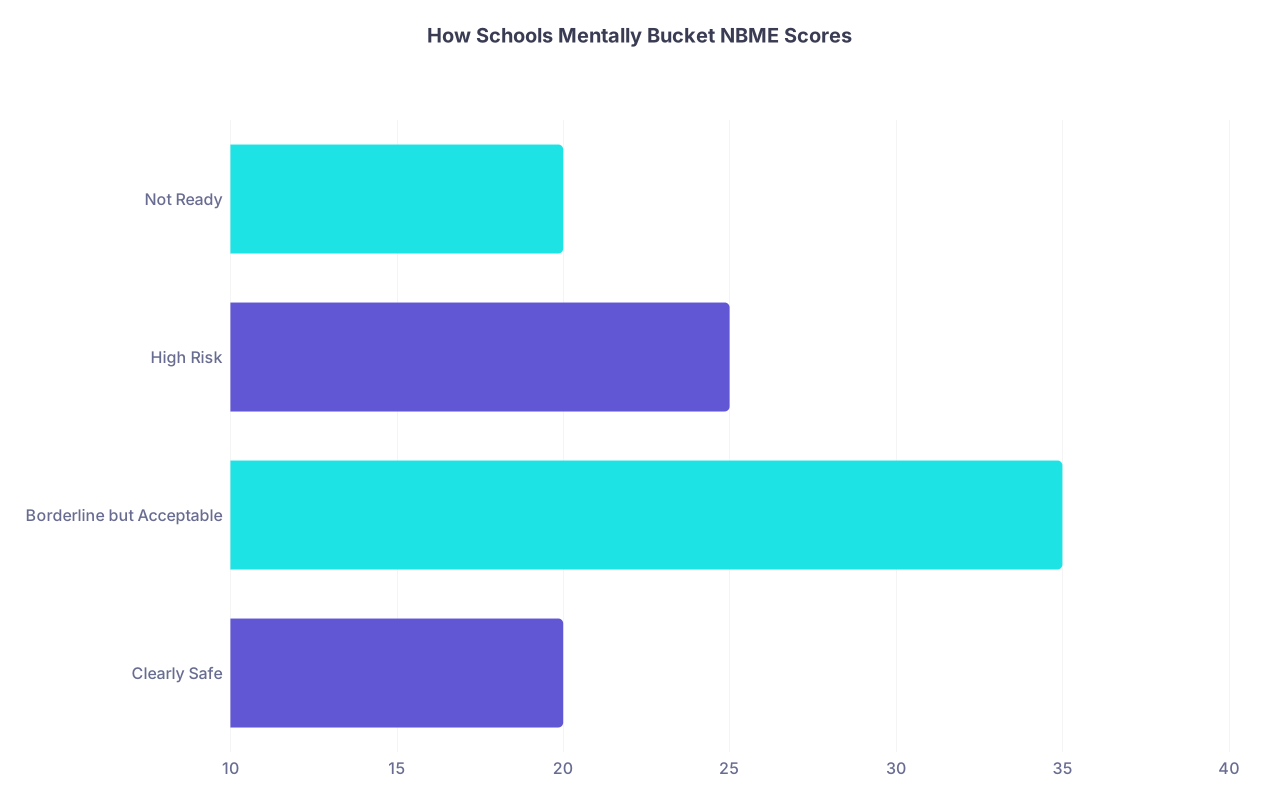
| Category | Value |
|---|---|
| Clearly Safe | 20 |
| Borderline but Acceptable | 35 |
| High Risk | 25 |
| Not Ready | 20 |
Those labels are rarely typed anywhere. They are said out loud.
What usually happens:
- “Clearly safe” (consistent above-cut margin, good trajectory): green light, no debate
- “Borderline but acceptable” (slightly above cut, improving, good behavior): allowed to test with a stern conversation
- “High risk” (near cut, flat or unpredictable pattern): heavy pressure to delay
- “Not ready” (below cut, no clear upward movement): forced delay or remediation
So when you say, “Well, this NBME predicts I’m about 2–3 points above passing,” what the committee hears is, “If anything goes slightly wrong—sleep, anxiety, a bad block—they could fail.”
They’re not trying to torture you. They’re protecting their board pass statistics and the school’s reputation. And honestly, trying to protect you from repeating the test, which is a long, ugly process.
What Impresses Faculty More Than High Scores
Here’s a secret: the students faculty quietly respect the most are not always the ones with the highest NBMEs. They’re the ones who show:
- Early, honest data gathering
- Real adjustments after low scores
- Appropriate humility and responsiveness
A scenario that makes faculty nod:
You took an early NBME. It stung. You met with an advisor before spiraling. You updated your study schedule. Two NBMEs later, your score climbed.
Then, when you meet your advisor, you say something like:
“I realized my biochem and pharm were dragging everything down, so I rebuilt my Anki, added 20 pharm questions per day, and rewatched those lectures. That’s when my scores started to shift.”
That’s gold. Because you’re not just an NBME number; you’re demonstrating the skill they care about most in a future resident: seeing a problem, owning it, and changing behavior.
Contrast this with what they hate:
You: “Yeah, I don’t know, I just have bad test anxiety.”
Meanwhile, your NBMEs are taken at erratic times, on poor sleep, and you never changed your resource overload once.
They’ve heard “test anxiety” as a shield a thousand times. Sometimes it’s real. Many times, it’s code for “I didn’t want to modify my habits.”
Exactly How To Make Your NBME Pattern Look Good
Let me be explicit. If you want your NBME history to tell a story that earns trust instead of suspicion, structure it.
Start Earlier Than You Think
Take a baseline NBME 8–10 weeks before your exam. Yes, it might hurt your ego. Faculty like students who face data early.
Then meet with someone if the score is low. Not two weeks before your test. Now.
Space Your NBMEs Like an Adult
Rough template that faculty psychologically like (even if they never say this explicitly):
- 8–10 weeks out: Baseline NBME
- 6–7 weeks out: NBME #2
- 4–5 weeks out: NBME #3
- 2–3 weeks out: NBME #4 or UWSA
- 1 week out: Optional final check (if your trajectory supports it and you’re not burning out)
The exact mix of forms doesn’t matter nearly as much as the rhythm.
Adjust Based on Weaknesses, Then Prove It
Your discipline breakdown shows biostatistics and pharm are low? Great, now your faculty want to see that 3–4 weeks later those two are no longer bottom-tier.
So you say to yourself:
- “Next 3 weeks: daily 20–30 pharm questions + focused review of weak stats topics.”
- Then, on the next NBME, your pharm/biostats bars creep up.
That’s the kind of before/after that makes a director say: “They learn. Let them test.”
The One Thing They Can’t See (But Infer Anyway)
NBME reports don’t formally list your study hours, sleep, or mental health. There’s no “burnout bar” on the page. But faculty infer those indirectly.
When they see:
- Early peaks followed by later declines
- Wild score swings from one NBME to the next
- Improvement that suddenly stalls despite “more time off”
They often suspect poor pacing or underlying mental strain.
I’ve sat in meetings where someone said:
“This student took a leave for ‘dedicated study,’ but their NBMEs got worse. I’m worried this is not just a content issue.”
That’s when they start asking for more than just a new study plan. They start nudging you toward counseling, test accommodations, or more structured remediation. And they’re not always gentle about it.
The Bottom Line: Your NBME Story Is Bigger Than a Number
Your NBME Step 1 reports are not just practice tests. They’re a narrative.
Faculty read that narrative fast:
- How early you looked at data
- How you handled bad news
- Whether you showed growth or denial
- Whether your weaknesses got addressed or ignored
- Whether you treated this exam like a serious professional milestone or like an undergrad midterm you could cram through
If you want that narrative to work for you, not against you, stop thinking like a points-chaser and start thinking like the committee that will eventually review your file.
Design a pattern that says: “I’m safe. I’m responsive. I’m getting better.”
Because once Step 1 is done, they’re going to do the same thing with your clerkship evals, your Step 2 practice tests, and your in-service exams as a resident.
This is just the first time you see how they think.
And once you understand how they read those pages, you can stop being the student hoping your numbers “somehow look OK” and start being the one whose trajectory speaks for itself.
With that foundation, you’re much better positioned when the conversation shifts from “Can you pass Step 1?” to “What does your Step 2 performance say about the kind of resident you’ll be?” That’s the next stage of the game—and a story for another day.