The default advice you hear about DO students and Step 1 is outdated.
For most osteopathic students seriously considering ACGME residencies, skipping USMLE Step 1 is a gamble. Sometimes it’s a smart gamble. Sometimes it quietly closes doors you didn’t realize you’d want later.
Let’s go through this like an attending who actually answers your question instead of giving a motivational speech.
The Core Question: Should You Take Step 1?
Here’s the blunt version:
If you’re even mildly interested in a competitive specialty or academic program:
You should strongly consider taking USMLE Step 1 in addition to COMLEX.If you’re 100% sure you want community IM, FM, psych, or peds and you’re okay with a more limited geographic/program range:
You might be fine skipping Step 1 and just taking COMLEX.If you’re struggling with your school’s curriculum and standardized tests already:
Forcing a rushed Step 1 on top of COMLEX can hurt more than help.
The right answer for you depends on three things:
- What specialties you’re considering
- What kind of programs (academic vs community, geographic goals)
- Your testing strengths, timeline, and mental bandwidth
We’ll walk through each of those with real decision points—not vague “follow your passion” nonsense.
How Programs Actually View COMLEX vs USMLE
Let’s cut through the brochure language.
Most PDs will tell you something like:
“We accept COMLEX and USMLE equally.”
That’s… partially true. Here’s how it usually plays out behind closed doors.
| Program Type | COMLEX Only | COMLEX + USMLE | USMLE Only |
|---|---|---|---|
| Competitive Surgical | Often Disadv | Preferred | Standard |
| Competitive Non‑surgical | Sometimes Disadv | Preferred | Standard |
| Mid‑tier Academic IM | Accepted, less comparable | Strong | Standard |
| Community IM/FM/Psych/Peds | Fully accepted | Strong | Strong |
And here’s the twist: with Step 1 now pass/fail, Step 2 CK has become the new screening tool. Some programs now say: “If you have COMLEX, we’d like to see Step 2 CK for comparison.”
So even if you skip Step 1, you may feel pressure to take Step 2 CK later anyway.
What PDs actually struggle with
I’ve heard some version of this quote a dozen times from PDs and faculty:
“We don’t know what to do with a COMLEX 540 compared to all these 240–250 USMLE scores we see every day.”
They’re not anti-DO. They’re pattern-recognition machines.
They’re used to USMLE distributions, cutoffs, and historical outcomes.
COMLEX scores are:
- On a different scale
- Less familiar
- Harder to compare quickly in an Excel sheet
So when you only have COMLEX, you may be:
- Put at a slight disadvantage at programs that say they accept COMLEX “equally”
- Screened out early simply because conversion feels messy
- Overlooked at ultra-competitive places that want easy apples-to-apples comparisons
That doesn’t mean you can’t match well with only COMLEX. But you’re making things harder, especially in crowded specialties.
Step 1 vs COMLEX Level 1: Overlap and Extra Work
Here’s the reality: if you’re studying properly for COMLEX Level 1, you’re already doing 70–80% of the work for USMLE Step 1.
The extra load comes from:
- Needing more depth in some basic science areas
- Less OMM and fewer “COMLEX-style” weird questions
- A different question style and pacing
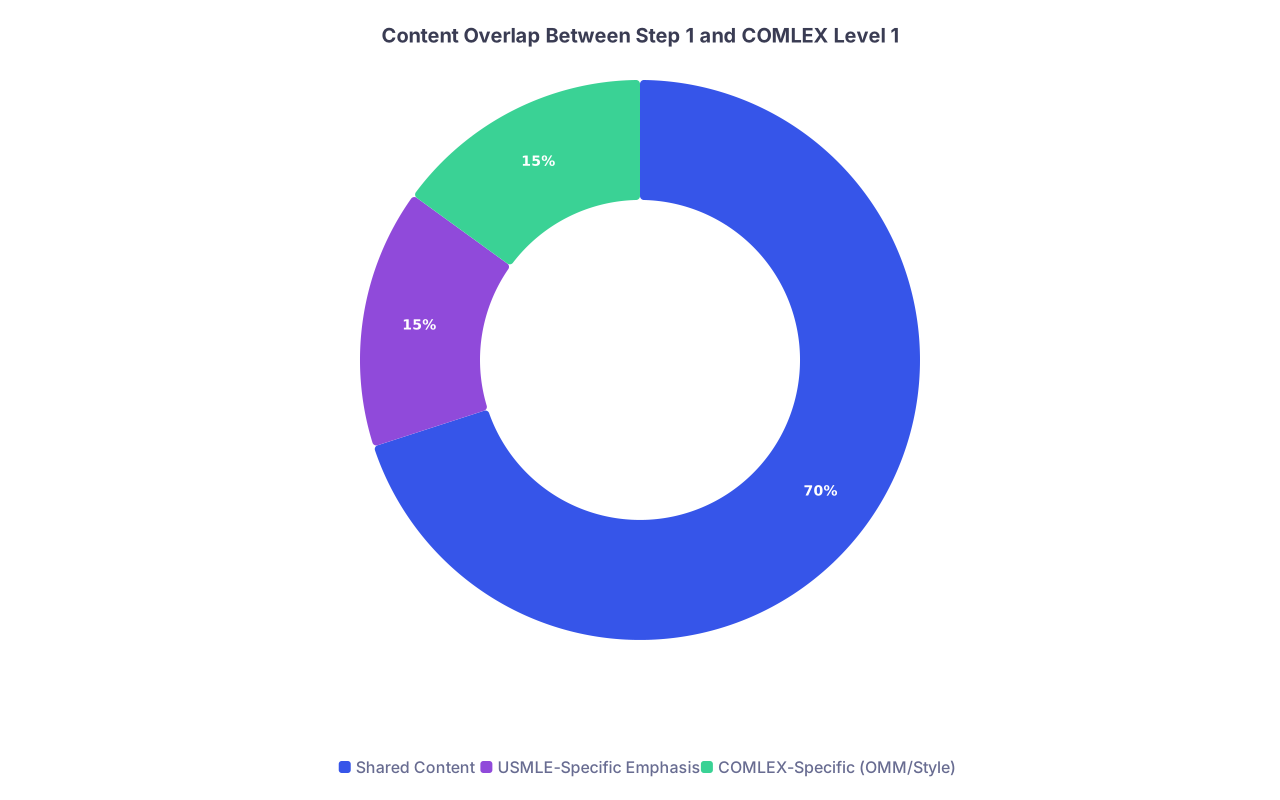
| Category | Value |
|---|---|
| Shared Content | 70 |
| USMLE-Specific Emphasis | 15 |
| COMLEX-Specific (OMM/Style) | 15 |
If your school only requires COMLEX, they might:
- Not give you dedicated USMLE prep time
- Not pay for NBME practice exams
- Be less helpful with USMLE-specific logistics
But content-wise? You’re already there. The question is whether:
- You can spare 7–14 extra days of targeted USMLE-style prep
- You can tolerate another long exam
- You care enough about future options to justify the cost (money, time, stress)
When You Should Definitely Take Step 1
If any of these sound like you, I’d lean strongly toward taking Step 1:
You’re considering competitive or moderately competitive specialties:
- Derm, ortho, neurosurg, ENT, plastics, urology, IR
- Competitive non-surgical like gas, EM (yes, it’s shifting), rads, rad onc
You want:
- Big-name academic centers
- Highly urban programs with tons of applicants
- California, NYC, Boston, Chicago “top” programs in any specialty
You’re a strong standardized test taker:
- Crushed the MCAT relative to your peers
- Did well on school exams and COMSAEs
- Can reasonably expect to pass Step 1 comfortably
You want maximum flexibility because your specialty plans are not stable at all
(Which, to be clear, is most MS1–MS2 students.)
Here’s the key: taking Step 1 isn’t just about the exam. It’s about signaling.
You’re telling programs:
- “I can function in the same testing ecosystem as MD applicants.”
- “You don’t have to guess how my board performance compares.”
- “You can plug me directly into your usual metrics.”
That matters more than anyone wants to admit.
When It’s Reasonable to Skip Step 1
There are absolutely situations where just taking COMLEX is a rational choice.
You’re probably safe to skip Step 1 if:
You’re truly set on:
- Family medicine
- Community internal medicine
- Psychiatry (non-ultra-competitive locations)
- Pediatrics (non-ultra-competitive locations)
You’re targeting:
- Community or smaller regional programs
- DO-heavy programs known to understand COMLEX well
You’re struggling:
- Barely passing classes
- Fighting severe test anxiety or burnout
- Worried that splitting focus will-jeopardize your chance of passing COMLEX
Your school support for USMLE is garbage:
- No extra time
- No advising
- No practice NBMEs
And you don’t have the bandwidth to build a USMLE plan solo.
Even in these cases, you should be very honest with yourself.
“Set on FM” in MS2 becomes “Actually EM seems cool” about every 3 months for a lot of people.
If you skip Step 1 and later fall in love with a more competitive specialty, you may:
- Be forced into taking Step 2 CK under more time pressure
- Have to overcome more skepticism from programs
- Rule out some top-tier and university programs entirely
A Simple Decision Framework (Be Honest, Not Aspirational)
Use this as a practical flow, not a personality test.

| Step | Description |
|---|---|
| Step 1 | DO student before Level 1 |
| Step 2 | Plan for Step 1 + COMLEX |
| Step 3 | Focus on COMLEX only |
| Step 4 | Considering competitive specialty? |
| Step 5 | Want academic/top programs or big cities? |
| Step 6 | Struggling with tests or burnout? |
| Step 7 | Want to keep future options open? |
Where people screw this up is answering these questions as the future idealized version of themselves.
Answer them as you are now, under the stress, with your current bandwidth.
Logistics: How to Add Step 1 If Your School Only Requires COMLEX
If you decide Step 1 makes sense, you don’t have to reinvent your whole schedule.
Typical route that works:
Study for COMLEX Level 1 as your primary anchor:
- Use resources like Boards & Beyond / Pathoma / Sketchy / UWorld / COMBANK/COMQUEST
- Keep OMM content in the rotation
About 4–6 weeks out from boards:
- Start mixing in USMLE-style questions (UWorld set to Step 1)
- Do one or two NBME practice exams to get a feel for question style
Scheduling trick that works well:
- Take USMLE Step 1 first
- Then take COMLEX Level 1 about 7–10 days later
This way:
- You peak for Step 1 with high-yield, clean question style
- Then pivot into OMM and COMLEX quirks for a short, focused sprint
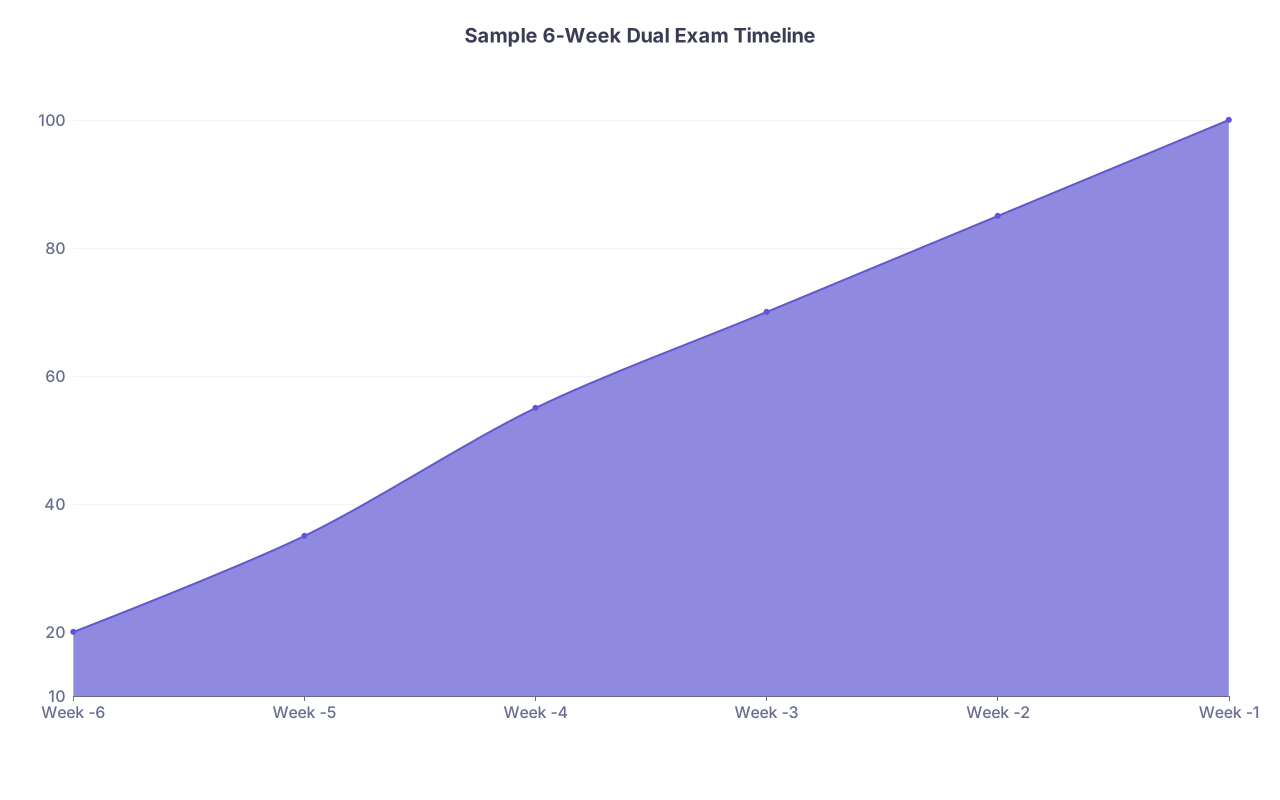
| Category | Value |
|---|---|
| Week -6 | 20 |
| Week -5 | 35 |
| Week -4 | 55 |
| Week -3 | 70 |
| Week -2 | 85 |
| Week -1 | 100 |
(Values here representing “overall readiness” with Step 1 ~1 week before Level 1.)
Risk Management: When Step 1 Can Hurt You
There are situations where Step 1 is more liability than asset.
Step 1 can hurt you if:
- You barely pass (or fail) while your COMLEX score is decent
- You burn so much time on USMLE content you underperform on COMLEX
- You force it into a ridiculously cramped schedule just to “check the box”
Programs can’t unsee a low Step 1, even though it’s pass/fail now.
A “Pass” is a pass, but the concern is what your Step 2 CK will look like.
I’d be cautious about adding Step 1 if:
- Your COMSAE/NBME practice exams are borderline for passing
- You haven’t built consistent stamina for full-length practice tests
- Your school gives you very limited dedicated time and you’re already behind
In that case, your priority is simple: pass COMLEX Level 1 on the first try.
That matters more than almost anything else in the short term.
What If You Skip Step 1 and Regret It Later?
You’re not trapped forever.
If you skip Step 1 and later want to upgrade your application:
- You can take Step 2 CK and crush it
- You can lean hard on clinical performance, strong letters, and audition rotations
- You can target programs known to be DO-friendly and COMLEX-savvy
But be realistic:
Without any USMLE (neither Step 1 nor Step 2), your life is harder if you’re shooting for:
- Competitive specialties
- Big-name academic programs
- Ultra-desired locations
Step 2 CK is your bailout exam if you skip Step 1. Just understand you’re then betting everything on a higher-stakes test taken later and closer to application season.
Quick Specialty Snapshot: Step 1 Value by Interest
This is approximate but directionally correct:
| Specialty Type | Step 1 Value | Comment |
|---|---|---|
| Derm/Ortho/Neurosurg/ENT | Very High | Take Step 1 + Step 2 CK |
| Gas/Rads/Urology/IR | High | Strongly recommended |
| EM (varies by region) | Moderate-High | Helpful, often expected |
| Academic IM/Peds | Moderate | Opens more doors |
| Psych | Moderate | Useful for top/academic sites |
| FM/Community IM | Low-Mod | Often okay with COMLEX only |
FAQs
1. Will not taking Step 1 automatically kill my chances at ACGME residencies?
No. Plenty of DO students match ACGME programs every year with COMLEX only.
But “possible” and “optimal” aren’t the same. If you’re targeting competitive fields or top academic programs, not having Step 1 (and later Step 2 CK) will absolutely limit some options.
2. If Step 1 is pass/fail now, is it even worth it?
Yes, but for a different reason than before.
You’re not taking it to flex a 250 anymore. You’re taking it to:
- Show you can handle USMLE-style boards
- Make your COMLEX look less “mysterious”
- Avoid being screened out by programs that quietly prefer USMLE data
It’s more about access and comparability than about the actual score now.
3. Should I take Step 1 or just wait and take Step 2 CK?
If you’re early (pre‑Level 1), I’d rather see you:
- Take Step 1 while your basic sciences are fresh
- Then follow through with a strong Step 2 CK
Relying only on Step 2 CK means you’re placing a ton of pressure on one exam taken later, when you’re also juggling clinical duties. Not ideal unless you had a rough preclinical phase.
4. I’m an average student at a mid-tier DO school. Is Step 1 still worth it?
Most likely, yes—if:
- You’re not failing classes
- You can realistically pass both exams on first attempt
- You’re even slightly open to non-primary-care or academic IM
Your “average” DO school plus decent COMLEX plus a Pass on Step 1 is often stronger than COMLEX alone. It shows breadth and makes PDs’ lives easier when they compare you to MD applicants.
5. What if my school doesn’t support USMLE at all?
Then you need to be strategic. That means:
- You self-organize USMLE-style question banks (UWorld, NBME practice tests)
- You time the exam so it doesn’t crush your COMLEX prep
- You’re honest about whether you can handle the added load
If your performance is already shaky, forcing Step 1 with zero institutional support might not be worth the risk. But if you’re solid and self-directed, you can still absolutely pull it off.
6. Is there any downside to “just taking Step 1 to keep options open”?
Yes. The downside is:
- Time away from COMLEX-specific prep, especially OMM
- Risk of failing or barely passing if you’re not ready
- Burnout from trying to do too much at once
If you’re confident you can pass both and manage your energy, it’s a good bet. If you’re stretched thin already, “just taking it” can backfire badly.
7. Bottom line: what should I do if I’m undecided about specialty?
If you’re early in school and undecided, I’d lean toward:
- Plan on taking Step 1 + COMLEX Level 1
- Reassess with real practice scores (NBMEs/COMSAEs) 6–8 weeks out
- If your numbers show you’re not ready, you can always drop Step 1 and protect COMLEX
That approach keeps the most doors open now without committing you to a bad decision later.
Key takeaways:
- If you care about competitive specialties or academic programs, Step 1 is still very much worth taking as a DO student, even if your school only requires COMLEX.
- If you’re primary-care focused, targeting community programs, and struggling with exams, it’s absolutely reasonable to skip Step 1 and protect your COMLEX performance.
- When in doubt early on, plan for both, monitor your practice performance honestly, and only back away from Step 1 if it clearly endangers your ability to pass COMLEX on the first try.