
It’s 10:30 p.m. You just finished an NBME. Your score popped up. It’s… not what you wanted.
Now you’re staring at Reddit threads where one person took 2 NBMEs and crushed Step, another took 15 and still feels miserable, and everybody’s throwing random numbers around.
You want a real answer:
How many NBMEs do you actually need before Step 1 — and which ones — without wasting time, money, or your sanity?
Here’s the straight answer and a framework that actually works.
Short Answer: What Most Students Should Do
If you just want the number and the plan, here it is.
For a typical student aiming to pass Step 1 confidently:
- Total NBMEs: 4–6
- Absolute minimum for almost everyone: 3 real NBMEs
- Upper limit for most people: 8 NBMEs (beyond that, you’re usually avoiding real studying)
Use them like this:
- Baseline (optional but useful):
- 1 NBME early (8–10 weeks before exam)
- Mid-phase check-ins:
- 1–2 NBMEs during dedicated (weeks 4–2 out)
- Final stretch:
- 2 NBMEs in the last 2 weeks (not closer than 2 days before test day)
If you’re already anxious: no, you don’t need to take every NBME ever released. That’s how people burn out and stop learning.
Now let’s be systematic about it.
Step 1: Decide Which Bucket You’re In
How many NBMEs you should take depends on where you’re starting and how much time you have. I’ll split you into three buckets.
| Starting Level | Goal | Suggested NBME Count |
|---|---|---|
| Strong | Solid pass / high confidence | 3–4 |
| Average | Safe pass / some cushion | 4–6 |
| At-risk | Borderline / previously failed | 6–8 |
Here’s what those mean in real terms:
1. Strong Student
You’re here if:
- You’ve been consistent with classes and Anki
- UWorld % correct is >60% (untimed, mixed or subject) early in dedicated
- Your school CBSE or early NBME is clearly above passing
You don’t need 10 NBMEs. You need:
- Enough data points to confirm you’re safe
- Enough exposure to “NBME-style thinking” so nothing feels foreign test day
- Time left to actually review and learn from them
Target: 3–4 NBMEs total.
2. Average Student (most people)
You’re here if:
- You’re not tanking, but not cruising
- UWorld % correct maybe 50–60%
- You’re close to passing on structured tests, but not comfortably
You need more checkpoints:
- To catch plateaus or false confidence
- To adjust your study plan based on actual performance trends
Target: 4–6 NBMEs total.
3. At-Risk Student
You’re here if:
- You’ve failed a CBSE / school comp / prior NBME
- UWorld % correct <50% late in pre-dedicated
- You’re repeatedly borderline on practice tests
You need:
- More frequent, spaced NBMEs (not all at the end)
- Time to remediate weak systems and topics based on each result
Target: 6–8 NBMEs total.
If you’re thinking of going beyond 8, usually the problem isn’t “too few NBMEs.” It’s content gaps and weak review.
Step 2: What NBMEs Should You Take (and In What Order)?
NBMEs change over time, but the principle holds: use newer, currently available, and retired-but-still-relevant forms in a logical order.
General priority:
- Most recent / currently available CBSSAs
- Slightly older but still representative forms
- Old retired forms or random question banks pretending to be “NBME-style” last
If you have, say, 6 slots for NBMEs, a decent framework looks like:
- Early baseline: 1 mid-numbered form
- Mid-dedicated: 2 forms spaced 1–2 weeks apart
- Final two weeks: 2 recent forms
- One extra anywhere you need a data point (after a big content push or remediation block)
And no, you don’t need to memorize which exact form number is “best”; you want a spread that includes some of the newer style.
Step 3: When to Take Each NBME
This is where people screw up the most. They cram all their NBMEs into the last 10 days and then wonder why nothing changed.
Here’s a clean time-based approach assuming a 6–8 week dedicated. Adjust proportionally if yours is shorter or longer.
Week 0 (Before Dedicated) – Optional Baseline (NBME #0 or #1)
Use this if:
- You have at least 8+ weeks total before test day
- You can emotionally handle a low score
Purpose:
- Identify if you’re already roughly near passing or way below
- Decide if your dedicated plan is realistic
- Set expectations (and maybe move the test early, or delay)
Do NOT:
- Obsess over the exact number
- Immediately move your exam based on a single pre-dedicated score
Week 2–3 of Dedicated – First Serious Check (NBME #1)
By now, you’ve:
- Done a chunk of UWorld
- Started to see patterns in weak systems (e.g., neuro, renal)
This NBME tells you:
- Are you trending upward from baseline?
- Are your weak areas what you thought they were, or something else?
After this one, you change your plan:
- If cardio/renal are tanking, you build a 3–5 day block focused on them
- If you keep missing “easy” questions due to rushing, you adjust timing strategy
Week 4–5 – Mid-Late Dedicated (NBME #2 and maybe #3)
This is your pivot zone. Especially for average/at-risk students.
Strong students:
- Take 1 NBME here
Average/at-risk: - Take 1–2 NBMEs here, at least 7 days apart
Use these to:
- Confirm upward trajectory
- Decide if your scheduled test date is realistic
- Commit to final 2-week plan (or talk about postponement with your dean/advisor if you’re still failing)
Never stack full NBMEs closer than 3–4 days apart here. If you’re taking one every other day, you’re practicing suffering, not learning.
Final 10–14 Days – Last 2 NBMEs
This is your “am I ready?” window.
Plan:
- NBME #Last-1 about 10–7 days before test
- NBME #Last about 5–3 days before test
Then:
- No full-length NBME within 2 days of your actual Step 1
- Day before: light review, rest, quick fact sheets, nothing intense
If your last 2 NBMEs are both:
- Above/pass threshold and reasonably consistent → you’re likely fine
- Trending downward or still below pass → this is the time for serious discussion about rescheduling, not blind optimism
Step 4: What to Do With NBME Results (The Part Almost Everyone Gets Wrong)
The value of an NBME isn’t the score. It’s what you do in the 2–4 days after.
Here’s the framework that works:
1. Score → Trend → Decision
After each NBME, ask 3 questions:
- Is this score above, near, or below passing?
- Compared to my last NBME, is this up, flat, or down?
- Does this change anything about my plan?
If your score:
- Went up and is clearly above the passing curve → keep doing what’s working
- Stayed flat, just around passing → you need more targeted work, not more random questions
- Went down → pause and diagnose; more hours and panic generally make it worse
2. Deep Review (Not Just “I Read the Explanations”)
Pick a fixed number of days (usually 1–2) for each NBME review. During that time, you:
Categorize misses as:
- Didn’t know the content
- Misread / rushed
- Overthought / changed from right to wrong
- Weird/unfamiliar style
Track patterns:
- Are you constantly missing pathology micrographs?
- Are you repeatedly wrong on endocrine biofeedback loops?
- Do you panic every time you see renal phys?
Then convert that into action:
- Build a short, focused list:
“Over next 4 days, I will fix: renal phys, acid-base, behavioral science biostats, immuno basics.”
Not “I will review First Aid end to end again.” That’s how people spin their wheels.
Step 5: When Are You Taking Too Many NBMEs?
Let me be blunt: if you’re doing a full NBME every 2–3 days for “practice,” you’re wasting opportunities.
Red flags you’re overdoing it:
- You’re too tired to deeply review questions
- Your last 3 NBME scores are flat or bouncing randomly
- You’re pushing off real content review “until after the next NBME”
- You’re starting to treat NBMEs like another Qbank, not as assessment tools
Rough rule:
- If you’re taking >8 NBMEs and still can’t tell me what your top 5 weak topics are, the number of exams isn’t your problem.
Step 6: How NBMEs Compare to Other Practice Exams
You don’t live in an NBME-only universe. You’ve also got UWorld Self-Assessments, AMBOSS SA, etc. Here’s how they fit in.
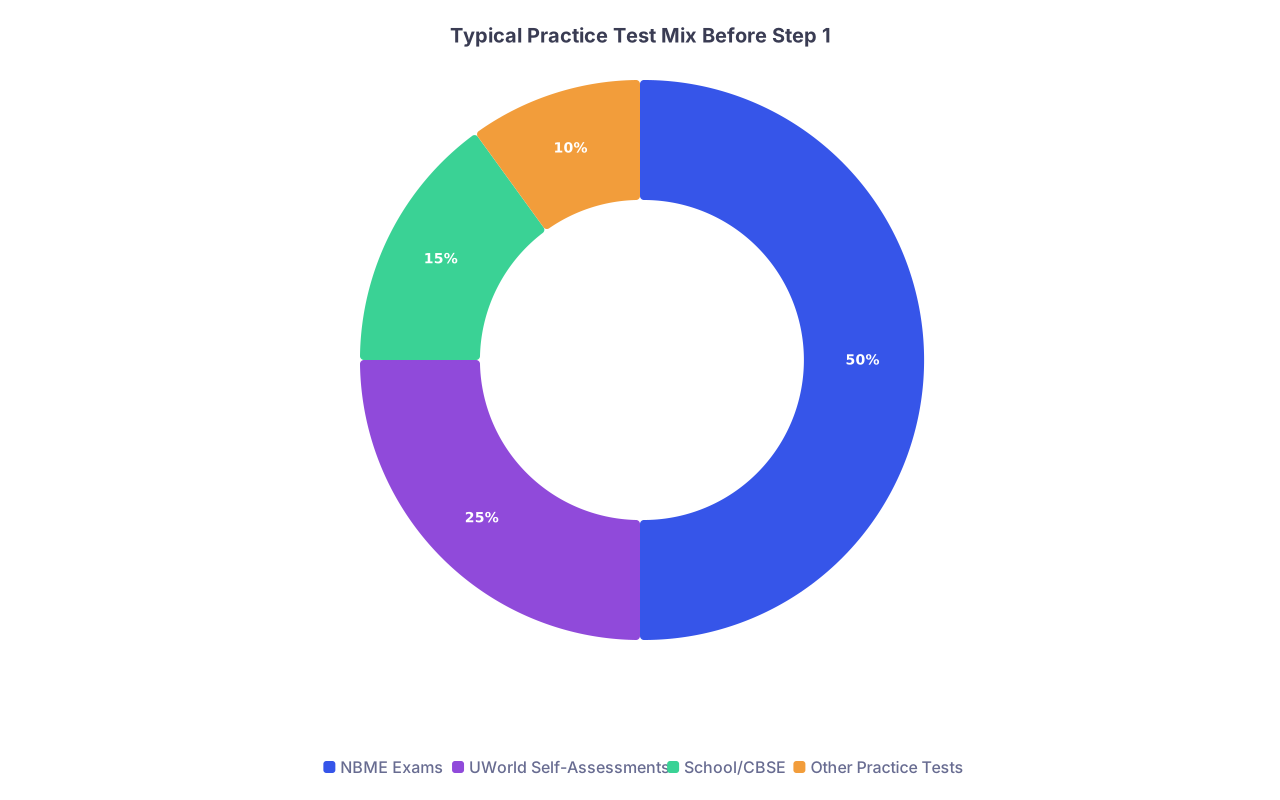
| Category | Value |
|---|---|
| NBME Exams | 50 |
| UWorld Self-Assessments | 25 |
| School/CBSE | 15 |
| Other Practice Tests | 10 |
Straight talk:
NBMEs
- Best for: “How close am I to actual Step 1?”
- Weakness: Explanations aren’t as detailed; some forms feel weird/old
UWorld Self-Assessments (UWAs)
- Best for: Explanations and study value
- Weakness: Predictive accuracy can be decent but not as tight as recent NBMEs
School CBSE / Comp
- Good for: Early signal; some schools rely heavily on these as gatekeepers
- Weakness: Timing and content sometimes off relative to your dedicated
Use these principles:
- Count NBMEs as your primary anchor for Step readiness
- Add 1–2 UWorld SAs for learning and confirmation, especially mid-dedicated
- Don’t try to take every test from every vendor “just because”
Example Schedules by Student Type
Let me give you a few concrete patterns.
Strong Student (6-week dedicated, wants 3–4 NBMEs)
- Pre-dedicated:
- Optional NBME (baseline)
- Week 3:
- NBME #1
- Week 5:
- NBME #2
- Week 6 (7–3 days before Step):
- NBME #3 (final)
- UWorld SA: 1 sometime around week 4
Average Student (8-week dedicated, wants 5 NBMEs)
- Week 0–1 (start of dedicated):
- NBME #1 (baseline)
- Week 3:
- NBME #2
- Week 5:
- UWorld SA
- Week 6:
- NBME #3
- Week 7:
- NBME #4
- Week 8 (5–3 days before Step):
- NBME #5
At-Risk Student (10–12 weeks planned, 6–8 NBMEs)
- Week -2 or 0 (pre-dedicated):
- NBME #1 (baseline)
- Week 2:
- NBME #2
- Week 4:
- NBME #3
- Week 6:
- UWorld SA
- Week 7:
- NBME #4
- Week 8:
- NBME #5
- Week 9–10:
- NBME #6
- Week 11:
- NBME #7 (final)
- Skip #8 unless there’s a strong reason and enough time to react
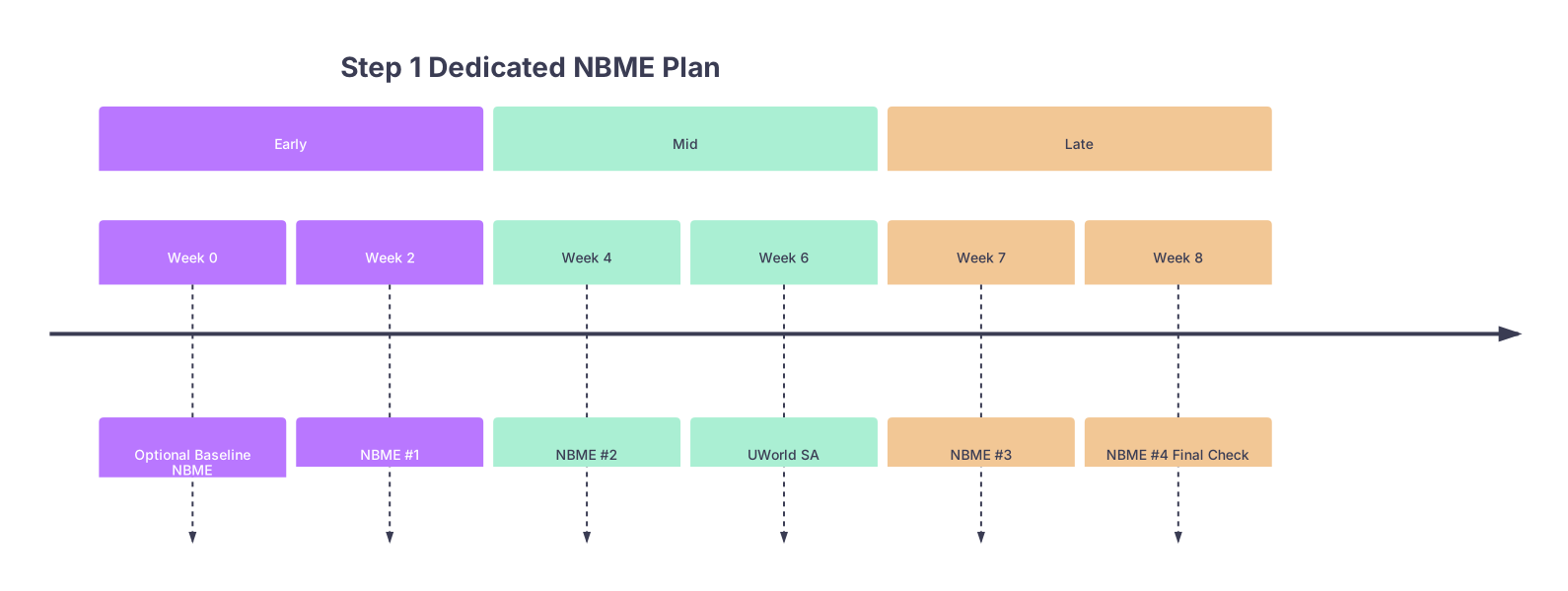
| Period | Event |
|---|---|
| Early - Week 0 | Optional Baseline NBME |
| Early - Week 2 | NBME #1 |
| Mid - Week 4 | NBME #2 |
| Mid - Week 6 | UWorld SA |
| Late - Week 7 | NBME #3 |
| Late - Week 8 | NBME #4 Final Check |
FAQ: NBMEs and Step 1
1. Is 2 NBMEs enough before Step 1?
For most people, no. Two data points give you almost no sense of trend. I’d call 3 the absolute minimum for a strong, low-anxiety student. If you’re average or unsure, aim for at least 4.
2. What if my NBME scores are all over the place?
First, check conditions: sleep, time of day, breaks, distractions. Then look at content consistency: are you always missing renal/endocrine/behavioral, or is it random? If your testing conditions and content gaps are inconsistent, your scores will be unstable. Fix those first. Don’t just keep stacking exams.
3. Should I repeat an NBME I did badly on?
No. Repeating a full NBME just to see a higher number is fake progress. Once you deeply review it, move on. Repeating individual questions as flashcards or drilling the concepts is fine. Repeating the entire exam for a new score is pointless.
4. How low is “too low” to keep my test date?
Look at your last two NBMEs, taken under real conditions. If both are clearly below the passing range, and you don’t have at least 2–3 weeks to significantly improve, you should be seriously considering postponing. One bad outlier can happen; two recent bad NBMEs is a trend.
5. My friend took 10+ NBMEs and did great. Should I copy that?
No. You’re seeing survivorship bias. Nobody posts the “I took 12 NBMEs and still failed” story with the same enthusiasm. If you review them well and have a long dedicated, you can get away with more NBMEs, but for most students, 4–6 well-reviewed exams beats 10 rushed ones every time.
Key takeaways:
- Most students should aim for 4–6 NBMEs, with 3 as a bare minimum and 8 as a practical upper limit.
- Space them out over dedicated, use the scores to change your plan, and reserve your last 2 exams for the final 2 weeks.
- The value isn’t in the number of NBMEs. It’s in the quality of your review and how honestly you act on what they show you.