
The biggest mistake students make with Step 1 is thinking “being tired of studying” equals “being ready.” It does not.
If you want a clean, honest answer to “How do I know I’m truly ready to sit for Step 1?” you need numbers, patterns, and a gut check that’s actually grounded in data—not vibes.
Here’s the framework I use when students ask me if they should schedule, postpone, or pull the plug and extend dedicated.
1. Your Scores: The Non‑Negotiable Baseline
If your scores are not in range, nothing else matters. You’re not ready.
Step 1 is pass/fail now, but programs still care whether you passed on the first attempt. A fail follows you. So you protect that at all costs.
There are three big buckets you need to look at: NBME, UWorld Self-Assessments, and your question bank performance.
A. NBME Scores: The Primary Signal
NBMEs are closest to the real thing. They’re not optional. They’re your main reality check.
Here’s the rule of thumb I tell students:
- At least 2–3 recent NBMEs within 2–3 weeks of your planned exam
- All of them comfortably above the passing threshold, not just barely
To put some numbers on it (yes, rough, because scaling changes, but the pattern is consistent):
| Status | Pattern of Recent NBME Scores* |
|---|---|
| Clearly Ready | All ≥ 10–15 points above pass |
| Probably Ready | Mostly ≥ 5–10 above pass |
| Questionable / Risky | Hovering 0–5 above pass |
| Not Ready | Any below pass in last 2–3 exams |
*“Points above pass” depends on the specific NBME form’s passing approximation. Use contemporary discussions + school advising.
If your last NBME before the exam is your worst, that’s a red flag. I’ve seen students ignore this because “I just had an off day.” Sometimes that’s true. But you don’t stake your transcript on that kind of hope.
Pattern matters:
- Trending up = good
- Flat but clearly above pass = acceptable
- Wavy or trending down = reconsider your date
B. UWorld Self‑Assessments (UWSA1 & UWSA2)
UWSAs aren’t as predictive as NBMEs, but they’re still valuable:
- Most students use UWSA1 mid‑dedicated
- UWSA2 is often done near the end, like a dress rehearsal
I care about two things:
- They’re also showing you above pass, not below
- They aren’t wildly discordant with NBME scores
If your NBMEs look great but both UWSAs look terrible, something’s off: fatigue, timing issues, anxiety, or poor test-taking strategies. You fix that before you sit.
C. Question Bank Performance (Especially UWorld)
Daily QBank percentages don’t tell the full story, but they’re a sanity check.
Here’s how I read them:
- Cumulative UWorld % correct:
- Around 55–65%: borderline but can be fine if NBMEs look good
- >65–70%: usually solid, again assuming NBMEs confirm it
- Recent blocks (last 2 weeks):
- You want to be consistently at or above ~60–65% in random, timed, mixed blocks
If your overall is low but your recent timed, mixed performance is strong—and your NBMEs are good—you’re probably okay. Early bad blocks drag down the mean for a long time.
2. Content Readiness: Are the Holes Manageable?
You’re never going to “know everything.” That’s fantasy. The better question is: Are the remaining gaps dangerous or acceptable?
Here’s what “acceptable” versus “dangerous” looks like.
A. Your Weak Areas Should Be Narrow, Not Global
You’re allowed to say:
- “I’m weaker in biostatistics and some of the odd microbiology bugs.”
You are not allowed to say:
- “I’m bad at cardio and renal and neuro” and think you’re ready.
If more than 2–3 major systems feel like a mess, you’re not ready. I don’t care what your friend’s cousin did and “still passed.” You’re gambling.
B. You’ve Done At Least One Full Pass of a Major Resource
Minimum realistic content exposure before sitting:
- One full, serious pass of:
- UWorld (or an equivalent primary QBank)
- A primary content source (e.g., Boards & Beyond, Pathoma, Sketchy, or a tightly integrated Anki deck tied to your questions)
If you’ve “sort of watched” a few videos and bounced around random questions without structure, you’re not done. You’re improvising.
C. You Can Explain Questions You Got Wrong
Here’s a simple test that separates “ready” from “pretending to be ready”:
Pick 10 random questions you got wrong in the last week. For each one, can you:
- Explain what the stem was actually testing
- State the correct concept in your own words
- Generalize it to at least one similar scenario
If your explanations sound like “I’ll just memorize that for next time,” that’s not understanding. You’re building sand castles.
3. Test-Taking Stamina and Strategy
Many students are “content ready” but “exam day unfit.” That’s still not ready.
A. Full-Length Practice: Non-Negotiable
You need at least one full exam‑length day under realistic conditions:
- Multiple back‑to‑back blocks (NBME + extra blocks or a long self-assessment combination)
- Timed, random, no pausing
- Real breaks, real schedule
You’re not just testing knowledge. You’re testing:
- Focus over many hours
- How you handle mental fatigue
- Hydration/food/caffeine strategy
- Pacing (finishing with 5–10 min buffer is ideal)
If you’ve only ever done single blocks on your couch, you don’t know what your brain does at hour 6. Step 1 will find that weakness for you.
B. Pacing and Panic Check
Ask yourself honestly:
- Do you routinely finish blocks with at least a few minutes left?
- Or are you always rushing, guessing on the last 5–10?
And during practice:
- Are there moments where your mind “blanks” and you spiral?
- Do you get stuck re-reading stems 3–4 times?
One or two bad blocks happen. But if this is your baseline, you need more practice with timed, mixed blocks and some work on test-day mindset, not just more facts.
4. Mental Readiness: Stress vs. Breakdown
Being nervous is normal. Feeling like you’re one question away from a meltdown is not.
I look for these signs of functional anxiety vs. toxic anxiety.
Signs you’re mentally ready enough
- You’re anxious, but you’re still sleeping at least 6 hours most nights
- You can sit for 40–60 minutes of questions without checking your phone or spiraling
- After a bad block, you’re annoyed but you can move on and review it productively
- When you look at the calendar and see your test date, you feel a mix of dread and “okay, let’s just do this”
Signs you should seriously consider postponing
- Panic attacks when you try to do a full block
- You’re consistently sleeping 3–4 hours or relying on ridiculous caffeine just to function
- You cry after practice exams regularly and avoid opening score reports
- Your performance is getting worse the harder you push
No exam date is worth destroying your mental health for. And needless to say, going in completely fried is a great way to fail a test you could have passed.
5. Objective Checklist: If You Can Say “Yes” To Most of This, You’re Probably Ready
Here’s the blunt checklist I’d run through with you if we were sitting in a study room together.
Within 2–3 weeks of your planned exam:
- At least 2–3 recent NBMEs, all at or safely above a reasonable buffer above pass
- UWSA(s) not failing, reasonably consistent with your NBME performance
- You’ve completed most or all of a primary QBank, with recent mixed, timed performance around or above 60–65%
- You’ve done at least one full-length exam day simulation without mental collapse
- You do not have multiple major systems that feel like unsalvageable disasters
- You can review incorrect questions and accurately explain what went wrong
- Your scores over time are flat-but-safe or trending up, not trending down
- Your anxiety is present but controlled; you’re functioning, not falling apart
If you’re missing one of those but everything else looks solid, you still might be okay.
If you’re missing three or more? You are probably talking yourself into something you’ll regret.
6. When You Should Postpone (And When You Shouldn’t)
Students postpone for the wrong reasons all the time. Let’s sort this out.
Good reasons to postpone Step 1
- Recent NBMEs are at/below the pass line or dropping
- You have big, fixable knowledge gaps (e.g., you never really learned renal phys)
- You’ve never done a realistic full-length and your stamina is clearly poor
- There’s a major life crisis (family, health, etc.) tanking your ability to focus
- Your school advisors or people who know your situation well are saying, “Do not sit yet”
Bad reasons to postpone Step 1
- “I just don’t feel 100% ready” (no one does)
- “What if I could get an even higher score?” — It’s pass/fail. Past safe territory, you’re chasing ego.
- “My friend studied 10 weeks, I’ve only done 7” — The calendar doesn’t matter as much as your data
- “I got a 1–2 point drop on a single NBME, so I panicked” — Look at trends and context, not one blip
If your last 2–3 NBMEs are clearly above pass, your QBank performance is reasonable, and your simulation day wasn’t a disaster, postponing usually adds burnout more than benefit. You just stretch the anxiety.
7. How to Use the Last 7–10 Days Before Your Exam
Assuming your data says you’re ready, the last week is not for reinventing your approach.
Here’s a rough, realistic layout:
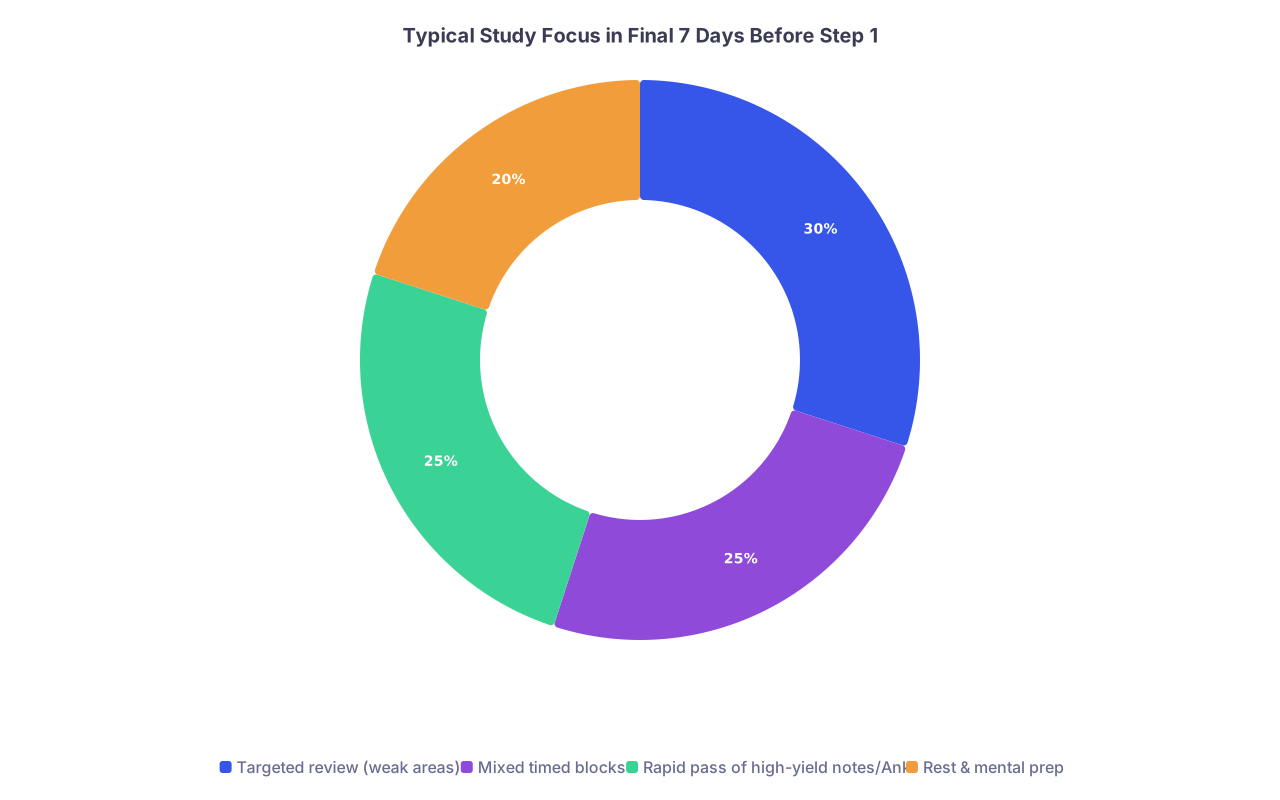
| Category | Value |
|---|---|
| Targeted review (weak areas) | 30 |
| Mixed timed blocks | 25 |
| Rapid pass of high-yield notes/Anki | 25 |
| Rest & mental prep | 20 |
Practical priorities:
- 1–2 more timed, mixed blocks per day, not 8. You’re maintaining sharpness, not doing a second dedicated.
- Targeted review of weak topics you’ve already seen before. No brand-new resources.
- Quick run-through of:
- Biostats formulas, ethics, common management algorithms
- High-yield micro, pharm, and favorite “gotcha” topics
- Protect sleep like it’s your job. No 3 a.m. cram sessions the night before.
If at this stage you’re still swinging wildly on scores, that’s a deeper problem. You don’t fix chaos in seven days.
8. A Simple Decision Flow: Sit, Postpone, or Re‑Evaluate
If you want a visual way to think about all this:

| Step | Description |
|---|---|
| Step 1 | Recent NBMEs >= Safe Margin Above Pass? |
| Step 2 | Postpone & Remediate |
| Step 3 | Full-Length Simulation Done? |
| Step 4 | Do Simulation Within 7-10 Days |
| Step 5 | Simulation Catastrophic? |
| Step 6 | Weak Areas Manageable? |
| Step 7 | Anxiety Functional, Not Debilitating? |
| Step 8 | Sit for Step 1 as Scheduled |
This is basically the decision-making tree good advisors already use, just written out instead of said between the lines.
FAQs
1. What’s the minimum number of NBMEs I should take before Step 1?
I’d call 3–4 total a realistic minimum, with at least 2 in the final 2–3 weeks. Anything less and you’re flying partially blind. If cost is an issue, prioritize the ones closest to your exam date; those give you the best reality check.
2. Can I still sit if my NBME scores are just barely above passing?
You can, but I wouldn’t call that “truly ready.” If you’re consistently 0–5 points above pass, your margin for a bad test day is tiny. If you can add 2–3 focused weeks and realistically push that buffer up, I’d strongly consider postponing. If you’re stuck at that level after solid studying, get a faculty/advisor opinion before making the call.
3. How much does UWorld percentage really matter now that Step 1 is pass/fail?
It matters less than your NBMEs but still gives context. A low UWorld percentage with strong NBMEs can be fine. A high UWorld percentage with mediocre NBMEs is more concerning, because NBMEs are closer to the real exam style. Use UWorld % as background noise and NBMEs as the main music.
4. I’m strong in content but I keep running out of time on blocks. Am I ready?
Not yet. Failing because you ran out of time counts the same as failing because you didn’t know the material. You need at least a week of timed, mixed blocks focusing just on pacing, stem triage, and moving on from time sinks. When you can regularly finish blocks with a few minutes left, and your scores are okay, then we can talk about readiness.
5. What if my last NBME score dipped a little but is still passing?
One small dip is not an emergency if the trend before that was up and you’re still clearly passing. Look at why it dipped: fatigue, bad sleep, poor break structure, or truly weaker content? Fix the cause. If the next assessment stabilizes or rebounds, you’re fine. If it drops again, that’s a pattern, and you should reassess your date.
6. How do I handle anxiety that’s not completely disabling but still intense?
You don’t need zero anxiety. You need functional anxiety. Build predictable routines: same start time each day, same pre‑block ritual, same break snacks. Use practice exams as exposure therapy—train your brain that “we’ve done this before and survived.” If you’re spiraling, a session or two with campus mental health or a therapist used to high-stakes testing can make a bigger difference than yet another day of cramming.
7. What’s the single strongest sign that I am ready to sit for Step 1?
Your recent NBMEs are consistently and safely above the pass threshold, your full-length simulation day wasn’t a disaster, and when you look at the test date, your dominant thought is not “I’m doomed” but “I’m nervous, but I can probably do this.” Scores + simulation + that grounded gut feeling—when those line up, you’re ready.
Key points to walk away with:
- “Ready” is not a feeling; it’s a pattern of data: recent NBMEs, UWSAs, QBank performance, and a full-length trial.
- Small gaps are normal; major, multi-system holes and unstable scores are not—those are postpone territory.
- If your numbers are solid and your anxiety is uncomfortable but functional, stop second-guessing yourself and sit.