
You’re not “bad at studying.” You’re doing Step 1 with a second full-time job: your family.
Most Step 1 advice quietly assumes you’re a single 24-year-old whose only responsibility is picking an Anki background color. If you’re changing diapers, managing daycare drop-off, helping aging parents with meds, or doing school pick‑up between UWorld blocks, that advice is useless. Or worse—guilt-inducing.
So here’s the real version: how to prepare for Step 1 when you are a caregiver and your life does not pause for this exam.
Step 1 With Family: What You’re Actually Up Against
Let me lay out your situation bluntly, because sugarcoating is a waste of time.
You’re juggling:
- Unpredictable demands (sick kid, parent falls, spouse’s schedule changes)
- Fragmented time (15 minutes here, 25 minutes there, maybe one real block a day)
- Chronic fatigue and decision overload
- Guilt from both sides: “I’m not studying enough” vs. “I’m not present enough”
And you’re trying to compete—on paper—with classmates who can do 10 hours of continuous study with no one calling their name from the next room.
The solution is not “try harder” or “just be more disciplined.” The solution is to completely change how you think about Step 1 prep.
You need three things:
- A realistic time map that reflects your actual life
- A minimal viable study system that works in fragments
- A boundary plan that your family understands and (mostly) respects
Let’s build those.
Step 1 Time Reality Check: Finding Your Real Study Hours
First thing: stop guessing how much time you “should” study. Start with how much you actually have.
Do a 3‑Day Time Audit
For 3 normal days (not vacation, not crisis), track your time in rough 30-minute chunks. Not perfect, just honest.
Categories:
- Sleep
- Paid work (if applicable)
- Classes / required school activities
- Commute
- Childcare / eldercare tasks
- Household tasks (cooking, cleaning, bills, logistics)
- Partner time / essential family time
- Mindless scrolling / TV / “numb-out” time
- Actual focused study time
You’ll probably discover two things:
- You have less time than you hoped.
- You have more scrap time than you realized.
Scrap time = 5–25 minute windows that are currently wasted or unfocused.
Typical places for scrap time:
- Sitting in the car during kids’ activities
- Waiting rooms (peds, PT, labs)
- Nap time transitions
- Microwave/oven timers
- Before bed scrolling
- Early morning before the house wakes up
That scrap time is your secret weapon. But only if you design for it.
Build a “Family-Adjusted” Step 1 Schedule
You do not need a perfect schedule. You need one decision: When—realistically—can I do deep work, and when can I only do light work?
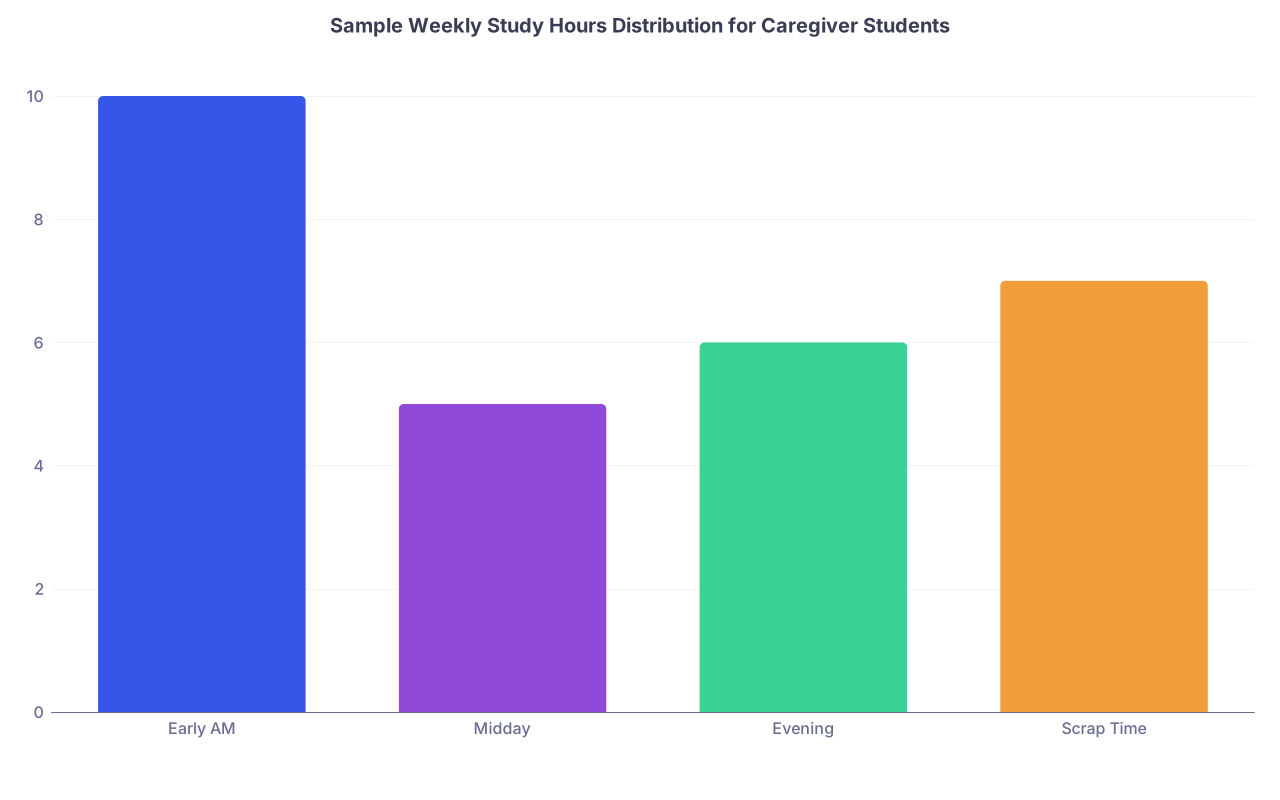
| Category | Value |
|---|---|
| Early AM | 10 |
| Midday | 5 |
| Evening | 6 |
| Scrap Time | 7 |
Step 1: Identify 3 Types of Time Blocks
Think of your day in three categories:
Deep-focus blocks (60–120 minutes)
- Example: Early morning 5–7 am before kids wake up
- Or late evening after bedtime, if your brain still works then
Medium blocks (25–40 minutes)
- During naps
- While a partner watches the kids
- During a long wait at an appointment
Micro blocks (5–15 minutes)
- Waiting for water to boil
- Sitting in the car at pick‑up
- Walking on a treadmill
- Standing in line
You’ll match tasks to block types. That prevents the “I have 15 minutes, what should I do?” paralysis.
Step 2: Build a One-Page Weekly Skeleton
Forget hyper-detailed daily plans. Do this instead:
- Circle 3–5 deep-focus blocks per week (non‑negotiable core study time)
- Mark daily medium blocks (aim for 1–2 per day)
- Assume you’ll get 3–10 micro blocks per day
Here’s what a realistic skeleton might look like for a parent with a toddler and classes:

| Step | Description |
|---|---|
| Step 1 | Morning 5-7am |
| Step 2 | Mon/Wed/Fri |
| Step 3 | Nap time 1-1:30pm |
| Step 4 | Daily |
| Step 5 | Evening 8:30-9pm |
| Step 6 | Sun-Thu |
| Step 7 | Scrap Time 5-15 min |
| Step 8 | Daily |
You’re not trying to study “all the time.” You’re trying to intentionally fill specific types of time with specific types of work.
What to Study in Each Type of Time Block
If you mismatch tasks and time, you’ll burn out and feel stupid. You’re not stupid. You’re tired.
Here’s the matching system that works.
| Block Type | Duration | Best Tasks |
|---|---|---|
| Deep Focus | 60–120 min | New UWorld blocks, system review |
| Medium Block | 25–40 min | UWorld review, focused videos |
| Micro Block | 5–15 min | Anki, quick fact review |
Deep-Focus Blocks (60–120 minutes)
Use these for the highest-yield, thinking-heavy tasks:
- Timed UWorld blocks (10–20 questions, not necessarily 40)
- Reviewing those questions in detail
- System-based full reviews (e.g., cardiology path + pharm together)
- Doing practice NBME sections
Sample 90-minute block:
- 50 min: 15 timed UWorld questions
- 35 min: Review explanations, tag weak topics
- 5 min: Quick Anki pass on tagged content
If you only get 3–5 of these blocks a week, that’s still powerful if you guard them.
Medium Blocks (25–40 minutes)
Use these for moderately demanding tasks:
- Reviewing missed UWorld questions you already did
- Watching a single high-yield video (e.g., one Sketchy micro, one Pathoma section)
- Doing a 10-question untimed, tutor-mode UWorld mini-block
- Light content review for one subtopic
Sample 30-minute block:
- 15–20 min: Review 5–7 previous UWorld questions
- 10–15 min: Related Anki / notes
Micro Blocks (5–15 minutes)
These are for low-friction, easy-to-start tasks:
- Anki reviews (unsuspended or already-learned cards)
- Flashcards for pharm mechanisms or bugs-drugs pairs
- Quick read of 1 First Aid page you’ve already seen
- Rapid review apps (e.g., Amboss Q-of-the-Day)
Rules for micro blocks:
- Phone-based only
- One click to start—no setup
- No “where did I leave off?” thinking decisions
Set your phone so opening it and tapping once gets you straight to Anki reviews or your question bank app.
Minimal-Viable Step 1 Study Plan for Caregivers
You don’t have time to do every resource. You barely have time to do one well plus a small support cast.
Here’s the honest truth: for most people in your situation, the backbone is:
- One primary question bank (UWorld or Amboss)
- One core content review approach (First Aid + videos or Boards & Beyond or Pathoma-heavy)
- Anki only if it fits your life without destroying sleep
Suggested Resource Strategy
If you’re caring for family, I’d pick:
- Primary QBank: UWorld
- Video/Content: Boards & Beyond (for breadth) + Pathoma (for path)
- Reference/Anchor: First Aid (or equivalently, Amboss library)
- Anki: Only targeted decks (pharm, micro, equations), not 5,000-card mega-decks
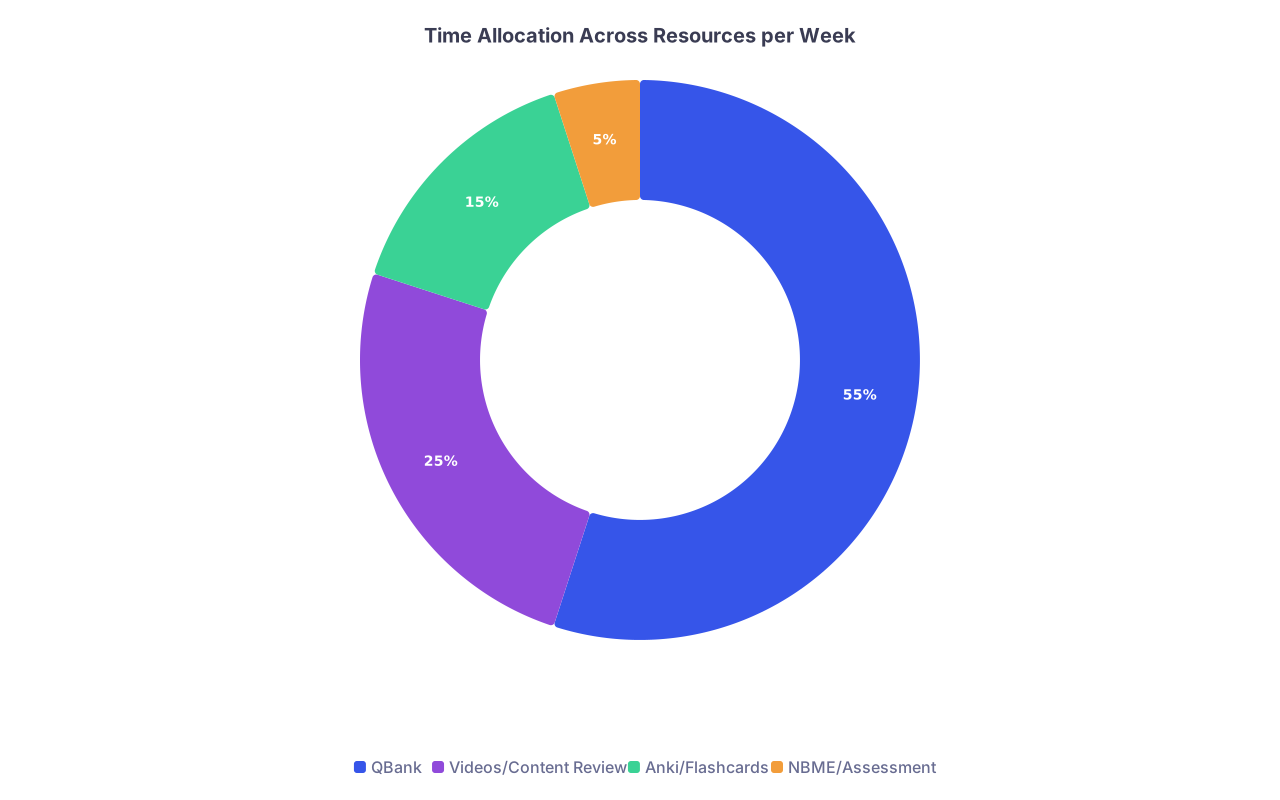
| Category | Value |
|---|---|
| QBank | 55 |
| Videos/Content Review | 25 |
| Anki/Flashcards | 15 |
| NBME/Assessment | 5 |
A Bare-Minimum Weekly Target (That Still Works)
For someone doing real caregiving (kids or elders) and classes or rotations, a realistic but meaningful week might look like:
- 80–120 UWorld questions answered thoughtfully
- 3–5 hours of content review/videos
- 200–400 Anki reviews (spread in micro blocks)
- Every 3–4 weeks: one practice exam section or NBME
Could you do more in a perfect world? Yes.
Do you live in a perfect world? No.
This volume can absolutely be enough to pass solidly and even do well, if your questions are done thoughtfully and your review is honest.
Turning Family Chaos Into Predictable Study Space
You’re not studying in a quiet library. You’re studying in a house where:
- Someone needs a snack
- Someone loses a shoe
- Someone is yelling “Mom/Dad!” every 6 minutes
You need explicit systems with your family, not vague “I’ll study when I can” fantasies.
Step 1: Have the Awkward Conversation
Sit down with your partner / co‑parent / key family members and say plainly:
“I have Step 1 on [date]. For the next [X] months I need [Y] hours a week of protected study time. If I don’t get that, I will likely need to delay the exam or risk failing. Here’s what I’m asking for. Can we problem-solve this together?”
Then propose specifics:
- Three mornings a week where you’re off-duty 5–7 am
- Two evenings where your partner handles bedtime solo
- One weekend block (2–3 hours) where you leave the house to study
- Backup plans for when a kid is sick / parent has an appointment
You’re not “asking for a favor.” You’re reallocating family resources during a temporary high-stakes period.
Step 2: Create Visible “Do Not Interrupt” Signals
You can’t rely on “they should just know I’m studying.” That’s fantasy.
Use clear, physical cues:
- Closed door with an agreed sign (e.g., red sticky note = only emergencies)
- Specific chair/table corner that means “I’m in a block, ask Dad/Mom/Grandma”
- Noise-cancelling headphones as a visual barrier
For younger kids, make it concrete:
- “When this red card is on the door, you can’t come in unless there is blood or fire.”
Sounds dramatic. But they remember it.
Step 3: Pre-Stage the House Before Deep Blocks
Before your 90-minute block:
- Snacks and water set out
- Devices charged
- Activity bins ready (coloring, Legos, puzzles)
- For elders: meds organized, TV remote nearby, bathroom trip done if needed
10 minutes of staging can protect 60 minutes of focus.
Studying Through Exhaustion Without Destroying Yourself
You’re probably tired before you even start the day. That’s your baseline.
So no, you’re not going to do 8 hours of dense pathophysiology and then “just push through” more Anki. That advice is written by people who’ve never held a puking toddler at 3 am.
Rule 1: Protect Sleep Like It’s Part of Step 1
Sacrificing an hour of sleep for an hour of low-quality midnight studying is usually a losing trade.
If your choice is:
- 6 hours sleep + 1 hour of trash studying
- 7 hours sleep + 0 hours that night
Pick sleep. Then use early morning or micro blocks tomorrow.
Chronic sleep loss will cost you:
- Question interpretation accuracy
- Memory consolidation
- Emotional resilience (aka: not losing it when you miss 50% of a block)
Rule 2: Have Light and Heavy Study Modes
On days your kid is sick or your parent had a fall and you’re emotionally wrecked, you need a light mode.
Heavy mode:
- UWorld timed blocks
- New content
- NBME sections
Light mode:
- Reviewing old UWorld explanations
- Re-watching a familiar Pathoma section
- Doing only Anki reviews
- Organizing notes / tagging weak topics
Before each day starts, ask yourself: “Do I have a heavy-mode brain or a light-mode brain today?”
Choose accordingly. That’s not weakness. That’s strategy.
Rule 3: Build a 10-Minute Reset Ritual
After a meltdown, argument, or family crisis, you’re not jumping straight into glycolysis.
Use a quick reset before study blocks:
- 2 minutes: walk around, stretch, water
- 5 minutes: breathe / music / sit in silence
- 3 minutes: open your planner, choose exactly one small task to start
Train your brain: “This little routine = we’re switching to study now.”
Sample Day Plans for Different Family Situations
Let’s get specific. Here’s how the same principles look in different real-life setups.
Scenario 1: Two Kids Under 6, Partner With 9–5 Job
You’re in M2, mostly preclinical, taking Step 1 in 4 months.
Sample weekday:
- 5:15–6:45 am (deep block):
- 15 UWorld questions timed
- Review 8–10 questions carefully
- 6:45–8:00 am: Breakfast, get kids ready, drop-off
- 8:30–12:00 pm: Class / recorded lectures
- Use any boring part: light Anki
- 12:00–12:30 pm: Lunch + 20 min Anki
- 1:00–3:00 pm: More school / admin stuff
- 3:30–6:30 pm: Pick-up, play, dinner, baths
- 7:30–8:00 pm (medium block, 3x/week):
- Pathoma or Boards & Beyond for today’s system
- Micro blocks during the day: 3–6 Anki bursts (5–10 min)
That’s maybe 2–3 real hours a day on weekdays, plus some micro time. Manageable. Honest.
Scenario 2: Single Parent, One School-Age Kid, No Local Help
Hard mode. But possible with brutal prioritization.
Key moves:
- After-bedtime may be your only true deep block
- Use school hours for your own classes and some study
- Weekends: negotiate playdates / activities that allow you to sit nearby and study
Sample weekday:
- 6:30–7:30 am: Get kid ready, breakfast
- 8:00–3:00 pm: School + your classes
- 1–2 medium blocks between classes: UWorld review / Anki
- 3:30–8:30 pm: Homework help, dinner, bedtime
- 9:00–10:30 pm (deep block 3–4 nights/week):
- UWorld 10–15 Qs + review
- Micro blocks: outside school, during kid’s activities, in waiting rooms
You might extend your study timeline rather than compress it. That’s smart, not lazy.
Scenario 3: Caregiving for an Elderly Parent at Home
Less predictable, more emotionally draining.
Strategies:
- Coordinate with siblings / home health aids for fixed protected times
- Use waiting rooms for aggressive micro-study
- Expect days where all you can do is light review
Sample weekday:
- Early AM 6–7: Medium block: light UWorld or Anki
- Mid-morning: Parent appointment → Anki in waiting room
- Early afternoon: 45-min medium block while parent naps
- Evening: 60–90-min deep block 3x/week, when someone else is home
You’re balancing guilt from both sides. Accept that. Design around it.
When Your Plan Falls Apart (Because It Will)
You will have weeks that implode:
- COVID in the house
- School closures
- New diagnosis for a parent
- Partner’s schedule suddenly changes
Instead of spiraling into “I’ll never be ready,” use a 90-minute triage session once things stabilize:
- Look at your exam date. Decide:
- Stay on date
- Push back by 2–4 weeks
- List exactly what changed (lost deep blocks, added exhaustion, etc.)
- Decide what to cut, not what to add:
- Maybe you stop watching full video series and just do QBank + targeted review
- Maybe Anki goes down to 20 minutes a day
- Maybe you lower UWorld question target for 2 weeks
You cannot “make up” lost time by heroics. You adjust the scope and keep going.
Mental Health: Not Optional Luxury, Actual Performance Tool
You’re not a machine. You’re someone being pulled in 3 directions. If you ignore your mental health, it will eventually shut the whole operation down.
Two minimum non-negotiables:
One protected off block per week
- No Step 1
- No guilt study
- Just family, or rest, or something that reminds you you’re a person
One outlet that isn’t medicine or family
- 20-min walks with a podcast
- Short workouts
- Journaling / prayer / quiet time
These feel indulgent when you’re behind. They’re not. They’re what keep you from bailing on the entire exam.
Quick Reality Check: Score Expectations
If you’re caring for family, your Step 1 goal may need to shift from “top percentile flex” to “solid pass with strengths where it counts.”
That’s not failure. That’s prioritizing a bigger life.
If you’re aiming at highly competitive specialties and also the main caregiver, you’ll need:
- A longer runway for Step 1
- Strong Step 2 scores later
- Smart research / letters strategy
But right now? Surviving Step 1 with your relationships intact is not some small side quest. It matters.
FAQs
1. I feel guilty every time I study because I’m not with my family. What do I do with that?
Reframe it. Studying for Step 1 is not you abandoning your family; it is you investing in your ability to provide for them long-term. You’re trading some presence now for stability and flexibility later. Also, be honest: most people don’t replace every “lost” study hour with quality family time—they replace some of it with scrolling and exhaustion. Protect 1–2 predictable “fully present” time windows with your family each week (phone away, no Step talk). When those exist, the guilt during study time usually drops a notch because you know you’re giving them real attention, not crumbs.
2. Should I delay Step 1 because of my family situation?
Delay if your trajectory is clearly off—not just because you’re anxious. If you’re consistently scoring far below passing on practice exams 6–8 weeks out, and you realistically cannot increase high-quality study time, pushing back 4–8 weeks can be the best move. But don’t delay indefinitely hoping for the mythical perfect quiet month. That month is not coming if you’re a caregiver. Delay once, with a concrete new plan and slightly trimmed expectations of what “perfect prep” looks like for you.
3. Is Anki even worth it with my schedule, or should I skip it?
If Anki is consuming your life and making you sleep-deprived, scale it way down or stop. For caregiver students, I usually like a targeted approach: micro/mnemonic-heavy decks for pharm, micro, and maybe a small set for biostats/equations. Use Anki primarily in micro blocks, not as the backbone of your studying. Your backbone is questions + focused review. Anki is the seasoning, not the main meal. If it starts to feel like a second unpaid job, you’ve gone too far.
4. How many UWorld questions do I really need to finish if I’m time-crunched?
Finishing 100% of UWorld is nice. It is not mandatory to pass. If your life is maxed out, I’d rather see you do 60–70% of UWorld well—with careful review and note-taking—than blast through 100% half-awake. Prioritize: (1) weaker systems, (2) high-yield organ systems (cardio, pulm, renal, neuro, GI, endocrine, heme/onc, micro, pharm), (3) mixed blocks as you get closer to test day. Track your weak areas and hit those hard. Quality beats bragging rights on “I finished the whole bank.”
Remember three things.
You’re not behind—you’re playing a harder version of the same game. You need a schedule built around your life, not your classmates’. And you pass this exam the same way you show up for your family: imperfectly, consistently, one small block at a time.