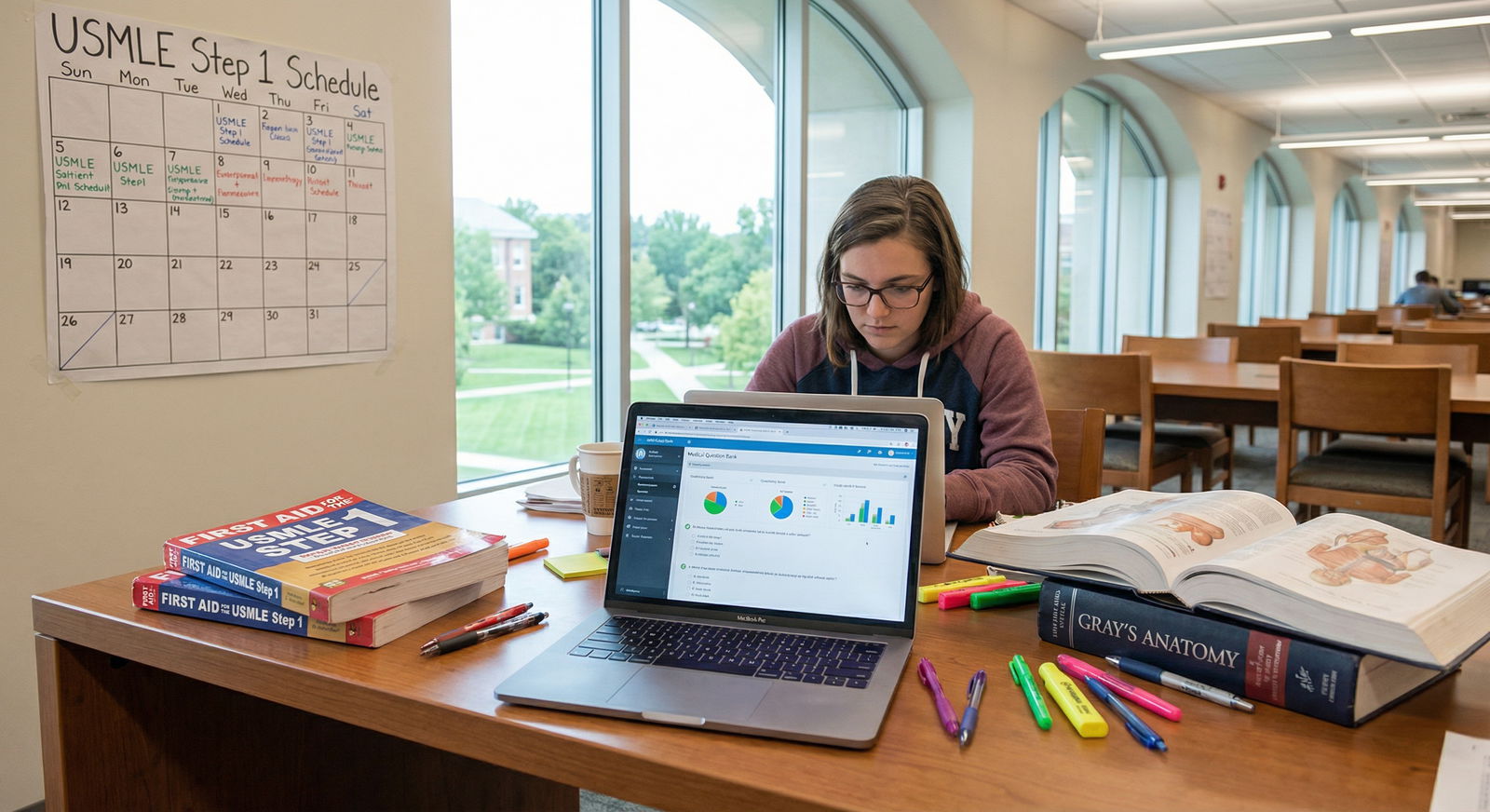
Why Practice Questions Are Essential for Acing USMLE Step 1
The USMLE Step 1 is one of the most defining assessments in medical school. Even as the exam has moved to pass/fail scoring, it still heavily influences your foundation of medical knowledge, eligibility to sit for Step 2, and your confidence entering clinical rotations. Strong Medical Exam Preparation for Step 1 builds the base you will rely on for the rest of your career.
Among the many Study Strategies available—lectures, textbooks, video series, flashcards—high‑quality practice questions remain the single most powerful tool to prepare efficiently and effectively. Used correctly, question banks do far more than just “test” you; they teach you how to think like the exam, how to apply concepts, and how to manage your time and stress on test day.
This guide explains why practice questions are central to USMLE Step 1 success, and how to integrate them strategically into your study plan to maximize learning, retention, and Test‑Taking Skills.
How Practice Questions Transform Your Step 1 Preparation
Active Learning: Turning Passive Review into Durable Knowledge
One of the biggest mistakes students make in USMLE Step 1 preparation is relying too heavily on passive learning—reading outlines, watching long video lectures, or endlessly highlighting First Aid. While these methods are useful for exposure, they are less effective for long‑term retention and real-world application.
Practice questions convert your studying into Active Learning, which is far more powerful for both Step 1 and clinical practice.
Why active retrieval beats passive review
When you answer a question—especially a difficult, vignette-style question—you force your brain to:
- Search for relevant concepts (e.g., “this sounds like a lysosomal storage disease, which one fits the clues?”)
- Select the key information from the stem
- Connect it with pathophysiology, pharmacology, or physiology
- Commit to an answer and then receive immediate feedback
This process is called active retrieval, and decades of educational research show it dramatically improves retention compared to rereading or rewatching material.
Example:
- Passive: Reading a page on nephrotic syndrome, you might think, “Yes, I’ve seen minimal change disease before.”
- Active: Facing a practice question about a child with periorbital edema, selective proteinuria, and recent URI, you must recall:
- The pathophysiology (podocyte effacement)
- Triggers (recent illness, immunologic factors)
- First-line treatment (steroids)
By working through that reasoning, you strengthen the memory trace much more than passive review could.
Applying knowledge—exactly what Step 1 tests
USMLE Step 1 is an application-heavy exam. It rarely asks for simple fact recall in isolation. Instead, it tests whether you can:
- Integrate basic sciences with clinical clues
- Move from signs and symptoms to mechanism and next step
- Recognize classic presentations—even when phrased in unfamiliar ways
Practice questions are essentially repeated, guided drills in this style of thinking. Over time, they train you to “read like the test” and recognize patterns quickly under time pressure.
Learning the USMLE Step 1 Question Style and Format
Understanding the content is only half the battle. The USMLE Step 1 is also a test of how well you can interpret dense clinical vignettes, sort through extraneous information, and avoid traps.
High‑quality practice questions simulate the exact environment you’ll face on exam day, building comfort and efficiency.
Getting comfortable with question structure
Step 1 questions typically include:
- A clinical vignette with age, sex, history, physical findings, labs, and imaging
- Often multiple distractor details you must ignore
- A task (e.g., “Most likely diagnosis?”, “Mechanism of action?”, “Next best step?”, “Underlying enzyme deficiency?”)
As you progress through thousands of questions, you become fluent in this style:
- You learn what details usually matter (onset, timeline, key lab abnormalities, specific phrases)
- You recognize “red flag” wording that points toward certain diagnoses or mechanisms
- You become faster at parsing complex stems without getting overwhelmed
Time management: building pacing instincts
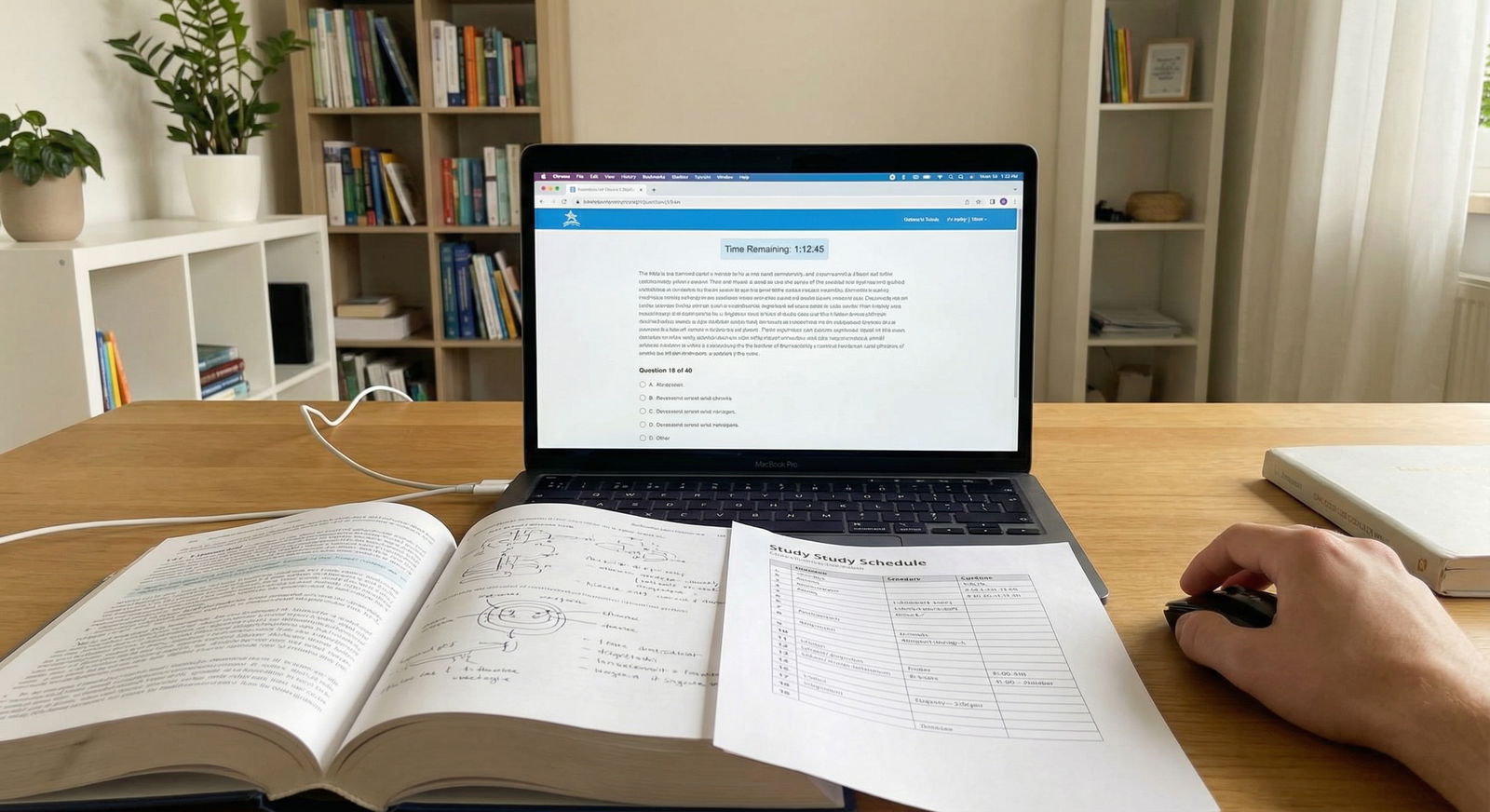
Time management is a core Test‑Taking Skill. Each USMLE Step 1 block is 60 minutes long with up to 40 questions. That’s about 90 seconds per question.
By consistently using practice questions under realistic timing, you learn to:
- Recognize when to move on from a stuck question
- Make educated guesses without overthinking
- Finish blocks with enough buffer to review marked items
Practical pacing tip:
- After ~45 seconds, if you’re still lost in the stem, quickly:
- Re-read the last line (the actual question)
- Eliminate obvious wrong options
- Choose the best remaining answer and mark the question for review
- Move on and protect your time for questions you can fully solve
Using Practice Questions to Diagnose and Fix Your Weaknesses
One of the hidden superpowers of question banks is their ability to act as a continuous diagnostic tool throughout your Medical Exam Preparation.
Identifying knowledge gaps and blind spots
Question performance gives you specific, data-driven feedback:
Weak subjects
If you consistently miss questions in genetics, immunology, or renal physiology, that signals a clear need for content review in those areas.Weak systems or disciplines
Many Qbanks break results down by system (e.g., CV, GI, neuro) and discipline (pharm, path, physio). Use this to see patterns:- Strong in pathology, weak in biochemistry?
- Great at cardiology, struggling with reproductive?
Conceptual vs. factual weaknesses
Are you missing questions because you:- Don’t know the fact (e.g., specific enzyme or drug side effect)?
- Misinterpret the question?
- Fail to connect mechanism to presentation?
Knowing why you’re missing questions is more important than just tracking your percentage.
Action step:
After each block, tag missed questions as:
- “Didn’t know content”
- “Misread question”
- “Overthought / changed from right to wrong”
- “Time pressure”
This helps you refine both your content review and Test‑Taking Skills.
Revealing integrated content and cross-links
USMLE Step 1 is highly integrated. A single question can test:
- Pharmacology (drug mechanism or side effect)
- Physiology (effect of that drug on hemodynamics)
- Pathology (the underlying disease process)
- Microbiology or Immunology (if infectious or immune‑mediated)
Working through practice questions reveals these cross-connections more naturally than reading separate sections of a book.
Example:
A one‑question vignette about a patient with peptic ulcer disease on chronic NSAIDs might test:
- Physiology of gastric acid and bicarbonate
- Pharmacology of prostaglandin analogs
- Pathology of mucosal injury and ulceration
- Adverse effects of specific GI medications
Seeing these integrated in a question helps your brain store them as a connected network—exactly how you’ll use them in clinical practice.
Feedback, Adaptation, and Building Superior Test‑Taking Skills
Leveraging explanations for deep learning, not just score chasing
The real value of Qbanks is not just answering questions—it’s the review afterwards. High‑quality resources (e.g., UWorld, AMBOSS, Kaplan) offer detailed explanations that can function as mini‑lectures.
To get the most out of them:
Review every question, not only the ones you got wrong.
- Ask: Why is the correct answer right?
- Why is each wrong option wrong?
Summarize key learning points
- Turn them into flashcards or concise notes
- Focus on mechanisms, not just memorizing final facts
Look for recurring patterns
- If a certain concept keeps popping up (e.g., G‑protein receptors, cytochrome P450 inducers/inhibitors), flag it as high-yield and master it.
This approach turns every missed question into a learning opportunity and every correct question into reinforcement.
Adapting your study methods based on question performance
Practice questions are essentially real‑time feedback on the effectiveness of your Study Strategies. Use them to adjust your approach:
- If you’re missing questions after long lecture sessions:
- You may need more active learning (flashcards, self‑testing) instead of just watching videos.
- If you can recall facts but still miss application questions:
- Shift towards more question-based learning and concept integration.
- If pharmacology is weak:
- Pair question review with drug charts, mechanisms, and comparison tables.
- If you’re making careless errors:
- Slow down slightly.
- Use a systematic approach to reading stems (e.g., first read last line, then the stem).
This is how you build a personalized, adaptive study plan instead of following a generic schedule that may not fit your needs.
Developing robust Test‑Taking Skills
Success on Step 1 requires more than knowing material. Strong Test‑Taking Skills can raise your performance significantly, especially on challenging or unfamiliar questions.
Key skills cultivated by consistent question practice include:
1. Strategic elimination
Most of the time, you don’t need to know everything; you just need to be better than the wrong options.
Eliminate answers that:
- Contradict the stem
- Don’t match the timeline (acute vs. chronic)
- Are pathophysiologically inconsistent
- Address a different disease entirely
Often, even if you’re unsure, you can narrow from 5 options to 2, raising your odds from 20% to 50%.
2. Recognizing distractors and common traps
With enough exposure to practice questions, you begin to identify:
- Classic distractors that are “almost right but not quite”
- Favorite wrong options for specific presentations
- Wording tricks that push you toward a premature diagnosis
This awareness helps you pause and re-check the key clue(s) before locking in your answer.
3. Managing test anxiety and cognitive fatigue
The more your brain experiences:
- 40-question timed blocks
- Long stems
- Multi-block days
…the less “threatening” the real exam will feel.
Simulating exam conditions:
- Reduces anxiety by replacing fear of the unknown with familiarity
- Helps you develop a sustainable pace for a full exam day
- Teaches you how to reset mentally between blocks
Best Practices for Integrating Practice Questions into Your Study Plan
Knowing that practice questions are powerful is one thing; using them well is another. Here’s how to structure your question‑based Medical Exam Preparation for USMLE Step 1.
Choose strong, exam‑relevant question resources
Not all question banks are equal. For Step 1, prioritize:
- UWorld – Considered the gold standard for USMLE-style questions and explanations.
- AMBOSS – Strong explanations, integrated library, adjustable difficulty.
- Kaplan – Good for early prep and building foundational understanding.
- NBME practice forms – Official practice exams that simulate the feel and scoring of the real test.
You don’t need every resource. It’s better to:
- Commit deeply to one primary Qbank
- Use additional resources selectively for targeted practice
Decide on timed vs. tutor mode—and random vs. subject blocks
Use different modes strategically at different phases of prep:
Early Phase (Building foundation)
- Mode: Tutor mode (untimed)
- Block style: Subject-specific (e.g., only cardiology, only biochemistry)
- Goal: Learn content, understand explanations thoroughly, build baseline familiarity
Mid Phase (Integration and pattern recognition)
- Mode: Mix of timed and tutor
- Block style: Begin incorporating mixed-system blocks
- Goal: Start simulating exam conditions while still emphasizing learning and review
Late Phase (Exam readiness)
- Mode: Timed mode, 40-question blocks
- Block style: Fully random, mixed-system questions
- Goal: Mimic real exam pacing, refine stamina, identify last-minute weak spots
How many practice questions should you do—and when?
There’s no universal number, but reasonable targets:
During dedicated study:
- 40–80 questions per day, depending on:
- Your schedule
- How thoroughly you review explanations
- Your baseline endurance
- 40–80 questions per day, depending on:
During pre-clinical years:
- 20–40 questions a few times per week, integrated with coursework
Quality matters more than raw quantity. Doing 40 questions with deep, reflective review is more valuable than rushing through 120 questions with superficial review.
Simulating full-length exams
Full-length simulated exams are critical for:
- Testing endurance
- Calibrating your pacing
- Estimating readiness
Options include:
- NBME practice exams – Official, closest in style and scoring to the real test
- UWorld self-assessments (UWSA) – Well-regarded predictor of performance
Suggested timing:
- First NBME: ~6–8 weeks before your test date
- Additional NBME or UWSA: Every 1–2 weeks as you approach the exam
- Avoid doing a full self-assessment the day before the real test; instead, lightly review and rest
Tracking your progress and using data effectively
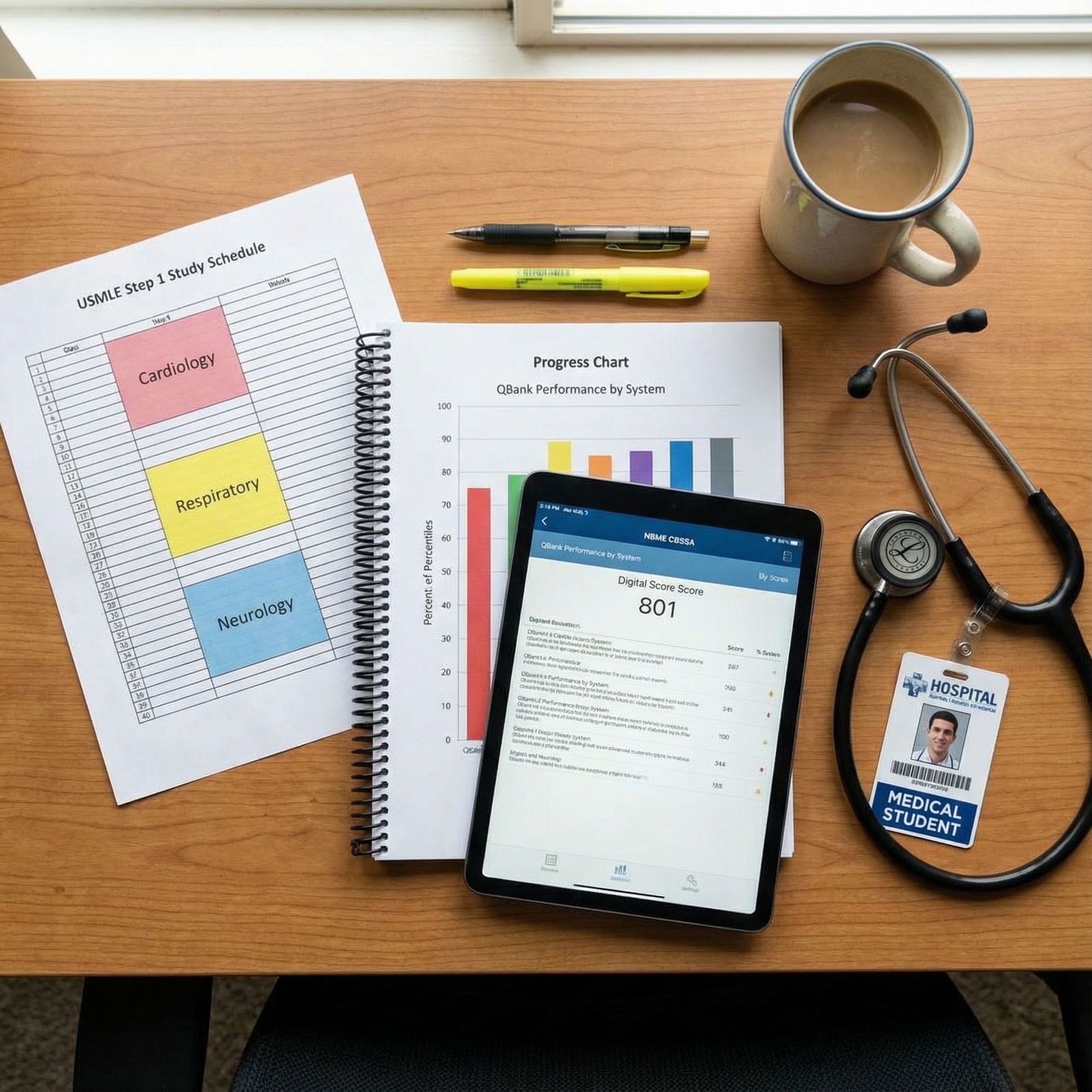
Track more than just your overall score. Look at:
- Performance by system (cardio, neuro, GI, etc.)
- Performance by discipline (path, pharm, physio, micro, biochem)
- Trend over time (are your percentages and NBME scores improving?)
Use this data to:
- Prioritize weak systems for targeted review
- Revisit high-yield but low-performing topics (e.g., biostatistics, genetics)
- Adjust your daily study emphasis
Simple tools—spreadsheets, apps, or Qbank dashboards—are enough to visualize progress and refine your strategy.
Frequently Asked Questions About Practice Questions and USMLE Step 1
1. When should I start using practice questions for Step 1?
You should begin integrating practice questions as early as possible, ideally during your pre-clinical years:
MS1–MS2 (pre-clinical):
- Use a smaller volume of questions related to your current courses.
- Focus on understanding explanations and building conceptual depth.
Dedicated Step 1 period:
- Shift to daily mixed blocks.
- Aim for 40–80 questions per day with thorough review.
Starting early converts questions from a last‑minute “test prep” tool into a continuous learning resource that reinforces your coursework.
2. How many practice questions should I complete before Step 1?
There is no exact “magic number,” but common benchmarks include:
- Most students complete at least one full UWorld Qbank (2,000+ questions).
- Many high-performing students also:
- Repeat UWorld (in reset or incorrects-only mode), or
- Supplement with another Qbank (e.g., AMBOSS) for additional practice.
More important than quantity is how you use them:
- Deep review of explanations
- Understanding why each option is right or wrong
- Turning high-yield concepts into flashcards or focused notes
3. Is it okay if my Qbank percentages are low?
Yes—especially early on. Qbank percentages are not the final word on your readiness.
Keep in mind:
- Qbanks like UWorld are intentionally challenging and often above the difficulty of the actual exam.
- Early in your study, it’s common to see percentages in the 40–60% range.
- What matters most:
- Your trajectory over time (upward trend)
- Your performance on NBME practice exams
- How effectively you learn from missed questions
Use low percentages as a guide for where to improve, not as a reflection of your worth or ultimate outcome.
4. Should I read textbooks or watch videos before doing questions?
You don’t need to fully “finish” content before starting questions. In fact, mixing content and questions leads to better Active Learning.
A balanced approach:
- Use videos or textbooks to build a basic framework.
- Quickly move to topic-based question blocks to:
- Apply what you just learned
- Reveal gaps or misconceptions
- Reinforce high-yield points through retrieval
As you progress, rely increasingly on questions and explanations as your primary learning source, using textbooks or videos only when you need deeper clarification.
5. Is it worth using more than one question bank for Step 1?
Using more than one Qbank can be helpful, but it’s not mandatory.
Consider:
- One primary Qbank (e.g., UWorld):
- Complete it thoroughly with detailed review.
- Optional secondary Qbank (e.g., AMBOSS, Kaplan):
- Useful if:
- You finish your primary bank with time to spare.
- You want additional question exposure or targeted system practice.
- Useful if:
Avoid spreading yourself too thin. Mastery of one strong Qbank plus NBME practice exams is usually more effective than shallow use of multiple banks.
Leveraging practice questions as the backbone of your USMLE Step 1 preparation will transform how you learn, recall, and apply medical knowledge. By emphasizing Active Learning, strategic review, responsive adaptation, and deliberate Test‑Taking Skills, you can walk into your exam with both the knowledge and the confidence you need to succeed—not just on Step 1, but throughout your medical training and beyond.