
It’s January of your second year. You just transferred schools after M1 or early M2—maybe because of family, visa issues, finances, or you realized your old school was a bad fit. Now you’re sitting at a new campus, different LMS, new classmates who already have their routines. Your old school’s “Step 1 game plan” is gone, and your new school’s calendar, exam style, and “we recommend Boards & Beyond / we don’t care about Anki / we push NBME X” is completely different.
You’re staring at an email that says: “USMLE Step 1 must be taken by [date] to proceed to clerkships.”
And your gut thought is: “I have no idea what I’m actually prepared for anymore.”
Here’s how to handle Step 1 prep in this situation—transferring mid-curriculum—without getting crushed by the mismatch between two schools’ systems.
Step 1 Reality Check: What Actually Changed When You Transferred
First you need clarity. Not vibes. Not anxiety. Facts.
There are really three overlapping but separate systems now in your life:
- What your old school taught you (and how).
- What your new school expects you to know (and when).
- What Step 1 actually tests.
They are not the same. They never were. Transferring just makes that brutally obvious.
You need to map these three quickly.
Step 1: Build Your “Curriculum Map” in One Afternoon
Sit down with:
- Old school syllabi / course titles / block sequence.
- New school syllabi / block sequence.
- A Step 1 content outline (NBME’s, or the one in the front of First Aid or from UWorld topics).
Now make a quick and dirty table for yourself. Something like this:
| System/Block | Old School Status | New School Status |
|---|---|---|
| Cardio | Completed (spring M1) | In progress |
| Renal | Not covered | Scheduled next block |
| Neuro | Completed, weak | Optional review only |
| Micro/Immuno | Completed, strong | Integrated throughout |
| Pharm | Fragmented | Dedicated pharm block |
This doesn’t need to be perfect. You just need to see:
- What you’ve fully done already.
- What you’ve sort-of done but feel shaky on.
- What you haven’t touched in any structured way.
Now you’re not “behind on everything”. You’re “missing renal and weak on neuro”. Way easier to fix.
Get Your Non-Negotiables Clear: Deadlines, Policies, and Gatekeepers
Before you start some beautiful, color-coded study plan, you need constraints. Hard ones.
There are three big constraints after you transfer:
- When you’re allowed to take Step 1.
- When you must pass Step 1 by.
- What your new school requires before you’re allowed to sit for it.
This is where people screw up: they build a dreamy 5‑month plan and then discover their new school expects them to take Step 1 in 10 weeks.
Conversations You Need to Have This Week
You do not figure this out from gossip in the GroupMe. You talk to actual decision-makers.
You need 3 short meetings or emails:
Academic Dean / Student Affairs (or equivalent).
Ask directly:- “What is the latest date I can take Step 1 and still start clerkships on time?”
- “Do you require completion of certain blocks or school exams before I’m eligible?”
- “Do you have an internal NBME or CBSE score requirement before you allow a Step 1 attempt?”
Course Director / Block Lead for your current term.
Ask:- “How do you recommend transfer students integrate board prep with this block?”
- “Are there any content areas you know our curriculum is lighter on that I should supplement for Step 1?”
Students 1–2 years ahead who also transferred or were non-traditional.
One or two people is enough. Ask:- “When did you start dedicated?”
- “What would you do differently if you had transferred here mid-curriculum?”
- “Did the school’s ‘recommended resources’ actually matter for Step 1, or just for internal exams?”
You’re trying to triangulate: school policy + real lived experience.
Only then do you build your plan.
Designing a Hybrid Study Plan: Two Curriculums + Step 1
You’re not a clean M2 following one school’s perfect “systems then dedicated” timeline. You’re patching holes while keeping up with your new institution.
So you need a hybrid plan:
- Stay afloat (and ideally solid) in your new school’s blocks.
- Backfill gaps from your old school.
- Start slow, early Step 1 exposure so “dedicated” isn’t your first encounter with real questions.
Step 1: Decide Your Core Resources (And Ignore the Rest)
You don’t get to play “resource collector” here. Transferring already injects chaos; your job is to simplify.
Pick:
- One primary Qbank: UWorld for Step 1 (non‑negotiable in my book).
- One main video/text foundation: Boards & Beyond or Pathoma + something like Sketchy for micro/pharm, or school’s provided resources if they’re actually good.
- One central reference: First Aid or similar Step 1 review book, mostly as a map, not your bedtime reading.
Then be ruthless. If someone says “Amboss is life” or “OMG this Anki deck changed me”—fine, maybe as a secondary tool, but do not overload. Your enemy is diffusion, not lack of content.
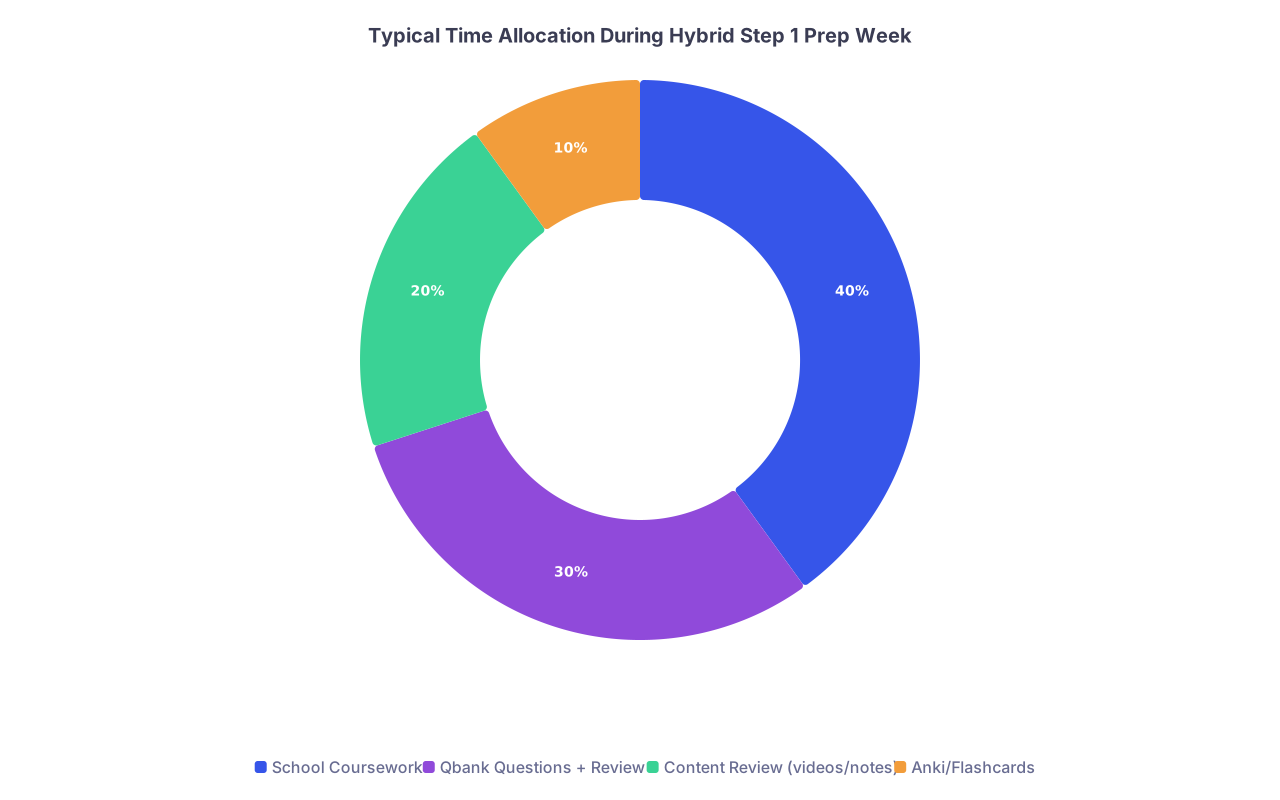
| Category | Value |
|---|---|
| School Coursework | 40 |
| Qbank Questions + Review | 30 |
| Content Review (videos/notes) | 20 |
| Anki/Flashcards | 10 |
Step 2: Weekly Structure During Non-Dedicated Time
Let’s say you’re in the middle of a cardio block at the new school, but you did cardio last year at the old one, sort of remember it.
A realistic weekly target during non‑dedicated, with coursework ongoing:
- 80–120 UWorld questions / week (not per day).
- 1–2 board-style blocks on the current system you’re studying in class.
- 1–2 “catch-up” blocks on your weak/missing system (e.g., neuro, renal).
- Daily light flashcards (20–80 cards; don’t be heroic).
Concrete example of a weekday:
- 8:00–12:00: Classes / labs / small groups.
- 1:00–3:00: School-specific studying (lectures, notes, whatever they test you on).
- 3:30–5:00: 20 UWorld questions (tutor or timed) focused on that week’s system.
- 7:00–8:00: Review UWorld explanations, tag weak topics, update flashcards.
- 8:00–8:30: Light Anki / flashcards, only if your brain isn’t fried.
On weekends:
- One longer UWorld block (40–60 questions) on your “hole” system (say, renal that you haven’t formally done yet).
- 2–3 hours of video/content review filling that gap.
Notice that I’m not telling you to do “300 questions/week and 5 hours of Anki a day.” You’re not a full-time Step 1 prep robot. You’re integrating.
Dealing with Content Gaps from the Transfer
There are three types of gaps after a mid-curriculum transfer:
- Stuff you literally never learned (e.g., renal block hasn’t happened yet).
- Stuff you learned once but in a different structure, now misaligned with your new school’s approach.
- Stuff you know in a “lecture note” way, but not in the “board question” way.
You fix each one differently.
1. Never-Learned Content: Build a Mini-Block
Say you never had a formal renal block. Your new school does renal in three months, but your Step 1 deadline is right after that. You cannot wait to understand any kidney until April.
Here’s how to run a personal “mini-block” at lower intensity:
Over 3–4 weeks, aim to:
- Watch 2–3 short focused videos per week on renal (Boards & Beyond, etc.).
- Do 1 UWorld block/week limited to renal.
- Take sketch notes or 1–page summaries after each video (“renal failure types”, “tubular transport”, whatever).
You’re not going for mastery yet. Initial exposure and a mental scaffold. So when your new school does renal, everything feels like a review instead of first pass.
2. Misaligned Structure: Translate, Don’t Restart
For example: you did “microbiology by organism” at old school, and new school does “micro integrated in organ systems.” That’s annoying but fixable.
What you don’t do: “I guess I should relearn all of micro their way from scratch.”
Instead:
- Use Step 1 frameworks as your “neutral language” (e.g., First Aid’s micro section).
- When your new school hits, say, pneumonia, you:
- Review your old notes for Strep pneumo, H flu, atypicals.
- Do UWorld questions filtered to “respiratory infections.”
- Tie them to whatever slides they give you now.
You’re not loyal to either school’s structure. You’re loyal to the Step 1 exam blueprint.
3. Lecture Knowledge vs Question Knowledge
Transferring makes this worse because you’ve adapted to one school’s exam style and now get whiplash from another’s. One might love recall; the other loves long-vignette integrative questions.
You fix this only by:
- Consistent Qbank exposure.
- Ruthless post-question review.
When you miss a question, have your own internal script:
- “Did I miss this because I didn’t know the fact at all?” → Flashcard or margin note.
- “I knew the fact but misread the stem or got tricked?” → Process error. Practice reading stems more slowly, focus on last 2 lines first, etc.
- “I got it right but I was guessing.” → Still treat it as a weakness. You do not pat yourself on the back for lucky guesses.

Managing Different Assessment Styles Between Schools
Your old school might’ve done block exams every 6–8 weeks, heavy on minutiae. Your new school might be more NBME-style but heavily weighted toward passing internal exams to progress. Or vice versa.
You do not get to blow off your new school’s tests “because Step 1 is pass/fail now.” Fail an internal exam, get remediation, lose 4–8 weeks of time. That will destroy your Step 1 plan faster than a low UWorld percentage.
So you need to deliberately split your studying:
- “School mode” (short-term, must-pass, annoying details).
- “Step 1 mode” (concepts, integration, durability).
How to Blend Them Intelligently
When new school gives you topic lists or learning objectives for an exam:
- Use that list as a filter for your Qbank that week.
- If they emphasize, say, “congenital heart defects,” don’t just memorize their tables. Do congenital cardiac UWorld questions and see how the exam expects you to use that info clinically.
Where they diverge:
- If the school is pushing some detail that you know is not high-yield for Step 1 (e.g., “name every single complement pathway protein by number and interaction”)—fine. Memorize just enough to pass their exam. Don’t burn hours turning it into 50 Anki cards unless you’ve already covered your true Step 1 core.
You’re allowed to study in two “tiers”:
- Tier 1: Concepts and patterns you invest in fully (strong flashcards, Qbank review).
- Tier 2: Local trivia you learn just enough to pass an internal exam, then let fade.
Planning Dedicated After a Transfer: Shorter, Smarter, More Targeted
Dedicated is not a magical, blank-slate period where you do nothing but watch videos and “cram First Aid.” That fantasy dies quickly when you’ve switched schools and your foundation is patchy.
You want dedicated to do three things:
- Tie together the systems you’ve seen in two schools into one coherent map.
- Patch the remaining holes aggressively.
- Build exam endurance and accurate self-assessment.
Length? I’m blunt about this:
- 4–6 weeks of true dedicated is enough for most transfer students who have done consistent UWorld + light prep during the year.
- 8+ weeks is usually overkill and leads to burnout, unless your foundation is genuinely weak or very interrupted.
A Simple Dedicated Structure
Assume 5 weeks of dedicated. You already did UWorld lightly during the year. Your plan might look like:
Week 1–3:
- Systems-based: 1 system every 2–3 days (cardio, pulm, renal, GI, etc.).
- Each “system block”:
- 1–2 UWorld blocks/day focused on that system.
- Rapid review of key videos/notes.
- Rewrite or refine 5–10 of your most important flashcards/summary sheets for that system.
Week 4:
- Mixed Qbank blocks only, no filters. Simulate the real exam.
- First NBME/CBSE early in week, second one at end of week, if your school permits multiple.
Week 5:
- Light review, focusing only on:
- Topics you consistently missed across Qbanks and NBMEs.
- Must-know but memorizable lists: vasculitides, storage diseases, immunodeficiencies, autonomics, etc.
- Full NBME if you and your dean agree it’s needed.
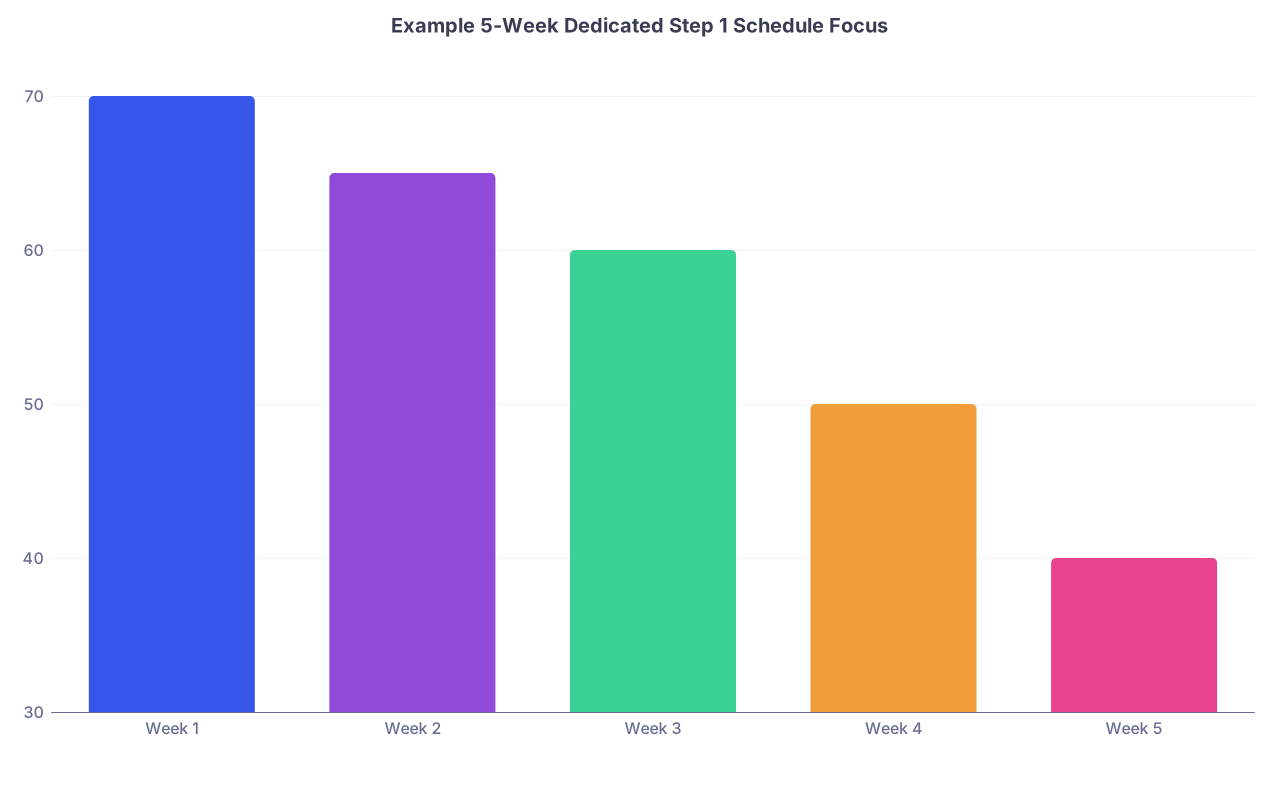
| Category | Value |
|---|---|
| Week 1 | 70 |
| Week 2 | 65 |
| Week 3 | 60 |
| Week 4 | 50 |
| Week 5 | 40 |
(Values represent approximate % of time on system-based content vs mixed review; time on systems tapers as mixed question practice and targeted review increase.)
Mental Game: Identity Shock, Imposter Syndrome, and Expectations
Transferring mid-curriculum messes with your head as much as your schedule.
You’ve probably had at least one of these thoughts:
- “Everyone here already has their friend group and study group; I’m the random transfer.”
- “I learned all of this differently; maybe I learned it wrong.”
- “If I mess this up, it proves I shouldn’t have transferred.”
Let me be blunt: that mental noise is way more dangerous to your Step 1 outcome than whether you watched all of Pathoma twice.
A few hard truths that help:
- You’re not behind. You’re out of sync. Different problem. Fixable.
- No residency PD is going to care which school taught you cardio. They care if you can function on the wards and if you passed Step 1 without drama.
- It’s okay if your dedicated looks different from your classmates’. You are literally running a different race.
Build one small, repeatable mental habit: a weekly review meeting with yourself.
Every Sunday, 20–30 minutes:
- What did I complete this week? (Questions, systems, videos.)
- What felt consistently weak? (Topics, not feelings.)
- What is the one thing I will do differently this week to improve that?
Not five changes. One.

| Step | Description |
|---|---|
| Step 1 | Transfer Mid-Curriculum |
| Step 2 | Clarify School Policies |
| Step 3 | Map Old vs New Curriculum |
| Step 4 | Select Core Resources |
| Step 5 | Build Hybrid Weekly Plan |
| Step 6 | Identify and Patch Gaps |
| Step 7 | Consistent Qbank + Review |
| Step 8 | Plan Short, Targeted Dedicated |
| Step 9 | NBME Self-Assessment |
| Step 10 | Schedule Step 1 within School Rules |
Quick Case Example: What This Looks Like in Real Life
You transferred after M1 from a Caribbean school to a U.S. MD program.
- Old school: Heavy lecture, minimal clinical integration, you did micro and immuno well, but neuro and renal were a disaster.
- New school: Organ-systems approach, strong emphasis on small groups and NBME-style exams.
You meet with the dean. They tell you:
- You must take Step 1 by August 15 to start M3 on time.
- They recommend 5 weeks of dedicated after your final M2 block in early July.
- They require a passing CBSE before they’ll authorize your test date.
Your move:
January–May:
- Do 80–100 UWorld questions/week, mostly on the system you’re in + constant low-dose neuro and renal.
- Watch neuro and renal videos independently on weekends for exposure.
- Follow new school’s exam objectives but always attach 1–2 Qbank sessions per topic cluster.
June:
- Finish remaining Qbank questions.
- Take a baseline CBSE/ NBME with your school.
- Spend last 2 weeks of June heavily on your lowest systems from that exam.
July–mid August (Dedicated 5 weeks):
- Run the 5-week plan above.
- Take a mid-dedicated CBSE; if above the school’s threshold and your predicted pass probability is high, lock your Step 1 date.
- Final NBME ~7–10 days before the real exam to confirm stability, not to decide whether you’re a “genius.”
This is how you turn chaos into a schedule instead of just repeating “I lost a year because I transferred.”