
Your school is not “letting you take Step 1 when you’re ready.”
They’re letting you take Step 1 when they think you’re safe.
You hear the sanitized version: “We want to ensure your success.”
Behind closed doors, the conversation sounds very different. I’ve sat in those meetings. I’ve watched program directors and academic deans argue over a single marginal student for 40 minutes because a failed Step 1 hurts more than anyone will admit publicly.
Let me walk you through how the decision actually gets made.
The Real Risk Calculation: You vs. The School
Here’s the blunt truth: once Step 1 went pass/fail, schools did not relax. They just changed what they fear.
Before:
Fail = obvious disaster, residency red flag, massive remediation.
Now:
Fail = still a disaster, plus a big question: “How did your school let this student sit?”
Deans track institutional failure rates obsessively. Every extra fail looks bad in LCME reports, internal reviews, applicant brochures, and residency director conversations. When they say “we’re committed to student success,” what they really mean is “we are not about to let our Step 1 stats slip.”
So the decision of whether you’re “ready” is really a simple internal equation:
Predicted probability you pass vs. The school’s acceptable risk tolerance.
That’s it. Everything else is window dressing.
The Hidden Algorithm: What They Actually Look At
No one will hand you the rubric. That would create arguments. Appeals. Lawsuits.
But almost every school is doing a version of the same thing: building a quiet, unofficial algorithm from a bunch of data points.
The Common Inputs (Whether They Admit It or Not)
- Pre-clinical grades
- NBME or school-written “comprehensive” exams
- Question bank performance
- Practice NBME scores (this one is huge)
- Attendance / professionalism issues
- Prior failures or repeats
- USMLE practice test history
Let me be specific.
I’ve watched an assistant dean flip to a spreadsheet that had each student’s:
- Average NBME subject exam percentile
- Score on one or two “internal” comprehensive exams
- Latest NBME self-assessment score
- Whether they’d ever failed a course or remediation exam
They didn’t care what resource you used. Boards and Beyond, Sketchy, Anki, UWorld. None of that shows up in the meeting. Only numbers and patterns do.
| Factor | How It’s Really Used |
|---|---|
| Pre-clinical GPA | Risk flag for weak foundation |
| NBME subject percentiles | Trend over time more than single score |
| Comprehensive basic science | Hard cutoff or gate exam |
| NBME self-assessment score | Main decision driver |
| Prior course failures | Lowers tolerance for borderline scores |
No dean will stand up at orientation and say, “Hit X score or we block you.” But among themselves? They absolutely talk in those terms.
The Gatekeeper: “Comprehensive” Exams vs. Real Step 1 Predictors
Almost every school has some version of a “comprehensive” or “CBSE” exam before they let you register. Here’s the unspoken breakdown.
1. The True Gate Exam
Some schools use the NBME CBSE as the filter.
Behind the scenes, you’ll hear:
“If they’re not at [insert number], they’re too risky.”
Pre-pass/fail era, that cut was often 200+. Now, some schools quietly dropped it to the 190s, others kept it around 200, but they pretend they’re “holistic.” They’re not. If your CBSE is way under, you’re not testing any time soon unless someone goes to bat for you.
2. The “Holistic” but Actually Numeric Approach
Other schools tell students:
“We look at trends rather than single scores.”
What they mean is: they’ll accept a slightly lower CBSE if:
- Your trajectory is rising
- Your class performance is average or better
- You have no professionalism problems
- You’re not already repeating anything
If your CBSE is flat or dropping, I’ve watched committees say, “They are not ready. Extend them.” That’s the entire discussion.
3. Fake Flexibility
I once saw a policy drafted that said: “There is no fixed minimum NBME score required to sit for Step 1.” Then immediately afterward:
“Scores below [redacted] will trigger individualized review by the academic progress committee.”
Translation: there is a threshold. Hit above it and no one talks about you. Fall below it and now your name is on a slideshow in a Wednesday afternoon meeting with six faculty members scoring your risk.
The Quiet Power of NBME Practice Exams
You want the real tell? Look at how your school reacts to NBME self-assessment scores.
Here’s what committees actually say:
- “Their last NBME was 192 three weeks ago. They’re scheduled in ten days. That’s not enough margin.”
- “They went 188 → 198 → 205 over 8 weeks. I’m okay letting them go ahead if they push their date by two weeks.”
- “Their school comprehensive was 195-equivalent but all their self-assessments are low 180s. Something’s off.”
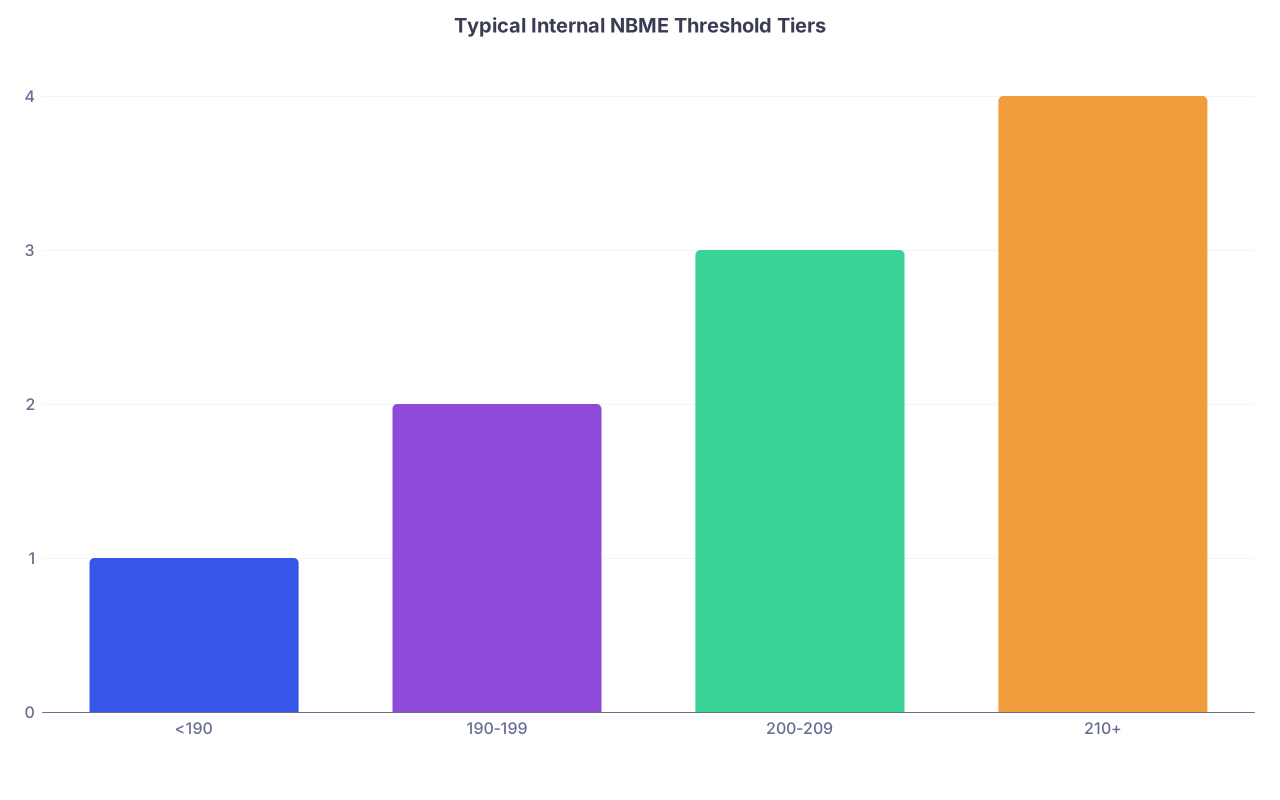
| Category | Value |
|---|---|
| <190 | 1 |
| 190-199 | 2 |
| 200-209 | 3 |
| 210+ | 4 |
No one in that room is talking about your “dedication” or “work ethic.” They are asking one question: What is the probability this person fails? And NBME practice tests are the closest thing to a crystal ball they have.
From what I’ve seen:
- Consistent scores under ~190 → nearly automatic delay.
- Mid 190s with upward trend → heavy debate, sometimes conditional approval with pushback on date.
- 200+ and stable → you’re considered “safe enough” in most places, as long as the rest of your profile isn’t a mess.
Are there exceptions? Rarely. And when there are, it’s usually because someone on that committee knows you personally and is willing to stick their neck out.
The Meeting You Never See: How Your Case Gets Discussed
Let me paint the room for you.
Mid-afternoon. Obnoxious fluorescent lighting. Half the faculty want to be somewhere else. There’s a shared spreadsheet up on the projector with color-coded cells: green, yellow, red. Your name is a row.
The assistant dean starts:
“We have 12 students flagged for Step 1 readiness review.”
Each case gets 3–6 minutes, tops, unless it’s really complicated.
Here’s the structure of the discussion I’ve watched play out dozens of times:
Your summary pops up:
- Pre-clinical GPA quartile
- Any course failures
- Comprehensive exam score
- NBME self-assessment trend
Someone reads the notes:
- “Remediated cardio block MS2.”
- “On academic probation year 1, now removed.”
- “Advised to push exam by advisor, declined.”
Then one of three things happens:
You’re an easy green:
“Scores are fine. No issues. Move on.” 10 seconds.You’re borderline but clean:
“Scores borderline but trending up, no professionalism or failures, recommend allowing with strong advisement.”You’re a problem:
“Multiple concerns – I recommend required delay and formal remediation plan.”
I’ve heard phrases like:
- “We can’t afford another fail this year.”
- “If they crash, it will not be a surprise based on this profile.”
- “We already bent for them once.”
- “They’re not engaging with the learning specialist; that’s a red flag.”
That’s what’s really being said while you’re in the library convinced it’s about “how hard you’re working.”
Why Some Students Get Blocked and Others Slipped Through
Here’s the part that feels unfair to students but is absolutely real: politics, relationships, and timing matter.
The Student With an Advocate
Some faculty actually know you. Maybe you worked in their lab, or you were great on their small group team, or you’re the one M1 who consistently showed up to their optional review sessions.
In that meeting, it sounds like this:
“I’ve worked with them all year. They’re much stronger than their numbers. I’d support letting them sit with a 2–3 week extension.”
That voice can swing the whole room. I’ve seen students with borderline numbers get the green light because one person is willing to personally vouch for them.
The Student Who Burned Bridges
On the flip side, the chronic no-show, late-assignment, always-an-excuse student? When they come up:
“We’ve given them multiple warnings about engagement and professionalism. I’m not comfortable letting them move forward on a low NBME.”
Nobody is going to say this to your face. They’ll say, “We want to give you more time to succeed.” In the room, it’s closer to, “They’ve ignored every prior recommendation.”
The Timing Game
There’s also timing fatigue. Early in the meeting, faculty are more meticulous. They look at trends, talk nuance. By student nine or ten, the room is tired.
Borderline #1 at 2:10 PM might get 15 minutes of debate and a creative compromise. Borderline #11 at 3:25 PM? Someone will say, “The scores are below threshold, just follow policy.” And that’s the end of it.
Unfair? Yes. Human? Also yes.
How Schools Quietly Tier Students Before Step 1
Another thing you won’t hear publicly: many schools essentially stratify the class into risk tiers before anyone starts “dedicated.”
They don’t publish the tiers, but they behave like they exist.
| Tier | Internal Label (Unofficial) | Typical Treatment |
|---|---|---|
| Low Risk | “Green” | Minimal oversight, standard timeline |
| Moderate | “Yellow” | Extra advising, watch NBME closely |
| High Risk | “Orange/Red” | Mandatory plans, strong delay bias |
Here’s how these tiers show up in your life:
- You’re “randomly” invited to meet with the learning specialist.
- You’re “highly encouraged” to share your NBME scores with an advisor.
- You’re given a specific list of “recommended” dates for Step 1 that are later than your classmates’.
None of this is random. It’s targeted.
They’ve already decided you’re a watch-list student. And now, every small misstep reinforces their bias: “See? That’s why we flagged them.”
Pass/Fail Didn’t Save You: How Standards Shifted, Not Softened
Post-pass/fail, a lot of students thought schools would relax. That’s not how institutions behave.
Instead, the internal messaging changed from:
“We want high averages.”
to
“We want near-zero failures.”
So actual behavior shifted like this:
- Cutoffs nudged slightly lower, but not by as much as you think.
- Oversight of marginal students tightened.
- Remediation structures became more formal.
- “Strong recommendations” to delay became “required” delays more often.
Behind closed doors, the question changed from “Could they get a 230?” to “Are we confident they will not fail?” Totally different game.
Faculty know a pass on Step 1 isn’t differentiating you for residency anymore. But a fail? That can still hurt you badly. And it sure hurts them.
How to Read the Signals Your School Is Sending You
You’re not in that committee room. But you can usually infer how you’re being seen.
Watch for this pattern:
- Your advisor insists on frequent check-ins.
- They’re very interested in your NBME scores, not just your “study plan.”
- They gently suggest pushing your date – more than once.
- They want you to meet with an academic support person “just to optimize things.”
That’s code. You are in their moderate or high-risk bucket.
The worst thing you can do if you’re in that group: get defensive, vague, or evasive. If they sense you’re not transparent, they will push for more control over your timeline.
On the other hand, students who come in with:
- A specific, realistic timeline
- All their NBME results printed or pulled up
- A clear understanding of their weak areas and how they’re addressing them
tend to be trusted more. I’ve seen advisors back off and let a borderline student test “on time” because the student came in frighteningly prepared and self-aware.
What You Can Actually Control in This Process
You cannot control that arbitrary meeting at 3:15 PM where they talk about you. But you can control the data and the narrative they see attached to your name.
Here’s what quietly moves the needle in your favor:
Clean, consistent NBME data.
Scattered scores, random practice exams, long gaps without objective data – those make committees nervous. A clear pattern (even if modest) is much easier to defend.Visible trajectory.
They love an upward-sloping line. 182 → 192 → 201 across 6–8 weeks looks much better than 194 → 190 → 191.Professionalism and follow-through.
When they say, “Meet with [learning specialist] and send us your plan,” actually doing it and doing it well puts people at ease. Blow that off and I can almost guarantee someone will say, “They’re not engaging with support.”Owning your weaknesses before they do.
In meetings, the students who say, “Renal and neuro are killing me; here’s what I’m doing about it” are taken more seriously than the ones who insist “I’m just a bad test-taker.”Not hiding scores.
This one hurts. Students think, “If I don’t share, they can’t stop me.” In reality, some schools already require it, and when they sense you’re holding back, they assume the worst.
If They Delay You: What’s Really Going On
When a school forces a delay, it’s almost never about “just a little extra prep.” It’s a legal and reputational decision.
Behind the scenes, people are thinking:
- “If this ever gets appealed or reviewed, can we show we took reasonable steps?”
- “Can we look a residency director in the eye and say: we didn’t ignore glaring risk?”
- “Are we protecting the student from an almost certain disaster, or just adding bureaucratic torture?”
You’ll hear soothing language: “We believe this will set you up for long-term success.” The real line in the minutes says something like:
“Committee unanimously agreed that allowing student to sit on current trajectory would present an unacceptably high risk of Step 1 failure.”
That’s the actual sentence.
If you get delayed, you have two urgent jobs:
- Stop treating it as a moral judgment. It’s a risk label, not a soul verdict.
- Make sure the next time your name shows up in that meeting, the story has changed.
That means structured, documented progress: higher NBME scores, more consistent question bank performance, signed notes from support staff that you actually did the work.
Because yes – those notes get read aloud in that room.
A Simple Mental Model: How They See You
You may find this annoying, but it’s how they think. Picture yourself as one of three profiles in their heads:
Safe:
Strong or solid data, few red flags, normal oversight. They’d be more surprised if you failed than if you passed.Uncertain:
Mixed data, borderline scores, uneven performance. Their dominant emotion is anxiety. They want more proof before they put you in front of the USMLE gods.Predictable Trouble:
Chronic issues, low scores, poor follow-through. They expect trouble and are now trying to prevent a failure they’ll later have to justify to the Dean.
Ask yourself, honestly: which profile would you assign to you, if you were sitting in that room with nothing but your transcript and NBME scores?
Because that, not your potential or how hard you’re “trying,” is what drives the decision of when you’re “ready.”

| Step | Description |
|---|---|
| Step 1 | Student Approaches Step 1 |
| Step 2 | Collect Data: Grades, NBME, History |
| Step 3 | Standard Timeline Approved |
| Step 4 | Advising & Extra Monitoring |
| Step 5 | Committee Review |
| Step 6 | Conditional Approval |
| Step 7 | Delay & Remediation Plan |
| Step 8 | Risk Category |
| Step 9 | NBME Trend Adequate? |
| Step 10 | Meets Internal Thresholds? |