
It’s late. You’re in the library, half-reading a path chapter, half-staring at Reddit threads about “Step 1 is pass/fail now, does it even matter?”
Your classmates are split into two camps.
One group is relaxed, telling anyone who’ll listen, “Dude, Step 1 is pass/fail, nobody cares anymore.”
The other group is quietly panicking, obsessing over UWorld percentages and saying, “If Step 1 doesn’t show I’m strong, I’m dead for ortho/derm/ENT.”
You’re stuck in the middle.
You passed Step 1. Maybe you did fine, maybe you barely scraped by, maybe you crushed it but no one can see the number. And the real question in your head is this:
What are program directors actually doing with Step 1 now that it’s pass/fail?
Not the PR answer. The closed-door, selection-meeting answer.
Let me walk you into that room.
The Harsh Truth: Pass/Fail Did Not “Free” You
Let me be blunt. Step 1 going pass/fail didn’t solve your problems. It just moved them.
Before:
Program directors had a number they could sort by. 260, 240, 220. Brutal but simple.
After:
They lost their favorite blunt weapon. They did not suddenly become holistic Zen monks. They just swapped tools.
Here’s how the logic actually shifted behind the scenes:
- They no longer have a precise score cutoff, but they still want to guess your test-taking strength.
- They still believe Step 1 content predicts performance on in-training exams and boards.
- They now lean harder on Step 2 CK, school reputation, clinical grades, and narrative clues to make up for the missing number.
You did not get out of being evaluated. You just got moved from a clean numeric column into a more subjective pile.
And yes, your Step 1 performance still bleeds through. Even without a numeric score.
What PDs Actually Look At Instead Of Your Step 1 Number
Here’s the ugly substitution game most programs play now. I’ve seen this literally on the projector screen in ranking meetings.
| Old Use (Step 1 Score) | New Stand-Ins After Pass/Fail |
|---|---|
| Basic filter for interview | Step 2 CK score + school reputation |
| Proxy for knowledge base | Clerkship grades + narrative comments |
| Proxy for test-taking skill | Step 2 CK + COMLEX, if applicable |
| Tie-breaker between applicants | Research + letters + school rigor |
| “Risk of failing boards” red flag | Failed Step 1 or late Step 2 CK |
Let’s break down where your Step 1 performance still echoes, even without a visible number.
Scenario 1: You Passed Cleanly, On Time, No Drama
You passed Step 1 on the first attempt, took it roughly on schedule, no remediation, no leaves of absence, no extended delay. That’s what programs want to see as the default.
Here’s how PDs treat that:
- They assume you’re at least baseline competent in foundational sciences.
- They don’t give you bonus points. Passing is just table stakes.
- They look immediately to Step 2 CK and clerkship performance for differentiation.
Inside the committee room, your Step 1 line just reads like:
“Step 1: Pass.”
No one lingers on it. They move on.
Where your “real” Step 1 performance matters is indirect:
If your Step 2 CK is strong (say 245+ equivalent for competitive fields) and your clerkship narrative comments talk about “excellent fund of knowledge,” PDs backfill the story:
“They probably would’ve scored well on Step 1 if it were numeric.”
They’ll never say that to you, but they say it to each other.
On the flip side, if your Step 2 CK is mediocre and your clerkships say “hard worker, reliable,” but nothing about knowledge or reasoning? The unspoken assumption becomes:
“They passed Step 1, but probably barely. Not a strong test-taker.”
That’s your reality now.
Scenario 2: You Barely Passed (And It Shows Indirectly)
You and I both know there’s a world of difference between a 220-equivalent and a 195-equivalent. PDs know that too. The exam being pass/fail doesn’t erase that gap.
How do they pick up that scent?
A few big ways:
Step 2 CK timing
If you took Step 2 CK late, close to ERAS, or after MS4 started, PDs start asking,
“Why so late? Struggling with content? Needed remediation?”
They’re not dumb. They correlate slow progression with borderline performance unless your dean’s letter explicitly explains otherwise.Step 2 CK score
If Step 2 CK is low for the specialty you’re applying into, they assume your Step 1 wasn’t strong either. They use CK as a backwards proxy.MS3 feedback language
Faculty love code words. “Hard-working, very pleasant” with no comment about knowledge or reasoning is a quiet red flag in many programs.Remediation or extra time
If your MSPE or transcript hints at “additional support needed” around the Step 1 timeframe, PDs know exactly what that phrase usually means.
No, they don’t have the actual number. But many of them don’t care. They’re pattern-matching.
Scenario 3: You Failed Step 1 Once (Or More)
This is where pass/fail stops being gentle.
A failed Step 1 attempt is still absolutely visible to programs. They see “Fail / Pass” on your USMLE transcript. And in most committees, that becomes a conversation.
Let me translate what’s actually said:
For competitive fields (ortho, derm, ENT, plastics, neurosurg, rad onc):
“A Step 1 fail is essentially disqualifying unless there’s a huge redemption story and the rest of the application is unbelievably strong.”
People won’t say it publicly, but I’ve heard “We have too many clean candidates to take this risk” more times than I can count.For moderately competitive fields (EM, anesthesia, OB, gas, radiology):
It’s a ding, not a death sentence. The key becomes:
“Did they absolutely crush Step 2 CK?”
If you failed Step 1, then score something like 245–255+ on Step 2 CK, the narrative turns into:“They had a bad exam, regrouped, and proved they can perform.”
Without that, it’s rough.For less competitive fields (IM, peds, FM, psych at many places):
It’s a concern, but not an automatic no. PDs will ask:
“Is this a pattern, or a one-time stumble?”
Then they look at:- Step 2 CK score
- In-service and board pass rates at your school
- Any story in your MSPE explaining the failure
Here’s the key insider truth:
A Step 1 failure changes how they read every other part of your file.
Your future performance has to rebut that first impression. Loudly.
How Different Specialties Are Actually Reacting
Some specialties shrugged and adapted. Others are still salty Step 1 worshippers in denial.
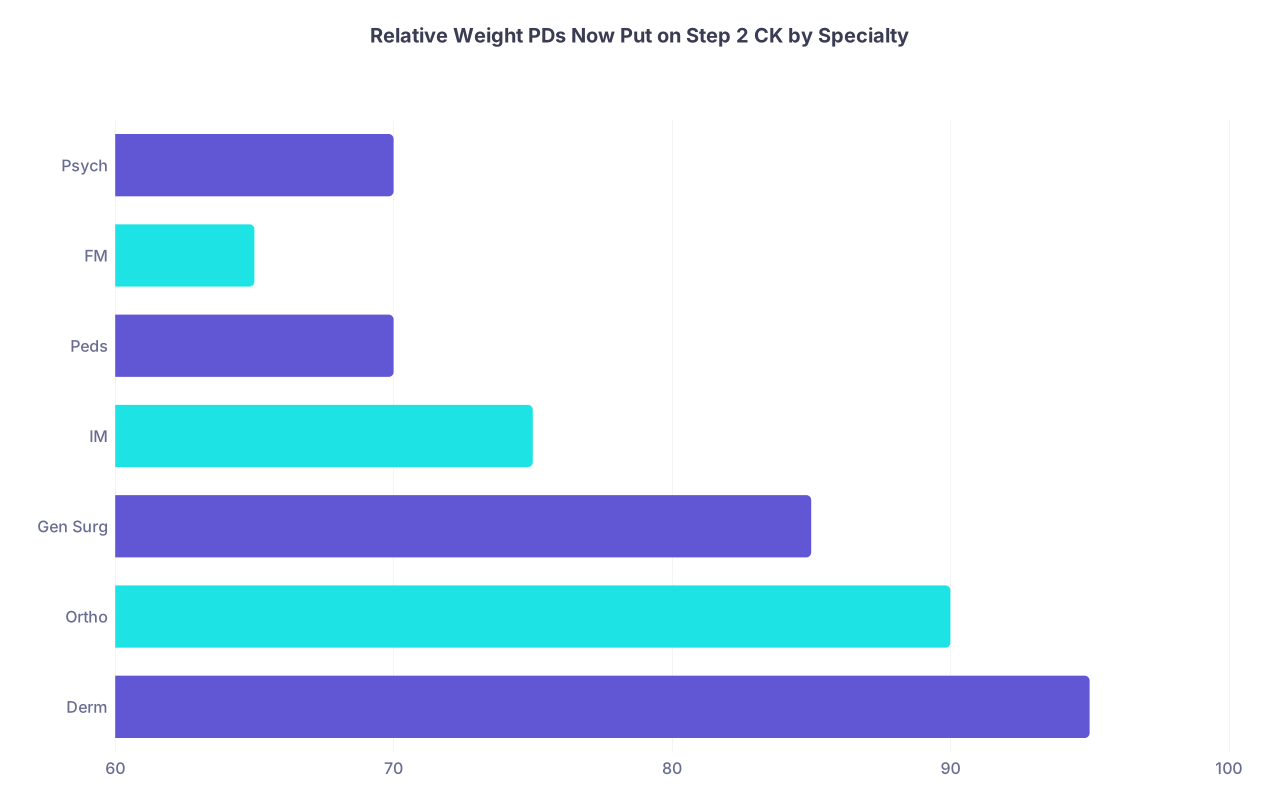
| Category | Value |
|---|---|
| Derm | 95 |
| Ortho | 90 |
| Gen Surg | 85 |
| IM | 75 |
| Peds | 70 |
| FM | 65 |
| Psych | 70 |
Take this as directional, not absolute, but it’s close to how people behave:
Derm, Ortho, ENT, Plastics, Neurosurg
These groups were addicted to Step 1. They’re now heavily addicted to Step 2 CK.
In closed meetings, I’ve heard:“We just use Step 2 the way we used Step 1. Different number, same function.”
They still want an objective screen to cull the pile.General Surgery, EM, Anesthesia, Radiology, OB/GYN
Mixed. Some are trying to be more holistic, some just ported their old Step 1 mindset onto CK.
Many now do: “Step 2 + strong letters + research + perceived ‘grit.’”IM, Peds, FM, Psych
More willing to accept a broader score range, more interested in clinical performance, but they are absolutely watching Step 2 CK for “board-fail risk.”
Programs get penalized when residents fail boards. They will avoid you if they’re scared you’ll tank their stats.
Bottom line: if your Step 1 performance was shaky, you’re under more pressure on Step 2 CK than the old cohorts ever were. That’s the trade.
How PDs Try To Reverse-Engineer Your Step 1
Let’s walk through what actually happens in a typical application meeting.
The coordinator throws an applicant’s ERAS file on the big screen. A PD might say:
“USMD, Step 1 Pass, Step 2 252, honors in Medicine, strong research, derm interest.”
Nobody in that room is saying, “Too bad we don’t know their Step 1 score.”
What they’re thinking is:
- “Good Step 2 = likely would’ve had a good Step 1.”
- “Honors in core rotation = strong fund of knowledge.”
- “Research + strong letters = engaged and probably smart.”
They implicitly back-calculate: “Safe bet academically.”
Flip it.
“IMG, Step 1 Pass, Step 2 228, mostly passes, no strong letters, gap before Step 2.”
The conversation:
- “Academic risk.”
- “We can’t tell if they barely passed Step 1 or did okay, but CK isn’t reassuring.”
- “We have limited interview spots. Pass.”
The missing Step 1 number just gets replaced by an approximate composite impression.
Your Medical School’s Reputation Quietly Got More Important
Here’s a part nobody likes to say out loud.
Before, a very strong Step 1 could help level the field between “big name” schools and less-known schools. A 250 was a 250.
Now? With only Pass/Fail and more subjectivity, school reputation weighs more heavily for many programs.
If I’m sitting in a meeting and see:
- “Pass Step 1, 245 Step 2, top 25% class at UCSF”
vs - “Pass Step 1, 245 Step 2, unknown Caribbean school, mid-class”
The first applicant gets more benefit of the doubt. People assume:
- Better clinical training environment
- More rigorous curriculum
- Better prior screening to get into that school at all
Is it fair? No. Is it real? Yes.
So if you’re not at a brand-name school, your Step 1 story and Step 2 performance matter even more.
What This Means For You During Step 1 Prep
You’re probably wondering: “Okay, so how hard should I actually go on Step 1 now?”
Here’s the insider answer:
You don’t need to grind for a 270-equivalent. But you absolutely cannot treat it as a throwaway.
Here’s how PDs mentally split people:
Solid passers
These are the students who would’ve scored ~225–245+ in the old system.
They:- Build a deep-enough foundation to do well on Step 2 CK.
- Don’t require delays or remediation.
- Have clerkships that say “excellent knowledge base.”
PDs are comfortable with these people. They rarely become problems.
Borderline passers
These are the ones who would’ve hovered just above the pass line.
They:- Often need to delay Step 1.
- Struggle early in MS3 with knowledge-based questions.
- Sometimes drag a low Step 2 CK.
PDs worry about these people. They’re “board failure risk.”
You don’t control what you would’ve scored. But you control which group you fall into functionally.
That means during Step 1 prep, your real goal is this:
Build enough depth that Step 2 CK is a weapon, not a rescue mission.
If you coast to a thin pass on Step 1 and tell yourself “it doesn’t matter,” you just pushed all that pressure onto Step 2 CK. And by the way, Step 2 CK is harder to “cram and memorize” your way through. It exposes clinical reasoning weaknesses brutally.
How Step 1 Performance Affects Your Life After You Pass
The exam itself ends. But its shadow lingers in a few tangible ways.
1. Your MS3 Shelf Exams
Students who fake their way through Step 1 with pattern recognition and brute memorization often get exposed on shelves. Attendings and PDs notice patterns:
- “Great with buzzwords, shaky on mechanism.”
- “Solid rote memorization, weak application.”
Those comments make their way into your MSPE and letters. Not always directly, but in tone.
2. Your Step 2 CK Ceiling
If your Step 1 foundation is weak, Step 2 CK becomes remediation plus test prep.
I’ve seen this play out many times:
- Student A: Worked hard for Step 1, built a real understanding. Step 2 CK focused mostly on question practice and fine-tuning. Scores 250+.
- Student B: Coasted to a pass. Spent Step 2 CK time relearning basic path/phys/pharm plus trying to master clinical reasoning. Scores 225–235.
Those numbers drive residency doors open or closed, especially in the competitive spots.
3. How Much Explaining You Have To Do
If anything around Step 1 is messy—failure, delay, LOA—expect to live with that story throughout interviews.
PDs and interviewers will ask:
- “Tell me about your Step 1 experience.”
- “What did you change after that challenge?”
- “How do we know this won’t repeat on boards?”
If you can pair that with a Step 2 CK hammer and clear insight into what changed, you can recover. If not, that question hangs in the air.
Concrete Moves To Protect Yourself
You want actionable stuff, not theory. Fine.
Take Step 1 seriously enough to build a real base.
Not insane perfectionism. But real mastery of high-yield path, phys, pharm, and micro.
Your goal: Step 1 prep that makes Step 2 CK feel like an upgrade, not a restart.Do not let yourself become a “borderline pass” story.
If you’re struggling badly in your dedicated period, it’s often smarter to delay strategically and solidify than to limp into a barely passing performance that signals “weak foundation” for the rest of med school.Plan Step 2 CK with intention, not desperation.
You want CK taken relatively early in MS4, but not rushed. PDs don’t love a super-late CK, and they definitely don’t love a mediocre one.Ask your school how they report delays or failures in the MSPE.
Some schools are blunt. Some are vague. Know what’s going to be visible, and shape your narrative accordingly.If you had a rocky Step 1 path, over-perform where you still can.
- Crush Step 2 CK.
- Dominate on key clerkships.
- Get at least one letter that explicitly mentions “excellent fund of knowledge” or “strong clinical reasoning.”
Those phrases are catnip for worried PDs.
Visualizing Your Exam Timeline Reality
Here’s the other part you don’t see when you’re in the middle of MS2: the time compression.
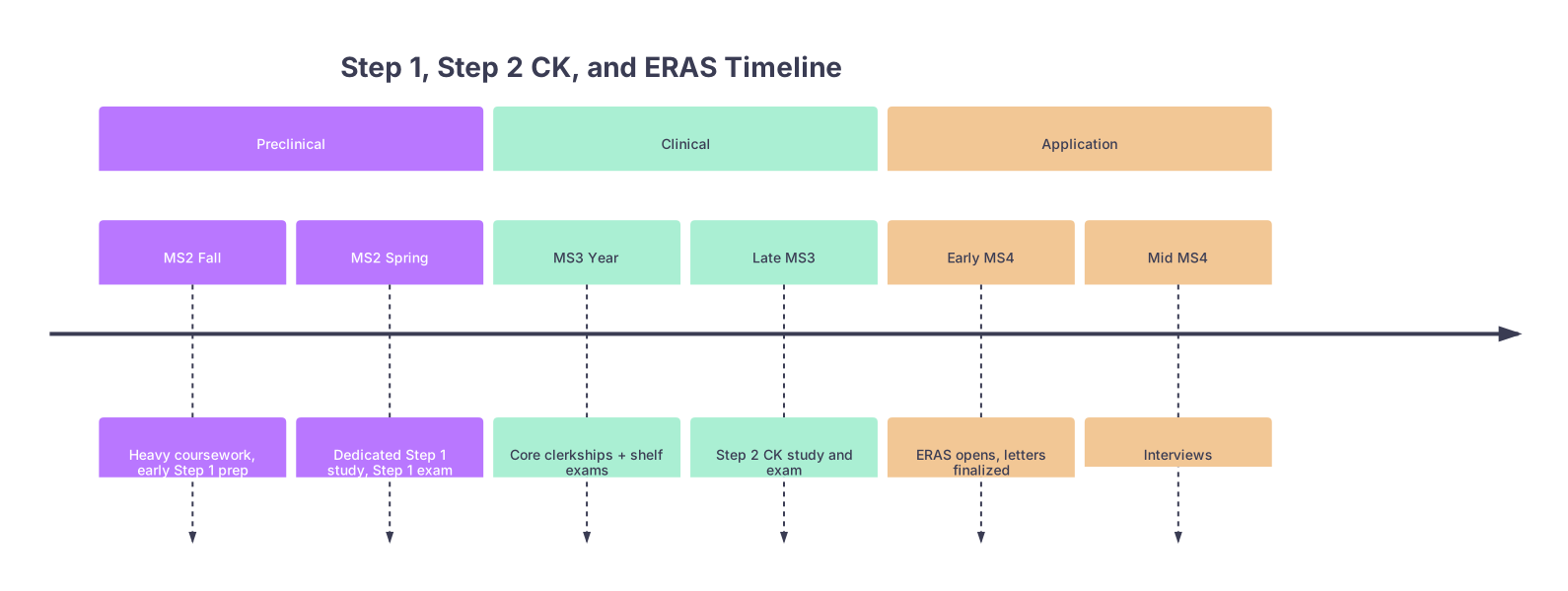
| Period | Event |
|---|---|
| Preclinical - MS2 Fall | Heavy coursework, early Step 1 prep |
| Preclinical - MS2 Spring | Dedicated Step 1 study, Step 1 exam |
| Clinical - MS3 Year | Core clerkships + shelf exams |
| Clinical - Late MS3 | Step 2 CK study and exam |
| Application - Early MS4 | ERAS opens, letters finalized |
| Application - Mid MS4 | Interviews |
If your Step 1 foundation is soft, that entire timeline compresses even more because you’re constantly playing academic catch-up. PDs can smell that in your record even without seeing a Step 1 number.
FAQs
1. If Step 1 is pass/fail, can a “strong pass” actually help me anymore?
Indirectly, yes. There’s no “strong pass” box for them to click, but if your Step 1 prep was at a “would’ve been 230–250+” level, that same preparation is what drives a strong Step 2 CK and better shelf performance. PDs won’t know your hypothetical Step 1 score, but they’ll see the downstream impact and treat you like a stronger applicant.
2. I failed Step 1 once but passed on the second try. Am I automatically out for competitive specialties?
For the ultra-competitive ones (derm, plastics, ENT, neurosurg, ortho at big-name places), your odds drop sharply. Not technically zero, but very low unless you pair it with an exceptional Step 2 CK score, top-tier research, and strong connections. For mid-competitive fields, it’s a serious ding but not a death sentence—your Step 2 CK and clinical performance now have to be undeniably strong.
3. Does delaying Step 1 (without failing) hurt me in PDs’ eyes?
It depends on the pattern. A short, clearly documented delay with a later solid performance and strong Step 2 CK is usually fine. A long, messy delay combined with average or weak Step 2 CK scores raises alarm bells. PDs aren’t mad about a delay by itself; they’re worried it signals underlying academic fragility.
4. I’m at a lesser-known school. With Step 1 pass/fail, am I at a bigger disadvantage now?
Yes, for many programs you are. Before, a high Step 1 number could partially neutralize school-name bias. Now, without that data point, PDs lean more on Step 2 CK, school reputation, and letters. That means you need to treat Step 2 CK like your public metric and aim to outperform your school’s average by a clear margin.
5. If my Step 2 CK is excellent, will PDs still care about a mediocre Step 1 story?
A truly strong Step 2 CK (for your specialty tier) is the single best way to make your Step 1 history fade into the background. PDs are pragmatists: they care about whether you’ll pass their in-service and boards. A high CK score calms their anxiety. They may still ask about Step 1 if there was a failure or delay, but your CK score gives them permission to move on.
Remember:
- Step 1 going pass/fail didn’t erase evaluation; it just forced PDs to infer your performance from everything around it.
- The real downstream currency now is Step 2 CK, clerkship performance, and narrative strength—but those are all built on the same foundation you lay for Step 1.
- Your job isn’t to “just pass.” Your job is to make sure, when PDs see “Step 1: Pass,” they can confidently assume you’re in the solid group, not the borderline one.