
It’s February of your dedicated study year. Your classmates are arguing in the group chat about whether you “need” UWorld plus AMBOSS plus USMLE-Rx plus every NBME ever written. You’ve paid for one Step 1 Qbank already, and your bank account is side-eyeing you. Now you’re staring at your study plan wondering:
“Is one question bank actually enough for Step 1 prep, or am I screwing myself if I don’t buy more?”
Here’s the direct answer:
If you pick the right primary Qbank and use it properly, one major question bank plus NBMEs is enough for most students to pass Step 1 comfortably and even do well.
It’s not enough if:
- You picked a weak or poorly structured bank as your only source, or
- You’re using your Qbank like a trivia game instead of a learning tool.
Let me break this down like someone who has watched hundreds of students overcomplicate this.
The Real Role of Qbanks in Step 1 Prep
You are not buying “questions.” You are buying:
- A structured way to force recall
- High-yield explanations
- Exposure to NBME-style thinking
- A feedback loop on your weak areas
The Qbank is the engine of your learning during Step 1 prep. Everything else (videos, Anki, review books) spins around it.
Your Step 1 learning stack should basically be:
- One strong primary Qbank (almost always UWorld; occasionally AMBOSS if you know what you’re doing).
- Official practice exams (NBME + Free 120).
- A content backbone (Anki / Boards & Beyond / Sketchy / Pathoma / etc.).
If that core is solid, adding a second full Qbank moves from “necessary” to “optional optimization” pretty fast.
When One Question Bank Is Enough
Assume we’re talking about a strong primary bank like UWorld or AMBOSS being used correctly. One Qbank is usually enough if:
You start early enough
If you start using your Qbank:- During systems in second year, or
- At least 8–10 weeks before your exam in dedicated
…and you actually work through almost all of it (65–80%+), that’s plenty of question exposure.
You focus on learning from questions, not just doing them
If your review looks like this:- Timed, random or system-based blocks of 40 (or 20 if early)
- 1–1.5x as much time reviewing as doing
- Actively rewriting missed concepts into Anki or notes
- Figuring out why each distractor is wrong
Then you are milking that Qbank for everything it’s worth. And that’s a lot.
You layer in NBMEs
One Qbank alone, no NBMEs? That’s irresponsible.
One Qbank + multiple NBMEs? That’s a legitimate full prep.The NBMEs give you:
- Score prediction
- True NBME style exposure
- Calibration of how “hard” your Qbank feels vs reality
Your baseline knowledge is not severely behind
If:- You passed all pre-clinical blocks reasonably
- You’re not missing entire subjects (e.g., zero biostats, zero renal phys)
Then one Qbank plus targeted content review is enough for a pass and usually more.
When One Question Bank Is Not Enough
There are scenarios where I’d tell you flat out: one Qbank is probably not going to cut it on its own.
You picked the wrong Qbank as your only one
If your only bank is:- Kaplan questions from 2014
- A school-made “question packet”
- USMLE-Rx used alone during dedicated with no UWorld or AMBOSS
You’re handicapping yourself. Those can be fine as early exposure, but they are not enough as your only serious Step 1 bank in 2026.
You’re starting late and behind
If:- You’re 4–6 weeks from test day
- You’ve barely touched Step material
- Your NBME baseline is scary-low
Then just “doing one Qbank” without a very aggressive plan and probably extra resources is risky. You may need:
- High-yield videos to patch holes
- Targeted question sets from an additional bank in your worst systems
You’re scoring far below passing on multiple NBMEs
Example:- NBME 25: 48%
- NBME 27: 50%
- Exam is in 4 weeks
In that situation, the problem is not “you need more questions.” The problem is “you don’t understand the content.” But additional Qbank exposure targeted to weak areas can help reinforce after rapid content review. If all you’re doing is running your primary bank randomly, that’s not enough.
You’re aiming for very top-tier performance and you have the time
Is Step 1 pass/fail now? Yes.
Do some competitive programs still quietly care about how strong your application looks? Also yes.If you’re gunning for something like derm, plastics, ortho, neurosurgery, then:
- Deep understanding and pattern recognition matter
- More question variety can help you handle anything thrown at you
In that narrow case, a second Qbank (or at least selected sections of it) can be useful after you’ve basically finished your primary one.
UWorld vs “Multiple Qbanks”: What Actually Matters
Let’s be blunt. The main decision is usually:
“Is UWorld + NBME enough, or do I need UWorld + AMBOSS + Rx + everything?”
For 90% of students: UWorld + NBME + one content resource is enough.
Why UWorld works as a solo primary Qbank:
- Question style is very NBME-like
- Explanations are dense and usually accurate
- The interface trains you for the actual exam environment
- It exposes almost every classic Step 1 concept at least once
So when is it actually smart to add AMBOSS or others on top of UWorld?
- You finished 80–100% of UWorld with real review and still have 3–6 weeks + energy
- Your NBMEs are pass-range but you want more cushion
- You have very specific weak areas (e.g., renal phys, biostats) you want more reps on
If you’re halfway through UWorld and thinking of buying a second full Qbank “just because everyone else has it,” save your money. Finish the bank you paid for and squeeze every drop of learning out of it first.
One Qbank vs Two: Tradeoffs That Actually Matter
Here’s the real calculus. Not the marketing.
| Factor | One Strong Qbank | Two Full Qbanks |
|---|---|---|
| Cost | Lower | Much higher |
| Depth of review | Higher per question | Often more shallow per item |
| Question volume | Moderate | Very high |
| Stress level | Usually lower | Often higher (“I’m behind”) |
| NBME prep | Adequate if chosen well | Similar if review is strong |
The biggest mistake I see:
Students buy multiple Qbanks, then rush through both and barely review either. That is objectively worse than doing one bank deeply.
If you can afford only one premium Qbank, don’t feel bad. Use it better than everyone else uses three. That will put you ahead, not behind.
How to Make One Question Bank “Enough”
If you decide to stick with one Qbank, here’s how you make that choice pay off.
Choose the right bank
For Step 1 dedicated, your primary should almost always be:- UWorld (standard choice)
- AMBOSS (acceptable if your school heavily integrates it and you like the style)
Early in M1/M2, you can play with Rx/Kaplan, but by dedicated, your “serious” bank should be UWorld or AMBOSS.
Decide your strategy upfront
Example structure over 8–10 weeks:- Weeks 1–4: System-based timed blocks (e.g., all cardio, all renal)
- Weeks 5–8: Mixed timed blocks, random topics
- Last 1–2 weeks: Random blocks + NBME review + Free 120
The key: don’t just “do whatever blocks you feel like.” That leads to gaps.
Review like you mean it
Your block workflow should look like:- Do 40 questions in timed mode (tutor mode is fine early, but switch to timed)
- Immediately review the block
- For each missed or guessed question:
- Identify the one concept you didn’t know or misapplied
- Add that to Anki or a very short “error log” (not a novel, a bullet)
- Ask: “How will I recognize this pattern next time?”
If you’re breezing through review in 20 minutes, you’re not actually learning from the Qbank.
Pair it with at least one real content resource
Your Qbank is not your textbook. When you find gaps, plug them. That usually means one of:- Boards & Beyond (content scaffolding)
- Sketchy (micro, pharm)
- Pathoma (path, pathophys)
- A solid Anki deck (Zanki / AnKing etc.)
The idea: questions reveal your weakness, content fills it.
How NBMEs Change the “One Qbank” Discussion
If you told me: “I’ll use UWorld only. No NBMEs. No Free 120,” I’d say: that’s not enough.
You need:
- At least 2–3 NBME practice exams
- The Free 120 from the official site
- Ideally spaced through your prep
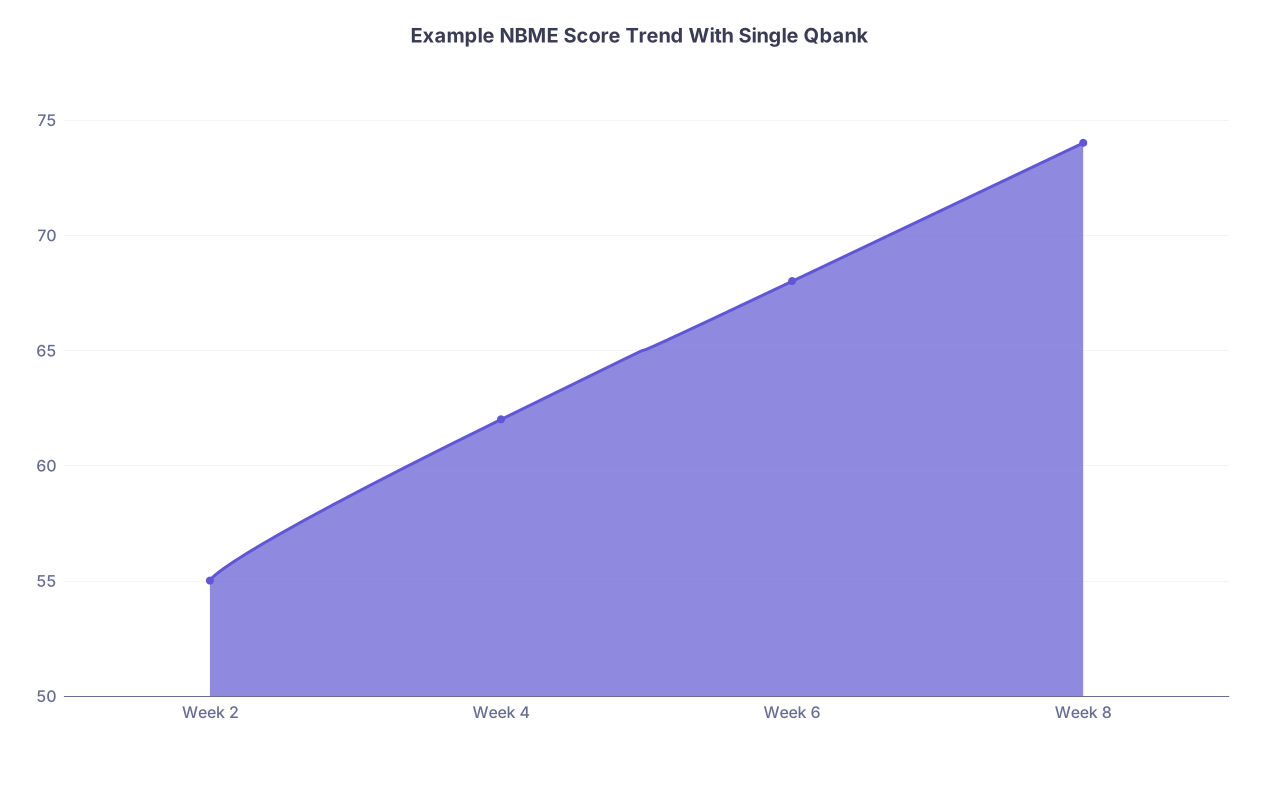
| Category | Value |
|---|---|
| Week 2 | 55 |
| Week 4 | 62 |
| Week 6 | 68 |
| Week 8 | 74 |
Those numbers are just an example, but that upward trend? That’s what you’re aiming for.
NBMEs do a few things your Qbank cannot:
- Show you exactly how far from passing you are
- Expose true NBME wording and style
- Reveal if your Qbank performance is “translating” to exam performance
One Qbank + 0 NBMEs = flying blind.
One Qbank + multiple NBMEs = legitimate full prep.
Common Patterns I’ve Actually Seen
Let me give you a few realistic scenarios.
Scenario 1: One Qbank, used well → Strong pass
M2, mid-tier US MD, uses:
- UWorld as only Qbank
- Boards & Beyond and AnKing
- 3 NBMEs + Free 120
Finishes ~85% of UWorld with detailed review. NBMEs move from borderline to safe. Passes Step 1 comfortably. No second Qbank. No drama.
Scenario 2: Two Qbanks, used badly → Stress, mediocre result
Another student:
- Buys Rx early, half-completes it
- Buys UWorld in dedicated
- Panics, also buys AMBOSS
- Ends up doing 30–40% of each, skimming explanations
- Exhausted, burned out, plate-spinning three platforms
Result: barely passing NBMEs, way more anxious than needed. Could have done better with one Qbank used properly.
Scenario 3: Strong student, one Qbank + selective second use
High performer:
- Does UWorld completely once
- Uses NBME to identify weak systems (biostats, neuro, renal)
- Buys 1-month AMBOSS subscription, but only targets those weak areas with tagged questions
- Reviews explanations deeply in just those zones
That’s how you use a second bank intelligently. Not “do all of it because FOMO.”
Practical Framework: Do You Need More Than One?
Quick decision tree for you.

| Step | Description |
|---|---|
| Step 1 | Have you finished & reviewed most of UWorld/primary bank? |
| Step 2 | Focus on finishing primary Qbank well |
| Step 3 | Have you done at least 2 NBMEs + Free 120? |
| Step 4 | Do NBMEs before buying more questions |
| Step 5 | Are your NBME scores safely above pass? |
| Step 6 | Use content review + targeted Qbank areas |
| Step 7 | Want extra cushion or high competitive specialty? |
| Step 8 | Stick with current plan & refine weak points |
| Step 9 | Consider selective use of second Qbank in weak systems |
If you’re below passing, your first move is not “buy more questions.”
It’s “fix the knowledge gaps revealed by the questions you already did.”
What I’d Tell You If You Were My Student
If you were sitting in my office saying, “I only bought UWorld. Is that enough?” I’d say:
Yes—as long as you:
- Don’t treat it like trivia
- Pair it with at least one real content source
- Take multiple NBMEs
- Adjust your plan based on data, not vibes
If your classmates are flexing with three Qbanks and no real plan, ignore them. Volume of questions is not the flex. Quality of learning is.

FAQs: One Qbank for Step 1
1. If I can only afford one Qbank for Step 1, which should I buy?
UWorld. That’s the standard, and for good reason. If your school gives you AMBOSS for free and heavily integrates it, AMBOSS can work as a primary bank too. But if you’re independently choosing and paying: pick UWorld.
2. Should I finish my Qbank before I start any NBME exams?
No. Waiting to “finish UWorld” before taking your first NBME is how people run out of time. A better pattern:
- Start Qbank
- Take your first NBME 4–6 weeks before your test date, even if you’re only ~50% through the bank
- Use NBME results to recalibrate your studying and Qbank focus
3. Is it bad if I do one Qbank in tutor mode only?
Early on, tutor mode is fine to build understanding. But if you only use tutor:
- You never practice time pressure
- You don’t build mental endurance for 40-question blocks
- Your performance will look artificially inflated
I’d switch to mostly timed mode (random blocks) at least 4–6 weeks before your test. You can still review thoroughly after.
4. What if I’m doing poorly on my primary Qbank—should I buy a second one?
No. Poor performance on your primary Qbank means you don’t understand the content yet. Another bank won’t magically fix that. What you should do instead:
- Slow down
- Spend more time on explanations
- Use videos/Anki to patch weak topics exposed by the Qbank
- Take an NBME to see where you actually stand
If you improve after that, you probably never needed a second bank in the first place.
5. How many total questions should I aim to do before Step 1?
If you’re using one major bank like UWorld:
- UWorld Step 1 has roughly 3,500+ questions (varies by year)
- Doing 2,500–3,500 of them with solid review is plenty for most people
If you start early, some students do one full pass and then a partial second pass of weak areas. But I’d rather see 3,000 questions well reviewed than 5,000 half-glanced.
6. What’s the minimum to feel safe with just one Qbank?
Bare minimum that doesn’t make me nervous:
- One strong primary Qbank (UWorld or AMBOSS), 70–80% completed with real review
- At least 2 NBMEs + the Free 120 taken and reviewed
- Some structured content review (videos/Anki/Pathoma)
- Your most recent NBME is clearly above the passing threshold with a bit of buffer
If you’re there, one question bank was enough.
Open your current Qbank dashboard right now and look at two numbers: completion percentage and average review time per block. If you’ve done fewer than ~50% of the questions or you’re flying through review in under 20–30 minutes, your problem isn’t “not enough Qbanks.” It’s how you’re using the one you already have. Fix that today.