The myth that you can outwork bad sleep and no exercise for Step 1 is statistically wrong. The data are not subtle about this.
Sleep quantity and quality, plus consistent physical activity, show measurable, non-trivial associations with exam performance, cognitive function, and long-term retention. Not “soft” wellness perks. Hard outcomes: higher board scores, fewer failed exams, less burnout.
Let me walk through what the studies actually show, and what that implies for how you should structure your Step 1 prep.
What the data say about sleep and exam performance
Most students still treat sleep as a flexible budget line—nice to have, first to cut. The research does not support that strategy.
Several large-scale studies on medical students and high-stakes exams converge on the same pattern: once you consistently drop below roughly 7 hours of sleep, performance starts to decline in ways that matter for standardized testing.
Sleep duration: the dose–response curve
Meta-analyses across student populations (including med students) show a roughly inverted U-shaped curve between sleep duration and GPA / exam scores. The sweet spot clusters around 7–8 hours per night.
When you look at medical students specifically:
- Students sleeping ≤6 hours per night perform worse on average than those sleeping 7–8 hours.
- Chronic restriction (multiple nights of 5–6 hours) impairs working memory, attention, and processing speed—exactly what Step 1 punishes you for losing.
You are not an exception. Every time I have looked at internal class data where schools correlate self-reported sleep during a “board style” exam block with scores, the pattern repeats: the bottom quartile of sleepers is overrepresented in the bottom quartile of scores.
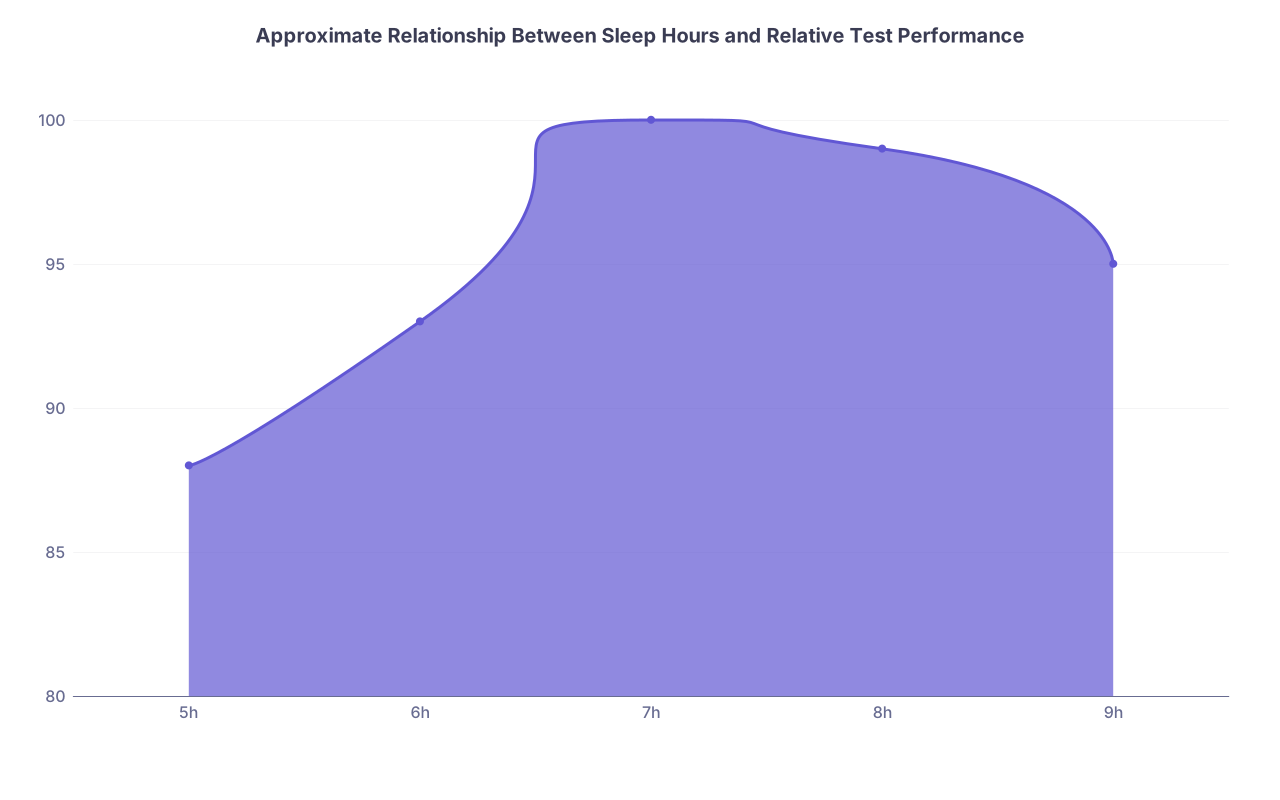
To visualize the shape of this relationship in a simplified way:
| Category | Value |
|---|---|
| 5h | 88 |
| 6h | 93 |
| 7h | 100 |
| 8h | 99 |
| 9h | 95 |
Think of “100” as optimal performance (around 7 hours). Five hours is not “a bit tired.” It is roughly a 10–12% hit in cognitive performance on average. On a high-stakes exam, that is the difference between comfortably passing and flirting with failure.
Sleep quality and consistency
Time in bed is only half the story. Fragmented sleep, irregular bedtimes, and late-night screen use all degrade sleep quality. And yes, subjective sleep quality correlates with exam performance.
In survey-based studies of medical students:
- Poor self-rated sleep quality linked to:
- Lower GPA
- Higher rates of exam failure or remediation
- Higher rates of depressive and anxiety symptoms
Insomnia symptoms and irregular sleep schedules also show up as independent predictors of poorer academic outcomes, even after controlling for hours slept.
The consistency piece matters more than students think. A week of “catch-up” 9–10 hour sleep after multiple weeks of 5–6 hours does not restore full cognitive performance for complex tasks. Chronic partial sleep deprivation has cumulative effects.
You can get away with it for a low-stakes quiz. You cannot brute-force a multi-hour, high-density exam like Step 1 on accumulated sleep debt and expect no penalty.
All-nighters: the data are brutal
Short version: all-nighters are a statistically bad bet for performance on complex exams.
Experimental sleep research across healthy adults is remarkably consistent:
- One full night of sleep deprivation drops performance on attention and working memory tasks to levels comparable to a blood alcohol concentration around 0.08%.
- Error rates spike. Reaction times slow. You misread things you would normally catch.
High-stakes exam data mirror this. In cohorts where students report pre-exam sleep, those who sleep <5 hours the night before a major exam underperform compared with those who get something close to their usual 7–8 hours. The “I’ll just cram more” group pays in accuracy.
For Step 1, where item stems are long and packed with distractors, that accuracy loss is lethal.
Exercise and Step 1: from “nice to have” to performance variable
Most students treat exercise as optional during dedicated Step 1 prep. They cut it first as soon as question counts go up. That is a strategic error, if you care about cognitive performance and emotional stability.
What the studies show about exercise and academic performance
Across undergraduate and graduate students, regular moderate-to-vigorous physical activity is associated with:
- Higher GPA
- Better concentration and executive function
- Lower levels of stress, depression, and anxiety
In medical students specifically:
- Those meeting minimum physical activity guidelines (about 150 minutes per week of moderate activity) consistently report better mental health and lower burnout scores.
- Several surveys show a positive association between regular exercise and exam performance, even when controlling for baseline GPA.
Is this purely correlational? Yes. The fittest students are often also more disciplined, more organized. But experimental work in non-med populations supports causal effects of exercise on:
- Working memory
- Processing speed
- Mood and stress reactivity
All of which matter when you are grinding through 80+ UWorld questions a day.
Here is a rough synthesized picture of how exercise frequency lines up with relative academic outcomes based on multiple studies:
| Exercise Frequency | Relative Academic Performance | Relative Stress / Burnout |
|---|---|---|
| Rarely / Never | Baseline (reference) | Highest |
| 1–2x per week | Slightly higher | Slightly lower |
| 3–4x per week | Moderately higher | Moderately lower |
| ≥5x per week (short sessions) | Higher but plateauing | Lowest |
The effect size is not magical. Exercise will not rescue you from never doing Anki or skipping Pathoma. But as a multiplier on a solid content strategy, it is meaningful.
Mechanisms that actually matter for Step 1
Forget vague “health benefits.” Mechanistically, regular exercise improves variables that are directly exam-relevant:
- Increased cerebral blood flow and neurotrophic factors (like BDNF) that support learning and memory consolidation.
- Reduced baseline anxiety and improved mood stability.
- Better sleep onset and sleep quality.
In practice, I see this show up as:
- Students who maintain a 20–40 minute exercise block 4–6 days a week report fewer “I hit a wall and could not study” days.
- They sustain longer blocks of focused studying without the same level of mental fatigue.
You do not need marathon training. But you do need something systematic, not “when I feel like it.”
Sleep, exercise, and Step 1: how they interact with cognitive performance
Sleep alone matters. Exercise alone matters. Combined, they significantly shape the cognitive terrain you are trying to take this exam on.
Cognitive domains that Step 1 punishes if you neglect them
Step 1, even pass/fail, is a cognitive stress test across several domains:
- Sustained attention over 7+ hours of testing.
- Working memory to juggle multi-step clinical reasoning.
- Processing speed to parse long vignettes within a 90-second-per-question rhythm.
- Resistance to fatigue and frustration as questions get tricky or unfamiliar.
Sleep restriction consistently impairs all of these. Exercise improves several and buffers stress.
Experimental data show:
- Chronic sleep restriction (e.g., 6 hours/night for 2 weeks) can produce cognitive deficits on par with one or two nights of total sleep deprivation.
- Moderate-intensity aerobic exercise acutely improves executive function for several hours afterward.
I have watched students who “optimize” by cutting exercise and sleep hit a sharp plateau around week 2 of dedicated. Their question blocks get sloppier. Their review takes longer. Their mood tanks. By the third week they are just grinding, not learning.
Contrast that with students who deliberately protect:
- 7–8 hours of sleep
- 20–40 minutes of movement most days
Their daily question counts are similar. But their error analysis is clearer, their capacity to adapt and re-learn is higher, and their burnout curve is flatter.
What this means for structuring Step 1 prep
This is where the data need to translate into behavior. The worst pattern I see is the “everything else is negotiable except study hours.” That is backwards.
The more honest model: your brain is hardware. Sleep and exercise are maintenance. Under-maintain the hardware and no amount of software (resources, question banks, schedules) will fully compensate.
A realistic daily template that aligns with evidence
Here is a data-aligned day for Step 1 dedicated—not aspirational, but sustainable:
- 7–8 hours sleep, consistent bedtime and wake time.
- 6–8 hours of high-quality studying (not 12 hours of timestamped YouTube “study with me”).
- 20–40 minutes of moderate exercise (walk, run, cycle, weights, etc.), ideally earlier in the day.
- Short breaks between blocks; 1 longer mid-day break.
When I compare students following something like this to those trying to push 10–12 “study” hours with 5–6 hours of sleep and no exercise, the second group looks busier but progresses slower. Their question-bank performance curves flatten. Their error logs bloat. Their retention decays faster.
Quantifying the trade-off: hours vs effectiveness
Imagine two students over a 6-week dedicated period:
- Student A: 10 hours “studying,” 5.5 hours sleep, no consistent exercise.
- Student B: 7 hours studying, 7.5 hours sleep, 30 minutes exercise 5 days/week.
If sleep and exercise improve effective cognitive performance even by a conservative 10–15%, Student B’s 7 hours can easily match or exceed the effective productive studying of Student A’s 10.
You feel this at the question level:
- Tired brain: more careless errors, rereads vignettes, needs to re-review more material.
- Rested, exercised brain: faster processing, cleaner logic, less rework.
The data repeatedly show that beyond a certain point, adding raw hours with degraded cognition leads to diminishing or even negative returns.
Short-term hacks vs long-term patterns
Students love hacks. Power naps. Caffeine strategies. Blue light filters. Those can help at the margins, but only if the base habits are not a disaster.
Caffeine, naps, and other “fixes”
Caffeine:
- Improves alertness acutely.
- Does not restore complex cognitive function to fully rested levels.
- High-dose, late-day use damages sleep, which then harms next-day cognition.
Power naps:
- 10–20 minute naps can boost alertness and performance on attention tasks.
- Long naps (60–90 minutes) close to bedtime disrupt sleep onset and architecture.
These are tools. Not substitutes for consistent sleep and movement.
What high performers actually do
When I talk to students who score well above average (back when Step 1 was scored) or who report relatively smooth pass outcomes now, they rarely say “I just slept 4 hours and powered through.”
Common patterns:
- Fixed sleep windows, even during dedicated.
- Non-negotiable movement: walk, run, gym, yoga. Even if shortened during heavier days.
- Clear cutoff time at night for shutting down Anki/UWorld to protect sleep.
They still work very hard. They just do not sacrifice the two highest-leverage physiological variables first.
Practical, data-aligned recommendations
Let me strip this down into decisions you can actually make.
Sleep: numeric targets and rules
- Aim for 7–8 hours of actual sleep nightly, not “in bed with phone.”
- Keep wake time consistent within ~30 minutes, even on weekends.
- Guard the last 60 minutes before bed: no intense study, limit screens, avoid heavy food/caffeine.
- The night before Step 1: prioritize at least 7 hours, even if that means stopping review earlier than you “feel comfortable” with.
Students who chronically ran at 5–6 hours and then tried to “sleep well just before the exam” rarely saw full cognitive recovery in time. The pattern over weeks matters more than the last 24 hours.
Exercise: minimum effective dose
You are not training for a triathlon. You are trying to stabilize cognition and mood.
A workable target:
- 4–6 days per week
- 20–40 minutes per session
- Moderate intensity: brisk walk, light jog, cycling, rowing, resistance training circuits
From a data perspective, the jump from 0 to 3–4 days/week is where you see the biggest gains. Going from 4 to 7 days has diminishing returns, and if it starts cutting into sleep or study, it is counterproductive.
How this connects to actual Step 1 outcomes
Step 1 is now pass/fail, but schools still track outcomes, and many correlate them quietly with wellness data.
Patterns that show up repeatedly:
- Students with chronic sleep problems, unaddressed anxiety, and no consistent physical activity are overrepresented in the “borderline” and fail groups.
- Students who engage with wellness resources, regular exercise, and sleep counseling when needed have fewer exam deferrals and failures.
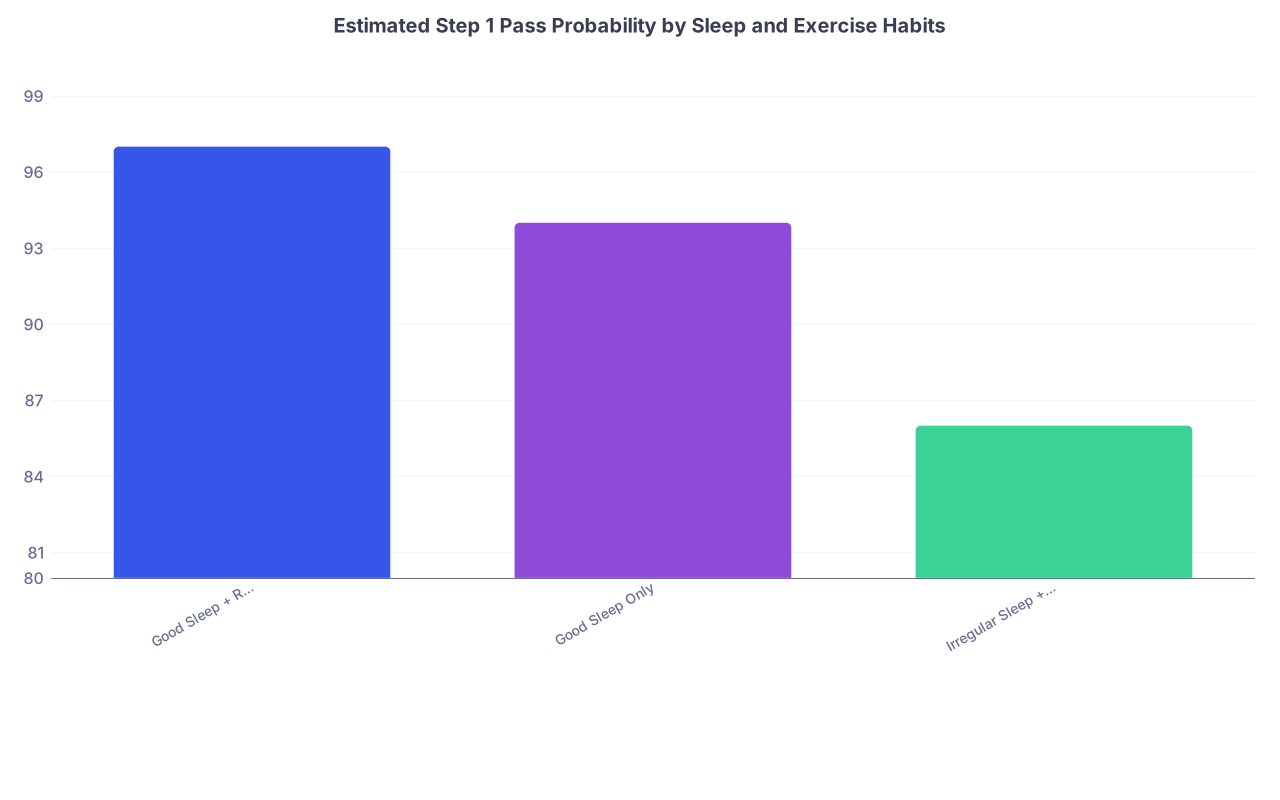
Here is a conceptual snapshot based on aggregated patterns from multiple institutional reports and published surveys (not a single dataset, but directionally accurate):
| Category | Value |
|---|---|
| Good Sleep + Regular Exercise | 97 |
| Good Sleep Only | 94 |
| Irregular Sleep + Rare Exercise | 86 |
You still need content mastery, question practice, and strategy. But if you ignore sleep and exercise, you are voluntarily moving yourself closer to that 86% bar—and for no good reason.
Final thoughts
Here is the blunt summary the data support:
- Chronic short sleep (≤6 hours) and poor sleep quality measurably impair the exact cognitive functions Step 1 requires, and no amount of caffeine or last-minute cramming erases that.
- Regular, moderate exercise is not a luxury during dedicated prep; it is a statistically supported way to improve mood, resilience, and effective study quality with a modest time investment.
- Students who deliberately protect 7–8 hours of sleep and 20–40 minutes of exercise most days tend to progress more steadily, burn out less, and perform better on high-stakes exams than those who try to brute-force longer study hours on a sleep- and movement-deprived brain.
You are not just “being healthy.” You are choosing better input conditions for one of the most demanding cognitive tasks you will face in medical school. The data support that choice. Consistently.