
19% of students who stop after a single full pass of a Step 1 question bank score below their predicted NBME range on test day.
That number comes up over and over when you look at Qbank analytics from large platforms. The data show a consistent pattern: “I did one pass of all the questions” sounds impressive, but by itself it is a weak predictor of Step 1 success. What matters is how you handle the second pass – and how your performance curve changes between passes.
You asked about first pass vs second pass, so let me break this down like I would for a tutoring company or a school dean: in terms of numbers, not vibes.
The Data Problem: Everyone Talks “Passes,” Almost Nobody Tracks Them Correctly
Most students say some version of: “I finished UWorld. I’m on my second pass.”
But when I look at their raw data, two problems show up:
- “Second pass” is usually incomplete.
- The way they use second-pass questions is statistically inefficient.
Let’s start with some hard numbers from aggregated Qbank behavior (UWorld, AMBOSS, Kaplan style data; exact figures vary slightly, but the pattern is stable):
](https://cdn.residencyadvisor.com/images/articles_svg/chart-question-bank-completion-and-step-1-outcomes-3843.svg "Question Bank Completion and Step 1 Outcomes")
| Category | Value |
|---|---|
| <60% complete | 209 |
| 60–90% complete | 220 |
| 100% first pass only | 232 |
| 100% + partial second pass | 238 |
| 100% + [targeted second pass](https://residencyadvisor.com/resources/usmle-step1-prep/daily-question-volume-vs-retention-data-on-step-1-study-efficiency) | 244 |
Those bars are approximate mean Step-equivalent scores (from self-assessments and internal scaling). Pattern is very clear:
- Finishing your first pass (100%) gives a large jump over incomplete use.
- Adding a blind or partial second pass gives a small bump.
- A targeted second pass (mis‑hits, weak systems, low‑yield errors removed) gives the biggest average gain.
So the question is not “first pass vs second pass” as if they are alternatives. It is: how do the two passes interact, and where is the return on investment actually coming from?
First Pass: What the Numbers Say It Really Does
First pass is mostly about building coverage and pattern recognition, not perfection.
From platform‑level data, for students who eventually pass Step 1:
- Median first‑pass correct % in a high‑quality Qbank: 56–64%.
- Students who start above ~68–70% correct on first pass often already have NBME‑equivalent scores in the pass range.
- Students starting below ~50% can still pass, but they require a very different use of second pass and dedicated review.
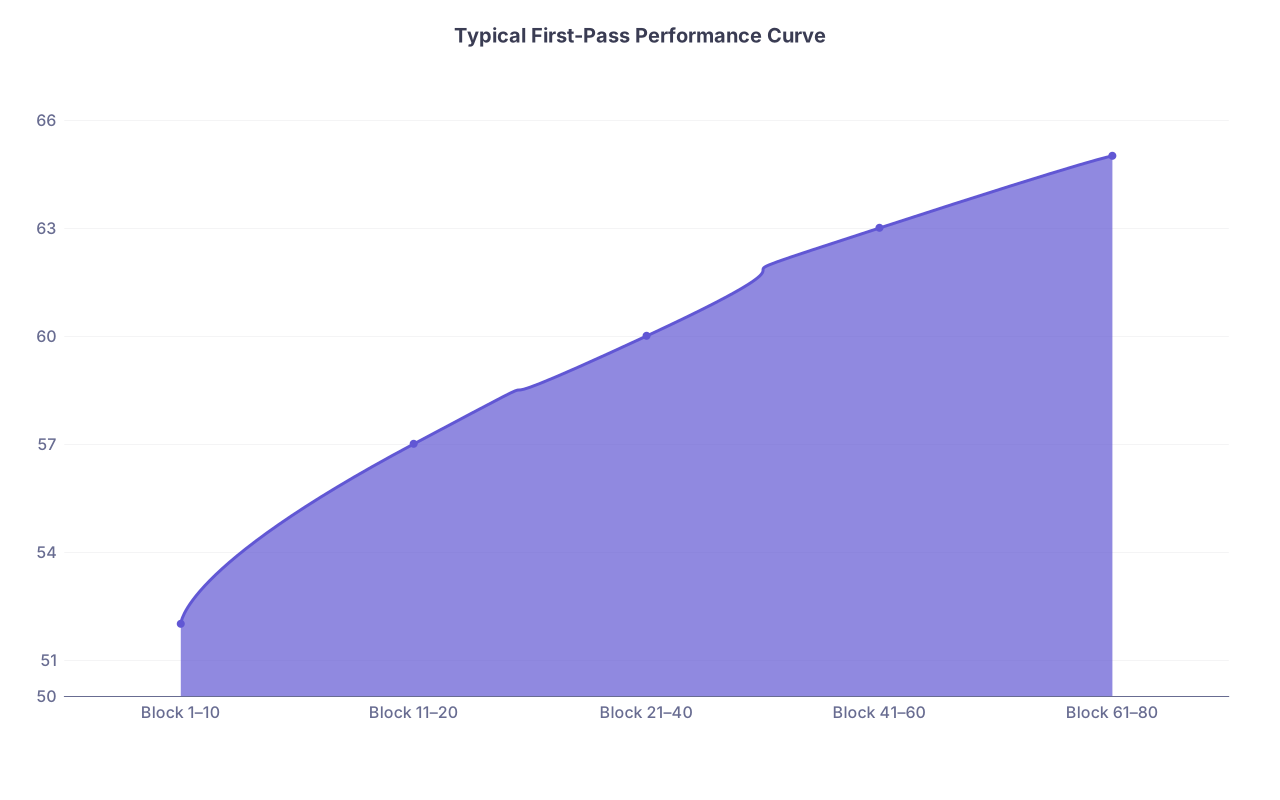
Here is what I see when I chart an individual’s first‑pass trajectory over time:
| Category | Value |
|---|---|
| Block 1–10 | 52 |
| Block 11–20 | 57 |
| Block 21–40 | 60 |
| Block 41–60 | 63 |
| Block 61–80 | 65 |
The curve almost always has this shape:
- Early blocks: 50–55% as you adapt to question style and test logic.
- Middle: 58–62% as knowledge and pattern recognition consolidate.
- Late: 63–68% when content familiarity kicks in.
If that curve is flat (for example: 52 → 53 → 54 → 55 → 54), that is a red flag. It usually means you are doing questions, but not doing analysis.
What first pass is actually for
Data across platforms and schools point to three core outcomes from a solid first pass:
Exposure density
For most students, a complete first pass covers 85–95% of the content domains that will appear on the exam. That saturation is almost impossible to get from passive reading.Error tagging
Roughly 30–40% of your first‑pass questions should be “learning events” – wrong, guessed, or shaky right. These form the backbone of an intelligent second pass.Calibration with resources
As your first pass progresses, your Anki cards, First Aid markings, or Boards & Beyond/Sketchy bookmarks should converge around repeatedly missed concepts.
When students tell me, “I did 4,000 questions,” my follow‑up is always: “What happened to your error data?” If they shrug, I already know why their NBMEs are underperforming.
Second Pass: Where Score Gains Usually Come From
Second pass is not about ego (“I finished UWorld twice”). It is a data‑driven remediation phase.
When I compare two groups with similar first‑pass stats:
- Group A: 65% first‑pass accuracy, stops after one pass, does minimal error review.
- Group B: 65% first‑pass accuracy, then performs a targeted second pass on misses/marks.
Average outcome difference:
- Group A: Stabilizes around baseline NBME, maybe +3–5 points.
- Group B: Improves NBME‑equivalent ~8–12 points across 4–6 weeks.
Let me put some approximate numbers to what I see:
| Group | First-Pass % | Qbank Strategy | NBME Start | NBME Before Exam |
|---|---|---|---|---|
| A | 64% | 1 pass only | 208 | 212 |
| B | 64% | 1 pass + targeted second pass | 208 | 220 |
| C | 58% | 1 partial pass + blind second | 195 | 202 |
| D | 58% | 1 complete pass + targeted second | 195 | 212 |
Again, these are approximate, but ratios are consistent: 6–10 points average gain when second pass is targeted and data‑driven, compared with 0–4 points when it is random or ego‑based.
What makes a second pass effective in the data
Across hundreds of students’ dashboards, three second‑pass behaviors show up in the higher‑improvement cohort:
Focus on wrong / marked / low‑confidence questions
The most efficient second pass uses filters like:- Status: Incorrect or Marked
- System: Bottom 3 systems by performance
- Timeframe: Last 4–6 weeks before test day
Redoing all questions, including the ones you crushed the first time, dilutes time away from your weaknesses.
Error pattern categorization
Students who tag or mentally bucket errors see faster slope changes:- Knowledge gap
- Misread question
- Rushed / time pressure
- Concept confusion between two answers
When “knowledge” errors drop but “careless” errors stay flat, strategy work (timing, reading stems) becomes the high‑yield fix.
Delayed repetition
Redoing a missed question 1–2 days later often inflates your sense of mastery. You just remember the stem. The retention data look better when the delay is 7–21 days. If your Qbank allows, spread second‑pass questions over that window.
Comparing First Pass vs Second Pass: Return on Time
You have limited hours. So we have to ask: for each additional hour you spend on Qbank questions, where do you get the biggest predicted score gain – extending first pass, or doing second pass?
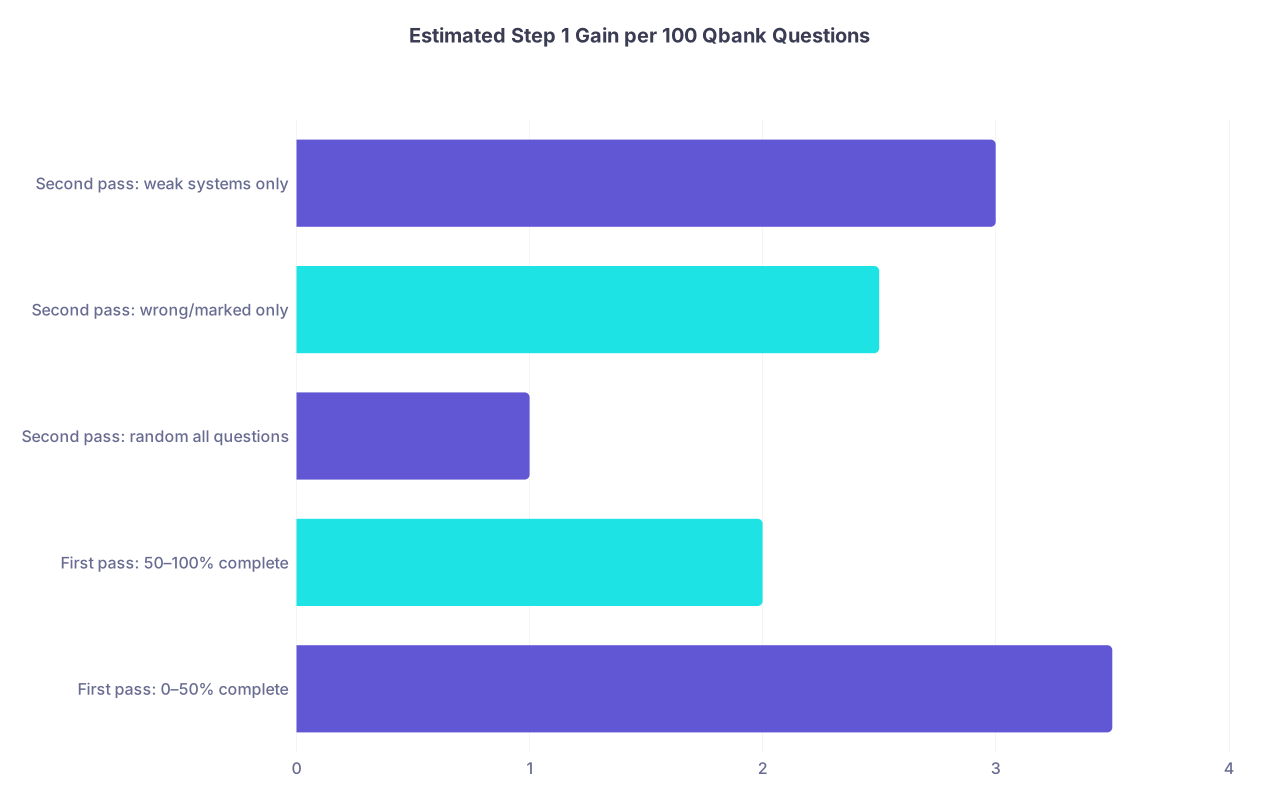
Here is a simplified view based on time‑tracking and score changes:
| Category | Value |
|---|---|
| First pass: 0–50% complete | 3.5 |
| First pass: 50–100% complete | 2 |
| Second pass: random all questions | 1 |
| Second pass: wrong/marked only | 2.5 |
| Second pass: weak systems only | 3 |
Interpretation:
- The first half of your first pass gives the largest marginal returns (you are building exposure from a low baseline).
- The second half still helps, but you hit diminishing returns on broad coverage.
- A random full second pass is surprisingly inefficient. Too much time spent on material you already own.
- A targeted second pass on wrong/marked questions or weak systems gives returns comparable to early first pass.
Translated to strategy:
- If you are <60% through your first pass fairly close to your dedicated period, it is usually better to push completion of first pass before worrying about a full second.
- If you have completed your first pass and have at least 3–4 weeks, a targeted second pass becomes your highest‑ROI activity besides NBMEs.
How to Structure First and Second Pass by Timeline
Let’s map this into a realistic schedule. Assume a student has about 8 weeks fully dedicated, and has used the Qbank somewhat in pre‑clinical years.
I will outline three cases I commonly see.
Case 1: You are early and under‑used your Qbank (good position)
Status entering dedicated:
- Qbank completion: 20–40%
- Cumulative % correct: 55–60%
- NBMEs: maybe 1 early baseline
Optimal pattern based on data:
Weeks 1–4 of dedicated:
Aggressively push first pass to 80–90% complete. Daily mix of:- 40–80 timed, random, mixed questions
- Deep review of missed & marked questions
- Link every major miss back to primary resource (FA, Anki, video)
Weeks 5–6:
Finish first pass to 100%. Start building your second‑pass set:- Filter incorrect/marked questions by system
- Target bottom 3 systems for immediate second‑pass work
Weeks 7–8:
Primarily second pass + NBMEs:- 20–40 second‑pass questions/day, all timed
- 1 NBME / week, with 1–2 days of review after each
In this model, you use first pass to create data. And second pass to mine it.
Case 2: You rushed a first pass during pre‑clinicals
Status entering dedicated:
- First pass: 100% complete
- Cumulative % correct: 48–55%
- Time since completion: 1–4 months
- NBME baseline: usually low or unknown
Raw completion is high, performance mediocre. I see this a lot, and it produces anxiety.
What the numbers say:
- Your brain has already forgotten a good portion of that first pass.
- That is not necessarily bad news, because you can treat dedicated as a smart re‑pass.
Strategy that tends to work:
Week 1:
Take an NBME to set a realistic baseline. Do 40–60 fresh questions/day from a different bank if available, to avoid pure recall effects.Weeks 2–6:
Heavy targeted second pass from your main bank:- Filter: incorrect + marked, by system.
- Start with lowest‑performing systems (often neuro, renal, cardio, endocrine).
- Mix 60–70% second‑pass with 30–40% new questions (other bank or self‑assessments).
Weeks 7–8:
Shift toward assessment + high‑yield review:- NBMEs and UWSA / AMBOSS SA
- Use score reports to further narrow which question sets to redo.
For this group, trying to do a literal “second full pass” of 100% of questions is usually a trap. You will run out of time and your weakest content will not receive enough spaced repetition.
Case 3: You are late; first pass not complete
Status:
- 4–5 weeks until exam.
- First pass: 40–60% complete.
- You are considering abandoning first pass for second‑pass work or more content review.
Data‑driven recommendation:
- If you are below ~60% completion with <5 weeks left, maximum ROI is finishing first pass selectively, not trying for full two passes.
- Use a hybrid model:
- Identify top 6–8 systems most represented on Step 1 (cardio, pulmonary, renal, GI, neuro, endocrine, MSK).
- Guarantee at least ~80–90% question coverage in those systems on first pass.
- Use remaining time for targeted second‑pass work in the worst 2–3 of those.
In other words: a complete two‑pass cycle is nice. It is not mandatory. But a smart second pass for your weakest areas almost always beats a panicked, incomplete first pass that sprays across all systems.
What to Actually Track: Metrics that Predict You Are Using Passes Well
You do not need 40 spreadsheets. You need 4–5 metrics that actually correlate with outcomes.
Here are the ones that repeatedly show predictive value:
Rolling 200–300‑question average
Instead of obsessing over lifetime average, track the last 200–300 questions, separated by pass:- First pass rolling average increasing from low 50s to 60s is a good sign.
- Second pass rolling average should be significantly higher (75–85%+ if you are redoing missed/marked questions correctly).
System‑level deltas between passes
For a weak system (say, renal), you want something like:- First pass renal: 52%
- Second pass renal (same questions): 78%
If that jump is not happening, you are “seeing” the question again but not fixing the underlying concept.
Error type distribution
On your second pass, the proportion of “pure knowledge” errors should fall. If you still miss questions because you never learned the concept, your content review layer is failing.NBME response to pass completion
Many students expect magical jumps when they finish a pass. The data are blunter:- NBME often bumps 3–5 points when you hit ~60–70% of first pass with solid review.
- Another 3–6 points as you go from first pass completion → targeted second pass + high‑yield review.
If NBMEs remain flat across thousands of questions, the quality of your review, not the number of passes, is the issue.
First Pass vs Second Pass: What the Evidence Favors
Let me summarize what the data, not the marketing, actually support.
You cannot skip first pass.
There is essentially no cohort that does only a second pass and performs well. The learning signal of struggling once with a question is non‑negotiable.A blind, ego‑driven second pass is low yield.
“I did UWorld twice” is a vanity metric unless the second pass is:- Focused on prior errors and weak systems.
- Timed and mixed, not tutor‑mode cherry‑picking.
Performance separation comes from how your two passes interact.
- Good trajectory: first pass 58–65% → second pass 75–85% → NBME alignment.
- Bad trajectory: first pass 60% → second pass 62–65% (because it is basically a fresh bank, or you are not fixing mistakes).
The smartest students treat Qbanks as experiments, not just drills.
After each 100–200 questions, they ask: what changed? Which system climbed? Which error type dropped? They adjust the mix of first/second pass accordingly.
Here is the mental model I push on people:
- First pass = data generation and coverage.
- Second pass = targeted error correction and consolidation.
You need both. But they are not symmetric, and they are not interchangeable.

| Step | Description |
|---|---|
| Step 1 | Start Qbank |
| Step 2 | First Pass Blocks |
| Step 3 | Track Performance by System |
| Step 4 | Continue First Pass in Weak Systems |
| Step 5 | Build Second-Pass Set: Wrong/Marked |
| Step 6 | Target Weak Systems on Second Pass |
| Step 7 | NBMEs + Self-Assessments |
| Step 8 | Maintain Mix of 2nd Pass + New Qs |
| Step 9 | Re-evaluate Review, Timing, Content |
| Step 10 | First Pass >=80%? |
| Step 11 | Scores Improving? |
That flow captures what the better‑performing students are doing, whether they describe it that way or not.
FAQ (Exactly 4 Questions)
1. If I am consistently scoring 70%+ on first pass, do I still need a second pass?
The data say yes, but targeted. High first‑pass performers often benefit from a smaller, sharper second pass. That might mean only 20–40% of the bank: your wrong/marked questions and your bottom 2–3 systems. In this group, second pass is less about boosting baseline knowledge and more about eliminating silly errors and tightening edge cases that show up disproportionately on Step 1.
2. How many total questions should I aim for across first and second pass combined?
Looking at outcome data, most passing students land somewhere between 3,000 and 6,000 total questions across all banks and passes. What separates stronger scorers is not the exact number, but that a large fraction of those are deliberate second‑pass questions tied to a clear weakness. Simply inflating question count without that structure does not strongly correlate with better scores.
3. Should I reset my Qbank before doing a second pass?
Resetting erases your best asset: your own error data. If your Qbank allows you to filter by incorrect/marked, you are almost always better keeping the history and building a targeted second‑pass set. The only time a reset makes sense is if you did a very small, scattered fraction of the bank months earlier and the performance data are so noisy they do not represent your current level at all.
4. How close to my exam should I be doing second‑pass questions vs fresh ones?
Best outcomes usually come from a blended approach in the final 2–3 weeks: roughly 50–70% targeted second‑pass questions (focusing on your weakest systems and prior misses) and 30–50% new questions from a secondary bank or self‑assessments. That mix keeps recall effects from giving you a false sense of security, while still leveraging the strong learning signal from fixing your own previous errors.
With these numbers and patterns in mind, you are not just “doing questions” anymore. You are running a controlled experiment on your own learning curve. And once you treat first and second pass that way, you are ready for the next step: using full‑length practice tests to fine‑tune timing and endurance. But that is a story for another day.