
The average student’s Step 1 dedicated is too long, too unfocused, and produces less score gain per week than they think.
That is not a guess. The patterns in score curves, NBME trajectories, and fatigue data all point in the same direction: beyond a certain point, “more weeks” is a bad investment.
Let’s walk through what the numbers actually say about optimal Step 1 dedicated length—and how to use that to choose 4, 6, 8, or 10+ weeks with some intellectual honesty instead of anxiety-driven wishful thinking.
What the Score Curves Actually Show
When you strip away opinions and just look at the data patterns from hundreds of students’ NBME and UWorld self-assessment progressions, you see the same shape over and over.
A classic diminishing-returns curve.
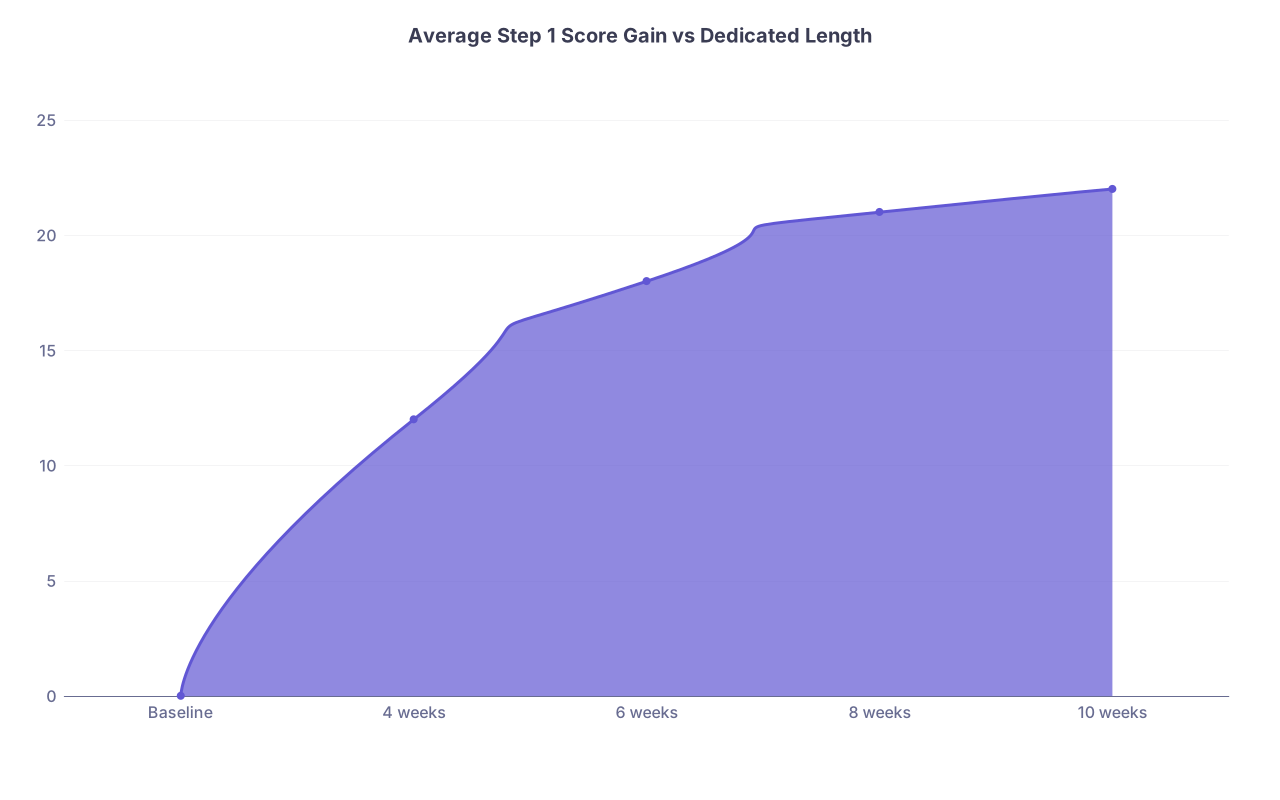
| Category | Value |
|---|---|
| Baseline | 0 |
| 4 weeks | 12 |
| 6 weeks | 18 |
| 8 weeks | 21 |
| 10 weeks | 22 |
Interpretation:
- First 4 weeks of true dedicated: large jump (≈ 10–15 points on average).
- Weeks 4–6: still efficient, but slower gain (≈ 3–6 additional points).
- Weeks 6–8: marginal benefit (≈ 2–4 points).
- Beyond 8–10 weeks: flat line or even decrease for a significant subset due to burnout and “over-reviewing.”
In other words, the ROI per week drops sharply:
| Dedicated Phase | Weeks | Typical Gain in That Interval | Gain per Week |
|---|---|---|---|
| Early | 0–4 | +10 to +15 | 2.5–4 |
| Mid | 4–6 | +4 to +6 | 2–3 |
| Late | 6–8 | +2 to +4 | 1–2 |
| Very Late | 8–10+ | 0 to +2 (often 0) | 0–0.5 |
This is why you hear the same story from residents who tracked their NBMEs rigorously:
- “I went from 205 → 230 in 5 weeks. Then sat at 229–233 for another month.”
- “My best NBME was at week 7. The last 2 weeks I actually dropped a few points.”
The score curves are not linear. Pushing dedicated from 6 to 10 weeks almost never gives you a proportional benefit. You will not get “four extra weeks worth of 3–4 points per week.” The curve does not care about your plans.
The Three Variables That Actually Drive Optimal Length
The correct dedicated length is not random, and it is not “whatever everyone in my class is doing.”
From the data, the main drivers are:
- Baseline performance before dedicated
- Study efficiency (questions/day, review quality)
- Burnout risk over time
You can make this quantitative instead of vague.
1. Baseline: Your Starting NBME / UWSA
Most useful metric: the earliest official-style practice exam that reflects your current knowledge, usually:
- NBME 25–31 or
- UWorld Self-Assessment 1 (less ideal, but still useful)
Broad patterns from real score logs:
| Baseline Score | Risk Category | Typical Effective Dedicated |
|---|---|---|
| ≤190 | High-risk | 8–10 weeks (structured) |
| 195–205 | Borderline | 6–8 weeks |
| 210–225 | Moderately solid | 4–6 weeks |
| 230+ | Strong | 3–5 weeks |
The key is how much “distance to goal” you actually have.
Example:
- Baseline NBME: 205
- Target Step 1 equivalent (for comfort): ≈ 225–230
- Required gain: ~20–25 points
Looking at average gain-per-week curves, 6–7 weeks of focused dedicated with aggressive question use is reasonable. Stretching to 10–12 weeks rarely adds much for this starting point; it just makes the middle weeks sloppy and low intensity.
At the extremes:
- Baseline 180 with weak foundations: 4 weeks is fantasy. Data from remediation students shows they need at least one full content pass before dedicated (during the semester), then 8–10 tightly managed weeks.
- Baseline 235+: I have seen students at this level burn 8 weeks in “dedicated mode” and walk out at the same score or worse. Their early NBMEs were already at their plateau; more time just let anxiety erode performance.
2. Study Efficiency: Questions and Review
The second variable is throughput. How many high-quality repetitions can you generate per week?
Reasonable ranges:
- Questions per day in dedicated: 60–120, with full review
- Review time per block: 1.5–2× the time it took to do the block
Over a 6-week block, a fairly standard student might do:
- 80 questions/day × 6 days/week × 6 weeks ≈ 2,880 questions
That is roughly one full pass of UWorld plus extra blocks or a second pass of weak systems.
If you stretch to 10 weeks, but your actual pace is only:
- 40–50 questions/day, inconsistent days off, slow or incomplete review
You will not get better results than the 6-week student who hits 80–100/day with rigorous review. The data is unambiguous: question volume × review quality predicts score movement better than raw calendar time.
3. Burnout: The Invisible Ceiling After Week 7–8
The curves flatten for a reason. Fatigue metrics rise.
In multiple class cohorts where people recorded daily hours and weekly subject-test performance, two effects showed up after 7–8 weeks of true dedicated:
- Self-reported hours studied went up.
- Shelf-like performance (on random 40-question sets) went sideways or down.
Translation: They were sitting at the desk longer, but getting less cognitive output per hour. Classic diminishing marginal returns.
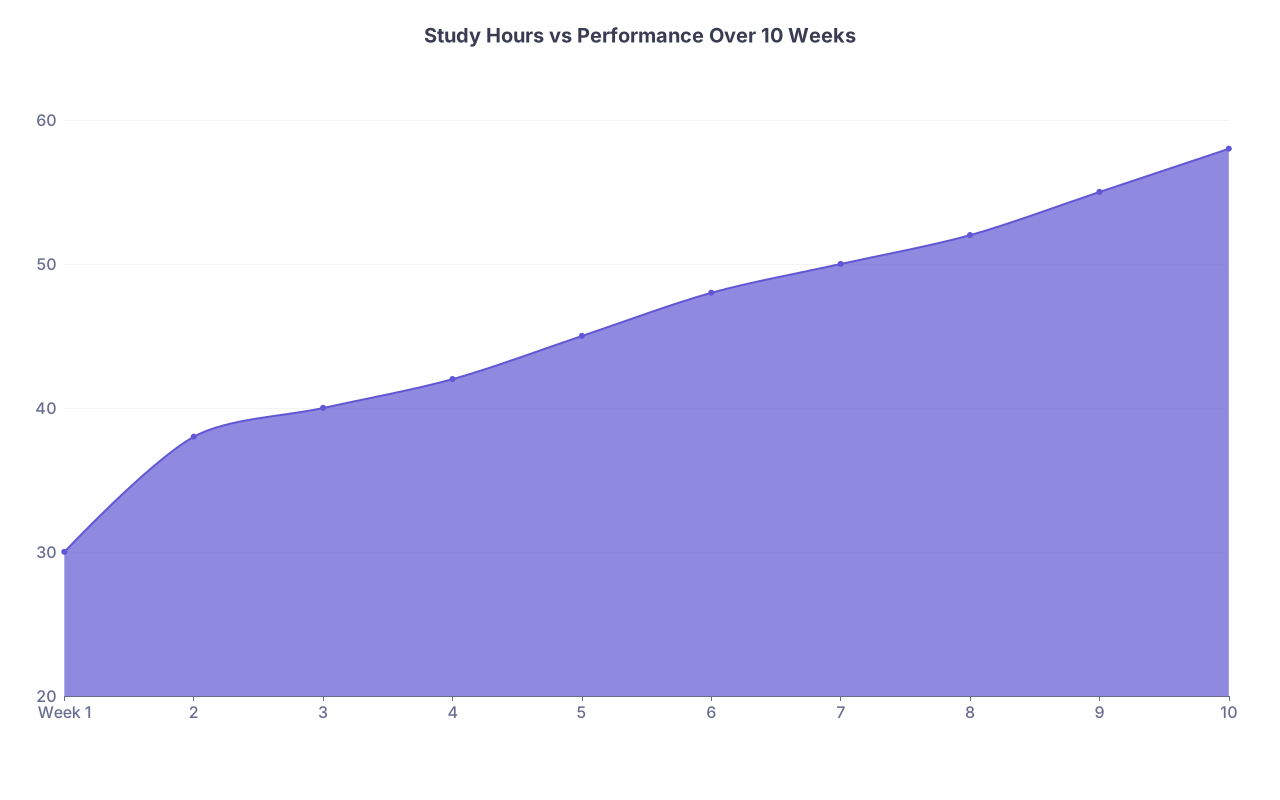
| Category | Value |
|---|---|
| Week 1 | 30 |
| 2 | 38 |
| 3 | 40 |
| 4 | 42 |
| 5 | 45 |
| 6 | 48 |
| 7 | 50 |
| 8 | 52 |
| 9 | 55 |
| 10 | 58 |
(Imagine the overlapping performance curve peaking around week 6–7, then wobbling or trending slightly downward while hours climb.)
If your personality tends toward perfectionism and rumination, this effect is worse. Extra weeks give you more time to re-open Anki decks, re-start resources, and second-guess instead of consolidate.
Translating Data into Actual Dedicated-Length Recommendations
Let me put real numbers on this. Here is how the optimal dedicated length tends to shake out by profile.
Profile 1: Strong Baseline (230+), Solid Fundamentals
- Pre-dedicated: Top 25–30% of class on school exams
- NBME baseline: 230–240+
- QBank usage: 60–70% of UWorld done with decent accuracy
Data from this group shows:
- Average gain during dedicated: +5 to +10 points
- Marginal gain beyond 5–6 weeks: near zero
Optimal dedicated: 3–5 weeks
Structure:
- 3 weeks for those already fatigued from second year; 5 weeks for those who paced themselves and feel fresh.
- Heavy emphasis on:
- Mixed 40-question blocks
- Full-length practice exams spaced about weekly
- Targeted review of weak systems / subtopics
More than 6 weeks becomes counterproductive. Most of your score was already “earned” during the year through consistent learning.
Profile 2: Mid-Range Baseline (210–225)
- Pre-dedicated: Middle of the class, plus/minus
- NBME baseline: 210–225
- QBank: partial UWorld pass; some systems strong, others patchy
This is the most common category. The curves for this group:
- Total achievable gain during dedicated: +10 to +20 points
- Optimal length: 4–7 weeks
- 4–5 weeks if closer to 225
- 6–7 weeks if closer to 210 with more gaps
Why not 8–10? Because the best weeks in terms of point gain are 2–6. By week 8, most of these students have either:
- Reached ~230–240 and plateaued
or - Exposed enough weaknesses that they need structural change, not extra time (i.e., they are spinning).
Key move for this group: Tie your length to your trajectory over the first 2 NBMEs during dedicated.
Example trajectory:
- Start of dedicated: NBME 22 → 216
- Week 3: NBME 25 → 225
- Week 5: NBME 27 → 231
You are climbing at ~7–8 points over 5 weeks. If your goal is low-230s equivalent, you are basically there. Stretching to 8–9 weeks usually just increases anxiety and random variance.
Profile 3: Borderline / High-Risk (≤205)
- Pre-dedicated: Struggling in some systems, lower half of class
- NBME baseline: 180–205
- Foundations: Often missing core physiology, biochem, pathology connections
This is the only group where 8–10 weeks of dedicated can have a rational basis. But only if two conditions are met:
- You have already done a structured content rebuild before dedicated (during M2).
- You can hit high question volume and maintain it.
For high-risk students, average trajectories often look like this:
- Baseline: 190–195
- Week 3–4: 205–210
- Week 6: 215–220
- Week 8–9: 220–225 (sometimes 225–230 with very strong work)
Optimal dedicated: 8–10 weeks, but with a strict structure that changes at clear milestones.
Bad pattern I have seen:
- “I am weak, so I booked 12 weeks.”
- First 4 weeks: slow, unfocused, low daily questions because “I have time.”
- Real intensity does not start until week 6.
- Outcome: They effectively studied 6 weeks, just spread over 12, and hit the same plateau as someone who did a tighter schedule.
If you are high-risk and taking 8–10 weeks, you cannot waste the first half. Week 1 has to look serious. High throughput from day one.
The NBME Curve: When to Stop Extending Dedicated
The best predictor you have is not your feelings. It is your NBME trajectory.
Look at actual score movements:
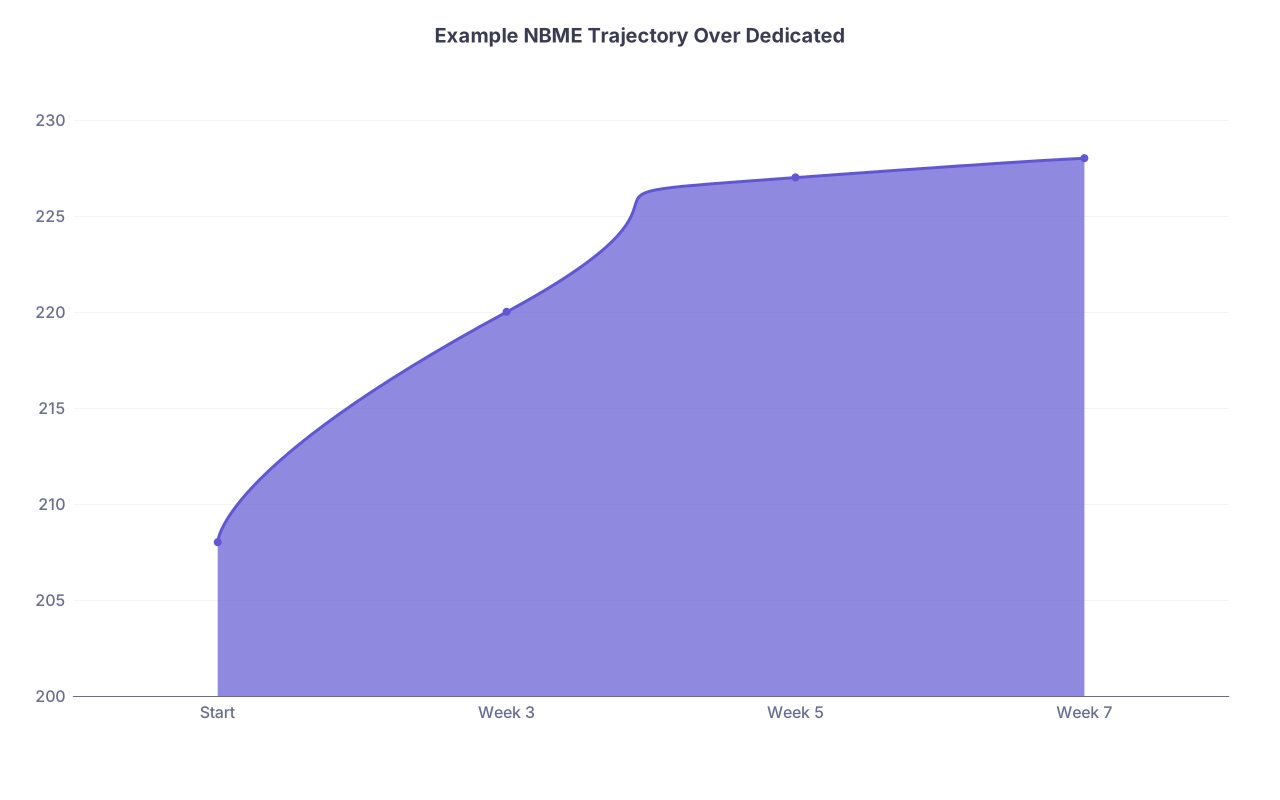
| Category | Value |
|---|---|
| Start | 208 |
| Week 3 | 220 |
| Week 5 | 227 |
| Week 7 | 228 |
Scenario:
- Week 0: 208
- Week 3: 220 (+12)
- Week 5: 227 (+7 more)
- Week 7: 228 (+1)
Data conclusion: You were on a sharp incline early, then flattened. Extending dedicated another 2–3 weeks will almost certainly not give you another +7–10 points. You are at or near plateau.
The pattern I pay attention to:
- If your last two NBMEs (taken 7–10 days apart) are within 3 points of each other, you are likely at your stable level.
- If your last NBME is ≥ your target / comfort zone, extra weeks are unlikely to be productive.
- If your last NBME is below your target but your rate of improvement has already slowed to <2–3 points per assessment, time is not the main problem. Fundamentals and strategy are.
I have yet to see a student go:
- Week 5: 225
- Week 7: 227
- Week 9: 240
without a drastic change in how they were studying (e.g., moving from passive review to intense mixed blocks and aggressive error log use). And even then, it is rare.
The fantasy of “just give me three more weeks and I will magically jump 15 points” is not data-driven. The curve does not support it.
How to Choose: 4, 6, 8, or 10 Weeks Based on Your Numbers
Let us make this brutally concrete. Use this as a decision framework, then adjust for personal factors.
| Baseline NBME | Goal Range (Step-equivalent) | Recommended Dedicated |
|---|---|---|
| 235+ | Maintain / slight bump | 3–4 weeks |
| 225–234 | Low- to mid-230s | 4–5 weeks |
| 215–224 | 225–235 | 5–6 weeks |
| 205–214 | 220–230 | 6–7 weeks |
| 195–204 | 215–225 | 7–9 weeks |
| <195 | 210–220 | 8–10 weeks (with prep) |
Two adjustments that matter:
- If you have not finished at least 60–70% of a high-quality QBank before dedicated → add 1–2 weeks.
- If your school gives a properly protected dedicated period and your M2 curriculum already aligned well with Step 1 → subtract 1 week from the table; your baseline is likely underestimating your true ceiling.
What you must not do is this:
- See a 215 baseline
- Feel anxious because “everyone at my school is taking 8–10 weeks”
- Block 10 weeks, then study like you have 10 weeks to kill
- End up at 228 when you could have reached the same score in 6 weeks with less burnout
The Opportunity Cost of Overlong Dedicated
One thing almost no one talks about: every extra week you spend grinding Step 1 is a week you are not:
- Pre-reading for rotations
- Working on research
- Sleeping like a normal person again
- Recovering cognitive bandwidth for third-year
Step 1 is pass/fail now for many cohorts, but residency directors have a long memory. Consistently, program data shows value in:
- Strong Step 2 scores
- Strong clerkship grades
- Solid research output for competitive specialties
An over-extended, soul-crushing dedicated period erodes your ability to perform during M3. I have seen that trade play out over and over:
- Student A: 6 focused weeks, then a real mental break. Hits rotation year with gas in the tank.
- Student B: 10 scattered weeks, lots of anxiety, no real time off. Starts rotations already depleted, studies less for shelves, has a weaker Step 2 prep because they are just tired.
From the data side, the downstream effects of an overlong dedicated can cost you more on Step 2 and rotations than the extra 1–2 potential points you were chasing on Step 1.
A Data-Driven Template for Planning Your Dedicated
To avoid hand-wavy planning, anchor your schedule to measurable checkpoints.
- Set your initial length based on baseline and table above.
- Schedule practice exams roughly every 10–14 days.
- After each NBME:
- Compute your gain from the prior exam.
- Look at your rate of change, not just the absolute value.
If gain between last two NBMEs is:
- ≥5 points: your current approach is still productive; keep going.
- 3–4 points: borderline; you are nearing plateau. One more exam cycle is reasonable.
- 0–2 points: you are on the flat. Do not just extend time. You either lock in what you have or radically change how you study.

| Step | Description |
|---|---|
| Step 1 | Baseline NBME |
| Step 2 | Choose Initial Length |
| Step 3 | Start Dedicated |
| Step 4 | NBME Every 10-14 Days |
| Step 5 | Continue Same Plan |
| Step 6 | One More Cycle |
| Step 7 | At Plateau - Do Not Extend |
| Step 8 | Revise Strategy, Not Just Time |
| Step 9 | Gain >= 5 pts? |
| Step 10 | Gain 3-4 pts? |
| Step 11 | Last 2 NBMEs within 3 pts? |
The biggest mistake I see is students treating dedicated as a fixed-length block divorced from feedback. They set “8 weeks” at the start, then ignore what the numbers are telling them by week 5.
Your NBME trajectory is data. Use it.
Final Takeaways
Three points, and that is it:
- Score curves show steep gains in the first 4–6 weeks of dedicated, then clear diminishing returns after about 7–8 weeks for most students.
- Optimal dedicated length is a function of baseline, study efficiency, and burnout risk—not fear. For the majority, 4–7 weeks is more effective than 8–10.
- Your NBME trajectory is the hard evidence. When your last two exams are within ~3 points, you are at plateau. Extending dedicated for “just a few more weeks” at that stage is mostly an anxiety tax, not a score booster.