
The average Step 1 student guesses how to use their time. Top scorers do not. Their schedules are basically time-budget spreadsheets with a pulse.
This is about those budgets. How the 240–260+ crowd actually allocate hours, in percentages, not vibes.
The Big Picture: How Top Performers Slice Their Time
Across score reports, schedule breakdowns, and self-reported data from high scorers (245+), a consistent pattern emerges. The details vary, but the proportions converge.
Here is the typical time allocation I see among top Step 1 performers over their dedicated study period (4–10 weeks):
| Category | Percent of Total Study Time |
|---|---|
| Question banks (UWorld + others) | 35–45% |
| Review of questions (post-block) | 20–25% |
| Core resources (First Aid/Boards) | 10–15% |
| Anki / spaced repetition | 10–20% |
| Videos (Pathoma, B&B, Sketchy) | 5–10% |
| Self-assessments (NBME, UWSA) | 3–5% |
To simplify, you can think in three macro-buckets:
- ~60–70%: Question-centric (doing + reviewing questions)
- ~20–30%: Memory maintenance (Anki / spaced repetition)
- ~10–15%: Content scaffolding (videos + reading)
Top performers are not reading all day. They are interrogating themselves with questions, then using content as a patch for weak spots.
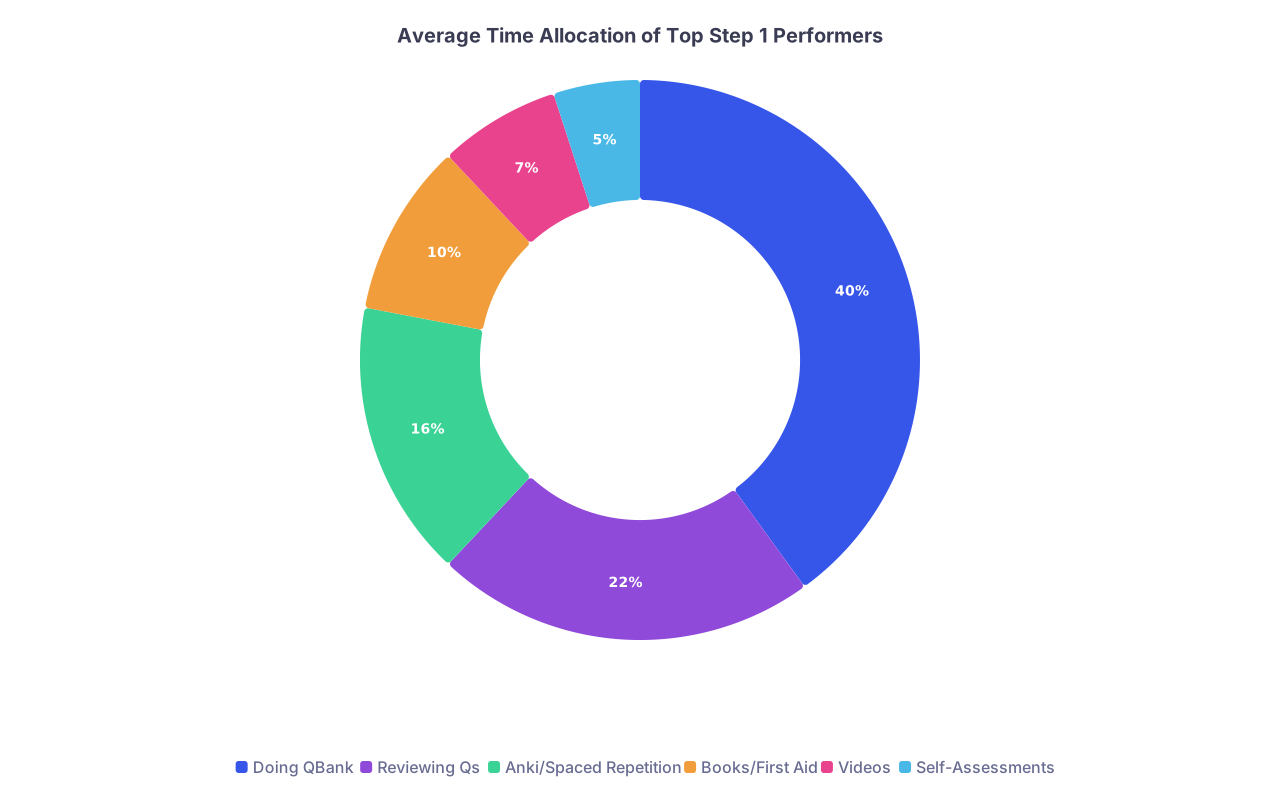
| Category | Value |
|---|---|
| Doing QBank | 40 |
| Reviewing Qs | 22 |
| Anki/Spaced Repetition | 16 |
| Books/First Aid | 10 |
| Videos | 7 |
| Self-Assessments | 5 |
Core Engine: Question Banks and Review (55–65%)
The data from dozens of shared schedules and debriefs converges on one hard rule: question banks dominate. Not optional. Not “when I feel ready.” It is the center of gravity.
1. Doing questions: ~35–45%
For top scorers, the question bank is not a diagnostic tool used at the end. It is the curriculum.
Patterns:
Daily question volume during dedicated:
- Lower 240s: ~60–80 questions/day
- 250+: ~80–120 questions/day
- 260+: 100+ is common (not day 1, but peak weeks)
Total UWorld questions completed:
- 1.0x full pass (all questions) is basically a minimum.
- 1.3–1.8x is common in the 250+ group (often second pass is timed, random).
Block structure:
- 40-question blocks, timed, simulating real exam pressure.
- Few high scorers do exclusively tutor mode; if they use tutor, it is usually early and transitions to timed within 2–3 weeks.
UWorld is the main driver. Secondary banks (AMBOSS, Kaplan) come in if there is time and cognitive bandwidth. But the marginal returns after 1.5–2 full question banks drop sharply if review quality falls.
I have seen the disaster pattern: 120 questions per day, 30 seconds of review per item. High volume, low comprehension. Scores stall in the 215–225 range.
Top performers flip that: they guard review time like gold.
2. Reviewing questions: ~20–25%
This is the underappreciated slice. For high scorers, review is often as long or longer than the time spent doing the block.
Common ratios in top-score study logs:
- 1 hour of questions → 1.5–2 hours of review.
- 40-question block (60 minutes) → 90–120 minutes of review.
What "review" actually looks like for them:
- Reading the full explanation, including why wrong answers are wrong.
- Tagging questions by system/topic (e.g., “renal phys,” “glycolysis regulation,” “Type II hypersensitivity”).
- Annotating First Aid or a digital notebook with patterns, not raw facts.
- Creating or updating Anki cards for conceptual gaps.
Less common among top performers:
- Rewriting entire UWorld explanations.
- Making fancy color-coded notes that never get re-read.
Time allocations within that review slice often look like this:
- ~50–60%: Deep dive on missed or guessed questions.
- ~20–30%: Confirmational pass on confident-correct questions (very quick).
- ~10–20%: Transferring high-yield nuggets to Anki / notes.
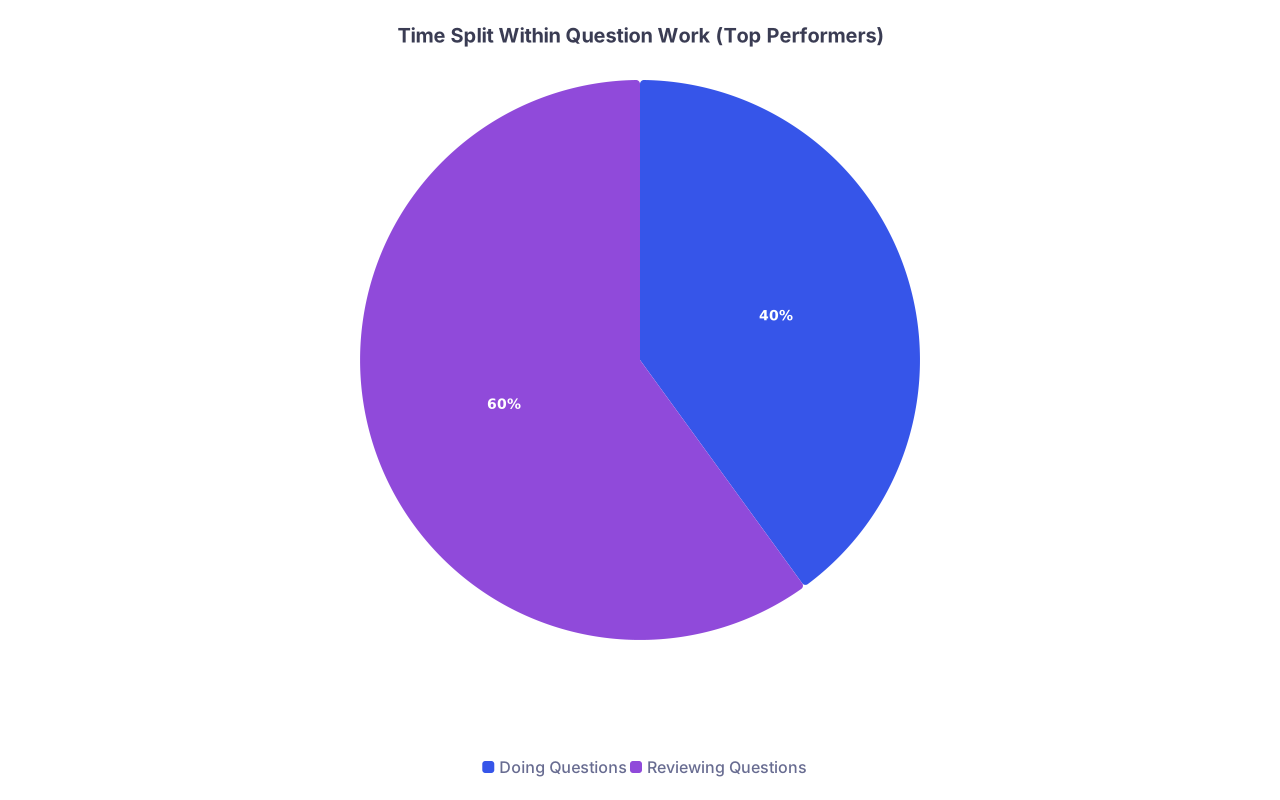
| Category | Value |
|---|---|
| Doing Questions | 40 |
| Reviewing Questions | 60 |
The data is clear: it is not “100 questions vs. 40 questions” that separates 220 from 250. It is depth of review per question that drives the curve upwards.
Memory Backbone: Anki and Spaced Repetition (10–20%)
You can brute-force content for an NBME next week. You cannot brute-force 18 months of mechanistic detail for Step 1 without a spaced repetition backbone.
Top scorers who are efficient almost always have one of two patterns:
- Long game: They used Anki throughout MS1/MS2 (e.g., AnKing / Bros deck).
- Hybrid game: They start Anki late but use it aggressively in the 3–6 months pre-dedicated.
During dedicated, daily Anki time looks like this for high scorers:
- Early dedicated: 60–120 minutes/day.
- Mid dedicated: often 45–90 minutes/day, tuned to workload.
- Late dedicated (final 2 weeks): 30–60 minutes/day, with heavier focus on questions and self-assessments.
Volume-wise, I have seen:
- Mature Anki users: 800–1,500 reviews/day in peak months, then scaled down.
- Late starters: 300–700 reviews/day, highly targeted to weak systems and pharm/micro.
Time share of total study day:
- Low users: ~10% of day on Anki.
- Heavy users: up to ~25% in prep months, ~15–20% during dedicated.
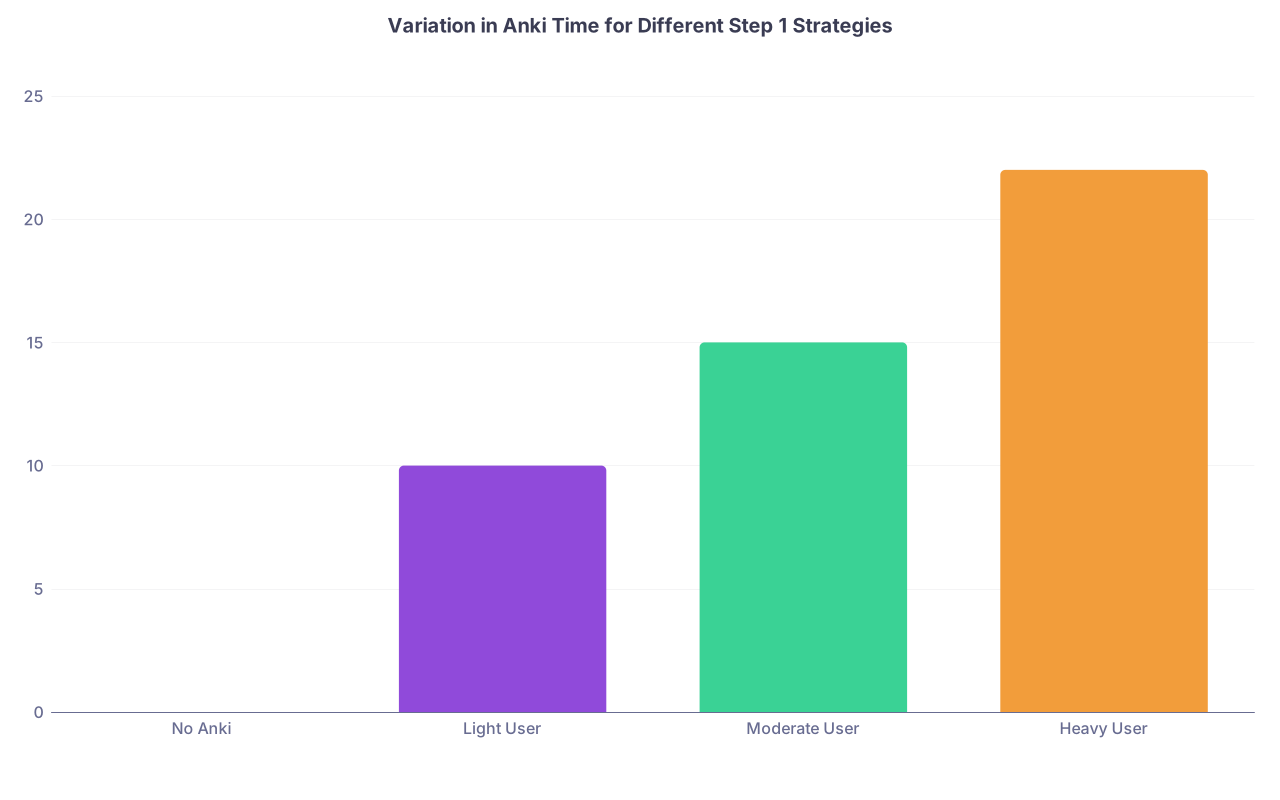
| Category | Value |
|---|---|
| No Anki | 0 |
| Light User | 10 |
| Moderate User | 15 |
| Heavy User | 22 |
The relationship with scores:
- Students with 0 structured spaced repetition who still score 250+ are statistical outliers with absurdly good natural recall or prior backgrounds (e.g., PhD in relevant field).
- For the majority, consistent spaced repetition correlates with:
- Less last-minute cramming.
- Higher NBME stability (less volatility between exams).
- Better performance in “easy but detail-heavy” questions (pharm mechanisms, enzyme deficiencies, weird bugs).
If you want hard numbers for planning:
- Dedicated period of 8 weeks, 10 hours/day → 560 total hours.
- A “top-performer” allocation might be:
- 80–100 hours to Anki (14–18%).
- 250–300 hours to questions + review (~55%).
- Remaining on reading, videos, self-assessments.
- A “top-performer” allocation might be:
Content Scaffolding: Books and Videos (15–25%)
This is where weaker students typically overspend time. They read and watch as if Step 1 were a content-recognition exam. It is not.
The high performers invert that: content is supportive, not primary.
First Aid / Boards & Beyond / Condensed Notes (10–15%)
Most high scorers treat First Aid (or a similar board book) as the master index rather than a first-read textbook.
Patterns:
- 1–2 fast passes months before dedicated.
- During dedicated:
- 30–90 minutes/day of FA or condensed notes.
- Often targeted to whatever systems/questions crushed them that day.
For a typical 8-week dedicated block, total reading time might be:
- 60–90 hours total on FA/condensed notes.
- Compare that to ~300+ hours on QBank-related activities.
If you are currently spending 5–6 hours/day “going through First Aid line by line,” you are already off the distribution that repeatedly produces 240+.
Videos (5–10%)
Videos are high-yield at one thing: building or repairing intuition.
Top performers lean on:
- Pathoma (especially for students with weaker path foundations).
- Sketchy (micro/pharm heavy coverage, used earlier in MS2 more than in dedicated).
- Boards & Beyond / similar to plug fundamental gaps.
But during dedicated, video time shrinks.
Typical dedicated allocation:
- Average: 30–60 minutes/day of video.
- Heavy gap-filling days: ~2 hours, but offset by less reading that day.
Over an entire 6–8 week dedicated period, you will often see:
- 30–50 total hours of video for top scorers.
- Heavy video users (>80–100 hours dedicated solely to video) rarely crack 250 unless their question volume and review depth also somehow remain high, which usually they do not.
Self-Assessments and Simulation (3–5%)
This slice is small in hours but massive in impact. High performers use NBME and UWSA exams as steering tools, not just ego metrics.
A typical pattern for 240–260+ students:
- Total full-lengths: 5–7 standardized tests:
- NBME forms (3–5 of them).
- UWSA 1 and 2.
- Sometimes Free 120 as a final calibration.
Each exam:
- 4 blocks × 40 questions (or similar) + breaks → ~4–5 hours.
- Review: 4–6 hours, sometimes split over 2 days.
Total time per exam cycle: ~8–10 hours.
Across 6 exams, that is 50–60 hours. In an 8-week dedicated period (560 hours total), that is about 9–11% of time.
Why the earlier table and doughnut show 3–5%? Because some of that is double-counted as “questions + review.” If we purely label unique self-assessment events, they visually look small; but they heavily shape how the other 90+% of hours are distributed.

Top performers do something weaker test-takers avoid: they obey the data.
- Score drops on NBME 27 vs. NBME 25? They cut back on micro videos and push more renal phys questions.
- Plateau at 230 for three tests? They change something drastic: time allocation, question review method, sleep schedule.
Subjective feelings (“I think cardio is weak”) matter less than NBME subscores.
How This Translates Into a Daily Schedule
Percentages are abstract. Let’s map them into hours.
Assume you are in an 8-week dedicated block, fairly aggressive but common among strong students:
- 10 hours/day, 6 days/week → 60 hours/week.
- That is 480 hours in 8 weeks (we will ignore any 7th-day light review for simplicity).
Aim for a high-performer distribution:
- QBank (doing) – 40%
- QBank (review) – 22%
- Anki – 16%
- Books/FA – 10%
- Videos – 7%
- Self-assessments (unique time, outside of QBank) – 5%
A typical non-exam day might look like:
- 2.5–3 hours: Doing UWorld questions (80–100 questions).
- 3–3.5 hours: Reviewing those UWorld questions.
- 1.5 hours: Anki.
- 1 hour: FA / notes targeting systems hit that day.
- 1 hour: Video for weakest current topic.
That is very close to:
- 5.5–6.5 hours on QBank-related activity (55–65%).
- 1.5 hours (15%) on spaced repetition.
- 2 hours (20%) on content scaffolding.
On a self-assessment day:
- 4 hours: NBME/UWSA exam.
- 4–5 hours: Review (can spill into next day).
- 1–2 hours: Light Anki and small-topic patching.
The big mistake is thinking you can keep your “normal day” and just tack NBME on top. High performers temporarily reallocate to let the data from that exam actually change their plan.
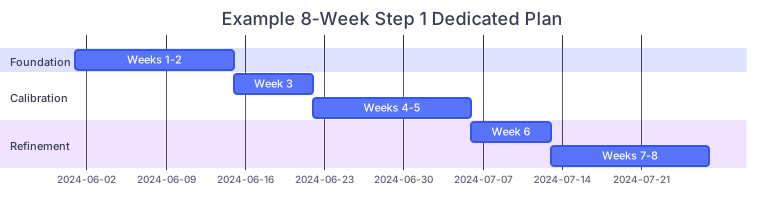
| Task | Details |
|---|---|
| Foundation: Weeks 1-2 | High QBank Volume & Review :a1, 2024-06-01, 14d |
| Calibration: Week 3 | NBME + Adjustments :a2, 2024-06-15, 7d |
| Calibration: Weeks 4-5 | Targeted Weak Areas :a3, 2024-06-22, 14d |
| Refinement: Week 6 | NBME + Intensive Review :a4, 2024-07-06, 7d |
| Refinement: Weeks 7-8 | Mixed Qs & Light Content :a5, 2024-07-13, 14d |
Pre‑Dedicated vs Dedicated: The Hidden Variable
If you only look at dedicated, you miss half the story. Top performers do not magically compress everything into 6–8 weeks.
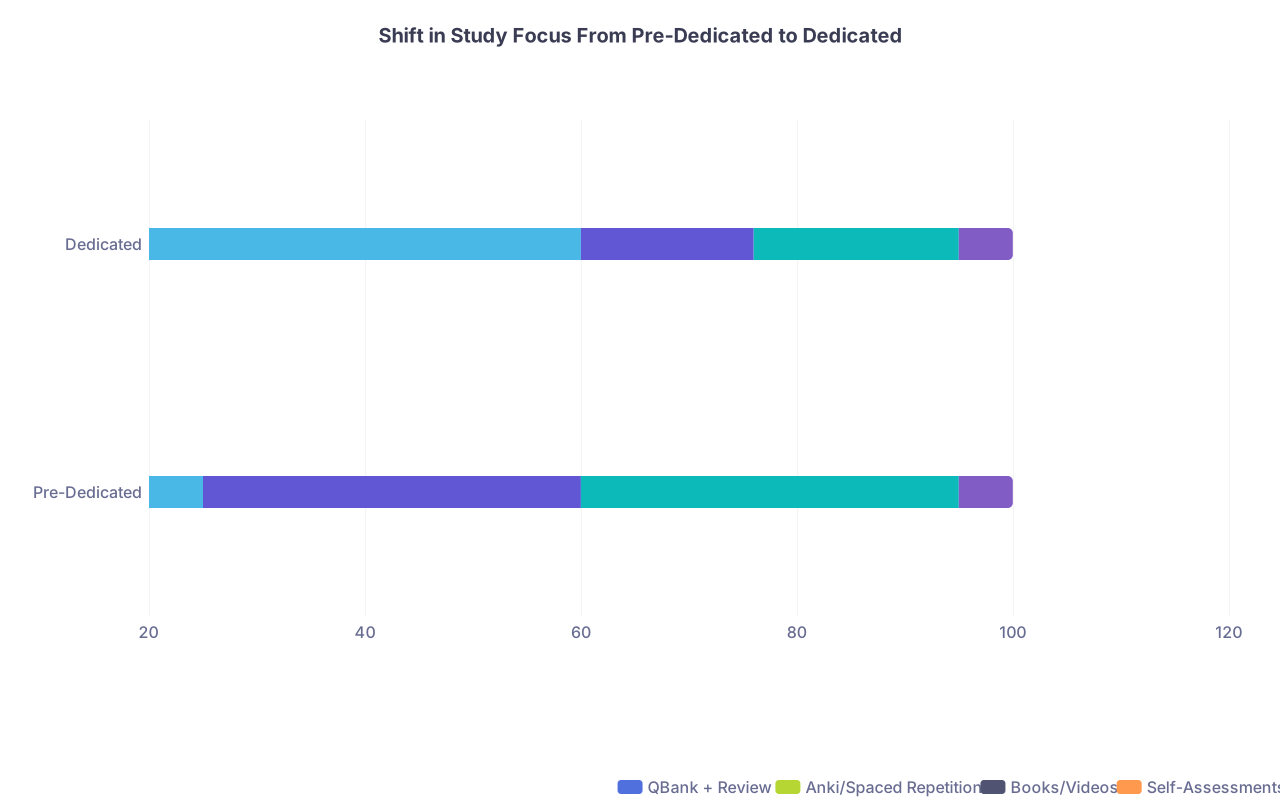
Over the full pre-clinical + dedicated arc, their time allocation looks different:
Pre-dedicated (MS1/MS2 months):
- Anki/spaced repetition: 25–40% of board-related study.
- Content videos: 30–40%.
- QBank (light, system-based): 20–30%.
- Reading/FA: 10–20%.
Dedicated:
- Anki: 10–20%.
- QBank + review: 55–65%.
- Content (books + videos): 15–25%.
- Self-assessments: 3–5%.
| Category | QBank + Review | Anki/Spaced Repetition | Books/Videos | Self-Assessments |
|---|---|---|---|---|
| Pre-Dedicated | 25 | 35 | 35 | 5 |
| Dedicated | 60 | 16 | 19 | 5 |
You can see the tilt: early on, memory foundation and concepts dominate. Later, questions and application take over.
Students who ignore boards until dedicated have to compress this entire migration into a few weeks. Statistically, they do not end up in the 250+ cluster. They may pass, but they swim upstream the entire time.
How to Adjust Based on Your Baseline
Not everyone should copy-paste a “260+ schedule.” The data implies direction, not a single template.
Here is how I would tune percentages based on where you stand today:
| Baseline Type | QBank + Review | Anki | Content (Books+Videos) | Self-Assess |
|---|---|---|---|---|
| Strong school exams, weak boards prep | 60–65% | 10% | 20–25% | 5% |
| Strong memorizer, weak application | 65–70% | 10–15% | 15–20% | 5% |
| Strong QBank history, poor retention | 55–60% | 20–25% | 15–20% | 5% |
| Starting late, content gaps everywhere | 50–55% | 15–20% | 25–30% | 5% |
Notice what never disappears:
- Question work + review is never under 50%.
- Self-assessments always get a small but protected slice.
- Anki/spaced repetition is present in all realistic top-score patterns.
If you find yourself with a schedule skewed like:
- 40% videos
- 30% reading
- 20% questions
- 10% “miscellaneous”
You are basically training for a different exam. One that does not exist.

The Data-Driven Bottom Line
Three key points, stripped of fluff:
Top Step 1 performers allocate the majority of their time (55–65%) to questions and deep review, not to reading or videos. Volume matters, but review quality drives the high scores.
Spaced repetition (Anki or equivalent) consistently shows up as 10–20% of total study time during dedicated and much more pre-dedicated, acting as the memory backbone that makes high-volume question work stick.
Content resources (First Aid, videos) are support players, not the lead—together usually 15–25% of time for high scorers, targeted toward gaps identified by NBME/UWorld data, not driven by comfort or habit.
If your current schedule does not roughly match those proportions, the numbers suggest you are training like an average scorer, not a top performer. Adjust the percentages; your score will follow.