
The biggest mistake students make with NBME Step 1 practice tests is simple: they look at single scores instead of trajectories.
The data shows something very clear. Week-by-week NBME performance tells a much richer story than any isolated number. A 210 can be good news or bad news depending entirely on the slope of the line that got you there.
Let me walk you through how to read that line properly—like a data analyst, not a panicked test-taker.
1. What a “Score Trajectory” Actually Is
Forget the drama for a second. At its core, your NBME Step 1 trajectory is just a time series.
You have:
- A sequence of time points (usually weeks in dedicated)
- A sequence of scores (NBME predicted scores or percent correct)
Put them together and you have a trajectory.
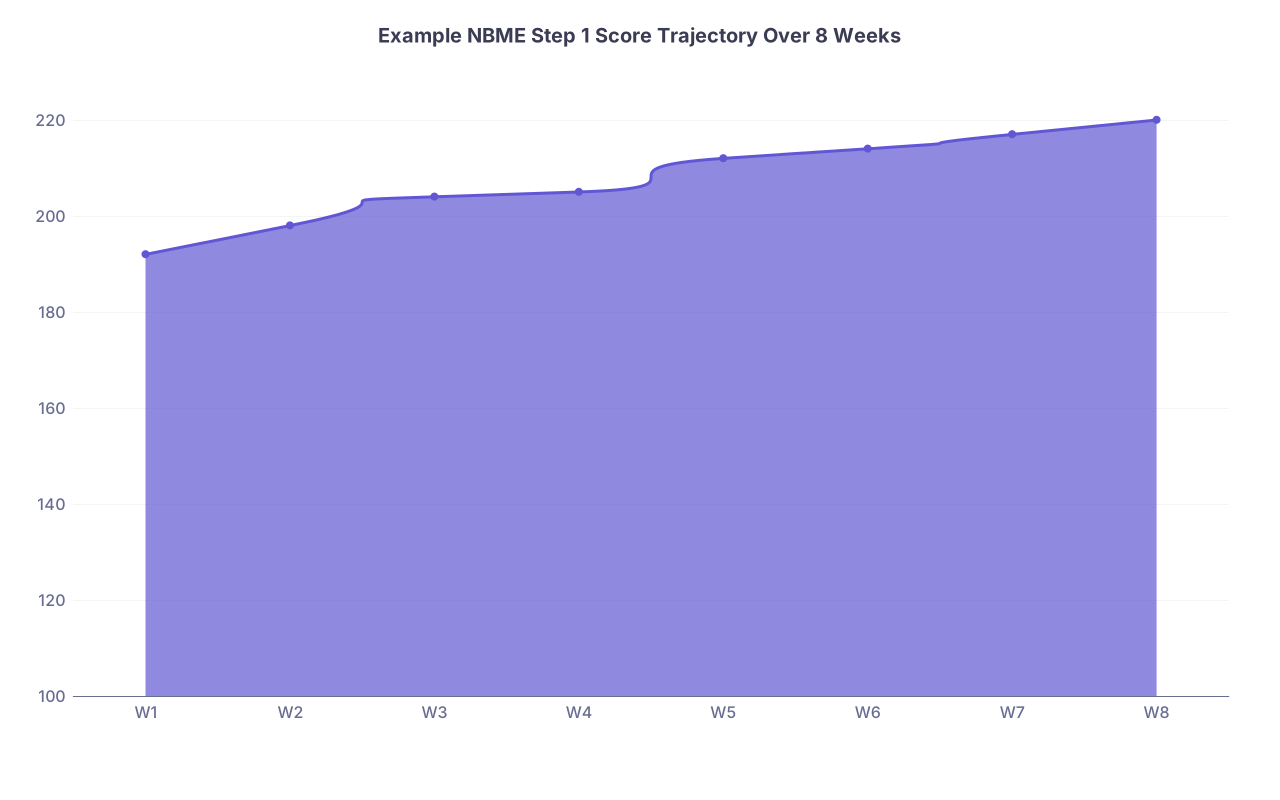
| Category | Value |
|---|---|
| W1 | 192 |
| W2 | 198 |
| W3 | 204 |
| W4 | 205 |
| W5 | 212 |
| W6 | 214 |
| W7 | 217 |
| W8 | 220 |
This fake student is not a genius. But the line is doing exactly what you want it to do: slow, steady upward drift. No big jumps. No crashes.
Most real students do not have this neat of a graph. Real trajectories look messy:
- Flat for 2–3 weeks then a jump
- One catastrophic NBME that looks like the apocalypse
- Big early improvements, then a hard ceiling
The question is not “Is my score good?” The question is “Is my trajectory healthy for where I am in the calendar?”
2. Typical Step 1 Score Growth: What the Numbers Say
There is no official NBME “growth curve” published, but after looking at hundreds of score logs from students, some patterns keep repeating. I am going to simplify them into something practical.
You can think of NBME growth in three broad phases:
- On-ramp phase (first 2–3 NBMEs)
- Linear phase (middle of dedicated)
- Plateau / asymptote phase (final weeks)
2.1 The On-Ramp Phase: Big Early Gains
This is where students often see their largest single-test jumps.
Going from:
- 180 → 195
- 190 → 205
- 200 → 212
Those 10–15 point jumps early are common. They are not magic. They are just you learning the test format, fixing pure knowledge gaps, and getting used to timing.
If you start around 170–190 on your first NBME and you are more than 6–8 weeks from test day, the data from real students suggests:
- 5–10 point gains per NBME in the first 3–4 exams are very realistic
- The total early jump of 20–30 points over 4–6 weeks is not unusual
The catch: that rate does not last.
2.2 The Linear Phase: Predictable but Slower
After the first ~3 NBMEs, gains usually slow. The line flattens into something more linear:
- 3–6 points per NBME
- Or 4–8 points over 2 weeks if you test biweekly
This is the “grind” zone.
If you are:
- Taking an NBME every 7–10 days
- Doing 60–80+ UWorld questions per day and actually learning from them
- Reviewing missed content aggressively
Then the typical slope in this period is meaningful but not wild.
2.3 The Plateau Phase: Marginal Gains Only
Almost everyone plateaus.
For most students this happens somewhere between 210–235, depending on their ceiling. Gains after that are usually:
- 0–3 points per NBME
- Sometimes even a “down then up” pattern
That last 5–10 points takes a disproportionate amount of effort. You are no longer fixing “you do not know this topic at all” problems. You are trimming random errors, fatigue mistakes, and subtle content gaps.
If your scores are:
- Bouncing between, say, 222, 219, 225, 224 over 3–4 weeks
- While your test is 1–2 weeks away
That is not failure. That is pretty much what a plateau looks like.
3. Interpreting Different Score-Shape Patterns
You are not just trying to get “higher.” You are trying to understand the shape of your trajectory.
Let us classify a few common shapes.

Pattern A: Steady Upward Slope
Example:
- Week 1: 192
- Week 2: 198
- Week 3: 203
- Week 4: 209
- Week 5: 213
- Week 6: 217
Key features:
- Gains of 4–6 points per week
- No major drops
- Slight deceleration near the top is acceptable
Interpretation:
- This is the “healthy” pattern. Your study system is working.
- With 2–3 weeks left, you are likely to land near the extrapolated trend, not below it (assuming no burnout, no illness, no major life disruption).
Pattern B: Flatline → Jump → Flatline
Example:
- Week 1: 195
- Week 2: 196
- Week 3: 197
- Week 4: 207
- Week 5: 208
- Week 6: 209
Key features:
- Long plateau
- One distinct jump
- Then another smaller plateau
Interpretation:
- This usually signals a structural change: you started actually reviewing questions properly, you fixed a subject (e.g., biochem), or you switched resources.
- The post-jump plateau is not failure. It is a new baseline.
What to do:
- Try to “force” one more structural improvement: better review, more targeted Anki, focused on your worst two systems.
- Stop expecting another 10-point miracle. Aim for 3–5 points more.
Pattern C: Up, Down, Up
Example:
- Week 1: 205
- Week 2: 212
- Week 3: 206
- Week 4: 214
Key features:
- Non-trivial drop mid-way
- Recovery afterward
Interpretation:
- Almost always a combination of:
- Bad test conditions (sleep, anxiety, noise)
- A content-heavy form that hit your weak areas
- Fatigue / burnout around the middle of dedicated
Singular drops are data points, not destiny. Look at what happens after the drop.
If you recover or exceed the prior high on your next NBME, the downward spike was noise, not a new trend.
Pattern D: Early Gains, Then Harsh Ceiling
Example:
- Week 1: 185
- Week 2: 198
- Week 3: 208
- Week 4: 214
- Week 5: 216
- Week 6: 217
- Week 7: 217
This is psychologically brutal. But typical.
Interpretation:
- You have harvested most of the low-hanging fruit.
- Weak “big block” subjects (pharm, micro, biochem) are now the primary barrier. Not random mistakes.
- Your final score is likely to fall within ±5 points of that ceiling unless you change something fundamental and you have time to let that change work.
If your goal score is far above that ceiling and you are <2 weeks out, something hard may need to be discussed: postponement.
4. Time Remaining vs. Target Score: A Quantitative Reality Check
You cannot talk about trajectories without talking about time. A 205 three months out is not the same as a 205 ten days out.
Let us quantify the typical rate of change that is actually realistic.
I will define a “reasonable” max average gain in the middle of dedicated as about 4–5 points per week, if:
- You are working full-time on Step
- You are not starting extremely high (230+)
Now use that to build a sanity check.
| Weeks to Exam | Reasonable Max Total Gain | Who This Applies To |
|---|---|---|
| 6–8 | ~20–30 points | Below 220 starting scores |
| 4–5 | ~12–18 points | 190–220 starting scores |
| 2–3 | ~6–10 points | Most students |
| 1–2 | ~0–5 points | Marginal gains, mostly consolidation |
If you are at 205 with 2 weeks left and saying “I want a 240,” the math is against you. You need a 35-point jump in 14 days. The typical data from hundreds of students does not support that.
On the other hand, 205 with 6–7 weeks left and a goal of 225–230 is very reasonable, if your trajectory is upward and your daily work is structured.
5. How Many NBMEs and How Often?
You cannot interpret trajectories if you have only two data points. Two NBMEs is a line, but it is a fragile one.
A practical schedule that generates useful data looks like this:
- Start of dedicated: 1 baseline NBME
- Then: 1 NBME every 7–10 days
- Final 2 weeks: 2–3 assessments (NBMEs + UWSAs)
That gives you 5–8 total data points, which is enough to see a trend shape instead of random noise.
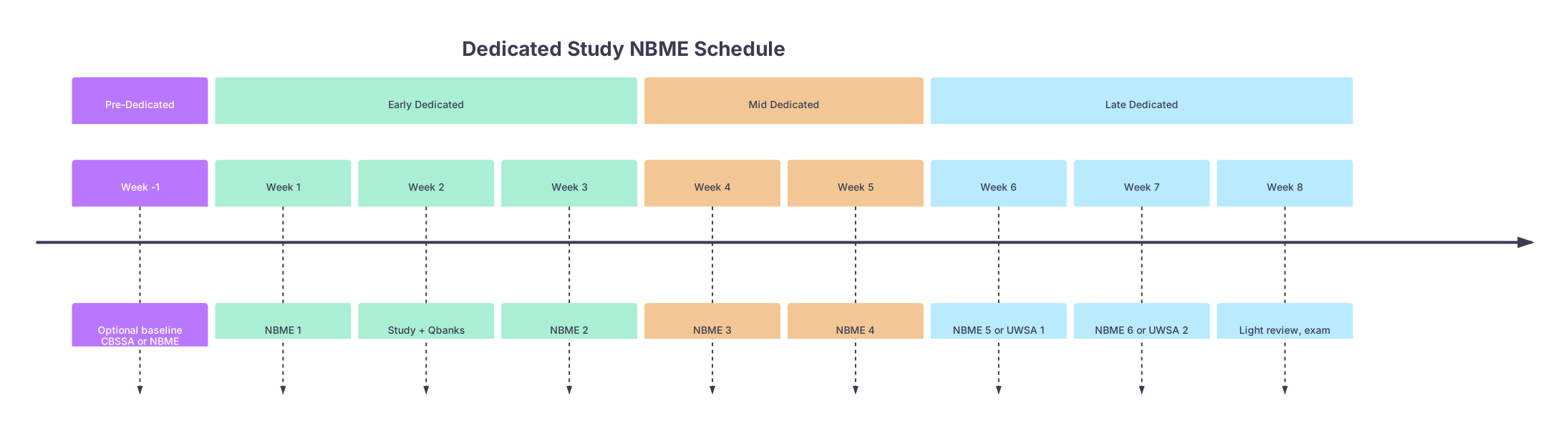
| Period | Event |
|---|---|
| Pre-Dedicated - Week -1 | Optional baseline CBSSA or NBME |
| Early Dedicated - Week 1 | NBME 1 |
| Early Dedicated - Week 2 | Study + Qbanks |
| Early Dedicated - Week 3 | NBME 2 |
| Mid Dedicated - Week 4 | NBME 3 |
| Mid Dedicated - Week 5 | NBME 4 |
| Late Dedicated - Week 6 | NBME 5 or UWSA 1 |
| Late Dedicated - Week 7 | NBME 6 or UWSA 2 |
| Late Dedicated - Week 8 | Light review, exam |
Notice that this schedule gives you something else: time between tests to react to what the data shows.
If you are taking a full NBME every 3–4 days, you are not analyzing; you are just collecting numbers.
6. When a Score Drop Actually Matters
Not every drop is equal.
Let us break it down more clinically.
6.1 Noise-Sized Drops (≤ 5 points)
Example:
- 219 → 215
- 226 → 222
Common causes:
- Poor sleep
- Slightly harder form
- Random distribution of topics
- Bad test-day nutrition, distractions
Interpretation:
- If the overall trend is still upward or flat, ignore the drama.
- Look at percentages in key systems instead of obsessing over the total.
6.2 Moderate Drops (6–10 points)
Example:
- 214 → 204
- 230 → 221
This deserves investigation.
Possible causes from real students:
- Burnout: doing 100–120 questions per day, sleeping 5 hours
- Overloading “review” and underdoing fresh questions
- Sudden focus on memorizing minutiae instead of core concepts
- Life events (illness, family issues, moving, etc.)
Action:
- Check correlation with your life log: sleep, exercise, mood.
- Look at performance by subject and by block. If your performance dropped uniformly, it is probably fatigue or mindset. If it is concentrated in, say, pharm and cardio, you have a targeted content problem.
6.3 Large Drops (>10 points)
Example:
- 215 → 198
Rare but real.
These are rarely “just a bad day.” They tend to signal one of:
- Severe burnout
- Test taken under truly non-representative conditions
- Complete meltdown in timing / anxiety
In that situation, you do not just push harder. You fix the underlying cause:
- Scheduled rest day(s)
- Shorter daily blocks
- Intentional test-day simulation practice for timing and anxiety
Then you verify with another assessment 7–10 days later. The next point on the trajectory tells you if it was an outlier or a new baseline.
7. Subject-Level Trends: Hidden Trajectories Inside the Total Score
Focusing only on the total score misses the real diagnostic gold. The NBME content breakdowns are noisy, but patterns across multiple exams are useful.
Across 3–5 NBMEs, track:
- Systems: cardio, renal, neuro, MSK, respiratory, GI, endocrine, etc.
- Foundational disciplines: pharm, micro, pathology, physiology, biochem, behavioral
You are looking for:
- Subjects consistently below your total percentile
- Subjects drifting upward vs stubbornly flat
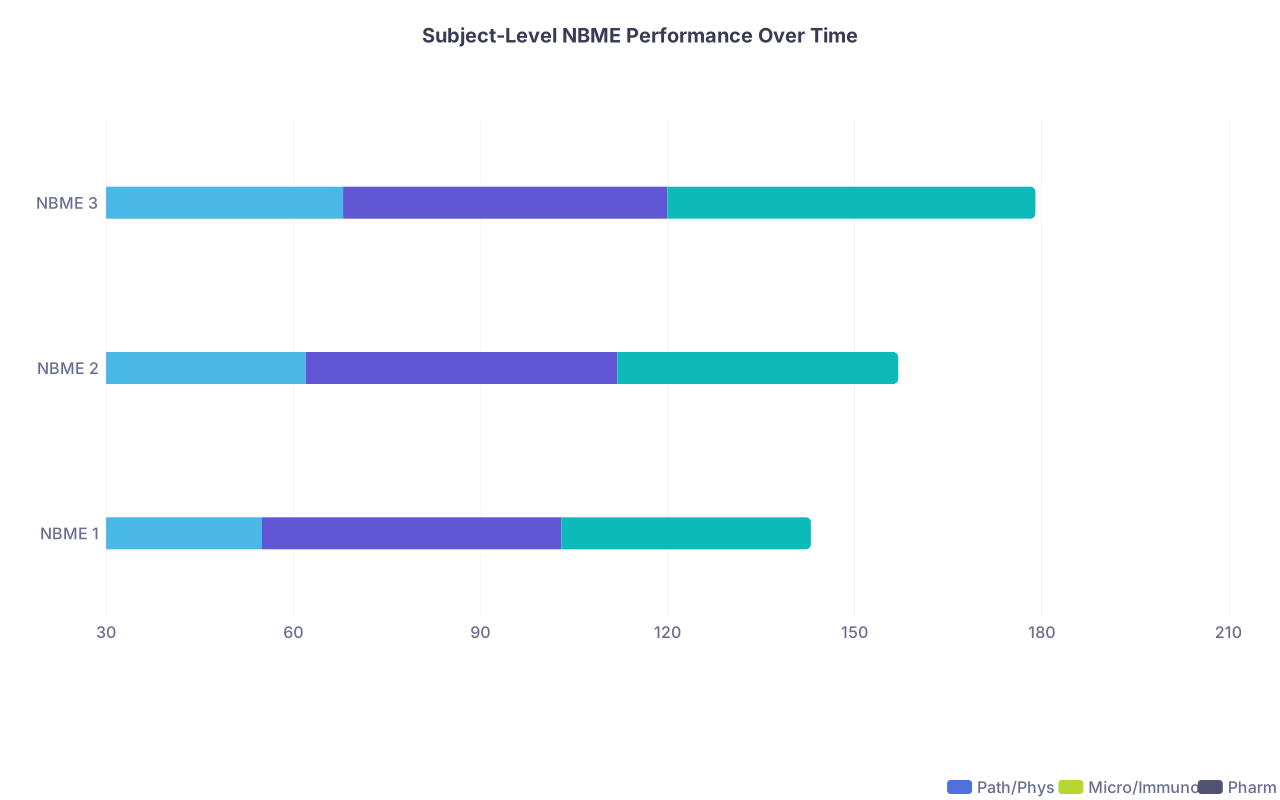
| Category | Path/Phys | Micro/Immuno | Pharm |
|---|---|---|---|
| NBME 1 | 55 | 48 | 40 |
| NBME 2 | 62 | 50 | 45 |
| NBME 3 | 68 | 52 | 59 |
In this example, pharm shows a big jump, micro is dragging, and path/phys is trending up nicely.
Interpretation strategy:
- A total score that is flat with one subject rapidly improving = you are building future gains. The total will “catch up” as the improvement stabilizes.
- A total score that looks stable but hides multiple declining subjects = danger. You may be masking real weaknesses.
Make subject-level corrections on a 1–2 week time horizon. Not daily. Change your emphasis (for example, +30 pharma questions per day, dedicated micro Anki) and then see if your next NBME reflects that.
8. When to Postpone: A Data-Driven Threshold
Nobody likes postponement discussions. But pretending the numbers say something they do not is worse.
Here is a pragmatic, data-based way to think about it.
Look at three things together:
- Your last 3 NBME-equivalent scores
- The slope between them
- Weeks remaining before test day
Then ask:
- Is my current average in the range where I would feel safe if the real exam matched it?
- Is the recent slope steep enough to reach my minimum acceptable target in time?
If both are no, postponement is rational.
Use something like this as a mental framework:
| Current Avg NBME | Weeks Left | Realistic Expected Final Range* | Consider Postpone? |
|---|---|---|---|
| 195 | 2 | 195–202 | Almost always yes |
| 205 | 2 | 205–212 | Yes if floor feels unsafe |
| 210 | 3 | 210–218 | Depends on school/program |
| 215 | 4 | 215–225 | Usually no if comfortable |
| 225 | 3 | 225–233 | Rarely |
*Assumes normal grind, no major life disruptions, and typical 3–5 point per-week max in this range.
The key is this: use your recent trajectory, not your dream scenario. If the last 3 tests are 203, 207, 210 and you have 2 weeks, you are not going to 240. And that is not a moral failing. It is just the math.
9. Turning Your Trajectory into a Feedback Loop
A trajectory is not a grade. It is a feedback system.
Here is how you actually use it, weeks 1–8 of dedicated.

| Step | Description |
|---|---|
| Step 1 | Take NBME |
| Step 2 | Record total + by-subject scores |
| Step 3 | Identify 1-2 weakest systems |
| Step 4 | Adjust study plan for next 7-10 days |
| Step 5 | Focused Qbank + targeted content |
| Step 6 | Rest day before next NBME |
| Step 7 | Take next NBME |
The loop is simple:
- After each NBME, write down:
- Total score
- Score change from last time
- 2–3 worst subjects
- For the next 7–10 days:
- Shift ~30–40% of your study time toward those weak areas
- Keep a stable core of mixed Qbank questions (to maintain general performance)
- Do not rewrite your entire study system every week. Make small, targeted adjustments.
Over 4–6 cycles of this, the data usually converges: subjects stabilize, total scores rise or flatten, and you know where your real ceiling is.
10. A Final Word on Emotion vs Data
You are not a robot. You are a human staring at numbers that feel like a referendum on your worth. I have watched very smart students meltdown over a 4-point drop that meant absolutely nothing in statistical terms.
Here is the blunt truth:
- Any single NBME is a noisy estimate with at least ±5 points of “fog” around it.
- The multi-week trend is vastly more predictive of your final score than your best or worst practice test.
- Panic-driven changes (new resources, random extra books, doubling question count overnight) almost always flatten or worsen the trajectory.
Your job is not to love the numbers. Your job is to use them.
If your scores are rising, protect your system and your sleep. If your scores are flat, make a specific change and give it 7–10 days to work. If your scores are dropping consistently and time is short, have the hard talk about postponement based on data, not fear.
Your Step 1 trajectory is not art. It is a graph. Read it like one.
Once you can do that, you are not just “studying more.” You are running a controlled experiment on your own learning. And when Step 1 is behind you, that same approach—measure, adjust, observe—will carry straight into clerkships, Step 2, and residency.
But that trajectory is a story for another day.