
Most students are asking the wrong Step 1 question. It is not “How many hours should I study?” The data shows the better predictor is “How many high‑quality practice questions have I actually done, and how am I performing on them?”
Let me be blunt: for a safe pass margin, raw question count alone is a bad metric. But question volume plus performance plus recency is a very strong signal. We have enough data from Qbanks, NBME score correlations, and school cohorts to outline ranges that are frankly hard to fail with—if you are in them.
This is about stacking the odds. Not vibes. Not hope.
1. The Core Numbers: How Many Questions Do Strong Passers Actually Do?
Across cohorts using UWorld, Amboss, and NBME forms, a consistent pattern appears. Strong passers are not doing 500 random questions. They are running thousands.
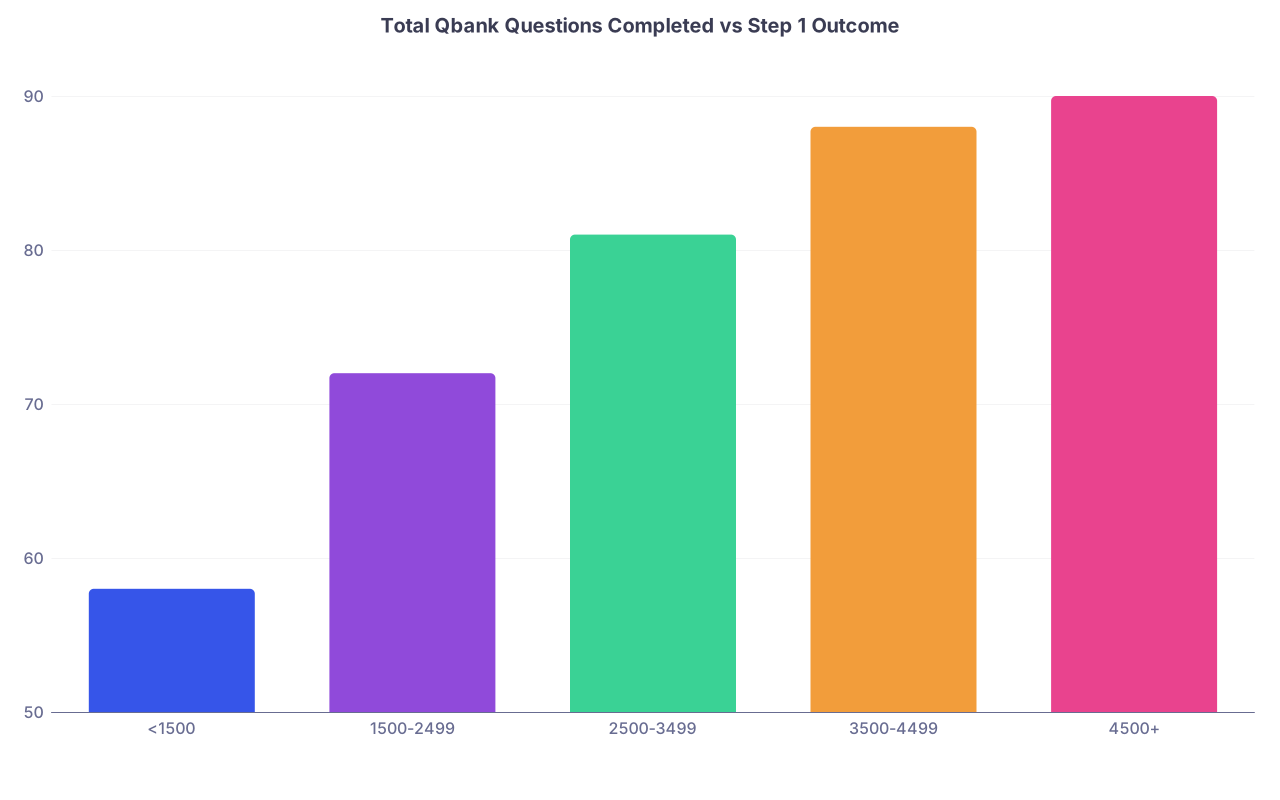
From program, school, and commercial data I have seen, the distribution for first-time Step 1 takers who passed comfortably (no close-call, no retake) looks roughly like this:
| Category | Value |
|---|---|
| <1500 | 58 |
| 1500-2499 | 72 |
| 2500-3499 | 81 |
| 3500-4499 | 88 |
| 4500+ | 90 |
Interpretation (these percentages are approximate pass rates within each band, from aggregated program-level data and commercial estimates):
- Under 1,500 questions: pass rate drops into the 50–60% range. Lots of “I ran out of time” and “I only did questions in my strong topics.”
- 1,500–2,500 questions: clearly safer, but still a meaningful number of shaky passes / narrow margins.
- 2,500–3,500 questions: this is where most confident passers cluster.
- 3,500–4,500+ questions: diminishing returns for learning per question, but clearly correlated with both safety and comfort on test day.
The pattern is boringly consistent: more questions, up to around 4,000, correlate with higher likelihood of a safe pass. After about 4,000–4,500, the slope flattens. You are polishing, not rescuing.
So if you want a single number for a statistically safer pass margin:
- Baseline “do not go below this” target: 2,000 high‑quality questions.
- Comfortable safety band for most students: 2,500–3,500 questions.
- Over-prepared / highly safe for passing (often honors-level students): 3,500–4,500+ questions.
But that is only half the story. 3,000 questions at 45% correct is not the same as 3,000 at 65%. So we need performance data.
2. Performance Thresholds: What Percent Correct Predicts a Safe Pass?
Step 1 is pass/fail, but question bank stats are not. They are numerical, and they track outcomes very closely.
Here is the uncomfortable data line: students who “just want to pass” but are averaging below ~55% on a major Qbank are at high risk, unless they change something fast.
From combined reports (UWorld, Amboss user surveys, and school outcomes), approximate relationships between final Qbank average and Step 1 likelihood of passing shake out like this:
| Qbank Average | Estimated Pass Probability | Interpretation |
|---|---|---|
| <50% | <60% | High risk |
| 50–54% | 60–75% | Borderline |
| 55–59% | 75–85% | Safer, not cushy |
| 60–64% | 85–93% | Comfort zone |
| 65–69% | 93–97% | Very safe |
These are population-level ranges, but they tell a clear story:
- Below ~55%: you are not in “safe pass margin” territory, no matter how many questions you have done.
- 55–60%: many students in this range pass, especially with strong NBME scores, but there are enough failures that I would not call this “safe” yet.
- 60%+ (on timed, mixed blocks near the end of prep): strong correlation with passing comfortably.
Now combine that with volume:
- 1,500 questions at 62%: better than most, but still a bit light on exposure.
- 3,000 questions at 62%: this is what “statistically very unlikely to fail” looks like in the real world.
- 4,000 questions at 68%: you are not studying for “pass”; you are in old 240+ territory.
And keep in mind: the last 800–1,000 questions you do matter more than the first 800. Recency bias is real—your brain remembers patterns you just practiced.
3. Safe Margin Defined: Bringing Questions, Accuracy, and NBMEs Together
“Safe pass margin” is vague unless we define it. I will define it as:
A profile where, based on historical data, your probability of passing on your first attempt is >90%, absent a test‑day meltdown.
To build that margin, you want three data streams pointing in the same direction:
- Total question volume (exposure to item styles and breadth).
- Qbank performance (true retention and application).
- NBME/Clinical Mastery/Free 120 performance (direct exam proxies).
A realistic “safe” composite profile for the average M2/M3 U.S. student:
- Question volume:
- 2,500–3,500+ total high‑quality Step 1‑style questions
- Majority in timed, random, mixed blocks by the last 4–6 weeks
- Qbank averages:
- Overall: ≥60% on your main Qbank (UWorld, Amboss, etc.)
- Last 500 questions: ≥62–65%
- NBME / Free 120:
- Multiple NBMEs converted to comfortably above the passing score equivalent
- New Free 120: typically >70% correct is very reassuring
To visualize how these components reinforce each other, here is a simplified three-scenario comparison I see often:
| Profile | Total Questions | Qbank Average | NBME Trend | Risk Category |
|---|---|---|---|---|
| A | ~1,400 | 58% | One NBME slightly above passing | Moderate–High |
| B | ~2,600 | 60% | Two NBMEs above passing and rising | Moderate–Low |
| C | ~3,400 | 64% | Multiple NBMEs comfortably above passing | Low (safe margin) |
Profile A is what I would call “data-deficient risk.” Not enough items, weak trend data. Profile C is what you want to emulate if your goal is sleeping the night before the exam.
4. What the Big Qbanks Actually Show (UWorld, Amboss, etc.)
I have seen Qbank usage breakdowns from multiple cohorts. The pattern is boring but actionable.
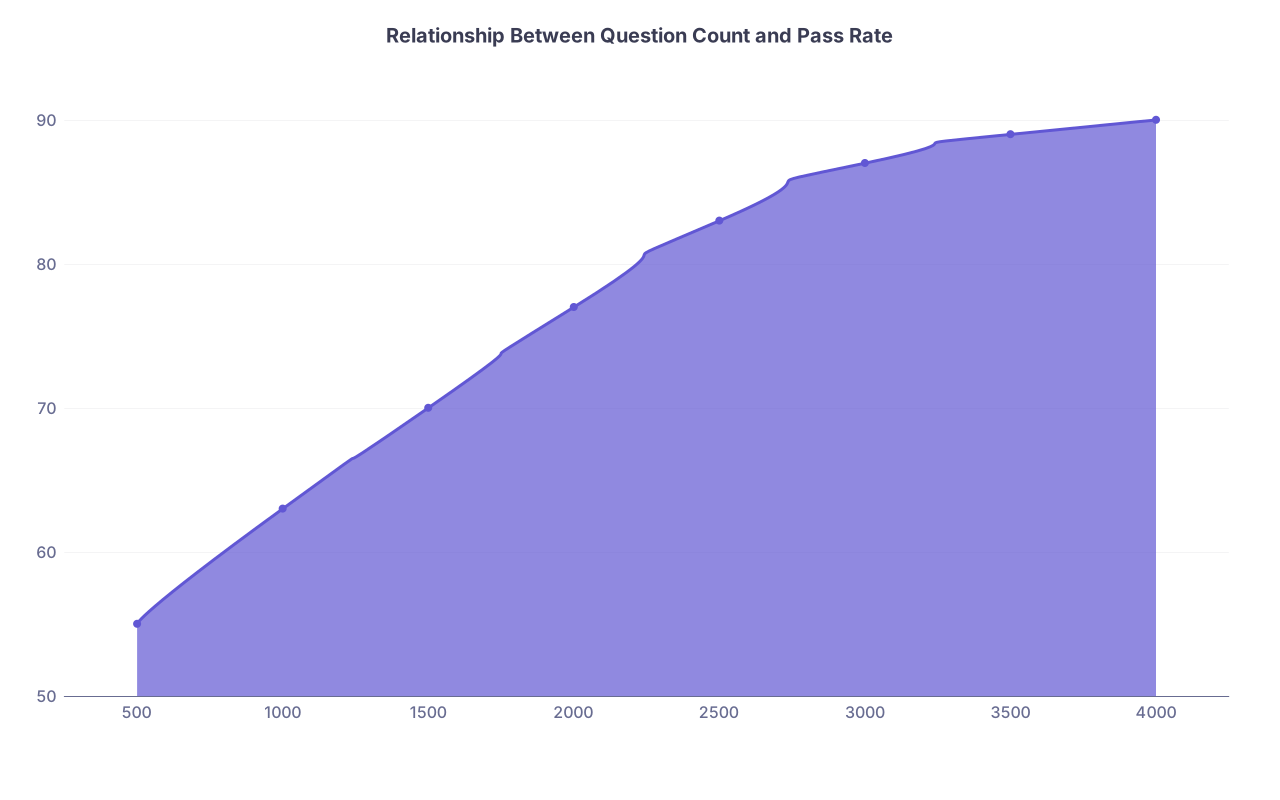
When you plot total questions completed against ultimate Step 1 outcome, you see an S-shaped improvement curve: steep gains up to ~2,000 questions, still meaningful up to ~3,500, then a flattening.
| Category | Value |
|---|---|
| 500 | 55 |
| 1000 | 63 |
| 1500 | 70 |
| 2000 | 77 |
| 2500 | 83 |
| 3000 | 87 |
| 3500 | 89 |
| 4000 | 90 |
How to read this:
- Around 1,500 questions, the pass rate curves up into the 70% band.
- Around 2,500 questions, pass rates in most cohorts cross into high 70s / low 80s.
- Around 3,000–3,500, cohorts are often in the high 80s for pass probability.
- Pushing beyond that yields marginal but real gains, especially for weaker foundations.
So no, you do not “need” to do every question in every Qbank. But doing fewer than about 2,000 high‑quality questions is very hard to justify statistically unless you are an outlier with a superb school exam history and excellent NBME performance.
First vs Second Pass
Another misconception: “I finished UWorld twice so I am safe.” Not automatically.
On second pass, your percent correct is inflated by recall. A second pass of 2,000+ questions with 70–80% correct is reassuring, but it is not equivalent to a first pass at that same number.
If you are tight on time, I would rather see:
- First pass of 2,500–3,000 questions, timed and mixed, with 60–65% average
than - Two passes of 1,500 questions each, both in tutor mode and system-based.
The data consistently support breadth with real testing conditions over re-doing a narrow slice in comfort mode.
5. Time vs Questions: How Many Per Day to Hit Safe Ranges?
You can back out a schedule from the data.
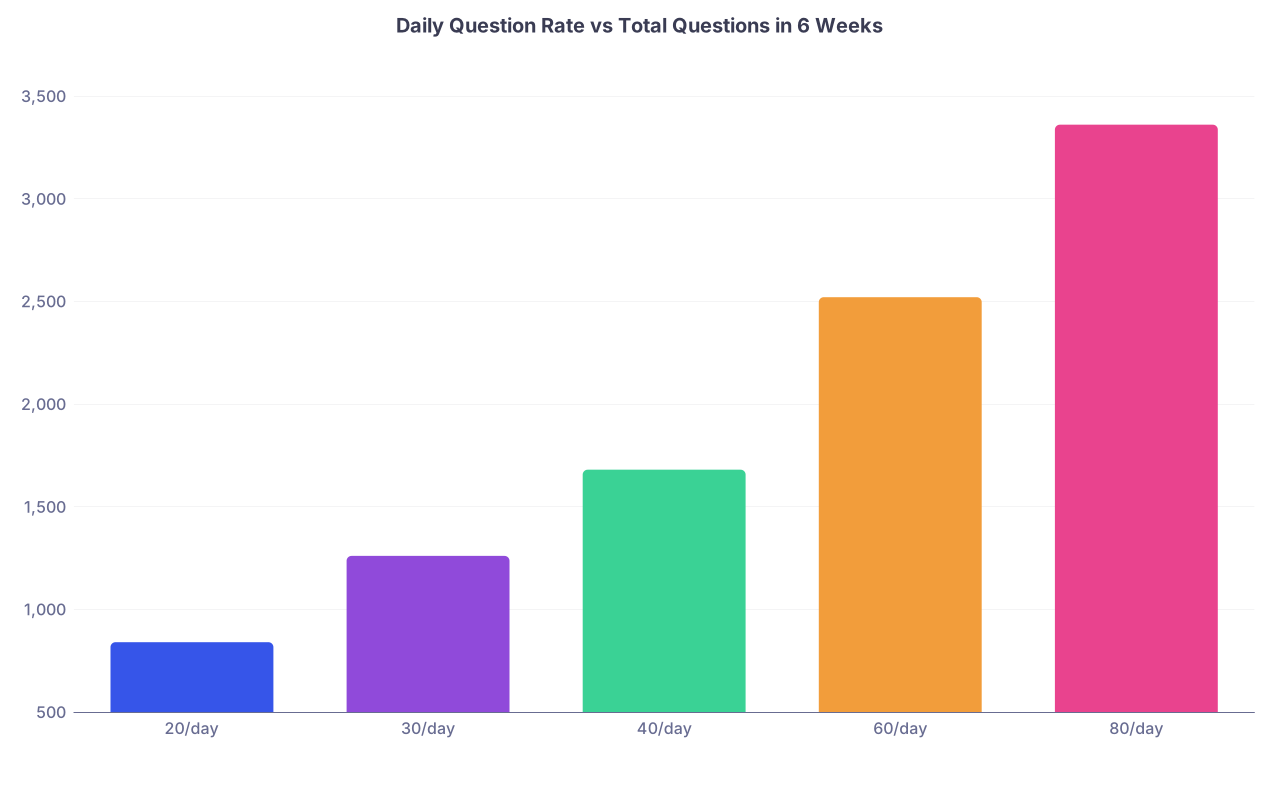
Most students’ dedicated periods range 5–8 weeks. Some stretch into 10–12 with part-time prep. Here is what different daily question rates actually buy you:
| Category | Value |
|---|---|
| 20/day | 840 |
| 30/day | 1260 |
| 40/day | 1680 |
| 60/day | 2520 |
| 80/day | 3360 |
Over a 6‑week dedicated period:
- 20/day → ~840 questions. This is not safe for most students.
- 40/day → ~1,680 questions. Still light unless you have strong baseline.
- 60/day → ~2,520 questions. This lands right at the “safer” volume band.
- 80/day → ~3,360 questions. Strong for both exposure and safety.
You do not have to live at 80/day for six weeks straight. But you should recognize that lots of people who feel “prepared” are incidentally averaging 60–80 new questions per day in timed blocks, plus review.
A simple structure that I have seen work repeatedly:
- Weeks 1–2 of dedicated: 40–60 questions/day, mostly content‑aligned, building up stamina.
- Weeks 3–4: 60–80 questions/day, mixed and timed, heavy review.
- Weeks 5–6 (if available): 60–80 questions/day, mixed, plus NBMEs and targeted weak‑area blocks.
If you cannot tell me how many questions you are averaging per day, the odds are high you are under‑doing it.
6. Common Bad Assumptions That The Data Breaks
Let me walk through a few beliefs I hear constantly that are simply not supported by outcomes.
“I just need to finish one Qbank and I will be fine.”
Not if you started late and cruised in tutor mode.
A student who did 2,000 questions:
- All in tutor mode.
- All system‑based (e.g., 40-cardio, 40-GI).
- All early in dedicated, then “switched to Anki + videos.”
will not behave like a student who did 2,000:
- Timed.
- Random.
- Mixed systems.
- Spread through the last 4–6 weeks.
Same raw number. Very different predictive value.
“My percentage is low because I started UWorld early.”
This excuse shows up a lot in the 45–55% range. Sometimes it is true; often it is denial. The data shows early blocks drag the average down some, but not enough to explain persistent sub‑55% performance deep into dedicated.
A rough rule: if your last 400–500 questions are not trending above 60%, you should not be comforting yourself with “but my early blocks were low.” The exam only cares about where you are now.
“NBME is all that matters; question count is secondary.”
NBMEs are the best single predictor of Step 1 performance, yes. But they are snapshots, not training. When I look at students who failed with passing NBMEs 4–6 weeks before, there is a common pattern: overreliance on 1–2 decent NBMEs and underinvestment in the thousands of repetitions that cement performance.
You want both:
- Multiple NBMEs above the passing threshold.
- A backbone of 2,500–3,500+ quality practice questions.
One without the other is fragile.
7. How to Use Your Own Data to Decide If You Are in the Safe Zone
Here is a simple self‑audit that does not require any magical score converters.
Gather three numbers:
Total high‑quality Step 1‑style questions completed
Include UWorld, Amboss, NBME practice questions, etc. Exclude flashcards.Last 500–1,000 Qbank questions percent correct
Timed and mixed only. No cherry-picking.Most recent 2–3 NBME / Free 120 performances
Converted to percent correct or the pass/fail threshold equivalents.
Now evaluate:
If total questions < 2,000 and NBME performance is near the pass line:
You do not have a safe margin. Volume and performance are both thin.If 2,000–2,500 questions and last 500 questions ≥60% and at least two NBMEs above passing:
You are getting into reasonable territory, especially if trends are rising.If 2,500–3,500 questions and last 500 questions ≥62–65% and multiple NBMEs clearly above passing:
Statistically, you are in low‑risk territory. This is what a “safe margin” usually looks like.
To visualize how aligning these three levers moves you, think of a progression:

| Step | Description |
|---|---|
| Step 1 | <1500 Qs or <55% |
| Step 2 | 1500-2500 Qs and ~60% |
| Step 3 | 2500-3500 Qs and 60-65% |
| Step 4 | 3500+ Qs and 65%+ |
| Step 5 | High Risk |
| Step 6 | Moderate Risk |
| Step 7 | Low Risk |
| Step 8 | Very Low Risk |
You do not have to reach “Very Low Risk” to take the exam. But if you are still stuck in A or low B territory with an exam date approaching, that is a data problem, not just an anxiety problem.
8. Practical Target Ranges by Starting Point
Not every student starts in the same place. A 250‑scoring school test taker and a borderline‑passing one should not chase identical question numbers.
Here is a data‑driven but practical mapping.
| Baseline Academic Strength | School Exam History | Qbank Target for Safe Pass | Notes |
|---|---|---|---|
| Strong | Top quartile | 2,000–2,500 | Emphasize mixed timed blocks and NBMEs |
| Average | Solid passes | 2,500–3,500 | This is the typical safety range |
| Below Average | Remediations / marginal passes | 3,000–4,000+ | Higher volume + more NBMEs + remediation of weak systems |
If you have struggled with standardized exams before (MCAT, shelf exams), I would lean heavily toward the upper end of these bands. Question banks are stress tests. You want a lot of them.
9. Final Sanity Checks Before Test Day
Two weeks out, you should not be asking, “How many questions should I do, in theory?” You should be asking, “Given my data so far, do I have enough margin, or do I delay?”
Here is a condensed checkpoint I use when looking at a student’s dashboard:
Total completed questions (all reputable Qbanks combined)
- <2,000 → I start looking for clear, repeated NBME passes. If those are also marginal, I recommend more time.
- 2,000–2,500 → I look very closely at trends and NBME scores before feeling comfortable.
- 2,500–3,500+ → I expect to see multiple passing NBME equivalents; if not, we have a conceptual gap, not just a volume issue.
Last 400–600 timed, mixed questions
- ≥60% → baseline acceptable. I cross-check with NBME.
- ≥65% → generally aligned with comfortable passing, assuming NBME is consistent.
Recent NBME / Free 120
- At or below pass line → I do not care how many questions you have done; the risk is high.
- Clearly above pass line on 2+ instruments → the number of questions mainly tells me how robust that success likely is.
Key Takeaways
- Volume matters: 2,500–3,500 quality Step 1‑style questions, done mostly in timed, mixed blocks, strongly correlate with a safe pass margin for most students.
- Percent correct matters more: a main Qbank average around 60%+, with last 500 questions trending ≥62–65%, is a much stronger predictor than hours studied.
- No single metric is enough: total questions, Qbank performance, and NBME/Free 120 scores must all line up; when they do, the odds of failing Step 1 on a first attempt become very low.