
The default advice about “never delaying Step 1” is outdated—and sometimes flat‑out dangerous.
You should absolutely consider pushing back your Step 1 date if key warning signs are there. But you need a clear framework, not vibes or panic, to make that call.
Here’s the answer you’re looking for: you move your date if the data, your trajectory, and your mental bandwidth all say you’re not on track—and staying the course puts you at real risk of an unsafe score.
Let’s break that down like an attending who doesn’t have time for fluff.
The Core Rule: Don’t Decide on Feelings. Decide on Data + Trajectory.
You don’t postpone Step 1 because you “feel behind.” Everyone feels behind.
You postpone when three things line up:
- Your NBME/CBSSA scores are below your target and below safe pass territory
- Your trend over 2–3 practice tests is flat or negative
- Your study conditions (time, health, mental state) make a sharp turnaround unlikely in the time left
If 2 of those are solid but 1 is off, you probably adjust strategy, not the date.
If all 3 are bad, you strongly consider moving the exam.
Let’s put some numbers on this.
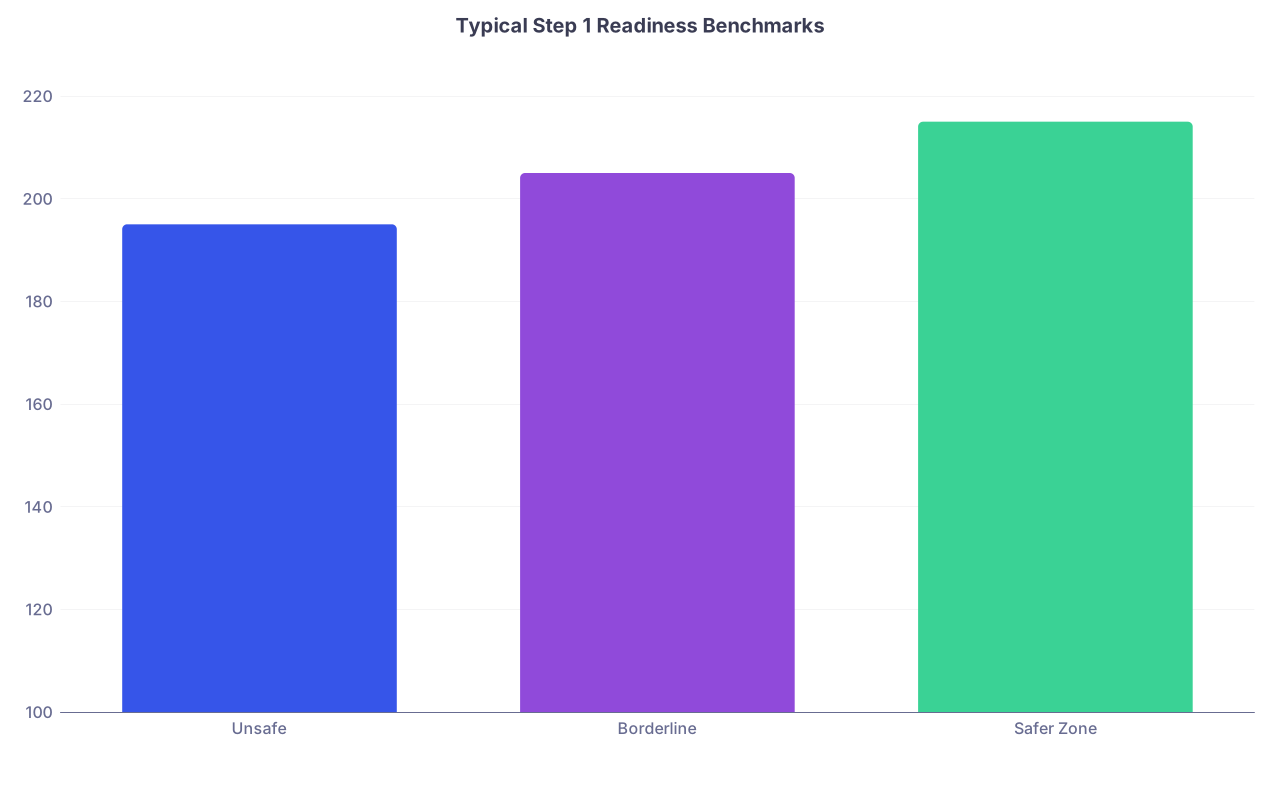
| Category | Value |
|---|---|
| Unsafe | 195 |
| Borderline | 205 |
| Safer Zone | 215 |
Interpretation (for current pass/fail Step 1, using approximate scaled scores from NBMEs/UWSAs):
- Unsafe zone: < 200 → High risk for failing
- Borderline: 200–210 → Could pass, but not a lock, especially with inconsistent q‑bank performance
- Safer zone: ≥ 215 on multiple forms → Reasonable to proceed, assuming consistent prep
Again: these aren’t magical cutoffs—but they’re the ballpark thresholds many schools and advisors use behind the scenes.
Sign #1: Your Practice Scores Are Nowhere Near Where They Need To Be
If you ignore everything else and only look at one thing, look at recent NBME/UWSA performance.
Here’s the practical way to read them:
- Use NBME CBSSA forms + UWSA 1/2 as your main anchors
- Ignore random percent‑correct from q‑banks as the primary decision tool
- Look at at least two tests about 2 weeks apart
You should seriously consider pushing your date if:
- Your latest NBME/UWSA is < 200 within 2–3 weeks of your exam
- Your scores are swinging wildly (e.g., 204 → 193 → 201) without a clear upward trend
- You’re guessing a ton and “getting lucky” on some forms (you know when this is happening)
Let me be even more concrete.
| Pattern (last 3 tests) | Example Scores | What it Usually Means |
|---|---|---|
| Flat Low | 195, 198, 196 | High fail risk – consider delay |
| Slight Up but Still Low | 192, 198, 204 | Borderline – exam likely too soon |
| Strong Upward Trend | 198, 208, 218 | Reasonable to keep date |
| Up, Then Down | 210, 202, 199 | Instability – examine causes |
| All > 215 | 216, 220, 223 | Generally safe to proceed |
If you’re < 200 on multiple forms in the last month before your test, and your date is locked in soon, you’re basically hoping for magic on exam day. That’s not strategy. That’s gambling with your license exam.
Sign #2: Your Trend Is Flat Despite Actually Studying
The single most overrated thing? One good NBME score.
What matters more: direction over time.
You should not push your date just because:
- Your first NBME in dedicated was bad
- You had one off day or one NBME that underperformed your others
- You’re in the low 200s early in dedicated
But you should be concerned if:
- You’ve been in dedicated for 4+ weeks, studying consistently, and your NBMEs are within the same 5–7 point band
- You’re doing lots of questions (UWorld, AMBOSS, etc.) and your percentage correct isn’t budging
- You’re burning out—you know the material when fresh, but by afternoon your brain is mush and your performance tanks
If you’re 3 weeks out and your last three scores look like this:
- NBME 27: 198
- NBME 29: 201
- UWSA 1: 199
…that’s not a promising slope. It says: “I’m working, but the curve isn’t moving.”
In that scenario, more time with the same approach won’t save you. But moving the date plus fixing your study strategy might.
Sign #3: Critical Content Gaps Are Still Massive
There’s a difference between “I occasionally miss some biostats questions” and “I don’t actually understand cardiac physiology.”
You should think about pushing your date if:
- You still haven’t done at least ~75–80% of a major q‑bank (e.g., UWorld) with review
- There are entire systems you haven’t properly touched (neuro, renal, cardio)
- You keep missing basic questions in:
- Renal phys and acid–base
- Cardio phys and murmurs
- Biostats and ethics
- Micro/antibiotics
- Your “review” is mostly rereading First Aid/Boards & Beyond/Pathoma without actually testing yourself
Step 1 doesn’t just test facts; it punishes weak foundations in physiology and pathology. If every cardio question feels like black magic, you’re not 2 weeks away from being ready. You’re 2 months away—assuming focused work.
Sign #4: Your Mental Health / Burnout Is Tanking Your Performance
This part gets ignored until it blows up.
You shouldn’t “tough it out” if what’s really happening is:
- You’re having daily anxiety spikes or panic attacks about the exam
- You can’t sit through a block without your mind blanking halfway through
- You’re sleeping 4–5 hours regularly and relying on caffeine just to function
- You read a question, and the words literally don’t register—over and over
Delaying Step 1 isn’t just about getting more time to memorize glycolysis. Sometimes it’s about:
- Getting back to normal sleep
- Seeing a therapist or getting started on actual treatment for anxiety/depression
- Resetting from a total burnout spiral
Here’s the harsh reality: if your brain is fried, you won’t suddenly perform better test day. The exam is 8+ hours long. It punishes mental fatigue brutally.
Sign #5: Your Timeline Is Artificial, Not Real
This one stings for a lot of people.
You should question your date if you set it because of:
- “Everyone in my class is taking it then”
- “I wanted it done before X trip / rotation / family plan”
- “My school suggested this week, so I locked it in early”
But your actual readiness doesn’t line up.
If your school gives you flexibility and your entire argument for not moving the exam is social (“I don’t want to be behind my friends”) — that’s ego talking, not strategy.
Now, sometimes the constraints are real:
- School‐mandated deadlines
- Visa timelines
- Tight schedules before clerkships
If you truly can’t move it much, then postponing 1 week won’t fix systemic problems. You need to work within the constraint and focus on maximizing the time you do have.
But if you can move it without blowing up your whole life? Then the “I don’t want to be the only one who delayed” argument is weak. No residency program cares you took Step 1 3 weeks later than your classmates. They care whether you passed.
When You Probably Shouldn’t Push Back
Now the flip side. Too many students delay for the wrong reasons.
You likely should NOT delay if:
- Your last 2–3 NBMEs are ≥ 215 and within ~5 points of each other
- You’re in the “I’m scared and I don’t feel ready” spiral but your data say you are
- Your performance issues are mostly:
- Second‑guessing right answers
- Perfectionism (“I want a 250 even though it’s pass/fail”)
- Fear of the unknown more than actual knowledge gaps
- You keep saying “I’ll feel better in 2 more weeks” with no specific plan to change anything
Step 1 will never feel “I’m 100% ready.” People who score 260+ also walk in nervous and feeling like they’ve forgotten everything.
If your practice scores are solid and stable, and you’re delaying because you want to feel emotionally comfortable… you’ll end up chasing a feeling that never comes.
A Simple Decision Framework You Can Use This Week
Here’s a 5‑step sanity check. Do this in writing.
- List your last 3 NBME/UWSA scores, with dates
- Write the trend: up / flat / down
- Rate your daily studying for the last 2 weeks:
- Consistent and focused
- Consistent but scattered
- Inconsistent / lots of wasted days
- List 2–3 biggest weaknesses (not “everything,” be specific)
- Ask: If I had 3–4 more weeks, could I realistically fix these with a new plan?
If your answers look like this:
- Scores: 196 → 201 → 203
- Trend: Slight up but still low
- Study: Consistent but not efficient
- Weaknesses: Cardio phys, renal phys, biostats
- Extra time: “Yes, I could build a structured plan for these”
Then delaying a few weeks plus building a targeted schedule is rational.
If your answers look like:
- Scores: 218 → 220 → 223
- Trend: Stable, in a good zone
- Study: Consistent
- Weaknesses: Random pockets, nothing catastrophic
- Extra time: “I’d just keep doing what I’m doing and hope to feel less scared”
Then pushing the date is just avoidance.
How Far Should You Push It If You Do Delay?
Don’t just punt it 2 weeks “to feel better.” Be strategic.
Rough guide:
- Scores in 190s with major gaps → Consider 4–6 weeks if allowed
- Scores ~200–205, flat trend → Consider 3–4 weeks with a clear, focused remediation plan
- Scores ~205–210, upward trend → Maybe 1–2 weeks or even keep date and tighten execution
And crucial: if you delay, you MUST:
- Change your study strategy (blocks + active review, not passive reading)
- Protect your sleep and mental health
- Schedule another NBME about 10–14 days before the new date to confirm progress
Otherwise, you just stretched out your burnout and bought nothing.
Common Real‑World Scenarios (And What I’d Advise)
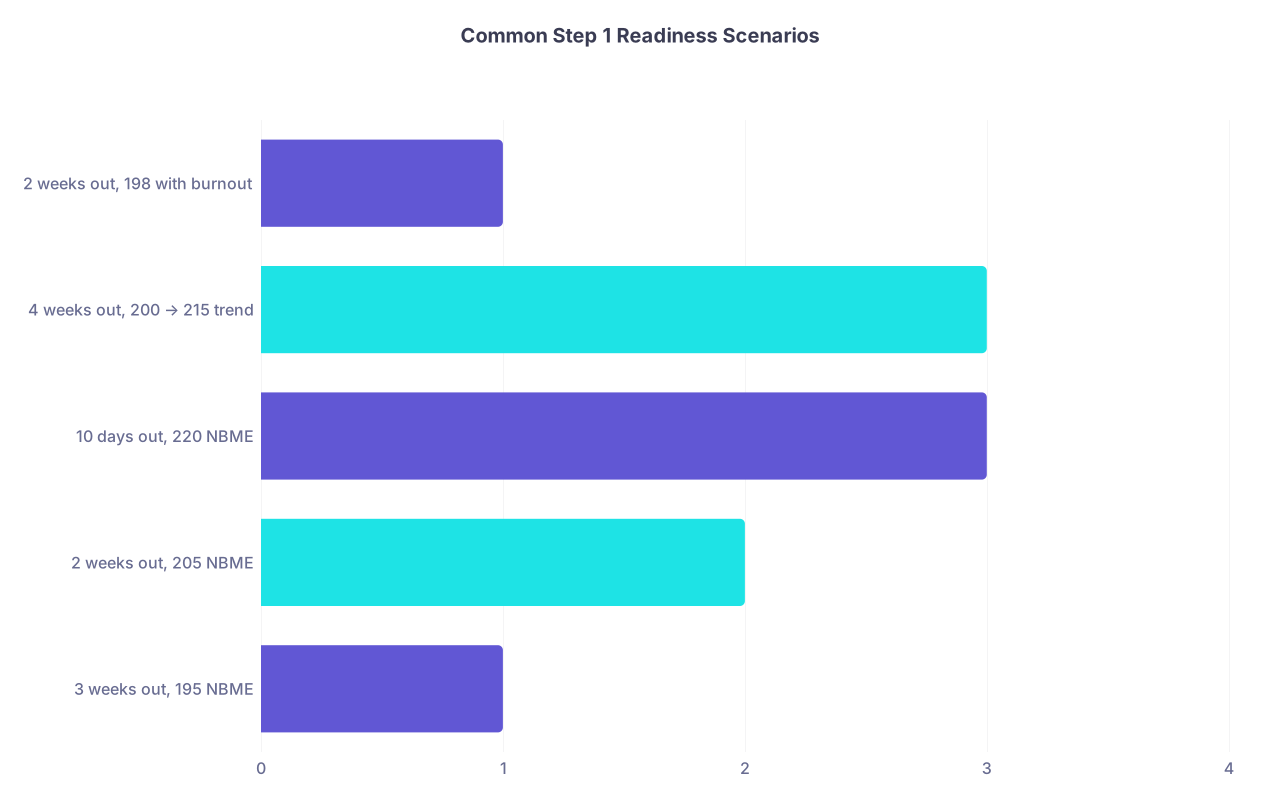
| Category | Value |
|---|---|
| 3 weeks out, 195 NBME | 1 |
| 2 weeks out, 205 NBME | 2 |
| 10 days out, 220 NBME | 3 |
| 4 weeks out, 200 → 215 trend | 3 |
| 2 weeks out, 198 with burnout | 1 |
Interpretation scale: 1 = Strongly consider delay, 2 = Depends, 3 = Usually proceed
You’re 3 weeks out, NBME 197, exhausted, cardio/renal are a mess.
→ I’d lean delay 4–6 weeks, rebuild foundations in those systems, restructure your daily schedule.You’re 2 weeks out, NBME 205, last two were 200 and 203.
→ Gray zone. If you can delay 3–4 weeks and feel like you can fix specific content gaps, it’s reasonable. If you can’t delay much, keep date, tighten test‑taking, and focus on high‑yield weak spots.You’re 10 days out, NBME 220, UWSA 225. You’re terrified.
→ Don’t delay. That’s fear, not data.You’re 4 weeks out, NBME 200 → 208 → 215.
→ Keep the date (unless you’re totally collapsing mentally). Your trajectory is your friend.You’re 2 weeks out, NBME 198, and you’re barely functioning from anxiety.
→ I’d seriously consider delaying and getting actual support (school counseling/therapy), plus reworking your schedule. This is a mental health + knowledge issue, not just content.
What To Do Today
Don’t just sit with the anxiety. Do three concrete things:
- Pull your last 2–3 NBME/UWSA scores and write them down.
- Be brutally honest about your study consistency and mental state this last week.
- Decide: Am I going to keep this date or move it? Then build a specific plan for whichever you choose.
Open your calendar right now and mark the date of your next NBME. That score—not your mood—should drive the final call on whether you stick or push back.
FAQ: Step 1 Date Decisions
1. What’s the absolute lowest NBME score where you’d still say “don’t delay”?
If you’re within ~2 weeks of your exam and your last 2–3 NBMEs are ≥ 215, I’d almost never tell you to delay just to feel better. Below ~210–212 that close to test day, it becomes much more case‑dependent.
2. How many NBMEs should I take before deciding to delay?
At least two, ideally three, spaced 7–14 days apart. One bad test could be a fluke. A pattern of low or flat scores is a stronger signal. Use a mix of NBMEs and one UWSA.
3. Can I pass Step 1 if I’m scoring under 200 three weeks out?
Yes, it’s possible. I’ve seen people pull it off. But they usually had:
- Identifiable, fixable weaknesses
- The ability to delay 3–6 weeks
- A totally revamped, aggressive but smart study plan
Without those, you’re mostly betting on luck.
4. Is it bad for residency applications if I delay my Step 1 exam?
Generally, no. Programs don’t care when during MS2 you took it. They care whether you passed and how you performed on Step 2. What does hurt you is a failure or a huge delay that pushes Step 2 too close to application season.
5. Should I delay if I’ve barely used UWorld but my NBMEs are okay?
If your NBMEs are in the safer zone (≥ 215) and stable, you can probably proceed even without fully completing UWorld. I’d tighten your use of questions in the final stretch and not delay just to hit 100% of a bank.
6. What if my school limits how far I can delay Step 1?
Then your decision space is smaller and you need to be more aggressive now. Talk to your dean or academic support office early. If you’re trending low, ask about formal extensions or academic support options before you run out of runway.
7. How often should I be taking NBMEs in the last month before Step 1?
Usually every 7–10 days during dedicated. Any more frequently and you waste practice material without enough time to meaningfully improve between tests. Use the in‑between days for targeted review based on what each exam exposes.
Now, open your last NBME score report and your calendar at the same time. Circle your current exam date. Then honestly decide: is that date aligned with your data—or just your fear?