
The way clerkship directors judge your Step 1 foundations is far harsher than anyone tells you—and it almost never involves them asking, “What was your Step 1 score?”
They do not need the number. They see it in how you move through the hospital, how you write a note, how you present, how you answer a single question about hyponatremia. Within one week on a core rotation, most seasoned directors can tell if your basic science foundation is solid, average, or quietly crumbling.
Let me walk you through how that judgment actually happens behind closed doors.
The Myth: “Step 1 Is Pass/Fail, So It Does Not Matter Anymore”
This is the first lie people get fed.
Pass/fail changed how programs use Step 1. It did not change that your Step 1 prep either built a foundation—or exposed that you never really understood pathophysiology in the first place.
Here’s the uncomfortable truth: clerkship directors have shifted from using a number to using you.
They watch you on the wards and treat your clinical behavior as the “real” Step 1 score. They’re asking themselves:
- Can this student reason through a problem, or are they a memorizer?
- Do they understand why we are giving this med, or are they just reciting an order set?
- When the patient is complex, do they fall apart?
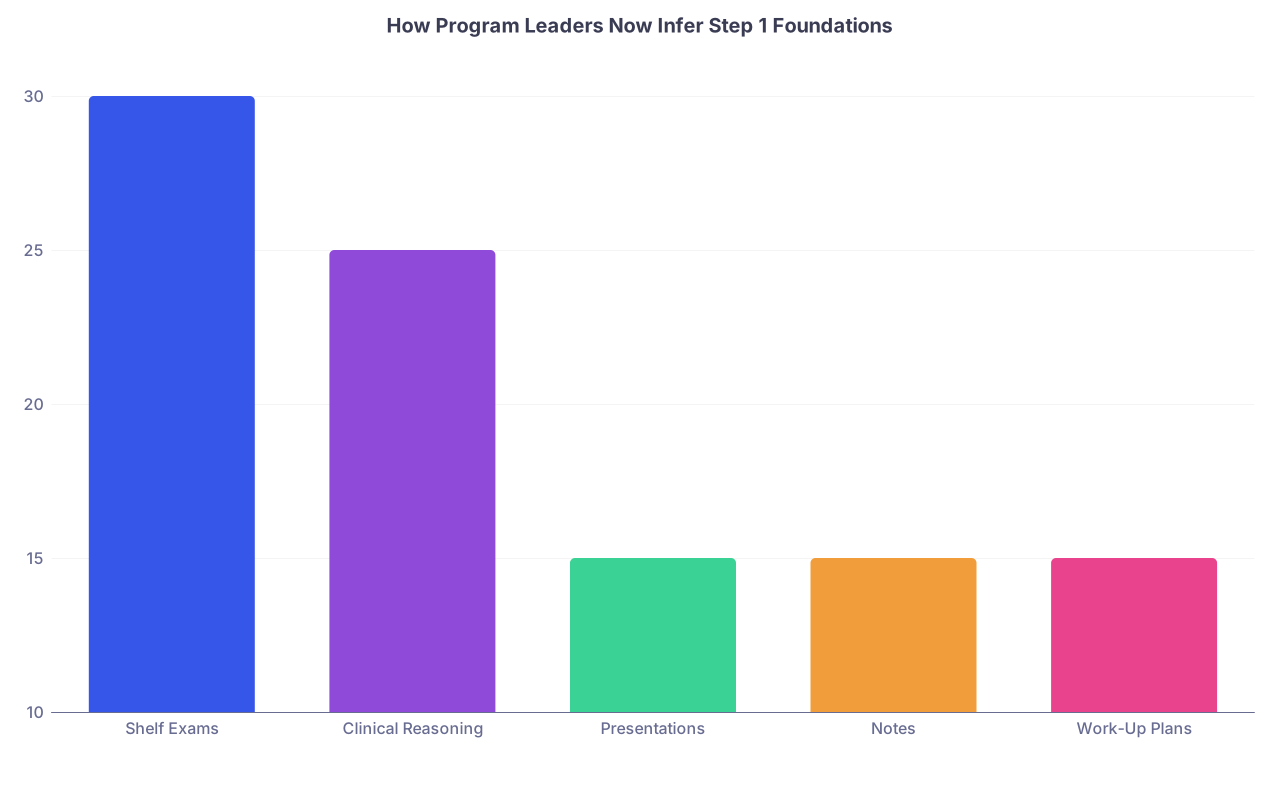
| Category | Value |
|---|---|
| Shelf Exams | 30 |
| Clinical Reasoning | 25 |
| Presentations | 15 |
| Notes | 15 |
| Work-Up Plans | 15 |
I’ve sat in meetings where a clerkship director said, word for word:
“She probably passed Step 1 by brute force. You can tell she never really got the physiology.”
Student had honors-level work ethic, lovely personality, but every time the team nudged into “why,” she froze. That’s how Step 1 weaknesses show up. Not as a score, but as gaps that bleed into everything else.
The First Week on Service: Where They Spot the Cracks
Every clerkship director I know pays disproportionate attention to your first week on the rotation. They won’t admit it out loud, but that’s where they sort students into mental bins.
They’re not looking for brilliance. They’re looking for whether you’ve got a functional chassis underneath the clinical veneer.
On rounds
Faculty use basic questions as a stress test of your Step 1 foundations. The content is “simple,” but the way you answer tells them everything.
Examples I’ve watched directors use on medicine or surgery:
- “Why does this patient with CHF get short of breath when they lie flat?”
- “Why can ACE inhibitors worsen creatinine when we start them?”
- “What actually causes ST elevation in an MI?”
- “Why is chronic steroid use a risk before surgery?”
They’re not grading trivia. They’re grading how you think:
- If you immediately jump to a memorized buzzword (e.g., “Oh, that’s preload/afterload” with no explanation), they know you are repeating, not understanding.
- If you pause, structure your answer logically, and tie pathophys to the patient in front of you, they know you actually learned medicine, not just UWorld flashcards.
In your presentations
Weak Step 1 foundation shows up brutally in your first few full H&P or SOAP presentations:
- Overinclusion of irrelevant data because you cannot prioritize what matters in this disease.
- Vague assessment: “This is a 65-year-old male with shortness of breath likely due to heart failure versus pneumonia versus PE,” with no physiologic reasoning why one is more likely.
- No linkage between physical exam, lab abnormalities, imaging, and a coherent pathophysiologic picture.
I watched a clerkship director at a major academic center (think big coastal IM program) pull a resident aside after rounds and say:
“Her presentation sounds like someone who got through Step 1 with question bank pattern recognition only. She has no disease model in her head.”
That student wasn’t “dumb.” She was a classic high–Qbank, low–true-understanding case. And it showed.
The Quiet Red Flags Clerkship Directors Trade Notes About
There are patterns. Certain behaviors and exam results scream “weak Step 1 base,” even if you passed comfortably on paper. Directors talk about these during grading meetings and MSPE discussions.
Here’s what actually sets off alarms.
1. Shelf scores that don’t match apparent effort
When a student is clearly working hard—asking for feedback, staying late, reading—and still scores borderline or low on shelves, directors get suspicious of the underlying foundation.
You’re doing “all the right things” on the surface, yet:
- Your medicine shelf is barely passing.
- OB/Gyn and surgery shelves show the same pattern.
- Your NBME practice forms bounce around without real improvement.
I’ve heard this exact line:
“If they’re this diligent and still scoring mid-60s, there’s something wrong under the hood. They never really built Step 1.”
Shelves are applied Step 1. If you skimmed through cardio phys or renal before, it will nail you on medicine, surgery, even psych.
2. Inconsistent performance across systems
Students with a shaky Step 1 base are often strong in areas they brute-memorized (micro cards, pharm tables) and weak where actual reasoning is required (renal, endocrine, heme/onc).
Clerkships expose that really fast:
- You’re fine on “what drug treats this bug,” but collapse when asked to interpret a complex acid–base scenario.
- You can list risk factors for DVT, but you cannot explain why a cirrhotic patient’s INR is high and they’re still clotting.
Clerkship directors pick up on that mismatch and file it away mentally as “Step 1 foundation issue.”
3. The “frozen when pathophys goes off script” moment
Every student hits a case that isn’t textbook. The strong Step 1 students improvise—maybe not perfectly, but logically.
The weak-foundation students simply shut down.
I watched a student on wards confronted with a patient with mixed respiratory alkalosis and metabolic acidosis. Attending asked, calmly:
“Walk us through why this ABG makes sense for this septic, cirrhotic patient.”
Student stared, then started reciting Winter’s formula from memory, with no idea what the numbers meant. Director scribbled a note on the evaluation form: “Memorized formulas. Does not understand physiologic compensation.”
That’s code, by the way, for “Step 1 foundation weak.”
How Low Step 1 Foundations Distort Your Clerkship Reputation
You are not being judged only on knowledge. You’re being judged on “trajectory.” Are you someone they want to train for 3–7 years?
Low Step 1 foundations ripple out into how you’re perceived, even when no one consciously says, “This is a Step 1 problem.”
You look unsafe sooner than you think
Directors worry about one thing above everything else: whether you are on track to be safe with real patients.
When your pathophys is shaky, your clinical plans are often subtly unsafe, even if nobody lets the order actually get placed:
- Suggesting fluids that don’t match the patient’s physiology.
- Missing why a medication is dangerous with renal failure.
- Forgetting the mechanism behind a drug–disease interaction.
Faculty will tolerate “doesn’t know yet, but can learn.” They get nervous around “doesn’t know because there’s nothing underneath.”
That nervousness? It shows up as “Low end of expected,” “Needs closer supervision,” “Not ready for high responsibility.” Those lines make their way into narrative comments and into conversations when they’re deciding who gets honors or strong letters.
You get labeled “hardworking but limited”
It’s one of the most common—and most damning—phrases that shows up in internal discussions:
“Very hardworking. Very pleasant. Limited clinical reasoning.”
Nobody will write that exact phrasing in your MSPE. But it will color which quotes they select, how they frame your growth, and whether anyone goes out of their way to call you “top-tier.”
I’ve seen two students on the same rotation:
- Student A: solid Step 1 foundation, not the hardest worker, but efficient. Reasoned well, read targeted topics, handled complexity.
- Student B: extreme work ethic, always volunteering, but shallow understanding, constantly confused in nuanced cases.
Guess who got the stronger narrative in the dean’s letter and the better “unofficial” advocacy when programs called? Student A. Every time.
The Truth About “Catching Up” During Clerkships
Here’s where people get misled. They think they can fix a weak preclinical foundation while working 60–80 hours a week on the wards.
You can patch. You cannot rebuild.
Clerkship directors know this. When they see a student with foundational gaps on medicine, they’re realistic: this is not getting fully fixed by surgery or family medicine.
You might raise your shelf scores a bit. You may become smoother at presentations. But the core Step 1–style reasoning? If it’s not there by the time you hit third year, you are working uphill.
That does not mean you are doomed. It just means the price of catching up is high, and most students never pay it fully because they’re too overwhelmed by the day-to-day chaos of clerkships.

| Step | Description |
|---|---|
| Step 1 | Step 1 Basic Science |
| Step 2 | Clerkship Shelf Exams |
| Step 3 | Clinical Reasoning on Wards |
| Step 4 | Clerkship Grades |
| Step 5 | Letters of Recommendation |
| Step 6 | Residency Interview Invite Quality |
Clerkship directors see this chain play out year after year. That’s why so many of them quietly say to MS2s: “If you’re weak in physiology or path, fix it now. You won’t have time later.”
How They Adjust Their Behavior When They Sense Weak Foundations
This is the part students never see directly—how attendings and clerkship directors change their teaching and supervision once they’ve decided your Step 1 base is soft.
They lower the ceiling on your evaluations
Even if you’re charming and hardworking, you’re unlikely to get “Outstanding” or “Exceeds expectations” in critical domains if faculty do not trust your underlying understanding.
You’ll get:
- “Meets expectations” for medical knowledge with comments like “adequate” or “appropriate for level.”
- Vague praise on professionalism and teamwork.
- Very cautious language about your readiness: “Will benefit from continued close supervision.”
What they really mean: “Nice student. Would not yet trust them independently. Foundation incomplete.”
They limit your autonomy
Students with strong Step 1 footing get more leash:
- Asked to write first-draft orders.
- Allowed to propose full plans that actually carry weight.
- Given more complex patients.
Students with weak foundations get filtered cases and simpler patients. You’ll notice that your residents “clean up” your plans more heavily. That’s a conscious safety decision based on their perception of your reasoning.
And yes, clerkship directors ask residents about this. I’ve been in feedback sessions where someone said:
“We had to double-check everything they suggested. Good heart, but they just don’t understand pathophys.”
That comment sticks.
They test your ceiling during final evaluations
Near the end of a rotation, some attendings will deliberately ask a slightly more advanced, integrative question to see if you’ve grown.
Not arcane Step 1 minutiae. Something like:
- “Okay, we’ve seen a ton of COPD. Can you walk me through the pathophys from smoke exposure to pulmonary hypertension to right heart failure?”
- “This diabetic patient has nephropathy and neuropathy. What’s actually happening at the microvascular level that links these?”
If, at the end of 6–8 weeks, your answer is still rote and fragmented, they assume your ceiling is not much higher than what they’ve already seen. That shapes the tone of their final evaluation.
What You Can Actually Do If You Know Your Foundations Are Soft
You’re not going to rebuild all of First Aid during clerkships, and you shouldn’t try. But you can be strategic. And directors do notice when a student is self-aware and clearly improving.
Own the weakness privately—and target it
The students who stay stuck are the ones who pretend everything is fine and just grind more flashcards.
If your Step 1 base is weak, you usually know where it leaks:
- Renal physiology.
- Acid–base.
- Cardiac pathophys.
- Endocrine feedback loops.
Pick 2–3 high-yield systems that are wrecking your reasoning on the wards and rebuild those, properly. Not just Qbank explanations. Actual conceptual review.
Short, focused blocks. For example:
- 30–45 minutes nightly on one system relevant to your current rotation.
- A dedicated pass through a good phys/path resource (BRS Phys, Costanzo, Pathoma sections) tied to real patients you saw that day.
Clerkship directors absolutely pick up on the student who was initially shaky but, 3–4 weeks later, suddenly gives a crisp, physiologic explanation of why a diuretic changed a patient’s sodium.
Link everything to real patients
The fastest way to backfill Step 1 deficits during clinical years is to anchor concepts to actual people. Weak students keep knowledge abstract. Strong ones attach it.
Example: You see a patient with SIADH. That night, you review:
- Hypotonic hyponatremia.
- ADH mechanism.
- Why slow correction matters (osmotic demyelination).
Next day, you volunteer to present at least part of that reasoning. You make your thinking visible.
I’ve seen directors change their mind on a student mid-rotation after a single, clearly improved, pathophys-grounded presentation. They notice effort plus trajectory.
Be explicit about your “why,” not just your “what”
On rounds, do not just state plans. Briefly explain the physiologic reasoning:
Instead of: “I’d give IV furosemide for this CHF exacerbation,”
Say: “I’d give IV furosemide to reduce preload since they’re volume overloaded; with their creatinine creeping up, I’d start low and monitor output closely.”
You are showing that there’s some Step 1 machinery behind your decisions. Even if it’s imperfect, that’s far better than a thin recommendation with no rationale.

What Clerkship Directors Say To Each Other That You Never Hear
Behind closed doors, in promotion meetings, in MSPE drafting sessions, the language around Step 1 foundations is more blunt than any feedback you’ll ever see written.
You’ll hear phrases like:
- “This is a classic Step 1 pattern-recognition kid. They crumble when it’s not UWorld-style.”
- “Good instincts, but their understanding of basic science is paper-thin.”
- “They improved a lot, but they still don’t get physiology. I’d be careful in a high-acuity environment.”
On the flip side, for students with solid foundations:
- “You can tell they really learned medicine in preclinical.”
- “Their pathophys is excellent. I’d trust them to figure things out.”
- “They’re still rough, but they think like a resident already.”
You will never see those exact words on paper. But they feed directly into:
- Who gets the best narrative in the MSPE.
- Who gets chosen for AOA or internal rankings.
- Who gets “quietly endorsed” when programs call back-channel.
| What They See on Wards | What They Conclude About Step 1 Base |
|---|---|
| Fluent pathophys explanations | Strong, durable foundation |
| Memorized lists, no mechanism | Pattern recognition, weak understanding |
| Hard work, low shelves | Foundation problem, not effort |
| Rapid improvement in reasoning | Trainable, high upside |
| Persistent confusion in common scenarios | Limited ceiling, risk for residency |
Where This Hurts You Most: Beyond Third Year
The damage from a weak Step 1 foundation doesn’t end with clerkship grades.
Here’s where it continues to bite:
- Step 2 CK: This is the “second chance” exam. If your foundation is soft, you will struggle to hit the higher percentiles, even with intense prep. Directors know this and watch for the discrepancy: hard worker, lower Step 2 = weak base.
- Sub-I performance: When you’re supposed to function “like an intern,” your pathophys deficits turn into real safety concerns. That gets noticed fast.
- Residency: Intern year is just Step 1 plus chaos. Programs increasingly prefer residents whose basic science base is deep enough that they’re not reinventing physiology at 3 a.m. on call.
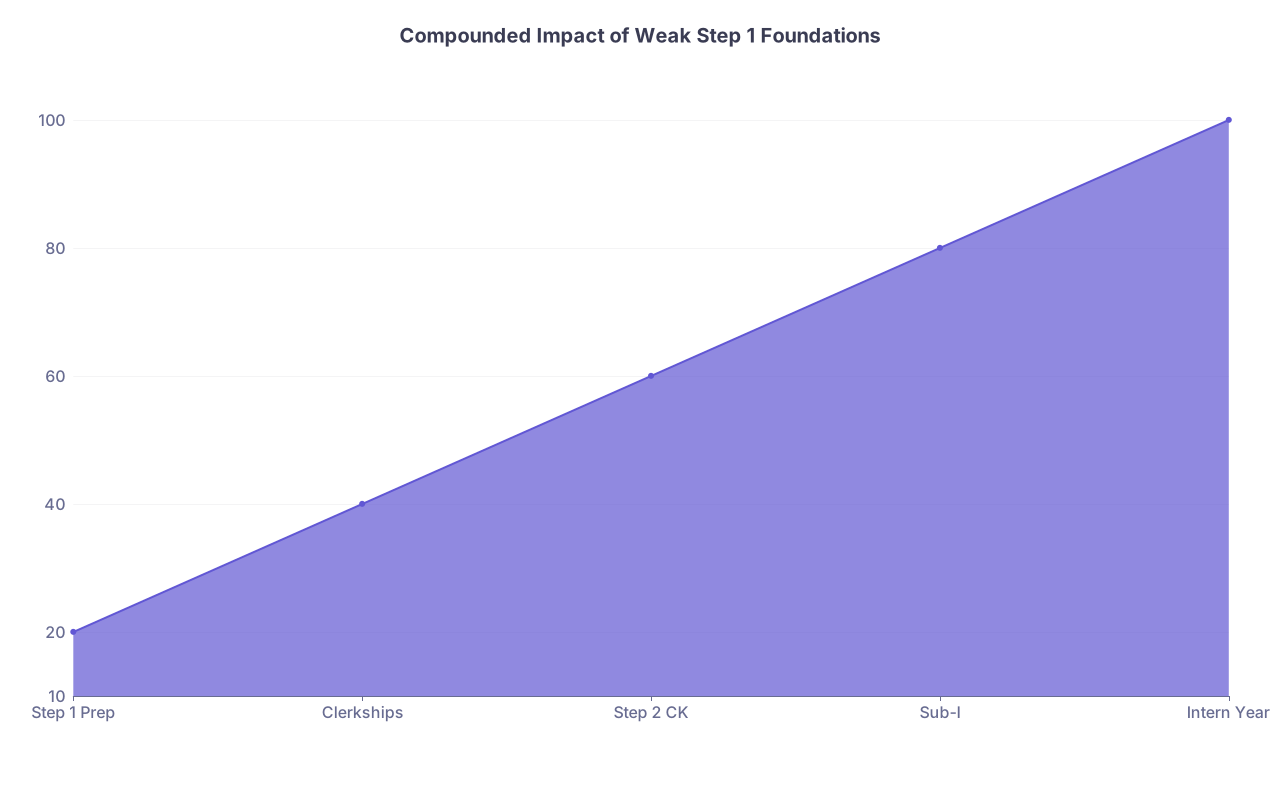
| Category | Value |
|---|---|
| Step 1 Prep | 20 |
| Clerkships | 40 |
| Step 2 CK | 60 |
| Sub-I | 80 |
| Intern Year | 100 |
Weak foundations compound over time. So do strong ones.
If You’re Still Pre–Clerkship: This Is Your Warning Shot
If you’re an MS1 or MS2 reading this, you’re in the only phase where fixing this is cheap. Preclinical is where you either build or fake your understanding.
Be brutally honest with yourself:
- Do you actually understand physiology, or are you just good at question banks?
- When you explain a disease, do you walk through mechanism, or do you throw buzzwords?
- When you get a new problem type, can you reason from first principles?
The students who treat Step 1 as “just pass, nothing matters” are the ones clerkship directors flag a year later as “unsound but hardworking.”
The ones who use Step 1 prep to deeply understand pathophysiology? They coast through third year looking “naturally smart” when really they just did the work early.

If You’re Already on Clerkships: How to Stop the Bleeding
You cannot rewrite your entire academic history, but you can change the story going forward.
Three high-yield moves:
Pick one core weakness and crush it.
If everyone keeps catching you on renal or endocrine, stop pretending you’ll “pick it up along the way.” Take 1–2 weeks and grind that system outside of work using a concise, concept-focused resource. Attach every concept to a real patient you’ve seen.Make your reasoning visible.
Every time you present or propose a plan, include a one-sentence physiologic explanation. Not a lecture. Just enough for your attending to think, “Okay, they actually understand this.” This is how you rebrand yourself from “memorizer” to “reasoner.”Ask for pathophys-focused feedback.
At mid-rotation: “I’m working on strengthening my pathophysiology reasoning. Are there specific times you’ve noticed gaps?” It signals self-awareness and gives them permission to actually help you. Directors like students who know their weakness and attack it.

FAQ: How Clerkship Directors Quietly Judge Low Step 1 Foundations
1. If Step 1 is pass/fail now, do clerkship directors actually care whether my foundation was weak?
Yes. They care more now, not less. Before, a low score was a quick filter. Now, your behavior on the wards is the filter. When your reasoning is thin, your plans are off, your shelves struggle despite effort—that’s all evidence of a weak foundation. They may not know your score, but they absolutely judge the quality of your preclinical learning.
2. Can strong shelf scores “hide” a weak Step 1 foundation from clerkship directors?
For a little while, but not forever. Good test-takers can brute-force shelves with pattern recognition and repetition. But when they’re asked to explain pathophysiology out loud, handle an unusual case, or justify a plan in detail, the cracks show. The best students are the ones whose shelf performance matches what faculty see on rounds: coherent, mechanistic thinking.
3. What’s the single most effective way to rebuild a shaky Step 1 base during clinical years?
Tie real patients to focused, system-based review. Do not “re-study Step 1” in the abstract. Take one or two systems that are repeatedly burning you (like renal or cardio), use a high-yield conceptual resource, and, each day, connect what you read to one patient you saw. Then, the next day, speak that reasoning out loud on rounds. That combination—targeted review plus visible application—is what actually changes how clerkship directors perceive you.
Key points:
Weak Step 1 foundations don’t hide; they leak into your shelves, presentations, and plans, and clerkship directors are very good at spotting them. You can’t rebuild all of basic science on the wards, but you can strategically backfill your biggest gaps and make your reasoning visible. The students who win are not just the ones who passed Step 1—they’re the ones who truly learned medicine the first time.