
Your Step 1 is not stuck. Your strategy is stuck.
Every year I see the same pattern: a student grinds through UWorld, takes multiple NBMEs, and then the nightmare—scores flat within the same 5–10 point band for a month or more. Their first instinct is always wrong: “I need more content,” “I just need to work harder,” or “I guess I have reached my ceiling.”
No. You hit the limit of your current method. Not your potential.
What you need now is not more random effort. You need a protocol. A structured way to break the plateau and convert work into points again.
That is what this guide is: a Step 1 Plateau Protocol you can implement within 7 days and refine over 3–4 weeks.
Step 1: Confirm It Is a Real Plateau (Not Noise)
Before you change everything, make sure you actually have a plateau and not just normal score variation.
A. Define “plateau” correctly
You are plateaued if:
- You have taken at least 3 NBMEs or UWSAs in the last 3–5 weeks, and
- Your scores are within a 5–7 point band (e.g., 214 → 217 → 213), and
- You have been studying full-time or near full-time.
Single bad test? That is noise. Two tests 2 months apart? Also noise. Three in a row, close together, same band? Plateau.
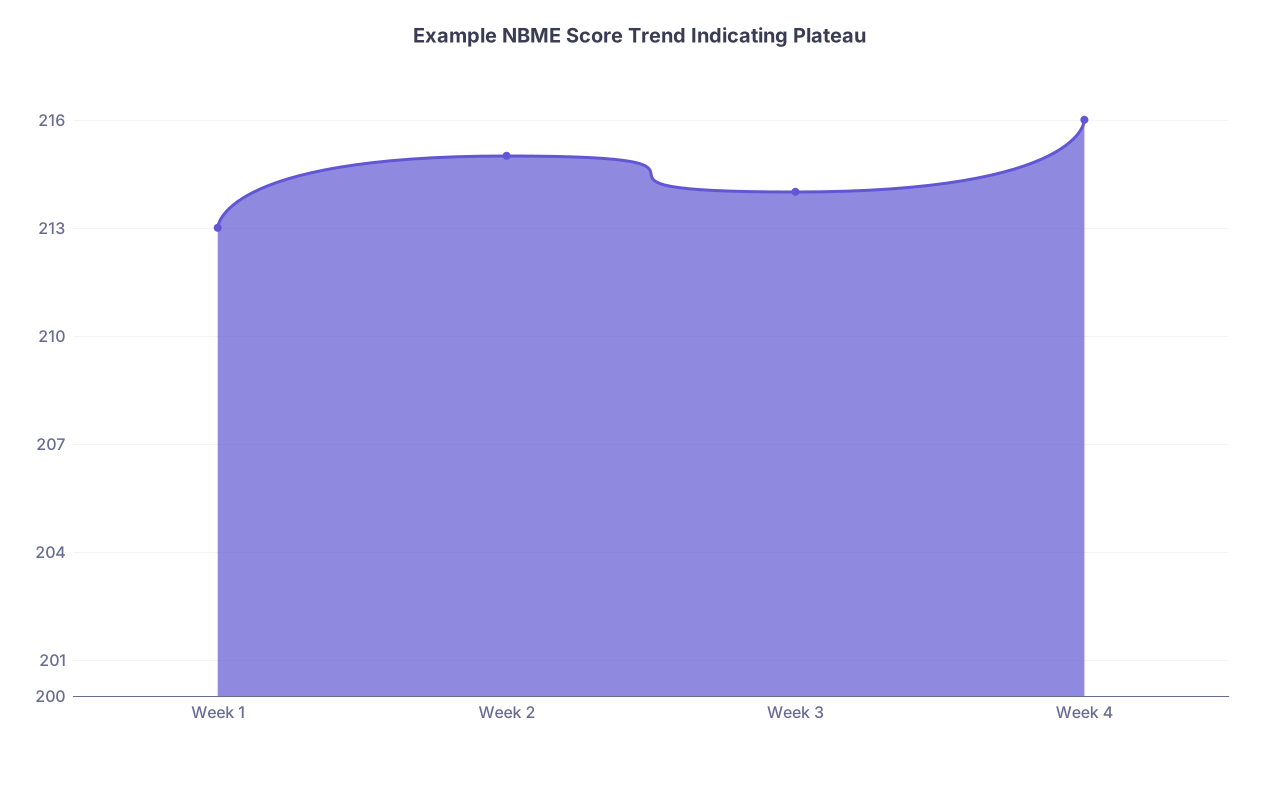
| Category | Value |
|---|---|
| Week 1 | 213 |
| Week 2 | 215 |
| Week 3 | 214 |
| Week 4 | 216 |
B. Check your context
Ask yourself, honestly:
- How many real, timed blocks (40 questions, 60 minutes) are you doing per day?
- How many hours of focused review (not just flipping Anki cards) are you doing?
- How often are you taking practice exams (NBMEs/UWSAs)?
If you are doing 20 random questions at midnight after clinic and a full-length once every 3 weeks, you do not have a plateau. You have an underpowered study plan.
If, however, you are doing:
- 2–3 timed blocks per day
- Reviewing them in detail
- Taking an NBME every 7–10 days
…and the score is frozen, then yes. Real plateau. Time for a protocol.
Step 2: Diagnose the Type of Plateau
Not all plateaus are created equal. Different causes, different fixes.
A. Use a simple score analysis
Grab your last 2 NBMEs + 1 UWSA (if you have them).
Make a quick table like this:
| Domain | NBME 1 | NBME 2 | UWSA |
|---|---|---|---|
| Systems Avg | 62% | 63% | 64% |
| Pathology | 68% | 69% | 70% |
| Physiology | 58% | 59% | 60% |
| Pharmacology | 54% | 55% | 56% |
| Biostat/Epi | 48% | 49% | 52% |
| Behavioral | 50% | 50% | 51% |
You are looking for patterns, not perfection.
Most plateaued students fall into 1–3 of these groups:
- Knowledge holes: Consistently low in specific content areas (e.g., biostatistics, endocrine, pharmacology).
- Question strategy failure: Decent content but miss questions because of:
- Misreading
- Panicking on multi-step questions
- Over-thinking distractors
- Stamina / timing issues: Strong first half, cliff in last 2 blocks.
- Scatterbrain study habits: Doing work, but in a completely unstructured, non-reinforcing way.
B. Quick self-interrogation
Answer these brutally honestly:
- In UWorld, when you review a block, how often do you say, “I actually knew that, I just misread” or “I switched from the right answer to the wrong one at the last second”?
- Are your first 2 blocks on NBME 10–15 points higher than your last 2?
- Do you have whole subject areas that cause dread? (Biostat. Renal phys. Immuno.)
Now match your answers:
- Lots of “I knew it but…” → Strategy plateau
- Scores collapse late in exam → Stamina/timing plateau
- Whole red zones in score report → Knowledge plateau
- A mix of all + chaotic days → Habits/structure plateau
You will probably see more than one. That is fine. We will treat them in order.
Step 3: Stop “More of the Same” – Reset Your Weekly Structure
Most students in a plateau keep doing the same thing harder. More Anki, more questions, more hours. They get more exhausted and their scores do not move.
You need a structural reset.
A. Set a 3–4 week “Plateau Protocol” window
For the next 21–28 days, you are not “studying randomly for Step 1.” You are running an experiment:
- Change inputs (how you study, what you target)
- Track outputs (scores on blocks and practice tests)
- Adjust weekly
This mindset matters. You are not failing. You are testing.
B. Build a weekly template
Here is a baseline weekly structure for someone in dedicated prep hitting a plateau:
- 5 days / week: Heavy work
- 1 day / week: Light / consolidation
- 1 day / week: Off (yes, off; your brain is not a machine)
On heavy days:
- 2–3 timed, random blocks (40 Q each) from UWorld or Amboss
- 3–4 hours targeted content repair based on your last exam weaknesses
- 30–60 minutes of high-yield review (Anki/flashcards/Boards and Beyond/Pathoma for specific issues)
On light days:
- 1–2 blocks
- Shorter, focused review only on your biggest 1–2 weak areas
Every 7–10 days:
- One full NBME or UWSA, timed, single sitting.
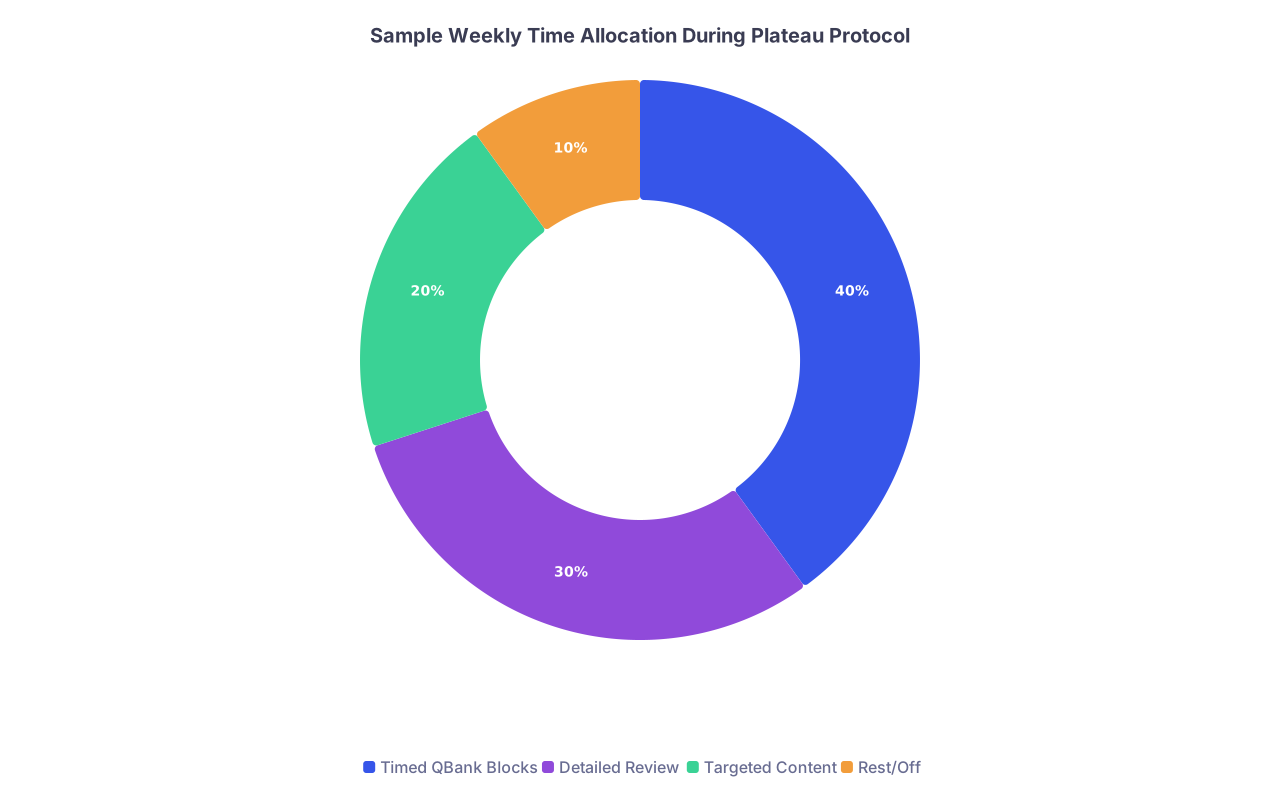
| Category | Value |
|---|---|
| Timed QBank Blocks | 40 |
| Detailed Review | 30 |
| Targeted Content | 20 |
| Rest/Off | 10 |
If your current week looks nothing like that (for example, 80% passive content, 20% questions), that alone can explain your plateau.
Step 4: Fix Content Gaps with a Surgical Strike Plan
Most students in a plateau respond to low scores with “redo all of First Aid.” That is a great way to burn 3 weeks and gain 2 points.
You do not need everything. You need specific repairs.
A. Use your NBME to create a “Red List”
Take your last NBME report.
List no more than 5 weak domains. That is your Red List.
For each domain, define the problem in one sentence:
- “Renal physiology – I do not understand Starling forces, clearance, and acid–base.”
- “Biostatistics – I cannot quickly interpret confidence intervals or choose the right test.”
- “Behavioral – always miss ethics / consent / capacity questions.”
This is not just labeling “low systems”. It is identifying specific recurring failure types.
B. Assign one primary resource per Red List item
Do not stack three resources per topic. Pick one go-to per weakness:
Examples:
- Biostatistics:
- OnlineMedEd biostats playlist or
- UWorld biostats questions + their subject review
- Renal physiology:
- BRS Physiology renal chapter
- Pathoma for pathology integration + relevant Boards and Beyond
- Immunology:
- Sketchy Immunology or
- A short, high-yield crash chapter from a physiology text

Then, for each Red List domain:
- Spend 2–3 focused hours reviewing only that domain (video + text + your own summary notes).
- Immediately do 20–30 topic-specific questions from UWorld / Amboss on that domain (timed, tutor mode is acceptable here).
- Create 5–10 key cards or notes for the main takeaways (not 50 useless flashcards).
You will cycle through your Red List repeatedly over your 3–4 week protocol.
Step 5: Rebuild How You Do Questions (Strategy Fix)
If your NBMEs are full of “I should have gotten that” misses, your content is not the main problem. Your question behavior is.
A. Adopt a strict question process
For the next 2 weeks, every single timed block you do, you follow the same process:
Read the last line first.
- “What is the most likely diagnosis?”
- “Which enzyme is deficient?”
- This frames what you are collecting.
Skim the stem for anchors.
- Age, sex, key history, labs, imaging phrases.
- Do not get lost in fluff on first pass.
Before looking at answers:
- Generate 1–2 possible answers or at least the category (e.g., “this is an autoimmune hemolytic anemia, probably warm type”).
Scan all answer choices once.
- Cross out 1–2 obvious wrong answers physically (if digital, mentally but deliberately).
Pick and move.
- No more than 75 seconds per question on average. Flag and go if stuck, but do not stew.
This structure does two things:
- Forces you to think before you anchor on distractors.
- Trains you to manage time and avoid emotional spirals mid-block.
B. Change how you review blocks
Most students’ “review” is them reading the explanation until they feel “yeah, that makes sense” and then moving on. Useless.
On review, for each missed or guessed question:
Classify the error type (write it down):
- Content: I truly did not know this fact / mechanism.
- Misread: I missed age, misread lab, skipped “most appropriate initial.”
- Strategy: I knew it but overthought / changed from right to wrong.
- Speed: Ran out of time, rushed last questions.
Write 1–2 bullet fixes:
- Content fix: “Add card for mechanism of action of XYZ + link to associated side effect.”
- Misread fix: “Underline age, sex, and question line before reading details.”
- Strategy fix: “Stop changing answers without new evidence.”
Capture patterns in a running log
Keep a “Stupid Mistakes Log.” Literally a note titled that.
Include entries like:
- “Twice this week: misread ‘next best step’ as ‘most definitive step’.”
- “Keep forgetting that Coxsackie B → dilated cardiomyopathy.”
Read this log every 2–3 days. It is ugly but extremely effective.
Step 6: Attack Stamina and Timing Directly
Score plateaus often come from dropping 6–10 points in the last 2 blocks of an exam. That is not knowledge. That is fatigue and pacing.
A. Train like the real exam
For at least 2 days per week, run “mini exam” sessions:
- 3–4 blocks of 40 questions, timed, minimal break in between.
- Same start time as your real exam (to set your circadian rhythm).
Then, once a week (or every 10 days):
- Full NBME or UWSA, 6–7 blocks, proper breaks, realistic setting.
Use these as stamina workouts, not just score checks.
B. Standardize your timing
On practice exams:
- Aim to finish each block with 5–7 minutes left.
- Use leftover time for flagged or “unsure” questions only.
If you chronically run out of time:
- Your per-question ceiling is ~75 seconds.
- At the 50% mark in the block, you should be around 20–25 questions done.
- If you are behind, you must accept skipping deep overthinking on hard vignettes and prioritizing completion.
C. Manage energy during the day
You cannot willpower your way through 7 blocks if you are crashing in block 4.
Simple protocol:
- Sleep: 7–8 hours, same bedtime / wake time daily for at least 2 weeks before exam. Non-negotiable.
- Caffeine: Use on exam-like practice days exactly how you plan on test day. No sudden Red Bull experiments.
- Food: Test your exam-day snacks during full-lengths (simple carbs + protein, easy to digest; nothing greasy).

| Step | Description |
|---|---|
| Step 1 | Block 1 |
| Step 2 | Short break 5-10 min |
| Step 3 | Block 2 |
| Step 4 | Short break 5-10 min |
| Step 5 | Block 3 |
| Step 6 | Longer break 15-20 min |
| Step 7 | Block 4 |
| Step 8 | Short break 5-10 min |
| Step 9 | Block 5 |
| Step 10 | Short break 5-10 min |
| Step 11 | Block 6/7 |
You are trying to make exam day feel like “just another long NBME day,” not a once-in-a-lifetime event your body freaks out about.
Step 7: Adjust Your QBank Strategy (Stop the Mindless Grinding)
If you are on your second or third pass of UWorld and nothing is changing, the problem is not that there are not enough questions. It is how you are using them.
A. Stop full random if you are hemorrhaging in specific areas
Total “All random” has its place, especially later. But in a plateau with known weak zones, you should blend:
- 1–2 blocks per day: mixed random (to simulate exam conditions).
- 1 block per day: targeted (your Red List topics).
This way you are not just hoping randomization gives you enough renal phys to fix it.
B. Shift from first-pass mentality to mastery mentality
If you are on pass 2 of UWorld:
- Your goal is not to see everything again.
- Your goal is to master what you already saw and still get wrong.
Protocol:
- Pull up your previous incorrects for your weak domains.
- Do them timed, mixed with some new questions.
- Keep a note: “Questions I still get wrong on second pass” and treat those as red-alert concepts to review in content resources.
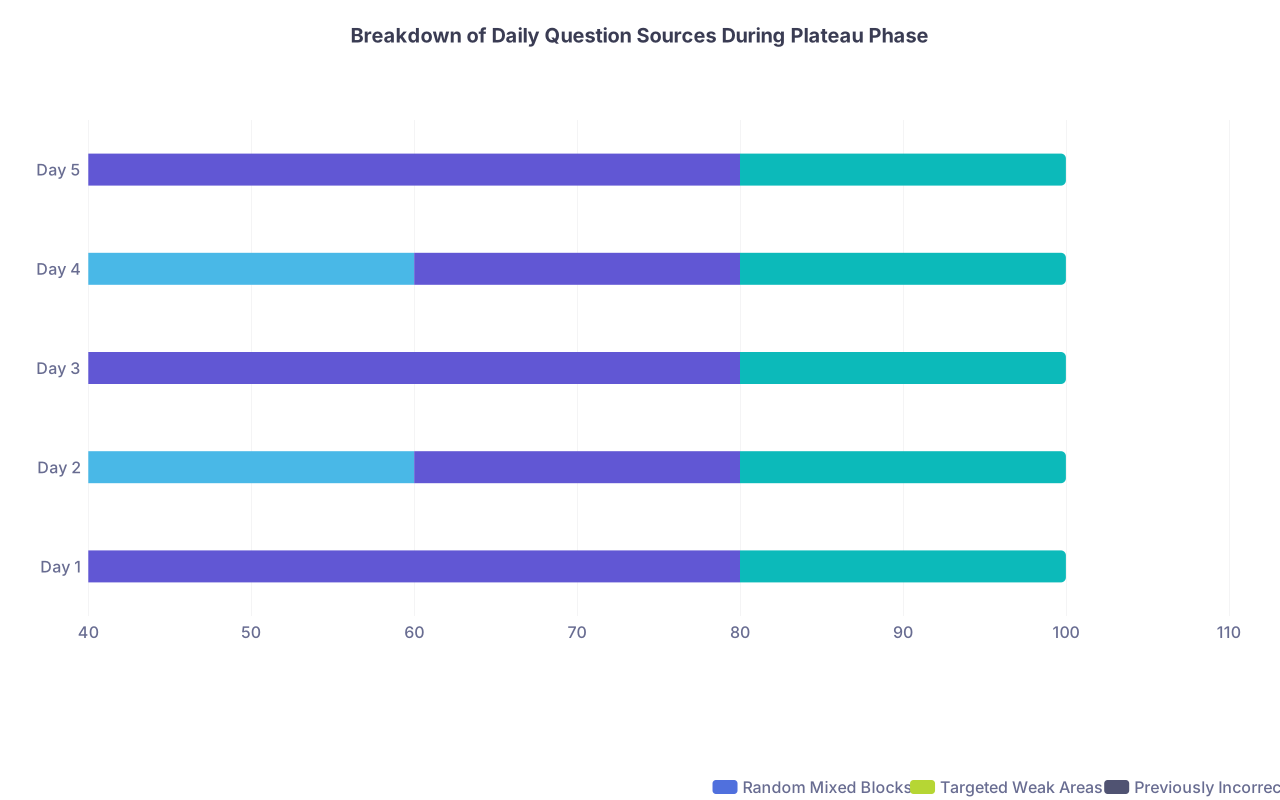
| Category | Random Mixed Blocks | Targeted Weak Areas | Previously Incorrect |
|---|---|---|---|
| Day 1 | 40 | 40 | 20 |
| Day 2 | 60 | 20 | 20 |
| Day 3 | 40 | 40 | 20 |
| Day 4 | 60 | 20 | 20 |
| Day 5 | 40 | 40 | 20 |
If you are still on pass 1 and ~70–80% through the bank, do not restart it. Use the incorrects and NBME-guided weaknesses as your focus.
Step 8: Use NBMEs and UWSAs Properly (Not as Emotional Torture)
I see students take an NBME every 4 days, chasing a dopamine hit. The plateau gets worse because they never actually fix anything in between.
Here is a sane way to use them.
A. Frequency
- Every 7–10 days: One practice exam (NBME or UWSA).
- Not more frequent. You need time to incorporate feedback.
B. Order and purpose
If you still have several NBMEs left:
- Use newer NBMEs (e.g., 25–31, depending on what is available) in the last 3–4 weeks before the exam.
- Use slightly older ones earlier to diagnose pattern.
Reserve UWSA 1 and 2:
- UWSA 1: 3–5 weeks out.
- UWSA 2: 1–2 weeks out (one of the highest predictive values historically).

C. Post-exam 48-hour protocol
Immediately after an NBME:
Day 0 (same day):
- Review all questions, especially wrong and marked.
- Categorize every miss: content vs. strategy vs. misread vs. timing.
- Update your Red List and Mistakes Log.
Day 1–2:
- Spend 2–4 hours on each of the top 2–3 weakness domains that exam exposed.
- Do 20–40 targeted questions per weakness.
- Summarize key fixes.
Only then go back to your regular mix of random + targeted.
Step 9: Mental Game – Fix the Anxiety Feedback Loop
Here is what usually happens during a plateau:
- NBME flat →
- “I am doomed” thought →
- More frantic, unfocused work →
- Less recovery, more burnout →
- Next NBME flat or worse → repeat.
You do not need therapy-level intervention to fix your head for this. You do need a few hard rules.
A. Separate evaluation days from identity
You are not allowed to interpret a single NBME as, “I am stupid” or “I will not match.” You are allowed to interpret it as:
- A data point.
- A map of what to fix next week.
Force this by writing, immediately after seeing your score:
- 3 things that improved (timing, certain topics, stamina, whatever).
- 3 specific actions you will take based on the report.
If you cannot write those 6 items, you are just catastrophizing, not analyzing.
B. Put a ceiling on daily hours
There is a point beyond which your extra hours become negative. For most people in dedicated Step 1 study:
- Effective ceiling: 8–10 focused hours / day.
- Beyond that, your retention crashes and anxiety soars.
If you are chronically going 12–14 hours, you are not working harder. You are slowly frying your prefrontal cortex.
Set a hard stop time each night. No Step 1 content after, say, 9 p.m.
C. Do one “non-medical” thing every day
Yes, this sounds fluffy. No, it is not optional if you want to break a plateau.
- 20–30 minutes of walking.
- Short workout.
- Cooking a meal.
- Short call with someone who is not in medicine.
Your brain consolidates and integrates while not actively cramming. That is how plateaus often break—on the back of sleep + lower stress, not “one more pass of First Aid.”
Step 10: A 7-Day Sample Plateau Protocol
To make this concrete, here is a sample week you can adapt. Assume you are 4–6 weeks from your test date and currently plateaued.
| Day | Morning | Afternoon | Evening |
|---|---|---|---|
| Mon | NBME / UWSA (full) | Break + start review | Light review / walk |
| Tue | Review NBME blocks 1–3 in depth | Target Red List #1 (content + questions) | 1 random block + review |
| Wed | 2 random timed blocks + review | Target Red List #2 (content + questions) | Anki / flashcards, then off |
| Thu | 3-block mini-exam (timed) | Review mistakes + stamina/timing notes | Light content review |
| Fri | 2 random timed blocks + review | Target Red List #3 or biostats/behavioral | Short walk, early stop |
| Sat | 1–2 targeted blocks (weak systems) | Light content consolidation, notes cleanup | Off by evening |
| Sun | Off (or max 1 hour skim review) | Off | Off |

| Step | Description |
|---|---|
| Step 1 | Practice Exam Day |
| Step 2 | Detailed Review |
| Step 3 | Identify Weak Domains |
| Step 4 | Targeted Content & Qs |
| Step 5 | Mixed Random Blocks |
| Step 6 | Mini-Exam / Stamina Work |
| Step 7 | Consolidation & Rest |
Is this the only correct schedule? Of course not. But if your current schedule is “wake up, panic, do some random Anki, some UWorld, maybe a video if I feel like it,” then this is already a massive upgrade.
When to Actually Change Your Test Date
Everyone wonders this during a plateau but almost no one gets honest guidance.
You should strongly consider pushing Step 1 back if:
- Your NBME scores over the last 3 weeks are all well below your target safety range, and
- There is no upward trend at all after implementing a structured protocol for ~2 weeks.
For example:
- You want to be comfortably passing with margin (or hitting a program-specific target if still scored).
- You are stuck at an unsafe band despite full-time prep.
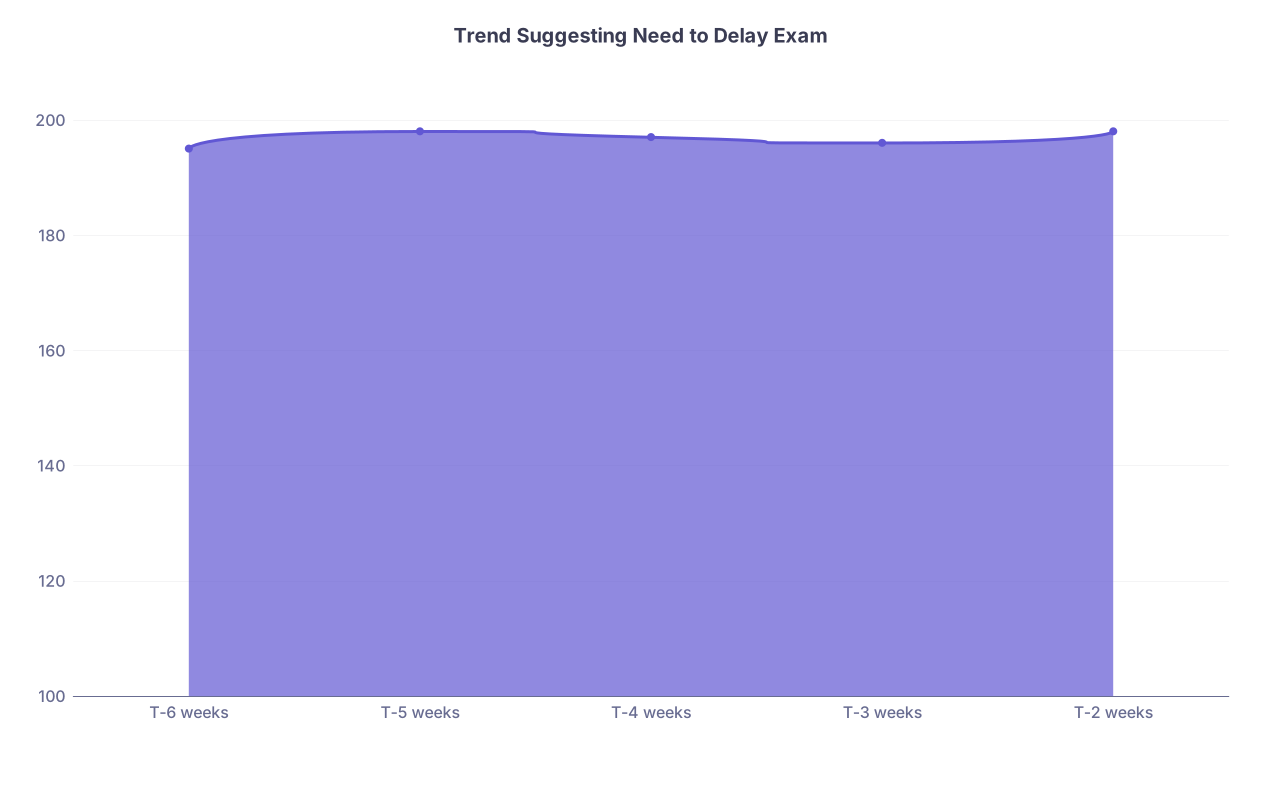
| Category | Value |
|---|---|
| T-6 weeks | 195 |
| T-5 weeks | 198 |
| T-4 weeks | 197 |
| T-3 weeks | 196 |
| T-2 weeks | 198 |
On the other hand, do not move your date just because:
- One NBME dropped by 3–5 points.
- You feel “not ready” in the abstract. Everyone feels that way.
- Your friends are scoring higher.
Decide based on data + time left + trajectory, not fear.
The Bottom Line
You break a Step 1 plateau by changing how you work, not by simply working more.
If you remember nothing else, keep these three points:
- Diagnose, do not guess. Use your NBME/UWSA breakdowns to identify specific content gaps, strategy failures, and stamina issues. Then build a Red List and attack it.
- Structure beats willpower. A 3–4 week plateau protocol with timed blocks, targeted repair, proper review, and scheduled practice exams will move your score more than random grinding ever will.
- Protect your brain. Limit daily hours, plan rest, and train under exam-like conditions so your best performance happens on test day, not at 11 p.m. in your bedroom during UWorld block #19.
Your scores are not stuck. They are just waiting for a better plan. This is it—now go run the protocol for 2 weeks and then look at the numbers again.