
Step 1 Dedicated While on Rotation: A Survival Strategy Blueprint
It is 9:40 p.m. You just finished sign-out on your medicine rotation. Your feet hurt, your brain is mush, and you finally sit down—only to see a reminder pop up on your phone: “Step 1 in 31 days. UWorld: 46% complete.”
This is the nightmare version of “dedicated”: no clean 6-week block, no library cocoon, just trying to cram First Aid and UWorld around prerounds, notes, and pages.
You are not alone. I have watched plenty of students take Step 1 either:
- Mid-IM or surgery
- With only a “soft” or partial dedicated
- Or after their school “kindly” scheduled them for OB nights right before their exam
Most of them survived. Some even crushed it. The ones who did not? They usually made the same predictable mistakes.
This blueprint is how you avoid those mistakes and turn a chaotic “rotation-dedicated hybrid” into something you can actually execute.
1. Get Real About Your Situation (Brutal Assessment First)
Before schedules, apps, or Anki decks, you need one thing: reality.
A. Define your constraints
Write this down on paper. Not in your head.
Rotation type and workload
- Light: psych, outpatient FM, some EM
- Medium: IM floor (reasonable team, not malignant)
- Heavy: surgery, OB, ICU, malignant anything
Average daily hours on site (including commute):
- < 9 hours
- 9–11 hours
- 12–14 hours
Call / nights?
- Yes – and how often?
- No
Actual energy levels after work. Not fantasy.
- “After work I can do 40–60 questions and review”
- “After work I can maybe handle 20 questions and some light review”
- “After work I am useless. Mornings or nothing.”
Your Step 1 plan lives or dies on those constraints. Do not copy someone else’s schedule who had a cush psych month when you are on trauma surgery.
B. Know your starting point
You cannot plan without a baseline. If you have not done this yet, here is the protocol:
- NBME or UWSA-style baseline exam (even if painful)
- Time-box it: 1 day off or post-call day
| Baseline Score Range | Interpretation | Strategy Shift |
|---|---|---|
| 190+ | At or near passing | Focus on consolidation and consistency |
| 180–189 | At risk but fixable | Tight structure, higher daily Q volume |
| <180 | High risk | Consider moving test date or negotiating rotation load |
If your score is:
- 190+: You are probably safe with a rigorous but sustainable schedule.
- 180–189: You must run a tight ship and monitor progress closely.
- <180: Stop. You need to rethink timing. No “grit” or magical schedule will fix a structurally impossible situation.
If you are in that <180 band while on a heavy rotation and your exam is <4 weeks away, the right move is usually:
- Talk to your dean / academic advisor
- Move the exam or lighten your rotation load
Not heroic struggle. Not “I will just push harder.” Actual structural change.
2. Build a Rotation-Compatible Dedicated Schedule
Now the real work: a schedule that fits around rotations instead of pretending rotations do not exist.
A. Decide your primary study window
On heavy rotations, you realistically get one high-quality block per day:
- Morning person with early rounds →
- 1–1.5 hours before the hospital (usually 5–6:30 a.m.)
- Night person or lighter rotation →
- 2–3 hours after the hospital
Pick one. Do not fantasize about both. You will end up doing neither.
Then add:
- 20–40 minutes of lower-energy Anki / review during:
- Commute (if bus/train)
- Lunch breaks
- Lulls in clinic
That is the backbone. Not 10 different windows. One major block, one minor.
B. Core daily targets (the non-negotiables)
On a rotation, you are not doing 120 UWorld questions per day with full review. Stop lying to yourself.
Target ranges:
Heavy rotation (surgery / OB / ICU)
- 20–30 UWorld questions / day (tutor or timed)
- 1–1.5 hours of focused review
- 30–60 minutes of Anki
Medium rotation (IM floors, EM, average inpatient)
- 30–40 UWorld questions / day
- 1.5 hours review
- 30–60 minutes of Anki
Light rotation (psych, outpatient FM)
- 40–60 UWorld questions / day
- 2+ hours review
- 45–90 minutes Anki
If your schedule cannot support those numbers, you need:
- Fewer days at that target (e.g., 5 study days, 1 lighter, 1 near-off)
- More total weeks before the exam
C. Weekly structure: rotation-dedicated hybrid
Here is a sample medium-load IM rotation schedule with Step 1 in 5 weeks:
Monday–Friday:
- Morning (if early person)
- 5:15–6:15: 20 UWorld questions (timed, random or system-based)
- Evening
- 7:30–8:30: Review those 20 questions in detail
- 8:30–9:00: Anki / flashcards
Saturday:
- 8:30–10:30: 40–50 UWorld questions
- 11:00–1:00: Deep review + pathophys videos (Boards & Beyond or similar)
- 3:00–4:00: Anki / weak topic drilling
Sunday:
- Alternating weeks:
- Week A: Light review (Anki, sketchy, weak subjects, 10–20 questions)
- Week B: Half-length practice block (3–4 blocks of 40 questions) + lighter evening
The key point: you move from fantasy “big dedicated” to a rotation-aware, modest but consistent program.
3. Priorities: What Actually Moves the Needle (and What to Drop)
When you are on rotation, you cannot do everything. So you need a ruthless hierarchy.
A. Non‑negotiable pillars
Question bank (UWorld or equivalent)
- This is the spine of your prep.
- Aim to complete at least 70–80% of the bank pre-exam.
- If you are late in the game, prioritize breadth (more unique questions) over perfect review of every single explanation.
Active recall (Anki or tightly structured review)
- Either:
- A focused Anki deck (e.g., Lightyear, AnKing) with realistic daily limits
- Or a structured “write and recall” system using First Aid / boards text
- Either:
Periodic full or half practice exams
- Every 2 weeks minimum: NBME or UWSA-style assessment
- You track progress, identify weak systems, and adjust.
B. Secondary resources (use with discipline)
Pick at most one primary content resource:
- Boards & Beyond
- Pathoma
- Sketchy (for micro/pharm)
Use them only when:
- A UWorld explanation revealed a soft spot (e.g., renal phys), and
- You time-box it: “I will watch 2 B&B videos on renal phys, then immediately do 10–15 related questions.”
Do not binge-watch 6 hours of neuroanatomy videos because it feels productive. That is Step 1 cosplay, not Step 1 study.
C. What to cut (for now)
On rotation-heavy dedicated, you likely do not have consistent bandwidth for:
- Multiple video series (e.g., B&B + Lecturio + Kaplan)
- Redoing entire decks you never touched before
- Reading full review books cover to cover
You use those as targeted tools, not default daily drivers.
4. Micro‑Tactics That Actually Work When You Are Exhausted
This is where most students crack. The plan is fine on paper, but at 8:30 p.m. you are cooked. So you need tactics designed for your tired brain.
A. The “bare minimum” rule
Create a non-negotiable minimum that you do even on awful days (post-call, emotional disasters, etc.):
Example minimum:
- 10–15 UWorld questions (even if tutor, even if slow)
- 30 minutes of Anki
If you hit that, the day is not a zero. No “I lost the day, so everything is ruined” spiral.
B. Use low-energy time for low-energy work
You are not doing fresh 40-question blocks at 11 p.m. after trauma sign-out. That is how you get demoralized.
Use your worst attention windows for:
- Anki reviews
- Skimming explanations of questions you did earlier
- Screenshots / quick notes consolidation
- Watching 1 short Pathoma/B&B video at 1.25x focused on one weak topic
Save the heaviest cognitive lift (fresh questions) for when you are most awake—often early morning or weekend mid‑day.
C. Question review method that does not waste time
When reviewing UWorld:
First pass:
- Why was your answer wrong or right in one sentence?
- What concept was this really testing? (e.g., “anion gap metabolic acidosis causes” not “this exact patient’s aspirin overdose”)
Second pass:
- Skim explanation.
- Capture only high‑yield misses:
- A tiny note in a running Google Doc / Notion page
- Or a quick custom Anki card
Hard rule:
- No more than 5 minutes per question on review, average.
- If you are spending 20 minutes on a single question, you are studying for your pride, not the exam.
5. Integrate Rotations Into Your Step 1 Prep (Instead of Competing With Them)
Smart students use clinical time to reinforce Step content. The exam is not purely preclinical anymore; clinical reasoning matters.
A. Clinical → Step 1 loop
When you see a disease/management topic on rotation, run a quick loop:
Ask: “What is the classic Step 1 version of this?”
- Example: You have a DKA patient on IM.
- Step lens: insulin deficiency, anion gap metabolic acidosis, K+ shifts, Kussmaul breathing.
That night (or the next morning), you do:
- 5–10 UWorld questions on DKA or similar endocrine topics
- Quick review of the relevant Anki tags
You anchor real patients to abstract facts. This sticks way better than pure book learning.
B. Talk like Step on rounds (selectively)
Do not be obnoxious, but when the attending asks something basic, answer with Step‑level structure:
- “This is likely SIADH—euvolemic hyponatremia with low serum osmolality and inappropriately high urine osmolality and sodium. Causes can include CNS disturbances, pulmonary disease, or ectopic ADH from small cell lung cancer.”
You are not just flexing. You are rehearsing Step content in real time.
C. Use downtime surgically
What I have seen work on rotations:
- 5–10 Anki cards while waiting for the attending to scrub
- 1–2 UWorld questions during a long ED wait, if your team culture allows phones/iPads
- Sketchy screenshot review during lunch
Tiny chunks. High frequency. It accumulates.
6. Exam Timing, Rescheduling, and When to Pull the Fire Alarm
Some of you are reading this with a date that is too soon for your reality. There is a difference between “uncomfortable” and “unsafe.”
A. Use data, not vibes
Every 2 weeks, take a practice test (NBME/UWSA-style) and track scores:
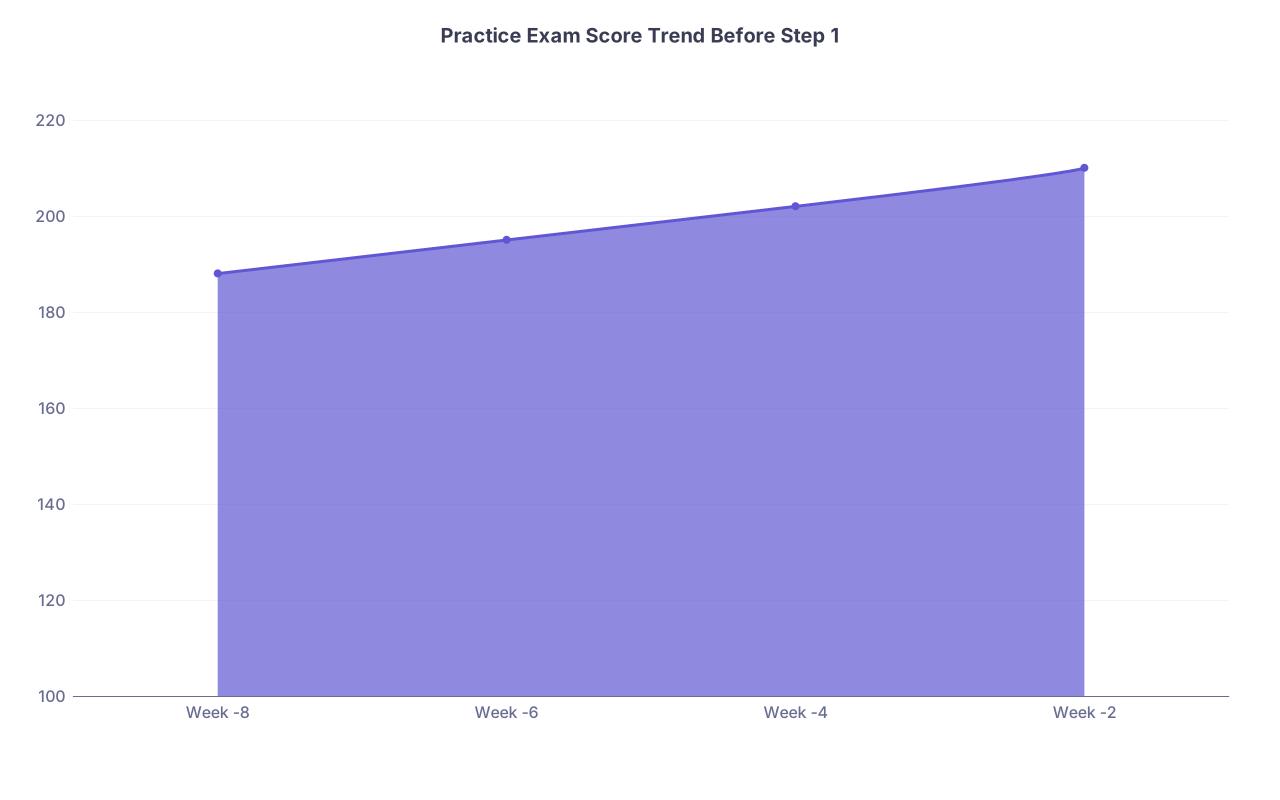
| Category | Value |
|---|---|
| Week -8 | 188 |
| Week -6 | 195 |
| Week -4 | 202 |
| Week -2 | 210 |
Interpretation:
- Upward trend and near/above passing → Stay the course, tighten weak areas.
- Flat and below passing for >4 weeks → Something is structurally wrong (too little time, too much rotation, poor plan).
- Downward trend → Burnout, overtesting, or poor review method.
B. Criteria to seriously consider moving your date
If you are:
- < 190 on NBME within 3 weeks of exam
- On a heavy rotation with no realistic schedule improvement
- Emotionally fried, with declining practice scores
Then moving the exam is not “weak.” It is adult-level risk management.
What you do not do:
- Keep the date because “everyone else in my class is taking it now”
- Pretend that 3 heroic all-nighters will fix 6 months of underpowered prep
Talk to:
- Your academic dean
- Student affairs
- A trusted mentor (ideally someone who has seen many Step 1 paths, not just your friend with a 260)
Get the logistics. Then decide.
7. Sample Schedules for Different Rotation Types
You asked for blueprint. Here are actual templates you can modify.
A. Heavy rotation (surgery / OB, 6 days/week, 12–14 hours/day)
Goal: Maintain momentum, not maximal growth. Use weekends as mini-dedicated.
Weekdays (M–F or M–Sat):
- 4:45–5:45 a.m.:
- 15–20 UWorld questions (timed, system-based if needed)
- At hospital:
- 10–20 min Anki during lunch or downtime
- After work (if not post-call, ~8:00–9:00 p.m.):
- Quick review of morning questions (45–60 minutes max)
- 10–15 min Anki
Sunday (main push):
- Morning:
- 40–60 UWorld questions (timed)
- Midday:
- 2 hours of review + targeted videos for weak areas
- Late afternoon:
- Light Anki / summary review
B. Medium rotation (IM floors, reasonable, 6 days/week, 10–12 hours/day)
Weekdays:
- 5:30–6:45 a.m.:
- 20–25 UWorld questions
- Evening (~7:30–9:00 p.m.):
- Review those questions
- 20–30 min Anki
Off day:
- Half‑day NBME or 3–4 block Qbank simulation every other week
- Otherwise: 60–80 questions + review + targeted video
C. Light rotation (psych, outpatient, 5 days/week, 8–9 hours/day)
This is as close as you get to “pseudo-dedicated” while on service.
Weekdays:
- Morning:
- 20–30 UWorld questions
- Evening:
- 20–30 more questions OR
- Practice block + review
- 45–60 min Anki
Weekend:
- One day bigger push:
- 80–120 questions (split)
- Deep review
- One day moderate:
- 40–60 questions
- Light review, Anki, rest
8. Managing Energy, Sleep, and Burnout (The Hidden Curriculum)
You are not a robot. The limiting reagent here is not your intellect. It is your ability to sustain effort.
A. Sleep is not optional
I have seen this play out:
Student does 100 questions/night on 4 hours of sleep → Looks “hardcore” → Scores flat or drops on NBME.
You will learn less per hour when sleep‑deprived. Which means your “extra” hours are fake.
Non-negotiable target: 6+ hours of sleep, preferably 7–8 on lighter days.
Sacrifice:
- Doom scrolling
- Long social media breaks
- Aimless YouTube/Netflix
Not sleep.
B. Micro‑recovery protocol
You will burn out if every minute is medicine.
Build in:
- One protected half-day per week that is:
- No heavy Qbank
- Just light Anki, maybe one small block, then real rest
- Daily 10–20 minutes of something that is not screens and not studying:
- Walk
- Stretching
- Short workout
Think of it as preventive maintenance. If you ignore it, you will do forced maintenance when you crash.
9. Adjusting As You Go: Weekly Debrief System
You do not set a schedule once and pray. You adapt.
Use a 15–20 minute weekly review:
Look at:
- How many questions did you actually do?
- How many Anki reviews?
- Any practice exam score changes?
Ask:
- What blocked me this week? (call, family issues, low energy, poor time use)
- Where did I waste time? (too much explanation reading, social media, random browsing of resources)
- Which topics keep appearing as weaknesses? (e.g., renal phys, biostats, neuro)
Adjust:
- Increase/decrease daily Q count by 10–15
- Add a short focused block on a weak system
- Drop a resource that is not pulling its weight

| Step | Description |
|---|---|
| Step 1 | End of Week |
| Step 2 | Review Qbank counts |
| Step 3 | Check practice scores |
| Step 4 | Reduce or increase daily Qs |
| Step 5 | Change review method or resources |
| Step 6 | Maintain current plan |
| Step 7 | On target? |
| Step 8 | Scores improving? |
You run your prep like a feedback loop. Not a superstition.
10. Example 4‑Week “On‑Rotation Dedicated” Blueprint
To put it all together, here is a concrete 4‑week timeline for someone on a medium IM rotation, testing at the end of Week 4, starting with a borderline baseline.
Week 1: Stabilize and Structure
- Take baseline NBME on day off if not already done
- Set daily Q target: 30/day weekdays, 60/day weekend day
- Focus: Cardio, pulm, renal—systems heavily represented and often weak
- One half day: 3-block (120 Q) timed session + review
Week 2: Expand and Reinforce
- Continue 30/day weekdays, 60–80 on weekend
- Add:
- Short focused videos for the worst-performing system from Week 1
- End of week:
- NBME or UWSA
- If improved ≥5–7 points and above passing: maintain
- If flat or worse: cut content bloat, increase question volume modestly
Week 3: Target Weakness + Stamina
- Identify bottom 2–3 systems from latest NBME (e.g., neuro, repro, biostats)
- Allocate:
- 50–60% of Qbank time to mixed blocks
- 40–50% to weak‑system focused blocks
- One long practice day:
- 6–7 blocks of 40 questions (simulate exam day timing)
- Review stamina issues: do you crash at block 5? Fix with more full-block practice.
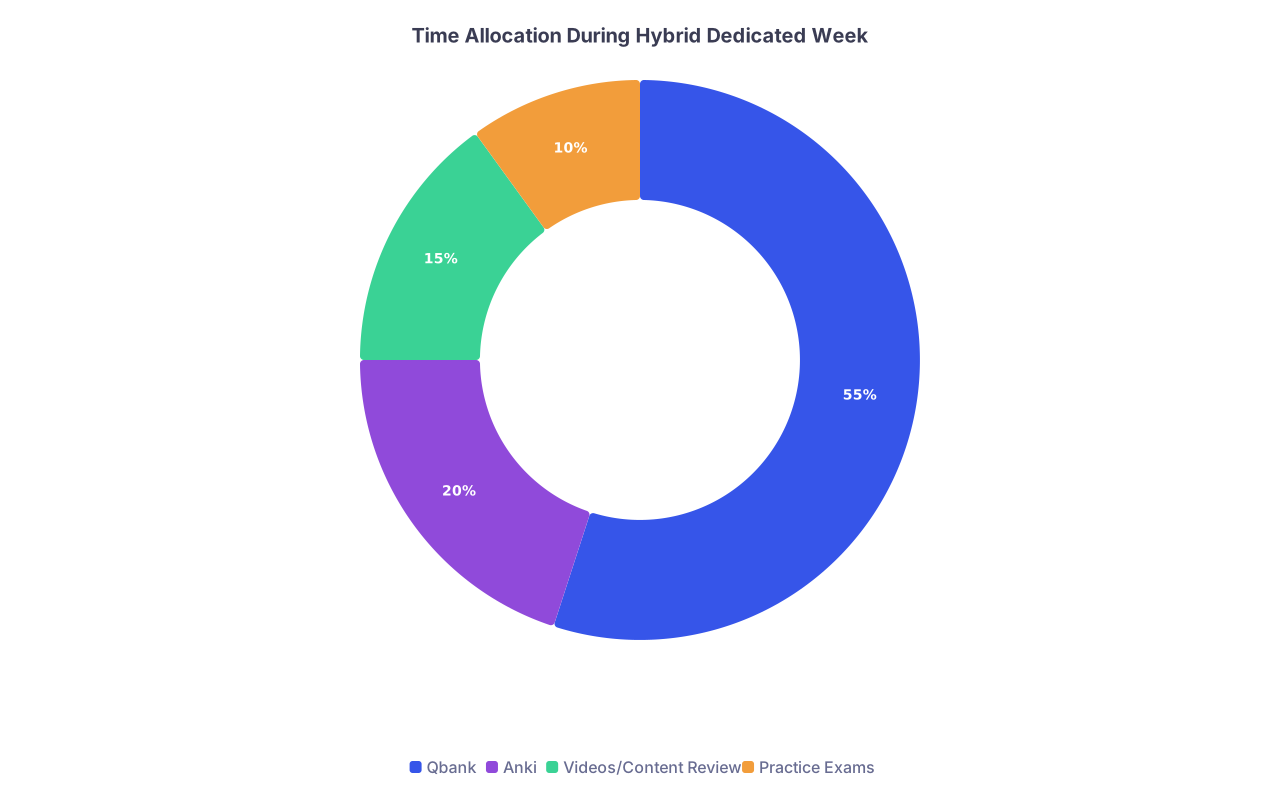
| Category | Value |
|---|---|
| Qbank | 55 |
| Anki | 20 |
| Videos/Content Review | 15 |
| Practice Exams | 10 |
Week 4: Taper, Consolidate, Protect
- Early week:
- Final NBME/UWSA 5–7 days before test
- If grossly unsafe: reconsider date
- Last 3–4 days:
- 40–60 mixed questions/day
- High-yield summary review (your own notes, weak topics)
- No new big resources
- Day before exam:
- Light: 20–30 easy questions or just flashcards
- Logistics, sleep, mental reset
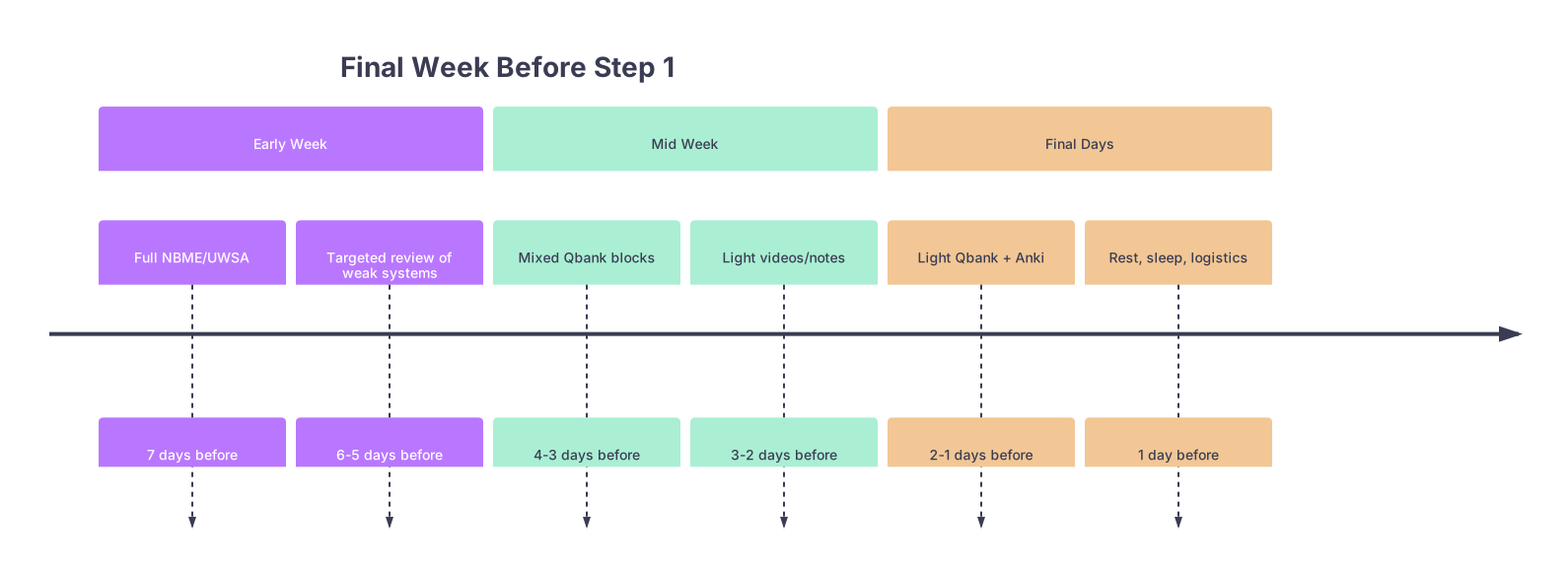
| Period | Event |
|---|---|
| Early Week - Full NBME/UWSA | 7 days before |
| Early Week - Targeted review of weak systems | 6-5 days before |
| Mid Week - Mixed Qbank blocks | 4-3 days before |
| Mid Week - Light videos/notes | 3-2 days before |
| Final Days - Light Qbank + Anki | 2-1 days before |
| Final Days - Rest, sleep, logistics | 1 day before |
11. Mental Framing: How to Think About This Mess
Studying for Step 1 while on rotation is not “ideal.” It is not fair. But it is common. The question is not “Is this fair?” The question is “What is the best move from where you are standing?”
So, three things I want you to keep in mind:
You are playing a long game. Passing Step 1 while staying functional on rotations is the win here. You can still build an excellent application with a solid, not-superhuman Step 1 outcome, strong Step 2, and good clinical evals.
Consistency beats heroics. Daily 20–40 questions and some Anki over 6–8 weeks will outrun one insane 300‑question Sunday followed by four zero days.
You have more control than it feels like—but you must use it. That means:
- Setting boundaries with co‑students who want to hang out every night
- Saying no to extra shifts that add nothing educationally
- Actually rescheduling the exam if the data say you are not safe yet
Key Takeaways
- Build a rotation‑aware Step 1 plan: one main study block per day, realistic Qbank targets, and structured weekly reassessment.
- Prioritize questions + active recall, use content videos surgically, and integrate clinical experiences into your learning instead of letting them compete.
- Let data, not ego, drive big decisions like increasing intensity or moving your exam date, and protect your sleep and sanity so you can sustain the grind.