
You can repair a shaky pathology foundation in eight weeks. But only if you stop pretending “doing more questions” alone will save you.
Pathology is the backbone of Step 1. If your foundation is weak, everything else—pharm, micro, even phys—starts to wobble. The good news: with eight weeks, you still have time to rebuild the structure, not just slap duct tape on it.
I am going to walk you through exactly how to do that. Week by week. Day by day. With concrete resources and specific targets.
This is not “study harder” advice. This is a protocol.
Step 1: Get Completely Honest About Your Pathology Problem
Before you fix anything, you need to know what is actually broken. “I’m bad at path” is useless. You need: “I consistently miss renal pathology questions that hinge on histology and nephritic vs nephrotic patterns.”
A. Run a Pathology Stress Test (1–2 days, max)
You will spend 1–2 days doing nothing but testing where you stand.
Create 3–4 pathology-only blocks
- Use UWorld or AMBOSS
- 40 questions per block
- Mixed organ systems, but path-heavy
-
- Timed, 1 hour per block
- No pausing, no checking answers mid-block
Then perform a ruthless post-mortem For every missed or guessed question, tag it specifically:
- Conceptual understanding problem (e.g., “I do not actually know how nephrotic syndrome works”)
- Pattern recognition problem (e.g., “I forgot what ‘tram-track’ glomeruli go with”)
- Memory recall failure (e.g., “I knew this once. Brain emptied it.”)
Categorize your weaknesses by system and type
Create a simple table like this:
| System | Concept Gap | Pattern/Pathognomonic Gap | Recall Gap |
|---|---|---|---|
| Cardio | ++ | + | 0 |
| Renal | +++ | ++ | + |
| Heme/Onc | + | +++ | + |
| Pulm | + | + | ++ |
Use +/++/+++ to mark severity. You do not need a fancy spreadsheet. Just something you will actually look at.
B. Decide Your Primary Tools
You cannot use ten resources in eight weeks. You will drown.
Pick one primary pathology explanation resource and one primary question bank:
Typical high-yield combos:
- Pathophysiology / concept:
- Pathoma
- Boards and Beyond Pathology (if you need slower, fuller explanations)
- Pattern recognition / integration:
- UWorld
- AMBOSS (fine as a second source or for extra questions)
- Visual mnemonics (optional but powerful):
- Sketchy Path (if you already used Sketchy for micro/pharm, leverage the same memory system)
You should end up with something like:
- “Primary explanations: Pathoma + a few targeted B&B videos”
- “Primary QBank: UWorld”
- “Supplement for recall/patterns: Sketchy Path (for my worst systems only)”
If you choose more than that, you are lying to yourself about time.
Step 2: Set an 8-Week Structure That Prioritizes Pathology
You do not fix a weak foundation by sprinkling in a few extra path questions. You front-load it.
For the next 8 weeks, pathology is your spine. Everything else wraps around it.
Big-Picture Breakdown
- Weeks 1–4: Rebuild system-level pathology foundations
- Heavy content review + high-quality questions
- Weeks 5–6: Integration and speed
- Multi-system questions, images, path–pharm–micro links
- Weeks 7–8: Exam simulation + plug remaining holes
- Full-length NBMEs/UWSA + brutal, focused cleanup
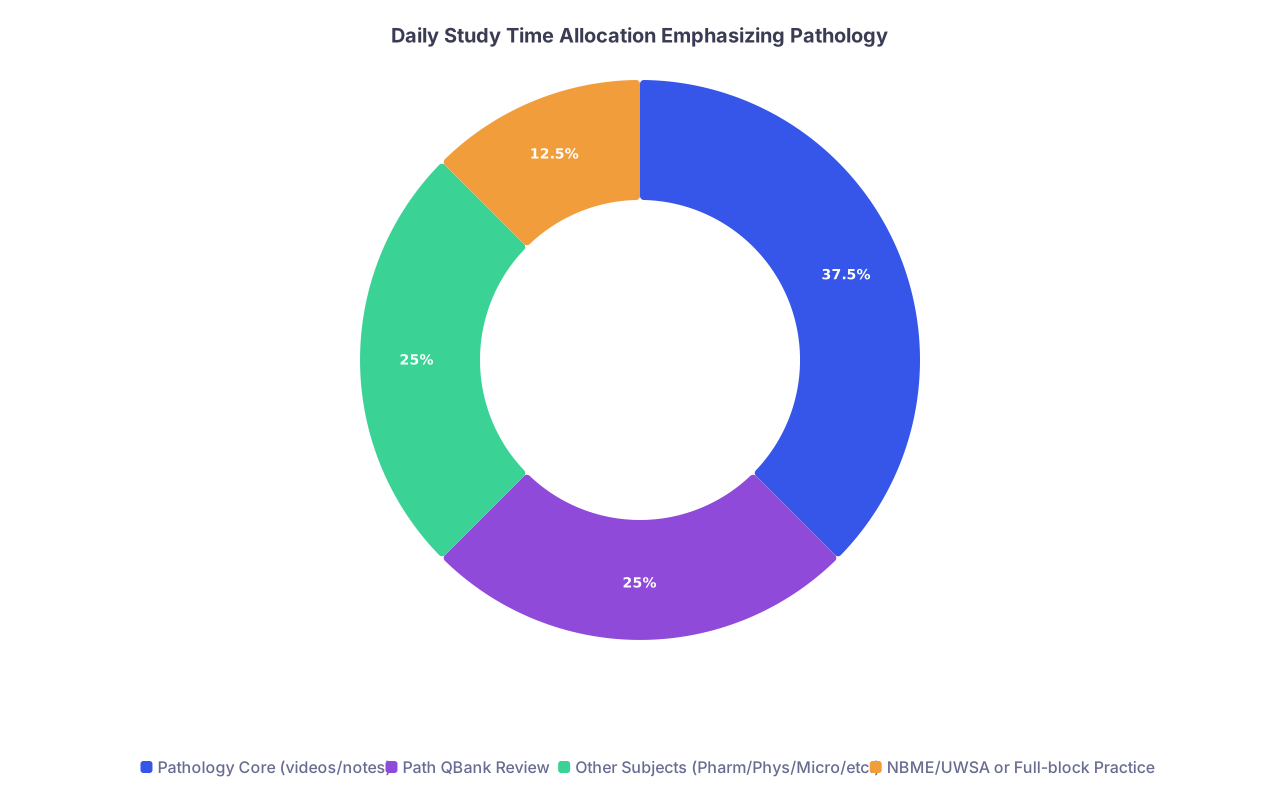
Weekly Time Allocation
Assuming you can give ~8–10 hours/day (adjust proportionally if you have less time):
| Category | Value |
|---|---|
| Pathology Core (videos/notes) | 180 |
| Path QBank Review | 120 |
| Other Subjects (Pharm/Phys/Micro/etc.) | 120 |
| NBME/UWSA or Full-block Practice | 60 |
That is 3 hours of pure path content, 2 hours of path questions, ~2 hours for “everything else,” plus practice testing time some days.
If your path foundation is genuinely weak and Step 1 is in 8 weeks, then yes, other subjects lose some space temporarily. They will come back later. If you pretend you can give everything equal attention right now, you will stay mediocre at everything.
Step 3: Four-Week Pathology Rebuild Plan (Weeks 1–4)
Here is the core. This is where you reconstruct your understanding instead of memorizing trivia.
A. System Order: Fix the Highest-Yield Systems First
These systems give you the most pathology questions and the most bang for your understanding:
- Cardiovascular
- Respiratory
- Renal
- Gastrointestinal
- Heme/Onc
- Endocrine
- Reproductive
- Neuro
- Musculoskeletal/derm/connective tissue
If your baseline is truly weak, do not start with neuro or rheum. You need wins early.
B. Weekly Structure Template
Each week, focus on 2–3 systems, depending on size:
Example Week 1: Cardio + Respiratory
Day 1–2: Cardio pathology foundation
- Watch Pathoma Cardio (1x speed if you are weak; 1.25–1.5x only if you can still follow everything)
- Actively annotate into:
- First Aid (if you use it)
- Or a tightly structured notebook (not 40 pages of chaos)
- Your notes should:
- Define the disease in 1–2 lines
- Include 3 things:
- Core mechanism
- Hallmark clinical features
- Hallmark path findings / labs / buzzwords
You are building a minimum viable understanding, not a review book.
Day 3: Cardio questions
- 40–60 UWorld cardio-heavy questions (mix of path-heavy blocks and system blocks)
- Review each question in depth:
- For every wrong question:
- Write a 1–2 line summary: “Missed: constrictive pericarditis vs restrictive cardiomyopathy – key difference is X, Y imaging, Kussmaul sign.”
- Add any path finding you did not know (e.g., “fibrinous pericarditis – bread and butter”)
- For every wrong question:
Day 4–5: Respiratory pathology foundation
- Same cycle:
- Watch Pathoma Pulm
- Annotate succinctly
- Focus on:
- Obstructive vs restrictive patterns
- Lung cancers (location, paraneoplastic, risk factors)
- Interstitial diseases
- Infections and associated bugs
Day 6: Respiratory questions
- 40–60 pulm questions
- Deep review + short written summaries of misses
Day 7: Mixed reinforcement day
- 40–80 mixed cardio + pulm questions
- Light review of your own notes
- Quick scanning of particularly deadly tables (e.g., lung cancer types, vasculitides involving lungs/heart)
How Aggressive Should You Be With Questions?
For a weak foundation, you must do questions close to your learning. Not two weeks later. Same week. Ideally within 24–48 hours after the videos/reading.
Do not overdo 120+ question days in the first two weeks. You are building understanding. You can push question volume harder in Weeks 5–6.
C. Micro-Strategy During Content Time
When you are rebuilding, you should constantly ask:
“If Step 1 gave me a question on this, what would they try to trick me with?”
That means:
- For MI:
- Timeline of changes (0–4 hours vs 1–3 days vs 1–2 weeks)
- Complications by time (arrhythmia vs rupture vs aneurysm)
- For glomerular disease:
- Nephritic vs nephrotic patterns
- Key associations:
- Post-strep GN – kids, humps, low complement
- RPGN – crescents, associations
If you cannot quickly list what they will try to confuse you with, your understanding is too soft.
Step 4: Turn Patterns and Images into Weapons
A massive part of pathology is pattern recognition. Slides. Gross specimens. Classic phrases.
You cannot “logic” your way through every image. You need to have seen the pattern enough times.
A. Build a Mini “Hallmarks” Deck
Not a 4,000 card Anki deck. That will sink you.
You want a lean, targeted deck: 150–250 cards max, focused only on:
- Pathognomonic histology findings
- Classic buzzwords
- Distinguishing features between commonly confused diseases
Structure each card like this:
- Front: “Lung cancer in non-smoker, peripheral, associated with hypertrophy of club cells, glands + mucin – name and key mutation?”
- Back: “Adenocarcinoma of lung – often KRAS, EGFR, or ALK mutations.”
Or:
- Front: “Kidney: subepithelial humps on EM after infection – diagnosis, complement levels?”
- Back: “Post-streptococcal GN – low C3, immune complex deposition.”
Do not put 15 facts on every card. 1–3 key links per card max.
B. Use Visual Resources Intelligently
If you use Sketchy Path or similar:
- Do not watch every video start to finish passively.
- Use it as:
- Reinforcement after Pathoma (for your worst systems)
- A way to lock in confusing histology or pattern-based diseases
Limit yourself:
- Max 1–2 Sketchy Path videos per day
- Always follow with:
- 5–10 related questions
- Quick notes on new associations you learned
C. Daily 20–30 Minute Image Drill
You can do this with:
- UWorld’s “image” filter
- Pathoma slides
- Webpath or Robbins review questions (if you already own them)
Routine:
- 10–15 images/day
- For each, force yourself to verbalize:
- What organ?
- What pattern? (granulomas? necrosis? fibrosis?)
- What 2–3 diagnoses could it be?
- What clin/lab findings help distinguish?
You do not need to be a histology expert. But you must be good enough to not be completely surprised on test day.
Step 5: Integrate Path with Pharm, Micro, and Physiology (Weeks 5–6)
After four weeks of building the core, your pathology should feel less like random facts and more like a story. Now you make it clinically sharp.
A. Shift to Mixed, Multi-System Blocks
At this point:
- 60–80% of question blocks should be mixed (organ-system + subject mix)
- 20–40% can be targeted to remaining weak path areas
Every mixed block is now a test of:
- Can you identify the pathology?
- Can you pick the right drug?
- Do you understand the mechanism enough to predict side effects?
- Can you connect the correct bug (if infectious)?
B. Build “Path → Pharm → Micro” Chains
For diseases with strong pharm or micro links, train yourself to think in chains.
Example: TB
- Path: caseating granulomas, cavitary lesions, apical lung disease
- Micro: acid-fast bacilli, mycolic acid wall
- Pharm: RIPE regimen, side effects (rifampin – orange fluids, P450 inducer; isoniazid – B6 deficiency, neurotoxicity, hepatotoxicity)
You want this automatic:
- See granuloma → think TB vs sarcoid vs fungal
- See chronic cough + night sweats → think TB → think RIPE → think major side effects
Do the same for:
- Endocarditis
- Pneumonias
- Hepatitis
- HIV-related infections
- Hematologic malignancies (leukemias/lymphomas + chemo)
C. Use Targeted Integration Sessions
1–2 times per week, do a 90–120 minute focused integration block:
- Step 1: Pick 1–2 diseases (e.g., DKA and nephrotic syndrome)
- Step 2: For each disease, write out:
- Pathophysiology (1 paragraph max)
- Key labs / findings
- Key drugs / treatments
- Relevant microbes (if any)
- One board-style question you could imagine
- Step 3: Do 10–15 questions on those topics
You are training yourself not to silo pathology. Because Step 1 will not silo it either.
Step 6: Full-Length Exams and Final Refinement (Weeks 7–8)
With two weeks left, your focus shifts to:
- Exam endurance
- Timing
- Identifying last remaining blind spots
A. Schedule Your Major Exams
You should aim for at least:
- 2–3 NBME practice exams (form choice depends on availability)
- 1 UWSA (sometimes more predictive for many students)
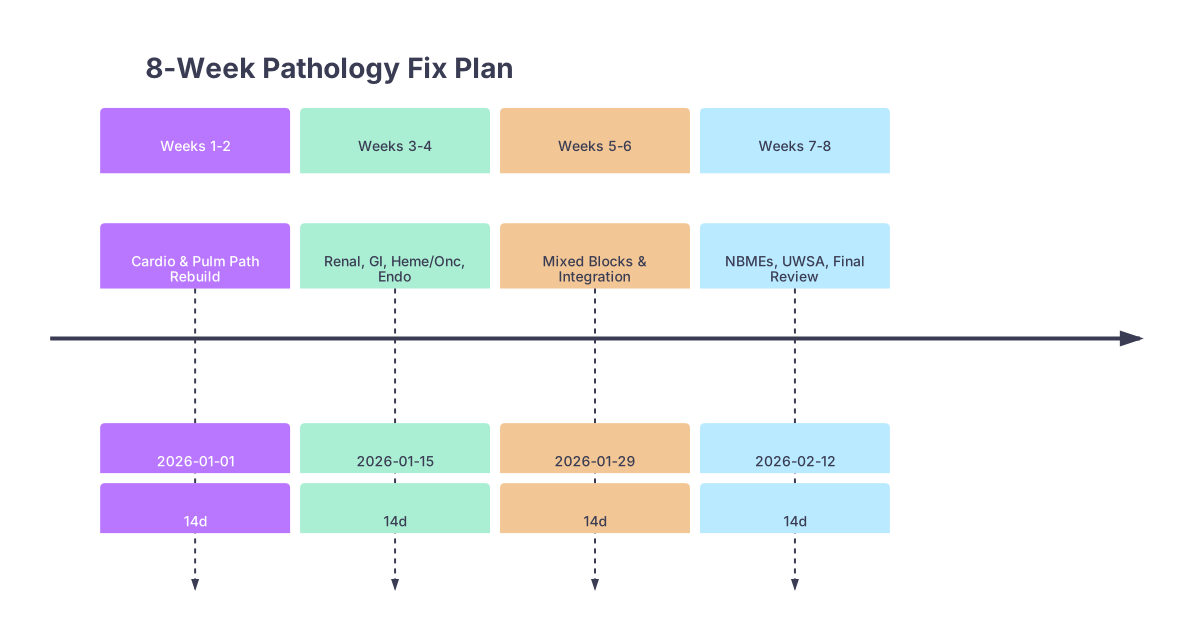
Example schedule:
| Period | Event |
|---|---|
| Weeks 1-2 - Cardio & Pulm Path Rebuild | 2026-01-01 |
| Weeks 3-4 - Renal, GI, Heme/Onc, Endo | 2026-01-15 |
| Weeks 5-6 - Mixed Blocks & Integration | 2026-01-29 |
| Weeks 7-8 - NBMEs, UWSA, Final Review | 2026-02-12 |
Concretely (adjust dates to your own):
- Day 43–45 (~2.5 weeks out): NBME
- Day 50–52 (~1.5 weeks out): NBME or UWSA
- Day 55–57 (~1 week out): Final NBME/UWSA depending on fatigue and availability
B. Pathology-Focused Review of Each Exam
When you review these practice tests, you treat pathology as priority #1.
For each exam:
- Make a Pathology Error Log with:
- Missed diagnoses (did not recognize disease)
- Misinterpreted findings (labs, images, buzzwords)
- Wrong differentiation between two similar diseases
You are looking for:
- Repeating offenders (e.g., vasculitides, glomerular diseases, leukemias)
- Deadly blind spots (e.g., “I always blank on storage diseases”)
Then you:
- Spend 1–2 hours the next day only on those clusters:
- Rewatch specific Pathoma sections
- Redo related UWorld questions
- Add 5–10 ultra-targeted Anki cards or 1-page summary sheets
This is not the time to start new full resources. You are sharpening, not remodeling.
C. Control Panic: Stable vs Fixable Gaps
You will still miss pathology questions 1 week before your exam. That is normal.
You do not treat every gap as a 3-hour project now. You classify:
- Fixable in <30 minutes
- Clarifying a concept
- One short Pathoma section
- 5–10 focused questions
- Too deep to fix fully, but can blunt damage
- Rare storage diseases
- Exotic vasculitides
- Hyper-rare tumors
For “too deep” topics, aim for:
- Basic recognition
- One or two hallmark features
- Enough to eliminate obviously wrong choices and guess between 2 options
You are now managing risk, not aiming for perfection.
Step 7: Daily Schedule Templates You Can Actually Use
You need something you can copy and adapt.
A. Sample Schedule – Early Phase (Week 2, Heavy Content)
Goal: Rebuild Renal + GI pathology
- 08:00–09:30 – Pathoma Renal (watch + annotate)
- 09:30–10:00 – Review/clean notes, make 5–10 key Anki cards
- 10:00–11:30 – UWorld: 40 renal questions (timed)
- 11:30–13:00 – Deep review of every question
- 13:00–14:00 – Lunch + short walk (non-negotiable)
- 14:00–15:30 – Pathoma GI part 1 (esophagus, stomach)
- 15:30–16:00 – Quick note consolidation
- 16:00–17:30 – UWorld: 20–30 mixed path questions (cardio/pulm/renal)
- 17:30–18:00 – Review top misses
- 18:00–18:30 – Image drill (10 renal + 10 GI images)
- 19:00–19:30 – Light review of Anki / key tables
- 19:30 onward – Stop new content; short skim if you want, then sleep
Notice:
- Multiple exposures to renal that day (video → questions → images)
- No giant, unfocused “reading blocks”
B. Sample Schedule – Late Phase (Week 7, Integration + NBME)
Day after NBME:
- 08:00–10:30 – NBME review, complete pass
- Tag path vs non-path issues
- 10:30–11:30 – Focus on path misses:
- 3–4 core topics you blundered
- Rewatch those specific Pathoma segments
- 11:30–13:00 – UWorld: 40-question mixed path-heavy block
- 13:00–14:00 – Lunch
- 14:00–15:00 – Review that block
- 15:00–16:00 – Build/adjust 1–2 one-page summary sheets (e.g., glomerular diseases, lung tumors)
- 16:00–17:00 – Light Anki / flash review
- 17:00 onward – Low-stress review or rest
Step 8: Common Mistakes That Will Keep Your Pathology Weak
If you recognize yourself in these, you need to change course. Now.
-
- Binge-watching Pathoma at 2x speed while half-distracted is useless. If you cannot teach the video’s content in 2–3 minutes afterward, you did not “learn it.”
Insane Anki addiction
- Thousands of low-yield, detailed cards. Zero deep understanding. If your Anki reviews take 4–5 hours/day, you are sacrificing actual learning for box-checking.
Avoiding questions “until I finish content”
- You will never “finish” content. And you will massively overestimate how much you retained. Early questions expose your weaknesses brutally. That is the point.
-
- Switching from Pathoma to B&B to Goljan to random PDFs. Pick one main explanation source. Commit. Supplement only when a concept is still unclear after a focused attempt.
Ignoring fatigue and sleep
- If you are sleeping 4–5 hours regularly, your recall will tank. Especially for pathology patterns and details. Sleep is a study tool, not a luxury.
What “Fixed” Pathology Actually Feels Like
You know you have genuinely repaired your foundation when:
- You can read a 3–4 line vignette and name the disease before the options appear.
- You consistently recognize classic patterns:
- “Middle-aged smoker + hematuria + mass -> renal cell carcinoma”
- “African child with jaw mass + EBV -> endemic Burkitt lymphoma”
- You start predicting wrong answer choices:
- “They are going to try to make me confuse Crohn disease with UC here.”
- Your UWorld/AMBOSS path-heavy blocks are:
- At least in the low–mid 60s early
- Moving toward 70s+ as you enter weeks 6–8
If, two weeks before the exam, your pathology performance is still erratic and you cannot describe what you actually did to fix it, you do not have a study problem. You have a planning and honesty problem.
Fixable. But not by accident.
Final Reality Check
Eight weeks is enough time to turn weak pathology into a strength, but only if you act like this is your main job. Because it is.
Boil it down:
- Diagnose your pathology problem precisely. Use 2–3 dedicated pathology blocks and brutally honest tagging by system and error type.
- Rebuild in a structured way. 4 weeks of system-based Pathoma/B&B + UWorld, with deliberate notes, image drills, and a lean hallmarks deck.
- Integrate and sharpen. Mixed blocks, full-length exams, and targeted repairs in weeks 5–8, with pathology driving your review priorities.
Follow that, and “weak path” becomes one more thing you overcame, not the reason you underperformed on Step 1.