
You are not failing Step 1 because you are “bad at tests.” You are failing because your knowledge leaks and you are not running a serious leak-detection system.
Let me show you how to build one.
Most students grind questions, watch videos, “review wrongs”… and still miss the same concepts weeks later. Not because they are lazy. Because they are flying blind. No map of their weaknesses. No protocol for patching. Just vibes and hope.
You need a system. Not more hours. Not another resource. A tight, repeatable system that:
- Exposes your content gaps
- Classifies them precisely
- Patches them with targeted actions
- Confirms the patch actually held
Everything below is built around that loop.
1. Stop Guessing: Build a Real-Time Map of Your Weaknesses
Most people “know” their weak areas like this: “Cardio is kinda weak. Biochem too.” That is useless. Step 1 punishes vagueness.
You need weakness at the level of:
“Hypertrophic cardiomyopathy pathophys and murmur maneuvers. Urea cycle disorders. Class III antiarrhythmics. Type II hypersensitivity examples.”
Step 1 Weakness Mapping: The Core Framework
You will build a live, evolving map of your knowledge gaps on three levels:
- System-level – cardio, renal, GI, etc.
- Topic-level – e.g., heart failure drugs, nephritic vs nephrotic, bilirubin metabolism
- Concept-level – e.g., why ACE inhibitors increase bradykinin, podocyte injury diseases list
Here is the rule:
If a question exposes a gap, it must appear somewhere in this map. No exceptions.
Use any tool that lets you see and update easily:
- A Notion page with headings by system
- A Google Sheet with filters
- A physical “Gap Notebook” divided by tabs (yes, old school works)
Basic table structure if you use a sheet:
| Domain | System | Topic | Specific Concept Gap | Date Found | Severity (1-3) | Action Status |
|---|---|---|---|---|---|---|
| Path | Cardio | Valvular disease | Differentiating murmurs by maneuvers | 1/5 | 3 | Unpatched |
| Pharm | Renal | Diuretics | Effects on serum Ca2+, K+, acid-base | 1/6 | 2 | In progress |
| Micro | GI | Parasites | Diagnosis and treatment of Giardia vs Entamoeba | 1/7 | 2 | Patched |
| Biochem | Metabolism | Urea cycle | Enzymes + treatment for defects | 1/7 | 3 | Unpatched |
| Immuno | Hypersensitivity | Type II | Mechanisms + classic disease examples | 1/8 | 1 | Patched |
Severity scale:
- 1 – Annoying: You knew 70–80%, missed a small linkage or detail
- 2 – Significant: You were partially lost or guessing
- 3 – Dangerous: You had no idea / totally forgotten / pure guess
If you do not track severity, you will drown in noise.
2. Use Question Banks as a Diagnostic Tool, Not Just a Hammer
Most people misuse UWorld and AMBOSS. They treat them as:
- Score generators (“I got 64%!”)
- Ego boosters (“I’m above average, so I’m fine”)
- Punishment machines (“I do random timed blocks until my brain melts”)
That is not how you fix content gaps.
How to Run “Diagnostic” Question Blocks
You will run at least 1–2 blocks per day with a specific diagnostic purpose.
Protocol:
Choose a focus
- Early prep: System-based (e.g., “Today: cardio block”)
- Late prep: Mixed blocks, but you still tag gaps by system
Block settings
- 40 questions, timed, random within chosen system(s)
- No pausing, no checking answers mid-block
During the block
For every question where you:- Guessed, or
- Felt fuzzy but got it right, or
- Missed it outright
Mark it (e.g., star in UWorld) and write ONE brief note in your scratchpad:
- “Did not know MOA of methimazole”
- “Confused restrictive vs obstructive flow-volume loop”
- “Forgot MEN syndrome mutation patterns”
After the block – the key step
You are not “reviewing questions.” You are extracting content gaps. For each starred item:- Identify: What exact concept was missing?
- Classify it on your weakness map
- Assign a severity rating (1–3)
If you finish a 40-question block and only add 2–3 items to your gap list, you are lying to yourself. You forgot about all the “lucky corrects.”
Assume: every feeling of “I am not 100% sure” is a gap. Log it.
3. Classify the Type of Gap Before You “Patch” It
Not all misses are equal. And they do not need the same fix. Students waste massive time treating everything like a “content problem.”
It is not.
Most Step 1 misses fall into one of five categories. Identify the type, then deploy the right patch.
The Five Gap Types
Pure Content Gap
You simply did not know the fact, pathway, or definition.
Example: You do not know that Pseudomonas is oxidase-positive, non-lactose fermenting, Gram-negative rod.Integration Gap
You know the pieces but cannot link them.
Example: You know ACE inhibitor effects and you know renal artery stenosis but fail to see why ACE inhibitors can precipitate renal failure.Pattern-Recognition Gap
You have seen the classic vignette 5 times but still do not instantly think of the right diagnosis.
Example: “Cafe-au-lait spots, Lisch nodules, optic gliomas” does not immediately trigger NF1 for you.Reading/Framing Gap
You misread the stem, got distracted by red herrings, or failed to answer the actual question.
Example: You knew the right treatment for the condition, but the question asked for “most likely pathophysiologic mechanism.”Memory-Retention Gap
You learned it, understood it, and forgot it.
Example: You knew the coagulation cascade cold 3 weeks ago and now it is gone.
If you do not label which type you’re dealing with, you’ll keep doing the same generic “watch a video + make a card” fix, which is overkill for some categories and useless for others.
4. Exact Patch Protocols for Each Type of Gap
Here is where we get aggressive. For each gap type, you will run a specific protocol. No more vague “I should review this later.”
4.1 Patching Pure Content Gaps
Goal: Add the missing fact to your mental library and to your spaced-repetition system, in a way that will actually stick.
Protocol:
Find the best concise explanation
Source priority:- First Aid / Boards & Beyond / Pathoma / Sketchy section for that topic
- Not random YouTube unless your primary resources fail
Extract the minimum viable fact set
For a fact, that usually means:- Definition / essential detail
- One high-yield example or association
- One “trap” or common confusion
Example – “MEN 2A mutation”:
- RET proto-oncogene
- Medullary thyroid carcinoma, pheochromocytoma, parathyroid hyperplasia
- Distinguish from MEN 1 (pituitary, parathyroid, pancreas)
Create 1–3 targeted Anki cards
- No paragraph cards
- One question, one idea
- Put the question stem style when useful:
“Child with medullary thyroid carcinoma + pheochromocytoma likely has mutation in which gene?”
Link the card back to your gap log
- Optional but powerful: add a tag like
GAP_2026-01-05_CARDIO_MENso you can audit old gaps later.
- Optional but powerful: add a tag like
Quick active recall check (2-minute rule)
- Close the resource
- Write from memory: “What did I just learn?”
- If you cannot reproduce it in 30 seconds, your card is too weak or your attention was not real.
4.2 Patching Integration Gaps
Integration gaps kill scores. These are the classic “I sort of knew the pieces but could not connect them in the moment.”
Protocol:
Draw it or map it
No, you are not an artist. You are a model builder.- Pathway → sketch boxes and arrows.
- Physiology → graph the variable changes (e.g., preload/afterload vs stroke volume).
- Drugs → create a 3-column table: action, clinical use, major adverse effect.
Talk through the logic
Out loud. Five sentences or less. Example:“Renal artery stenosis → decreased perfusion pressure in affected kidney → increased renin → increased angiotensin II → efferent arteriole constriction → maintains GFR despite low RPF. ACE inhibitors block this compensation → drop GFR → acute kidney injury.”
Make 1–2 “reasoning” cards, not fact cards
Example:- Q: “Why do ACE inhibitors sometimes cause acute kidney injury in bilateral renal artery stenosis?”
- A: Short logical chain, not a single word.
Do 3–5 related questions immediately
From your Qbank:- Same mechanism in different disease contexts
- Close variations that force you to re-apply the logic
Integration is practice-dependent. If you do not test the new connection in a few similar problems right away, it will not wire in.
4.3 Patching Pattern-Recognition Gaps
This is where Sketchy, images, and repetition matter. If you keep missing the same disease presentations, you need a pattern library.
Protocol:
Build a “pattern card” for the missed entity:
- Age group
- Key symptoms/signs
- Buzzwords (use them; NBME does)
- One image in your head (e.g., “string of pearls” for PCOS, “boot-shaped heart” for TOF)
Use visual anchors whenever available
- Sketchy for micro/pharm
- Atlases / Google Images for classic rashes, radiology signs, histology
Create 1–2 “vignette-style” cards
Example:
- Front: “3-year-old boy, cafe-au-lait spots, axillary freckling, optic glioma. Diagnosis?”
- Back: “NF1 – mutation in NF1 tumor suppressor gene on chromosome 17, codes for neurofibromin (Ras regulator).”
Micro-strategy: mini-rapid review lists
When you see a pattern gap, list 3–5 related diagnoses with overlapping features, side by side, and highlight differentiators.Example: nephritic vs nephrotic, or UC vs Crohn.
4.4 Patching Reading/Framing Gaps
These are not “I did not know the content.” These are “I answered a different question than the one being asked.”
If you do not fix this, you will bleed 5–10% of your score for no good reason.
Protocol:
Tag every reading error explicitly in your gap log as “FRAMING.”
During review, rewrite the question in one short sentence
“They are asking: What is the mechanism of this drug’s side effect?”
Identify the exact misstep
Examples:- You ignored the word “most immediate”
- You chose the long-term complication instead of the acute effect
- You let an early irrelevant detail anchor you (“young woman” = lupus in your head)
Train a pre-answer checklist (takes 3–5 seconds per question):
Before locking in your answer, mentally ask:
- “What exactly are they asking?”
- “Am I answering mechanism, diagnosis, next step, or risk factor?”
- “Is there a time frame (acute vs chronic)?”
Write this checklist on your scratch paper at the start of each timed block until it becomes automatic.
Do short, focused framing drills
- 10 questions, untimed
- Before looking at choices, say out loud: “The question is asking X.”
- Only then read options.
You are training your brain to not sprint to options like a dog to a tennis ball.
4.5 Patching Memory-Retention Gaps
This is where people pretend Anki will magically fix everything. It will not, unless you design it properly and feed it consistently.
Memory gaps appear as:
- “I used to know this cold.”
- “This is my third time missing the same enzyme.”
- “These pathways keep decaying.”
Protocol:
Identify fragile topics that need “overlearning”
- Biochem pathways
- Immunology classifications
- Pharmacology side-effect profiles
- Microorganism traits
Audit your cards
- Are they too dense? (Long cloze deletions, paragraphs)
- Too vague? (“What is X?” without context)
- Too many? (You stop reviewing them)
Convert weak cards to leaner, more atomic versions
Examples:- Bad: “Tell me everything about urea cycle disorders.”
- Good:
- “Rate-limiting enzyme of urea cycle?”
- “Deficiency causing hyperammonemia that increases orotic acid without megaloblastic anemia?”
- “Treatment strategies for hyperammonemia (3 items)?”
Use “linking hooks”
Instead of pure facts, build associations:- OTC deficiency → x-linked, boy baby with vomiting + hyperammonemia + orotic acid
- Match each enzyme to a patient story or board-style vignette
Schedule micro-reviews by topic, not just cards
Once per week in dedicated review time:- “30 minutes: pure biochem pathways”
- Skim your summary pages, redraw one pathway from memory, then check.
Spaced repetition is not enough. You need spaced reconstruction of the big picture.
5. Weekly “Leak Audit”: Tighten the System
Finding and patching gaps daily is good. But you need an overhead view to know if you are actually sealing the ship or just moving buckets around.
Build a Simple Weekly Dashboard
End of each week, pull your gap log and categorize:
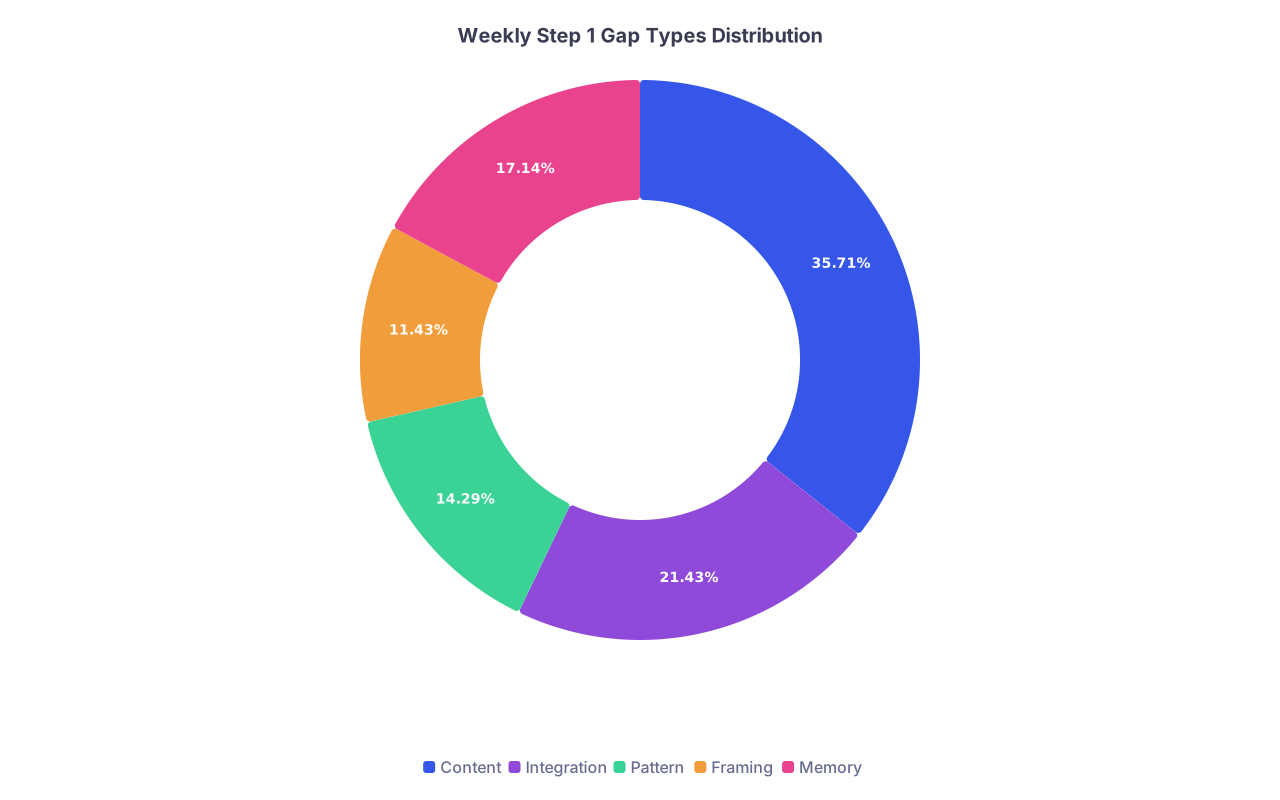
| Category | Value |
|---|---|
| Content | 25 |
| Integration | 15 |
| Pattern | 10 |
| Framing | 8 |
| Memory | 12 |
Then answer:
- Which systems generated the most severe (3) gaps?
- Which gap types are most common? (e.g., lots of integration vs lots of content)
- Are the same topics reappearing? That means your patch failed.
Weekly Leak Audit Protocol (60–90 minutes)
Quantitative pass (15–20 minutes)
- Count gaps by system
- Count gaps by type
- Circle any topic that appeared 2+ times
Qualitative pass (30–40 minutes)
For each repeated topic:- Review your previous patch steps
- Did you actually do them fully (cards, questions, explanation)?
- If yes, upgrade attention: this topic goes into “high-risk” list and gets special treatment next week.
Plan 3 focused mini-blocks for next week
Example:- 10–15 cardio murmurs questions
- 10–15 renal physiology questions
- 10–15 biochem metabolism questions
These are not your only blocks, but they are guaranteed.
Adjust your resource mix if necessary
If you keep missing pathology in renal, maybe your Pathoma coverage is thin. Add a short targeted rewatch.
6. Timeline: How This System Fits in Different Phases
Your leak-detection system changes slightly depending on how far you are from your exam.
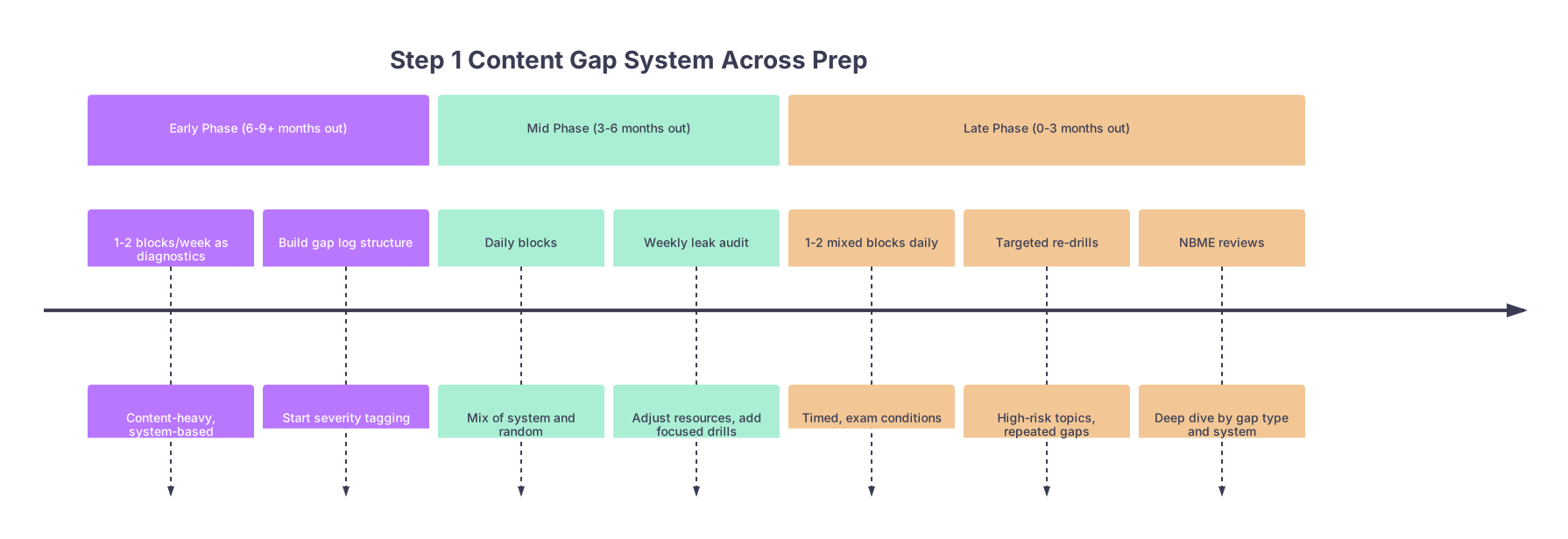
| Period | Event |
|---|---|
| Early Phase (6-9+ months out) - 1-2 blocks/week as diagnostics | Content-heavy, system-based |
| Early Phase (6-9+ months out) - Build gap log structure | Start severity tagging |
| Mid Phase (3-6 months out) - Daily blocks | Mix of system and random |
| Mid Phase (3-6 months out) - Weekly leak audit | Adjust resources, add focused drills |
| Late Phase (0-3 months out) - 1-2 mixed blocks daily | Timed, exam conditions |
| Late Phase (0-3 months out) - Targeted re-drills | High-risk topics, repeated gaps |
| Late Phase (0-3 months out) - NBME reviews | Deep dive by gap type and system |
Early Phase (> 6 Months Out)
- Main goal: Build broad knowledge and start the gap log habit
- Qbank: More tutor mode is acceptable, system-based
- Focus: Content gaps, memory structure, Anki build-out
Mid Phase (3–6 Months Out)
- Main goal: Make your map accurate and dense
- Qbank: Mostly timed, mix of system and random
- Focus: Integration gaps, pattern recognition, increased volume of questions
Final Phase (0–3 Months)
- Main goal: Eliminate persistent leaks
- Qbank: Timed mixed blocks, near-exam conditions
- NBME practice: Every 1–2 weeks
- Focus: Framing/reading errors, repeated topics, test stamina
When you take an NBME, treat it as a mega-diagnostic:
- Classify every miss into one of the five gap types
- Add to your log, patch with the appropriate protocol, then
- Re-visit similar NBME questions or Qbank problems 1–2 weeks later to confirm the patch held
7. Operational Details That Separate Serious From Casual
A good system dies in the details. These are the little rules that keep it alive.
Keep the Gap Log Frictionless
If logging a gap adds 2 minutes per question, you will stop.
- Use short phrases for “Specific Concept Gap”
- Do not write essays
- Use keyboard shortcuts or quick templates
Example quick phrase templates:
- “MOA of X drug”
- “Differentiate A vs B”
- “Pathophys of complication”
- “Diagnostic test of choice”
Hard Rule: Every Severe (3) Gap Gets a Patch Within 24 Hours
No parking lot. No “I will come back later.”
You either:
- Patch it today, or
- Admit you are choosing not to fix a known hole in your score
You will not fix everything. But you do not lie to yourself about it.
Stop Hoarding Resources
If you are doing UWorld, AMBOSS, Sketchy, B&B, Pathoma, random PDFs, 3 Reddit decks, and a YouTube guru… you do not have a gap system. You have chaos.
Pick:
- 1 primary Qbank
- 1 main video resource (Pathoma + one more)
- 1 central notes source (First Aid-ish)
- 1 flashcard system
Then funnel every patch through those. Consistency beats novelty.
8. Example Day Using This System
Let me make this concrete.
You have: 5–6 hours to study.
Block 1 – Timed, mixed (40 questions, 1 hour)
- Do NOT check answers mid-way
- Star any “guess”, “fuzzy”, or “wrong” questions
Block review + gap logging (60–75 minutes)
- For each star:
- Identify gap type (content, integration, pattern, framing, memory)
- Add to gap log with severity 1–3
- For severe (3) gaps: start patch steps immediately (at least find resource + plan card)
- For each star:
Patch session (60–90 minutes)
- Work down the list of today’s severe (3) and some (2) gaps
- Create targeted cards
- Draw diagrams or lists for integration issues
- Do small related Qbank subsets when needed
Review session (60 minutes)
- Anki: targeted plus your scheduled reviews
- Quick skim of high-risk topics (from previous gap logs)
Optional second block or mini-block (if time / stamina)
- 20–40 questions focused on a system you repeatedly flagged this week
Repeat this 5–6 days per week, with the weekly audit layered on top, and you stop being “surprised” by your NBME scores. They start matching your map.
FAQs
1. How many gaps per day is “normal,” and when should I worry?
Early in prep, 10–20 logged gaps from a 40-question block is normal. That does not mean you are doomed; it means you are being honest. Worry less about how many gaps you have and more about whether they repeat. If the same topic shows up 3–4 times over 2–3 weeks despite you “reviewing” it, your patch protocol is weak and needs tightening.
2. Should I pause content learning to focus only on patching gaps?
No. You run both in parallel. If you stop advancing content completely, you will fall behind the exam’s breadth. A reasonable split for most students in the mid-phase: 50–60% of your time on Qbank + patching gaps, 40–50% on planned content coverage and structured review. In the final 1–2 months, the balance shifts heavier toward questions + fixing leaks.
3. What if I am scoring very low on NBMEs—do I still use this system or restart everything?
You still use this system, but you tighten it and simplify your life. Students scoring very low often have two problems: scattered resources and no brutal accounting of gaps. Strip down to core resources, increase the volume of questions, and make the gap log your primary driver of what to review. You may need a brief 2–3 week “content boot camp” on your weakest 2–3 systems, but the gap-patching loop remains central.
4. How do I know a gap is truly “patched” and not just temporarily memorized?
Two tests: time and transfer. Time: You see the concept again 1–2 weeks later (via Anki, notes, or another question) and you recall it with high confidence. Transfer: You can apply the idea correctly in a different context or question style, not just the original vignette. If you pass both, you mark the gap as “patched” in your log and move on. If you fail either, you upgrade its risk level and give it one more structured patch cycle.
Open your Qbank right now and start your next timed block with one change: for every question that feels fuzzy, log the exact gap type and severity. That is your first real step from guessing to a controlled, fixable system.